50 Great Guitarists, All Better Than Slash (In No Particular Order)–Part VI

26. Lindsay Buckingham

Sure, founding member Peter Green had a pretty cool guitar style, but really, Lindsay Buckingham and Stevie Nicks made Fleetwood Mac. Buckingham’s guitars achieve a strange, almost paradoxical tone: hard rock chunkiness by way of New Wave-thin; Brian Wilson-influenced melodies by way of punk rock; songs that ache with classic pop harmony but still remain unavoidably dark. Coke-fueled Rumours secured an already great legacy, but my favorite Mac album is, of course, their White Album, Tusk.

I hate to admit it, but I prefer this version of “Go Your Own Way” (dig the percussive guitar solo at the end)–

–to this one from the 70s. You tell me which is better.

27. Junior Brown

Genre-defying Junior Brown built his own guitar/steel guitar hybrid, “Big Red,” an improbably shrewd instrument of shred. Brown’s eclectic mix of country, blues, rock and roll, hillbilly, and even classical playing has probably kept him off of more radio stations than is fair, but his brilliant music has led to a huge following. Observe:

28. Lee Renaldo

Self-confessed one-time Deadhead, Lee Renaldo was the “old guy” in Sonic Youth from the outset. I’ve always imagined that his sense of melody and his quiet, intense disposition are what anchored Thurston Moore’s manic tendencies and Kim Gordon’s dour art poses. Plus, I’ve always liked Renaldo’s solo stuff the best. And then, of course, there’s the Reed Richards look he’s been kickin’ for the past couple of years.

29. Les Paul

When Les Paul was injured in a terrible car accident in 1948, he had his arm set at a permanent right angle so that he could still play guitar. Now that’s dedication. Les Paul’s flashy, futuristic multi-layered tracks still sound ahead of their time.

Fantastic footage:

30. Ben Chasny

Ben Chasny is heir to a tradition that began with Robbie Basho and John Fahey. As Six Organs of Admittance, he makes strange, beautiful psychedelic music that mixes tropes of Western folk with the exotic motifs of Eastern ragas. Very heady stuff. His new album, Shelter from the Ash, set to drop any day now from Drag City records, picks right up where last year’s gorgeous Sun Awakens left off. Great stuff.
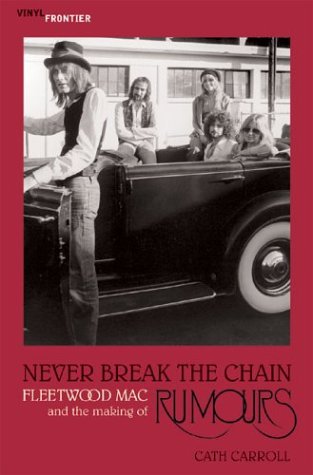
Never Break the Chain–Cath Carroll on Fleetwood Mac

neverbreakthechain.jpg

Never Break the Chain: Fleetwood Mac and the Making of Rumours by Cath Carroll (yes, that Cath Carroll) provides an excellent overview of the long, strange career of Mick Fleetwood and company. Like many of you (I’m guessing), I was introduced to Fleetwood Mac via my parents, who played Rumours ad infinitum. It was one of the first albums I “owned”–from the vinyl, I recorded a cassette copy that I played on my Sony Walkman repeatedly. I believe Born on the USA was on the other side. As the years passed, Fleetwood Mac somehow became very uncool to my ears (i.e., they did not rap, there was a paucity of shredding metallic guitar overtures, etc), then slightly cooler, then totally uncool (i.e. the Clintons, the reunion tour), then very very cool (thank you college, thank you Tusk).

Never Break the Chain is organized chronologically, making it easy for readers such as myself to skip around to sections of greater interest. The majority of Carroll’s research comes from previously published articles from magazines like Creem and Rolling Stone, as well as a few interviews. Carroll navigates the Mac’s bizarre history, detailing the numerous personnel changes. Mick Fleetwood is the book’s undisputed hero, the rock(er) who kept the band together through the tumultuous tempest of three decades. It’s fascinating to see how the band transforms from a British blues rock group from the John Mayall school of rock, to the melodic songwriting team that recorded the utterly-Western masterpiece Rumours.

As the title suggests, the making of Rumours becomes the focal point of the book. Carroll explores the bizarre love quadrangles that erupted within the band during that time, although for my taste there wasn’t quite enough VH1’s Behind the Music trashiness to her analysis. Ditto for the legendary cocaine use that supposedly fueled the FM’s late seventies output, which is largely glossed over.  However, gearheads who can’t get enough descriptions of studio equipment, instrumentation, and production techniques will love this book. Carroll goes into very detailed accounts of how FM approached songwriting–some of the most interesting passages recount how the band arrived at the album sequences. Plenty of in-fighting, plenty of fights with the studio, and a whole chapter devoted to Tusk. On the whole not bad. However, no substitution for actually listening to the albums.