“Suicide and wife arrive in Cuba” and Other Wise Cracks from F. Scott Fitzgerald

From the “Epigrams, Wise Cracks and Jokes” section ofd  F. Scott Fitzgerald’s Noteboooks:

Suicide and wife arrive in Cuba.

Let’s all live together.

Debut—the first time a young girl is seen drunk in public.

He repeated to himself an old French proverb he had made up that morning.

A sleeping porch is a back room with no pictures on the walls. It should contain at least one window.

Kill the scrub sire is our slogan.

Why can’t you be square? Well, when I was young I used to play with old automobile tires.

Forgotten is forgiven.

If all your clothes are worn to the same state it means you go out too much.

American actresses now use European convents as a sort of female Muldoon’s.

You must stoop a little in order to jump.

For a car—Excuse my lust.

Andre Gide lifted himself by his own jockstrap so to speak—and one would like to see him hoisted on his own pedarasty.

Creditors’ jokes


“Hot Springs” — F. Scott Fitzgerald


Hot Springs:
In a Spring vacation hotel the rain is bad news indeed. The hundred French windows of the great galleries led the eye out to ink-and-water pines snivelling listlessly on to raw brown tennis courts, to desolate hills against soiled white sky. There was “nothing to do” for hotel and resort were one and the same and no indoor activity was promised on the bulletin board until the concert of the Princeton Glee Club Easter Monday. Women who had come to breakfast in riding clothes rushed to the hairdresser instead; at eleven the tap-k’tap of ping-pong balls was the only sound of life in the enormous half empty hotel.
The girl was one of a pair in white skirts and yellow sweaters who walked down the long gallery after breakfast. Her face reflected the discontent of the weather, reflected darkly and resentfully. Looking at her Deforrest Colman thought: “Bored and fierce,” and then as his eyes continued to follow her, “No, proud and impatient. Not that either, but what a face—vitality and hand cuffs—where’s this getting me—liver and bacon, Damon and Pythias, Laurel and Hardy.

A fragment from F. Scott Fitzgerald’s Notebooks.


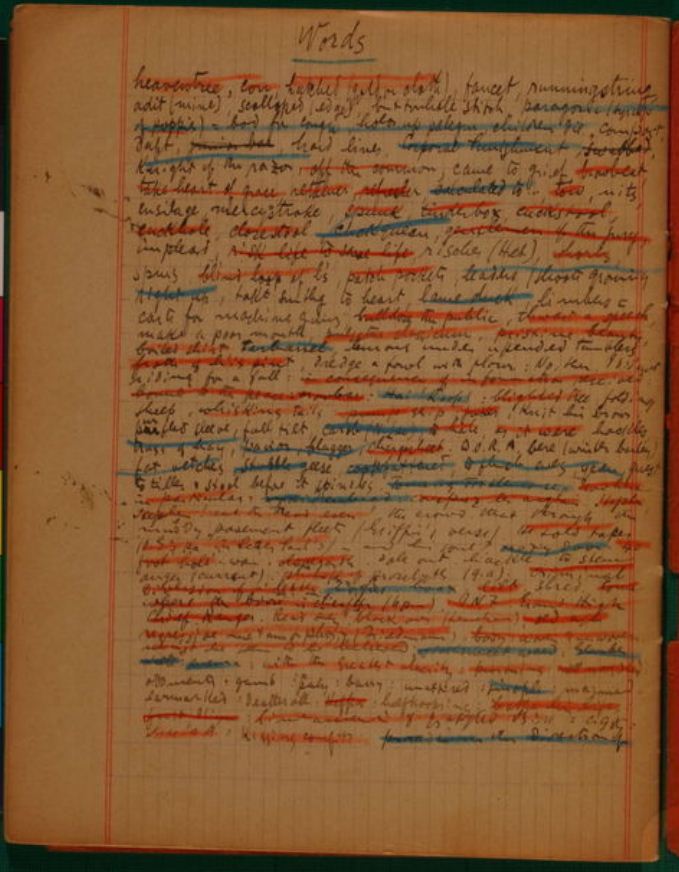
“Words” — A Page from James Joyce’s Notebooks

This page is from the same notebook where Joyce headed a page he titled “Rhetoric”; the notes in the books seem to suggest the notebook is part of the preparatory material for Ulysses. From the National Library of Ireland, which probably doesn’t want me posting their material like this.

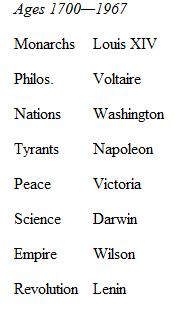
“Ages 1700-1967” — F. Scott Fitzgerald

From F. Scott Fitzgerald’s Notebooks.

F. Scott Fitzgerald’s “Dyed Siberian Horse” (And Twelve Other Descriptions of Things and Atmosphere)

More from F. Scott Fitzgerald’s magical Notebooks

143 Days of this February were white and magical, the nights were starry and crystalline. The town lay under a cold glory.

144 Dyed Siberian horse.

145 As thin as a repeated dream.

146 The sea was coming up in little intimidating rushes.

147 The island floated, a boat becalmed, upon the almost perceptible curve of the world.

148 Lost in the immensity of surfaceless blue sky like air piled on air.

151 On the great swell of the Blue Danube, the summer ball rocked into motion.

152 A circus ring for ponies in country houses.

153 The tense, sunny room seemed romantic to Becky, with its odor of esoteric gases, the faint perfumes of future knowledge, the low electric sizz in the glass cells.

154 A rambling frame structure that had been a residence in the 80’s, the country poorhouse in the 1900’s, and now was a residence again.

155 The groans of moribund plumbing.

156 The silvery “Hey!” of a telephone.

161 Whining, tinkling hoochie-coochie show.

“Seen in a Junk Yard” — F. Scott Fitzgerald

From F. Scott Fitzgerald’s Notebooks

Dogs, chickens with few claws, brass fittings, T’s elbow, rust everywhere, bales of metal 1800 lbs., plumbing fixtures, bathtubs, sinks, water pumps, wheels, Fordson tractor, Acetylene lamps for tractors, sewing machine, bell on dingy, box of bolts, No. 1 van, stove, auto stuff (No. 2), army trucks, cast iron, body hot dog stand, dinky engines, sprockets like watch parts, hinge all taken apart on building side, motorcycle radiators, George on the high army truck.

“List of Troubles” — F. Scott Fitzgerald

F. Scott Fitzgerald’s “List of Troubles” (from his Notebooks)—

 List of troubles

  • Heart burn
  • Eczema
  • Piles
  • Flu
  • Night sweats
  • Alcoholism
  • Infected Nose
  • Insomnia
  • Ruined Nerves
  • Chronic Cough
  • Aching teeth
  • Shortness of Breath
  • Falling Hair
  • Cramps in Feet
  • Tingling Feet
  • Constipation
  • Cirocis of the liver
  • Stomach ulcers
  • Depression and Melancholia

“The Sport Roadster” — F. Scott Fitzgerald

“The Sport Roadster,” a short short story/scene/memory (?) from F. Scott Fitzgerald’s Notebooks

The Sport Roadster
When I was a boy I dreamed that I sat always at the wheel of a magnificent Stutz—in those days the Stutz was the stamp of the romantic life—a Stutz as low as a snake and as red as an Indiana barn. But in point of fact, the best I could manage was the intermittent use of the family car. If I were willing to endure the most unaristocratic groanings and vibrations I could torture it up to fifty miles an hour.
But no matter how passionately I slouched down in the seat, I couldn’t make it look like a Stutz. One day I lowered the top and opened the windshield, and with the car thus pathetically jazzed up, took my mother and another lady down town shopping.
It was a scorching day. The sun blazed down upon us, the molten air blew like the breath of a furnace into our faces—through the open windshield. I could literally feel the sunburn deepening on me, block by block. It was appalling.
The two ladies fanned themselves uneasily. I don’t believe either of them quite realized what the trouble was. But I, even with the perspiration pouring into my eyes, found sight to envy the owner of a peagreen cut-down flivver which oozed by us through the heat.
My passengers visited a series of stores. I waited in the sun, still slouched down, and with that sort of half-sneer on my face which I had noted was peculiar to drivers of racing cars. The heat continued to be terrific.
Finally my mother’s friend came out of the store and I helped her into the car. She sank down into the seat—then sank quickly up again.
“Ah!” she said wildly.
She had burned herself.
When we reached home I offered—most unusually—to take them both for a long ride—anywhere they wished to go. They said politely that they were going for a little walk to cool off!

“He’s One of My Favorite American Writers” — F. Scott Fitzgerald

Another fragment from F. Scott Fitzgerald’s Notebooks. The piece was left out of Tender Is the Night. Phillips Oppenheim was British.

“Did you ever read the books of Phillips Oppenheim?”
“I think I’ve read one.”
“He’s one of my favorite American writers,” Tommy said simply. “He writes about the Riviera, you know. I don’t know whether the things he writes about are true but this place is like that.”
Standing before the gate they were suddenly bathed in a small floodlight, quick as a flashlight, that left them blinded for a moment. Then a voice from behind the gate.
“Who’s this, please?”
“Tell Monsieur Irv that it’s Monsieur Tommy. Tell him we can’t come in the house, but can he come out in the garden a minute.”
A section of the gate rumbled open like a safe and they were in a park, following a young Italo-American dandy toward a lighted house. They waited just out of range of the porch light, and presently the door opened and a dark thin man of forty came out and gazed blindly.
“Where you, Tommy?”
“Down here. Don’t come. I have a lady with me who wants to remain anonymous.”
“How?”
“I’ve got a lady with me who doesn’t want to be seen— like you.”
“Oh, I unestand, I unestand.”
“We want to swim. Anybody on the beach?”
“Nobody, nobody. Go ahead, Tommy. You want suits, towels?”
“All right, some towels. Nodoby’s going to come down, are they?”
“No, no, nobody. Say, did you see Du Pont de Nemours went up—”
“No stock market in the presence of ladies.”
“All right, excuse me, lady. You wait now—Salve will take you down—don’t want you to get in trouble.”
As Irv re-entered the house Tommy said, “Probably he’s phoning the machine gunner to pass us. He was a fellow townsman of yours in Chicago—now he has the best beach on the Riviera.”
Curiously Nicole followed down an intricate path, then through a sliding steel door that operated like a guillotine, out into a roofless cavern of white moonlight, formed by pale boulders about a cup of phosphorescent waters. It faced Monaco and the blur of Mentone beyond. She likes his taste in bringing her here—from the high­handed storming of Mr. Irv’s fortress.
Then, starting back the lane by which they had come Tommy tripped over a wire and a faint buzzer sounded far away.
“My God!” he excalimed, “that a man should have to live like this!”
“Is he afraid of burglars?”
“He’s afraid of your lovely city and came here with a bodyguard of a dozen monkeys—is that the right slang? Maybe Al Capone is after him. Anyhow he has one period between being drunk and being sober when he is very nice.”
He broke off as again they were momentarily bathed in the ubiquitous spotlight. Then amber lamps glowed on the porch of the castellated villa and Mr. Irv, this time supported by the very neat young man, came out unsteadily.
“I kept them off the beach, Tommy,” he announced.
“Thank you, very much.”
“Won’t you both change your minds and come in? In greatest confidence. I have some other ladies here.” He raised his voice as if to address Nicole. “As you are a lady of background you will like ’em.”
“It’s four o’clock,” said Tommy. “We have to get to our background. Good night.”
Irv’s voice followed them.
“You never make a mistake having to do with a lady.”

F. Scott Fitzgerald’s Dirty Talk

From the section of F. Scott Fitzgerald’s Notebooks titled “Rough Stuff,” some choice morsels—

My mind is the loose cunt of a whore, to fit all genitals.

His bowels, heavy with the night’s catch groaned out new scenes.

A man giving up the idea of himself as a hero. Perhaps picking his nose in a can.

You can’t take the son of a plough manufacturer, clip off his testicles and make an artist of him.

“Did you ever see squirrels yincing?” he asked her suddenly.

Scenario hacks having removed all life from a story substituting the stink of life—a fart, a loose joke, a dirty jeer. How they do it.

Apology to Ogden Nash:
Every California girl has lost at least one ovary
And none of them has read Madame Bovary.

F. Scott Fitzgerald’s College Slang, Including Some Amorous Vocabulary

Even more from F. Scott Fitzgerald’s Notebooks

Slang (collegiate)

A Jeep……………….Orchid Consumer

Floating……………….Long Dress

Drag……………….Main Street

Jelly……………….Small Date

Joe College……………….Collegiate

A drip……………….Bird<

” of the pt. water……………….Bird

Clapping……………….Cutting in.

Trucking……………….Walking like that.

Smooch)

Perch)                                    Necking

Pitch and Fling Woo)

“Ernest Taking Me to That Bum Restaurant” and Other References to Hemingway in F. Scott Fitzgerald’s Notebooks

F. Scott Fitzgerald’s Notebooks are crammed with little sketches, scenes, observations, and, uh, notes (obviously). Although they are brief, his notes on Ernest Hemingway reveal much about Fitzgerald’s agon with Papa.

Ernest—until we began trying to walk over each other with cleats.

Snubs—Gen. Mannsul, Telulah phone, Hotel O’Con­nor, Ada Farewell, Toulman party, Barrymore, Tal­madge, and M. Davies. Emily Davies, Tommy H. meeting and bottle, Frank Ritz and Derby, Univ. Chicago, Vallambrosa and yacht, Condon, Gerald in Paris, Ernest apartment.

Day with a busy man. Combine the day of Ernest’s pictures, the man of genius episode,

As to Ernest as a boy—reckless, adventurous, etc. Yet it is undeniable that the dark was peopled for him. His bravery and acquired characteristics.

Nevertheless value of Ernest’s feeling about the pure heart when writing—in other words the comparatively pure heart, the “house in order.”

That Willa Cather’s poem shall stand at beginning of Mediaval and that it shall be the story of Ernest.

Just as Stendahl’s portrait of a Byronic man made Le Rouge et Noir so couldn’t my portrait of Ernest as Phillipe make the real modern man.

Didn’t Hemmingway say this in effect:  If Tom Wolfe ever learns to separate what he gets from books from what he gets from life he will be an original. All you can get from books is rhythm and technique. He’s half-grown artistically—this is truer than what Ernest said about him. But when I’ve criticized him (several times in talk) I’ve felt bad afterwards. Putting sharp weapons in the hands of his inferiors.

Ernest Hemingway, while careful to avoid cliches in his work, fairly revels in them in his private life, his favorite being Parbleu (“So what?”) French, and “Yes, We Have No Bananas.” Contrary to popular opinion he is not as tall as Thomas Wolfe, standing only six feet five in his health belt. He is naturally clumsy with his body, but shooting from a blind or from adequate cover, makes a fine figure of a man. We are happy to announce that his work will appear in future exclusively on United States postage stamps.

Parallel of Ernest’s and French conversation as opposed to Gerald and me and U.S.A. emotional bankruptcy.

Do you know what your affair was founded on? On sorrow. You got sorry for each other. (Did Ernest borrow this one?)

Very strong personalities must confine themselves in mutual conversation to very gentle subjects. Everything eventually transpired—but if they start at a high pitch as at the last meeting of Ernest, Bunny and me their meeting is spoiled. It does not matter who sets the theme or what it is.

Ernest taking me to that bum restaurant. Change of station implied.

Ernest would always give a helping hand to a man on a ledge a little higher up.

Ernest Hemingway and Ernest Lubitsch—Dotty “We’re all shits.”

I talk with the authority of failure—Ernest with the authority of success. We could never sit across the table again.

People like Ernest and me were very sensitive once and saw so much that it agonized us to give pain. People like Ernest and me love to make people very happy, caring desperately about their happiness. And then people like Ernest and me had reactions and punished people for being stupid, etc., etc. People like Ernest and me————

Tom Fast’s story of Ernest.

Ernest and “Farewell to Arms”—producer story.

An inferiority complex comes simply from not feeling you’re doing the best you can—Ernest’s “drink” was simply a form of this.

It [For Whom the Bell Tolls] is so to speak Ernest’s ’Tale of Two Cities’ though the comparison isn’t apt. I mean it is a thoroughly superficial book which has all the profundity of Rebecca.

I want to write scenes that are frightening and inimitable. I don’t want to be as intelligible to my contemporaries as Ernest who as Gertrude Stein said, is bound for the Museums. I am sure I am far enough ahead to have some small immortality if I can keep well.

But there was one consolation:  They could never use any of Mr. Hemingway’s four letter words, because that was for fourth class and fourth class has been abolished—
(The first class was allowed to cheat a little on the matter.)
But on the other hand they could never use any two letter words like NO. They had to use three letter words like YES!

Bald Hemingway characters.
“Notes on Accident Room” — F. Scott Fitzgerald

“Notes on Accident Room,” another fragment from F. Scott Fitzgerald’s Notebooks, which I am enjoying so very much—I know that The Notebooks are Fitzgerald’s sketches and ideas and quotes and anecdotes and dreams (etc.), but they read like some strange experimental novel.

Notes on Accident Room

Afternoon—Rolling table with splints, gauze bandages, rotten
Tiled floor—wall halfway
Tubes nitrous oxide (gas)
Deaf man—humble. Man with broken arm. Whether I took my coat off or not. Coat like intruding. Fireman’s child (make it wife) take wings, notices on door, smoking. Red headed conceited interne who took me other ward. Laughter of O’ O’Donovan’s nurse.
First Night—Thrice told story of the night before about the transfusion from the assailant to the victim. Why it was necessary. Crowding medical student. Barber. Barrel of fish. Souture with flap, the ordinary needle and black thin gut. The two lady dactors. “Externes” Blonde nurse. Bad cut of uniforms. Injections, pink disinfectant, needle and tweezers to draw it through, the flap. Negresses with gonorrhea probably. Zinder’s wife. Barber’s pretentiousness—wonderful. Oyster barrel from biggest sea food dealer in X. Can I work? Wiggles fingers. Straps on chair. Orderly and board washed; his morality. Big legs of doctoresses, petit bourgeousie manners of Zinder. Negroes by first name even by northerners. Discussion about dyes. Difference and relation between lady doctors one already the prom girl, her coat.
Second Night—Jamaica negro. His name. Writing it. Two wounds, one found. Drunk named Katy or Casey ( damn good name he says; hesitation saying it) Medical students in evidence. Princeton spies, Trimbles schedule (relatives, diet, time—other doctors’ rounds) Blood transference—won’t you have a chair? Not a wrinkle in the colored woman’s face—nor a flicker—her disease. How it sounded bad faucet, looked—wine sloshed around looking for vein, lost pump, elevators, close both doors, upstairs in biology laboratory. Previous memories “never mind how much” and “it’ll do you good” and joking while they do it and change of tone as if patient wouldn’t understand “Awful trouble getting this blood.” Little boy, fanning wet cast. Dirty feet. Miss Brady—her psychology. Miss Brady knowing everything. The stitches through the eyebrows, Niagara Falls, North Falls, Miss Brady kidding. The student who got fresh. The policeman. The sick negro kid with 103 degrees. The father with “six head of children” and the son with the dislocated arm that would have to be operated on.
He had other commission from outside. One of the nurses in the accident room, an abandoned movie fan, wanted to know if she was really going to marry a certain star. It was in all the magazines— all Bill had to ask her was yes or no.

“Two Dreams” — F. Scott Fitzgerald

“Two Dreams,” a fragment from F. Scott Fitzgerald’s Notebooks

(1) A trip to Florida with Howard Garrish and many bathing beauties. Asleep standing on the prow the beach and girls dancing. The one one skates like skiis. Like Switzerland, far castles and palaces. The horseman in the sea, the motor truck on sand, the horsemen coming ashore, the Bishop rears, falls, the horse saves him. My room, suits and ties, the view, the soldiers drilling under arcs in khaki, the wonderful water man is now Tom Taylor, I buy and ties wake in strange room. Blunder into Mother who nags me. My mean remarks.
(2) The colored burglar. Found clothes in hotel—underwear, suit; I discover pocket book, Echenard, my accusation.