“You’ve Got Worms” and Other Images from Anton Chekhov’s Note-Books

* * * * *

The French say: “Laid comme un chenille”—as ugly as a caterpillar.

* * * * *

People are bachelors or old maids because they rouse no interest, not even a physical one.

* * * * *

The children growing up talked at meals about religion and laughed at fasts, monks, etc. The old mother at first lost her temper, then, evidently getting used to it, only smiled, but at last she told the children that they had convinced her, that she is now of their opinion. The children felt awkward and could not imagine what their old mother would do without her religion.

* * * * *

There is no national science, just as there is no national multiplication table; what is national is no longer science.

* * * * *

The dog walked in the street and was ashamed of its crooked legs.

* * * * *

The difference between man and woman: a woman, as she grows old gives herself up more and more to female affairs; a man, as he grows old, withdraws himself more and more from female affairs.

* * * * *

That sudden and ill-timed love-affair may be compared to this: you take boys somewhere for a walk; the walk is jolly and interesting—and suddenly one of them gorges himself with oil paint.

* * * * *

The character in the play says to every one: “You’ve got worms.” He cures his daughter of the worms, and she turns yellow.

* * * * *

–From Anton Chekhov’s Note-Books.

“Books Are Like Brothers” and Other Notes from F. Scott Fitzgerald’s Notebooks

  1. Nothing is any more permitted in fiction like stage convention of keeping people on stage by coincidences.
  2. Must listen for conversation style a la Joyce
  3. Nevertheless value of Ernest’s feeling about the pure heart when writing—in other words the comparatively pure heart, the “house in order.”
  4.  Resent the attempt of the boys and girls who tried to bury me before I was dead.
  5. Books are like brothers. I am an only child. Gatsby my imaginary eldest brother, Amory my younger, Anthony my worry. Dick my comparatively good brother but all of them far from home. When I have the courage to put the old white light on the home of my heart, then—
  6. Shakespeare—whetting, frustrating, surprising and gratifying.
  7. Forebearance, good word.
  8. I can never remember the times when I wrote anything—This Side of Paradise time or Beautiful and Damned and Gatsby time for instance. Lived in story.
  9. That Willa Cather’s poem shall stand at beginning of Mediaval and that it shall be the story of Ernest.
  10. Just as Stendahl’s portrait of a Byronic man made Le Rouge et Noir so couldn’t my portrait of Ernest as Phillipe make the real modern man.
  11. There never was a good biography of a good novelist. There couldn’t be. He is too many people if he’s any good.
  12. And such condescension toward the creative life— Tolstoi caught the sense of the Napoleonic wars out in the street from the man in the street; his comments on fiction which would make any old 1864 copy of Leslie’s more humanly valuable than The Red Badge of Courage—the idealization of all that passes through his empty mind; his hatred of all people who formed the world in which he lives—a political Oscar Wilde peddling in the provinces the plums he took from our pudding; his role of Jesus cursing. You can see him going from prize fight to first night to baseball game-maybe even to women—trying to put back into movement the very things Lenin regretted that he might have destroyed—gracelessness and ugliness for its own sake. Gentlemen, proletarians—for a prize skunk I give you Mr. Forsite.

—From F. Scott Fitzgerald’s The Notebooks.


Seven Notes on Humanity from Samuel Butler’s Note-Books

  1. We are like billiard balls in a game played by unskilful players, continually being nearly sent into a pocket, but hardly ever getting right into one, except by a fluke.
  2. We are like thistle-down blown about by the wind – up and down, here and there – but not one in a thousand ever getting beyond seed-hood.
  3. A man is a passing mood coming and going in the mind of his country; he is the twitching of a nerve, a smile, a frown, a thought of shame or honour, as it may happen.
  4. How loosely our thoughts must hang together when the whiff of a smell, a band playing in the street, a face seen in the fire, or on the gnarled stem of a tree, will lead them into such vagaries at a moment’s warning.
  5. When I was a boy at school at Shrewsbury, old Mrs. Brown used to keep a tray of spoiled tarts which she sold cheaper.  They most of them looked pretty right till you handled them.  We are all spoiled tarts.
  6. He is a poor creature who does not believe himself to be better than the whole world else.  No matter how ill we may be, or how low we may have fallen, we would not change identity with any other person.  Hence our self-conceit sustains and always must sustain us till death takes us and our conceit together so that we need no more sustaining.
  7. Man must always be a consuming fire or be consumed.  As for hell, we are in a burning fiery furnace all our lives – for what is life but a process of combustion?

—From Samuel Butler’s Note-Books.

Five Scenes from Anton Chekhov’s Note-Books

* * * * *

Daughter: “Felt boots are not the correct thing.”

Father: “Yes they are clumsy, I’ll have to get leather ones.” The father fell ill and his deportation to Siberia was postponed.

Daughter: “You are not at all ill, father. Look, you have your coat and boots on….”

Father: “I long to be exiled to Siberia. One could sit somewhere by the Yenissey or Obi river and fish, and on the ferry there would be nice little convicts, emigrants…. Here I hate everything: this lilac tree in front of the window, these gravel paths….”

* * * * *

A bedroom. The light of the moon shines so brightly through the window that even the buttons on his night shirt are visible.

* * * * *

A nice man would feel ashamed even before a dog….

* * * * *

A certain Councillor of State, looking at a beautiful landscape, said:
“What a marvelous function of nature!” From the note-book of an old
dog: “People don’t eat slops and bones which the cooks throw away.
Fools!”

* * * * *

He had nothing in his soul except recollections of his schooldays.

* * * * *

–From Anton Chekhov’s Note-Books.

Eight Notes on “Life” from Samuel Butler’s Note-Books

  1. The beginning of life is the beginning of an illusion to the effect that there is such a thing as free will and that there is such another thing as necessity – the recognition of the fact that there is an “I can” and an “I cannot,” an “I may” and an “I must.”
  2. Life is not so much a riddle to be read as a Gordian knot that will get cut sooner or later.
  3. Life is the distribution of an error – or errors.
  4. Life is a superstition.  But superstitions are not without their value.  The snail’s shell is a superstition, slugs have no shells and thrive just as well.  But a snail without a shell would not be a slug unless it had also the slug’s indifference to a shell.
  5. Life is one long process of getting tired.
  6. Life is the art of drawing sufficient conclusions from insufficient premises.
  7. Life is eight parts cards and two parts play, the unseen world is made manifest to us in the play.
  8. Life is like music, it must be composed by ear, feeling and instinct, not by rule.  Nevertheless one had better know the rules, for they sometimes guide in doubtful cases – though not often.

—From Samuel Butler’s Note-Books.


Six Ideas and Images from Nathaniel Hawthorne’s Note-Books

  1. In an old London newspaper, 1678, there is an advertisement, among other goods at auction, of a black girl, about fifteen years old, to be sold.
  2. We sometimes congratulate ourselves at the moment of waking from a troubled dream: it may be so the moment after death.
  3. The race of mankind to be swept away, leaving all their cities and works. Then another human pair to be placed in the world, with native intelligence like Adam and Eve, but knowing nothing of their predecessors or of their own nature and destiny. They, perhaps, to be described as working out this knowledge by their sympathy with what they saw, and by their own feelings.
  4. A singular fact, that, when man is a brute, he is the most sensual and loathsome of all brutes.
  5. A snake taken into a man’s stomach and nourished there from fifteen years to thirty-five, tormenting him most horribly. A type of envy or some other evil passion.
  6. A sketch illustrating the imperfect compensations which time makes for its devastations on the person,–giving a wreath of laurel while it causes baldness, honors for infirmities, wealth for a broken constitution,–and at last, when a man has everything that seems desirable, death seizes him. To contrast the man who has thus reached the summit of ambition with the ambitious youth.

Notations from Nathaniel Hawthorne’s American Note-Books.

“List of Drawings” — Leonardo da Vinci

 A head, full face, of a young man
with fine flowing hair,
Many flowers drawn from nature,
A head, full face, with curly hair,
Certain figures of Saint Jerome,
The measurements of a figure,
Drawings of furnaces.
A head of the Duke,
many designs for knots,
4 studies for the panel of Saint Angelo
A small composition of Girolamo da Fegline,
A head of Christ done with the pen,
8 Saint Sebastians,
Several compositions of Angels,
A chalcedony,
A head in profile with fine hair,
Some pitchers seen in perspective,
Some machines for ships,
Some machines for waterworks,
A head, a portrait of Atalanta raising her
face;
The head of Geronimo da Fegline,
The head of Gian Francisco Borso,
Several throats of old women,
Several heads of old men,
Several nude figures, complete,
Several arms, eyes, feet, and positions,
A Madonna, finished,
Another, nearly in profile,
Head of Our Lady ascending into Heaven,
A head of an old man with long chin,
A head of a gypsy girl,
A head with a hat on,
A representation of the Passion, a cast,
A head of a girl with her hair gathered in a knot,
A head, with the brown hair dressed.

From The Notebooks of Leonardo da Vinci.

“On a Notebook” — Hilaire Belloc

“On a Notebook” by Hilaire Belloc

A dear friend of mine (John Abdullah Capricorn, to give him his full name) was commandeered by a publisher last year to write a book for £10. The work was far advanced when an editor offered him £15 and his expenses to visit the more desperate parts of the Sahara Desert, to which spots he at once proceeded upon a roving commission. Whether he will return or no is now doubtful, though in March we had the best hopes. With the month of May life becomes hard for Europeans south of the Atlas, and when my poor dear friend was last heard of he was chancing his popularity with a tribe of Touaregs about two hundred miles south of Touggourt.

Under these circumstances I was asked to look through his notebook and see what could be done; and I confess to a pleased surprise…. It would have been a very entertaining book had it been published. It will be a very entertaining book if it is published.

Capricorn seems to have prepared a hotchpotch of information of human follies, of contrasts, and of blunt stupidities of which he intended to make a very entertaining series of pages. I have not his talent for bringing such things together, but it may amuse the reader if I merely put in their order one or two of the notes which most struck me.

I find first, cut out of a newspaper and pasted into the book (many of his notes are in this form), the following really jovial paragraph:

“Archdeacon Blunderbuss (Blunderbuss is not the real name; I suppress that lest Capricorn’s widow should lose her two or three pounds, in case the poor fellow has really been eaten). Archdeacon Blunderbuss was more distinguished as a scholar than as a Divine. He was a very poor preacher and never managed to identify himself with any party. Nevertheless, in 1895 the Prime Minister appointed him to a stall in Shoreham Cathedral as a recognition of his great learning and good work at Durham. Two years later the rectory of St. Vacuums becoming vacant and it being within the gift of Archdeacon Blunderbuss, he excited general amazement and much scandal by presenting himself to the living.”

There the paragraph ends. It came in an ordinary society paper. It bore no marks of ill-will. It came in the midst of a column of the usual silly adulation of everybody and everything; how it got there is of no importance. There it stood and the keen eye of Capricorn noted it and treasured it for years.

I will make no comment upon this paragraph. It may be read slowly or quickly, according to the taste of the reader; it is equally delicious either way.

The next excerpt I find in the notebook is as follows:

“More than 15,000,000 visits are paid annually to London pawnbrokers.

“Jupiter is 1387 times as big as the earth, but only 300 times as heavy.

“The world’s coal mines yield 400,000,000 tons of coal a year.

“The value of the pictures in the National Gallery is about £1,250,000.” Continue reading ““On a Notebook” — Hilaire Belloc”

Seven Entries from Anton Chekhov’s Note-Books

Mankind has conceived history as a series of battles; hitherto it has considered fighting as the main thing in life.

Solomon made a great mistake when he asked for wisdom.

Ordinary hypocrites pretend to be doves; political and literary hypocrites pretend to be eagles. But don’t be disconcerted by their aquiline appearance. They are not eagles, but rats or dogs.

Those who are more stupid and more dirty than we are called the people. The administration classifies the population into taxpayers and non-taxpayers. But neither classification will do; we are all the people and all the best we are doing is the people’s work.

If the Prince of Monaco has a roulette table, surely convicts may play at cards.

Aliosha: “My mind, mother, is weakened by illness and I am now like a child: now I pray to God, now I cry, now I am happy.”

Why did Hamlet trouble about ghosts after death, when life itself is haunted by ghosts so much more terrible?

Notations from Anton Chekhov’s Note-books.


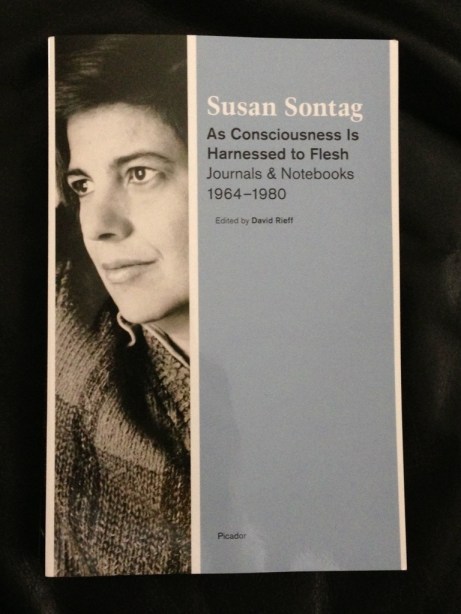
Susan Sontag’s Notebooks, 1964-1980 (Book Acquired, 7.09.2013)

20130717-120722.jpg

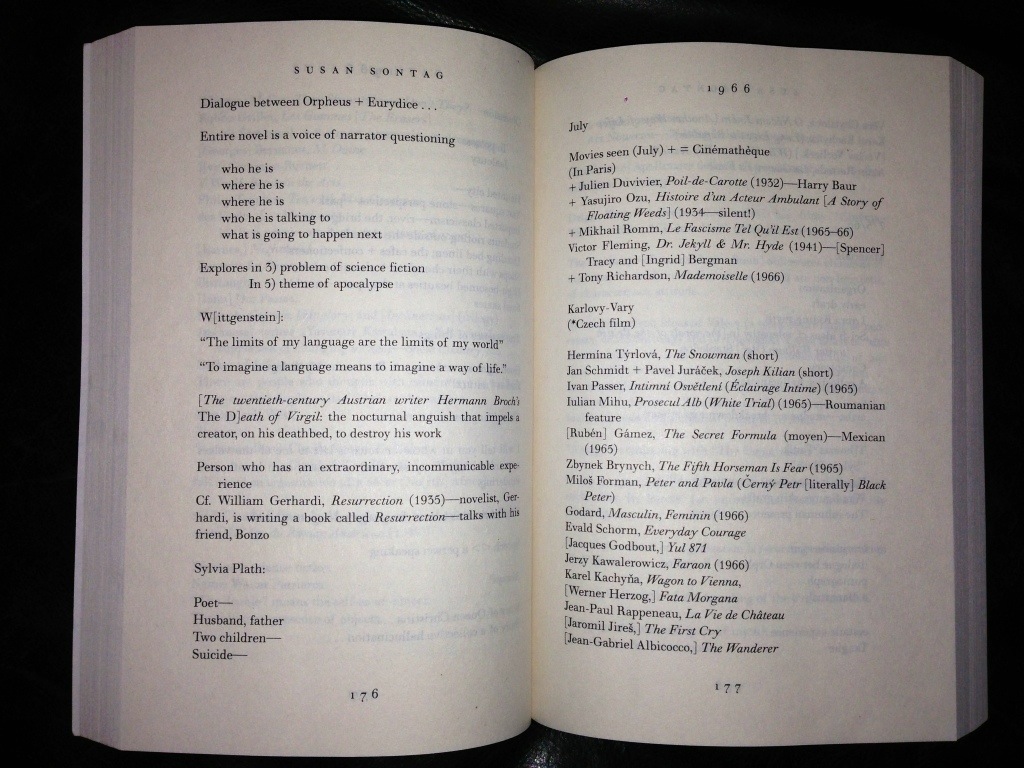
I’ve been—I don’t know—strolling through Susan Sontag’s journals and notebooks this past week. Collected as As Consciousness Is Harnessed to Flesh and new from Picador, this volume picks up where Reborn left off. I’ll be doing a full write up some time this month—really more about writer notebooks (I love Hawthorne’s in particular). Until then—a sample spread from the summer of ’66:

20130717-120729.jpg

Nine Notes from Nathaniel Hawthorne’s Note-Books

  1. The elephant is not particularly sagacious in the wild state, but becomes so when tamed. The fox directly the contrary, and likewise the wolf.
  2. A modern Jewish adage,–“Let a man clothe himself beneath his ability, his children according to his ability, and his wife above his ability.”
  3. It is said of the eagle, that, in however long a flight, he is never seen to clap his wings to his sides. He seems to govern his movements by the inclination of his wings and tail to the wind, as a ship is propelled by the action of the wind on her sails.
  4. In old country-houses in England, instead of glass for windows, they used wicker, or fine strips of oak disposed checkerwise. Horn was also used. The windows of princes and great noblemen were of crystal; those of Studley Castle, Holinshed says, of beryl. There were seldom chimneys; and they cooked their meats by a fire made against an iron back in the great hall. Houses, often of gentry, were built of a heavy timber frame, filled up with lath and plaster. People slept on rough mats or straw pallets, with a round log for a pillow; seldom better beds than a mattress, with a sack of chaff for a pillow.
  5. In this dismal chamber FAME was won. (Salem, Union Street.)
  6. Those who are very difficult in choosing wives seem as if they would take none of Nature’s ready-made works, but want a woman manufactured particularly to their order.
  7. A council of the passengers in a street: called by somebody to decide upon some points important to him.
  8. Every individual has a place to fill in the world, and is important, in some respects, whether he chooses to be so or not.
  9. Merry, “in merry England,” does not mean mirthful; but is corrupted from an old Teutonic word signifying famous or renowned.

Notations from Nathaniel Hawthorne’s American Note-Books

Eight Ideas from Nathaniel Hawthorne’s Note-Books

  1. A man, perhaps with a persuasion that he shall make his fortune by some singular means, and with an eager longing so to do, while digging or boring for water, to strike upon a salt-spring.
  2. To have one event operate in several places,–as, for example, if a man’s head were to be cut off in one town, men’s heads to drop off in several towns.
  3. Follow out the fantasy of a man taking his life by instalments, instead of at one payment,–say ten years of life alternately with ten years of suspended animation.
  4. Sentiments in a foreign language, which merely convey the sentiment without retaining to the reader any graces of style or harmony of sound, have somewhat of the charm of thoughts in one’s own mind that have not yet been put into words. No possible words that we might adapt to them could realize the unshaped beauty that they appear to possess. This is the reason that translations are never satisfactory,–and less so, I should think, to one who cannot than to one who can pronounce the language.
  5. A person to be writing a tale, and to find that it shapes itself against his intentions; that the characters act otherwise than he thought; that unforeseen events occur; and a catastrophe comes which he strives in vain to avert. It might shadow forth his own fate,–he having made himself one of the personages.
  6. It is a singular thing, that, at the distance, say, of five feet, the work of the greatest dunce looks just as well as that of the greatest genius,–that little space being all the distance between genius and stupidity.
  7. Mrs. Sigourney says, after Coleridge, that “poetry has been its own exceeding great reward.” For the writing, perhaps; but would it be so for the reading?
  8. Four precepts: To break off customs; to shake off spirits ill-disposed; to meditate on youth; to do nothing against one’s genius.

—Notations from Nathaniel Hawthorne’s American Note-Books(See also: Ten ideas and then Twenty ideas from Nathaniel Hawthorne’s Note-Books).

“Sir Arthur Aston had his brains beaten out with his own wooden leg” (Nathaniel Hawthorne)

October 22d.—At a dinner-party at Mr. Holland’s last evening, a gentleman, in instance of Charles Dickens’s unweariability, said that during some theatrical performances in Liverpool he acted in play and farce, spent the rest of the night making speeches, feasting, and drinking at table, and ended at seven o’clock in the morning by jumping leap-frog over the backs of the whole company.

In Moore’s diary he mentions a beautiful Guernsey lily having been given to his wife, and says that the flower was originally from Guernsey. A ship from there had been wrecked on the coast of Japan, having many of the lilies on board, and the next year the flowers appeared,—springing up, I suppose, on the wave-beaten strand.

Wishing to send a letter to a dead man, who may be supposed to have gone to Tophet,—throw it into the fire.

Sir Arthur Aston had his brains beaten out with his own wooden leg, at the storming of Tredagh in Ireland by Cromwell.

In the county of Cheshire, many centuries ago, there lived a half-idiot, named Nixon, who had the gift of prophecy, and made many predictions about places, families, and important public events, since fulfilled. He seems to have fallen into fits of insensibility previous to uttering his prophecies.

The family of Mainwaring (pronounced Mannering), of Bromborough, had an ass’s head for a crest.

“Richard Dawson, being sick of the plague, and perceiving he must die, rose out of his bed and made his grave, and caused his nephew to cast straw into the grave, which was not far from the house, and went and laid him down in the said grave, and caused clothes to be laid upon him, and so departed out of this world. This he did because he was a strong man, and heavier than his said nephew and a serving-wench were able to bury. He died about the 24th of August. Thus was I credibly told he did, 1625.” This was in the township of Malpas, recorded in the parish register.

At Bickley Hall, taken down a few years ago, used to be shown the room where the body of the Earl of Leicester was laid for a whole twelvemonth,—1659 to 1660,—he having been kept unburied all that time, owing to a dispute which of his heirs should pay his funeral expenses.

—Nathaniel Hawthorne’s journal entry of October 22nd, 1853; collected in Passages from the English Note-Books.


Ten Ideas from Nathaniel Hawthorne’s Note-Books

  1. A tree, tall and venerable, to be said by tradition to have been the staff of some famous man, who happened to thrust it into the ground, where it took root.
  2. A fellow without money, having a hundred and seventy miles to go, fastened a chain and padlock to his legs, and lay down to sleep in a field. He was apprehended, and carried gratis to a jail in the town whither he desired to go.
  3. An old volume in a large library,–every one to be afraid to unclasp and open it, because it was said to be a book of magic.
  4. A ghost seen by moonlight; when the moon was out, it would shine and melt through the airy substance of the ghost, as through a cloud.
  5. A scold and a blockhead,–brimstone and wood,–a good match.
  6. To make one’s own reflection in a mirror the subject of a story.
  7. In a dream to wander to some place where may be heard the complaints of all the miserable on earth.
  8. Some common quality or circumstance that should bring together people the most unlike in all other respects, and make a brotherhood and sisterhood of them,–the rich and the proud finding themselves in the same category with the mean and the despised.
  9. A person to consider himself as the prime mover of certain remarkable events, but to discover that his actions have not contributed in the least thereto. Another person to be the cause, without suspecting it.
  10. A person or family long desires some particular good. At last it comes in such profusion as to be the great pest of their lives.

—Notations from Nathaniel Hawthorne’s American Note-Books. (See also: Twenty ideas from Nathaniel Hawthorne’s Note-Books)

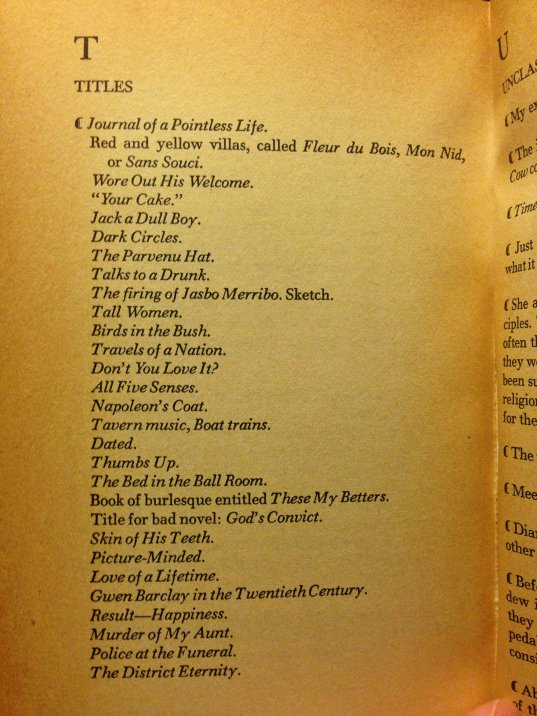
Journal of a Pointless Life, and Other Titles from F. Scott Fitzgerald’s Notebooks

IMG_5729

“Bread and Butter Letter from a Chicago Gentleman” — F. Scott Fitgerald

Dear Marion,

I certainly enjoyed myself. The chow was all good, mostly, but the butter was rancid. The bed was hard but uncomfortable. The talk was over my head but there was some made sense—that part about my being a great guy for instance.
I got home sick at the stummuck but I do not blame you at all.
Will you tell the servents next time I like my soup hot and more of a sharp edge when they press my pants.
You said I only had to pay one buck for board but even that is too much when the service is not good. That black bean soup was rancid too, and mine had a beetle in it. Besides there wasn’t enough blankets and the only good one was stale like it had been used for a baby or something.
I liked all the people I met except that woman I had to slug at dinner. Tell her I hope she found her teeth in the tomato soup when they emptied it out. No gentleman should have done a thing like that but I cannot stand a warm stocking on my ankle under the table.
I’m sorry I shot the horse and dog but they kep me awake 1/2 the night and I come there for a rest. You will find a lot of cigar stubs in the refrigidaire as I did not know where to put them. I do not want them however so give them to one of the negro servants, you know the colored ones, not your uncle or aunt or anybody like that. The black ones.
I’ll tell you when I can come down again and we will have more of that fun in the dumb waiter—hey kid, you know? Only I’m sorry I left you between floors when I went to bed. I thot it would give you more time to cool off so you could get some sleep too.
All right kid and goodby and I know now you are not such a dumb cluck as you look like.

“Tick”

P.S. If you called that thing a cocktail then listerine is the Holy Grail.

From F. Scott Fitzgerald’s Notebooks.

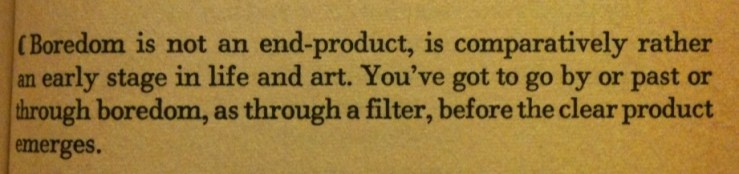
Boredom // F. Scott Fitzgerald

20130211-213526.jpg