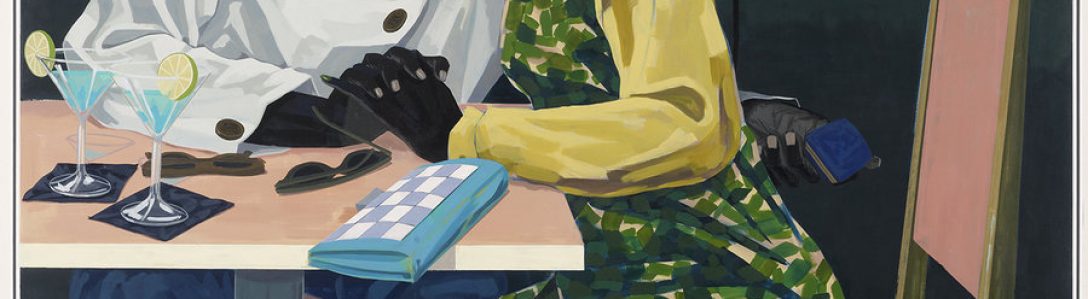
“May-Day” — Ralph Waldo Emerson

“May-Day” by Ralph Waldo Emerson

Daughter of Heaven and Earth, coy Spring,
With sudden passion languishing,
Maketh all things softly smile,
Painteth pictures mile on mile,
Holds a cup with cowslip-wreaths,
Whence a smokeless incense breathes.
Girls are peeling the sweet willow,
Poplar white, and Gilead-tree,
And troops of boys
Shouting with whoop and hilloa,
And hip, hip three times three.
The air is full of whistlings bland;
What was that I heard
Out of the hazy land?
Harp of the wind, or song of bird,
Or clapping of shepherd’s hands,
Or vagrant booming of the air,
Voice of a meteor lost in day?
Such tidings of the starry sphere
Can this elastic air convey.
Or haply ‘t was the cannonade
Of the pent and darkened lake,
Cooled by the pendent mountain’s shade,
Whose deeps, till beams of noonday break,
Afflicted moan, and latest hold
Even unto May the iceberg cold.
Was it a squirrel’s pettish bark,
Or clarionet of jay? or hark,
Where yon wedged line the Nestor leads,
Steering north with raucous cry
Through tracts and provinces of sky,
Every night alighting down
In new landscapes of romance,
Where darkling feed the clamorous clans
By lonely lakes to men unknown.
Come the tumult whence it will,
Voice of sport, or rush of wings,
It is a sound, it is a token
That the marble sleep is broken,
And a change has passed on things.
Continue reading ““May-Day” — Ralph Waldo Emerson”

“Gifts” — Ralph Waldo Emerson

“Gifts” by Ralph Waldo Emerson

“Gifts of one who loved me,—
Twas high time they came;
When he ceased to love me,
Time they stopped for shame.”

IT is said that the world is in a state of bankruptcy, that the world owes the world more than the world can pay, and ought to go into chancery, and be sold. I do not think this general insolvency, which involves in some sort all the population, to be the reason of the difficulty experienced at Christmas and New Year, and other times, in bestowing gifts; since it is always so pleasant to be generous, though very vexatious to pay debts. But the impediment lies in the choosing. If, at any time, it comes into my head that a present is due from me to somebody, I am puzzled what to give until the opportunity is gone. Flowers and fruits are always fit presents; flowers, because they are a proud assertion that a ray of beauty outvalues all the utilities of the world. These gay natures contrast with the somewhat stern countenance of ordinary nature; they are like music heard out of a workhouse. Nature does not cocker us: we are children, not pets: she is not fond: everything is dealt to us without fear or favor, after severe universal laws. Yet these delicate flowers look like the frolic and interference of love and beauty. Men used to tell us that we love flattery, even though we are not deceived by it, because it shows that we are of importance enough to be courted. Something like that pleasure the flowers give us: what am I to whom these sweet hints are addressed? Fruits are acceptable gifts because they are the flower of commodities, and admit of fantastic values being attached to them. If a man should send to me to come a hundred miles to visit him, and should set before me a basket of fine summer fruit, I should think there was some proportion between the labor and the reward. Continue reading ““Gifts” — Ralph Waldo Emerson”

“Art” — Ralph Waldo Emerson

“Art” by Ralph Waldo Emerson

Because the soul is progressive, it never quite repeats itself, but in every act attempts the production of a new and fairer whole. This appears in works both of the useful and the fine arts, if we employ the popular distinction of works according to their aim either at use or beauty. Thus in our fine arts, not imitation but creation is the aim. In landscapes the painter should give the suggestion of a fairer creation than we know. The details, the prose of nature he should omit and give us only the spirit and splendor. He should know that the landscape has beauty for his eye because it expresses a thought which is to him good; and this because the same power which sees through his eyes is seen in that spectacle; and he will come to value the expression of nature and not nature itself, and so exalt in his copy the features that please him. He will give the gloom of gloom and the sunshine of sunshine. In a portrait he must inscribe the character and not the features, and must esteem the man who sits to him as himself only an imperfect picture or likeness of the aspiring original within.

What is that abridgment and selection we observe in all spiritual activity, but itself the creative impulse? for it is the inlet of that higher illumination which teaches to convey a larger sense by simpler symbols. What is a man but nature’s finer success in self-explication? What is a man but a finer and compacter landscape than the horizon figures,—nature’s eclecticism? and what is his speech, his love of painting, love of nature, but a still finer success,—all the weary miles and tons of space and bulk left out, and the spirit or moral of it contracted into a musical word, or the most cunning stroke of the pencil?

But the artist must employ the symbols in use in his day and nation to convey his enlarged sense to his fellow-men. Thus the new in art is always formed out of the old. The Genius of the Hour sets his ineffaceable seal on the work and gives it an inexpressible charm for the imagination. As far as the spiritual character of the period overpowers the artist and finds expression in his work, so far it will retain a certain grandeur, and will represent to future beholders the Unknown, the Inevitable, the Divine. No man can quite exclude this element of Necessity from his labor. No man can quite emancipate himself from his age and country, or produce a model in which the education, the religion, the politics, usages and arts of his times shall have no share. Though he were never so original, never so wilful and fantastic, he cannot wipe out of his work every trace of the thoughts amidst which it grew. The very avoidance betrays the usage he avoids. Above his will and out of his sight he is necessitated by the air he breathes and the idea on which he and his contemporaries live and toil, to share the manner of his times, without knowing what that manner is. Now that which is inevitable in the work has a higher charm than individual talent can ever give, inasmuch as the artist’s pen or chisel seems to have been held and guided by a gigantic hand to inscribe a line in the history of the human race. This circumstance gives a value to the Egyptian hieroglyphics, to the Indian, Chinese and Mexican idols, however gross and shapeless. They denote the height of the human soul in that hour, and were not fantastic, but sprung from a necessity as deep as the world. Shall I now add that the whole extant product of the plastic arts has herein its highest value, as history; as a stroke drawn in the portrait of that fate, perfect and beautiful, according to whose ordinations all beings advance to their beatitude? Continue reading ““Art” — Ralph Waldo Emerson”

Hawthorne and Thoreau Dine Together Then Take a Stroll

From Nathaniel Hawthorne’s journal (via):

September 1, 1842. Mr. Thoreau dined with us yesterday…. He is a keen and delicate observer of nature–a genuine observer–which, I suspect, is almost as rare a character as even an original poet; and Nature, in return for his love, seems to adopt him as her especial child, and shows him secrets which few others are allowed to witness. He is familiar with beast, fish, fowl, and reptile, and has strange stories to tell of adventures, and friendly passages with these lower brethren of mortality. Herb and flower, likewise, wherever they grow, whether in garden or wildwood, are his familiar friends. He is also on intimate terms with the clouds, and can tell the portents of storms. It is a characteristic trait that he has a great regard for the memory of the Indian tribes, whose wild life would have suited him so well; and strange to say, he seldom walks over a ploughed field without picking up an arrow-point, a spearhead, or other relic of the red men–as if their spirits willed him to be the inheritor of their simple wealth.

With all this he has more than a tincture of literature,–a deep and true taste for poetry, especially for the elder poets, and he is a good writer,–at least he has written a good article, a rambling disquisition on Natural History, in the last Dial, which, he says, was chiefly made up from journals of his own observations. Methinks this article gives a very fair image of his mind and character,–so true, innate, and literal in observation, yet giving the spirit as well as letter of what he sees, even as a lake reflects its wooded banks, showing every leaf, yet giving the wild beauty of the whole scene. Then there are in the article passages of cloudy and dreamy metaphysics, and also passages where his thoughts seem to measure and attune themselves into spontaneus verse, as they rightfully may, since there is real poetry in them. There is a basis of good sense and of moral truth, too, throughout the article, which also is a reflection of his character; for he is not unwise to think and feel, and I find him a healthy and wholesome man to know.

After dinner (at which we cut the first watermelon and muskmelon that our garden has ripened) Mr. Thoreau and I walked up the bank of the river; and, at a certain point, he shouted for his boat. Forthwith, a young man paddled it across the river, and Mr. Thoreau and I voyaged farther up the stream, which soon became more beautiful than any picture, with its dark and quiet sheet of water, half shaded, half sunny, between high and wooded banks. The late rains have swollen the stream so much that many trees are standing up to their knees, as it were, in the water, and boughs, which lately swung high in air, now dip and drink deep of the passing wave. As to the poor cardinals which glowed upon the bank a few days since, I could see only a few of their scarlet hats, peeping above the tide. Mr. Thoreau managed the boat so perfectly, either with two paddles or with one, that it seemed instinct with his own will, and to require no physical effort to guide it. He said that, when some Indians visited Concord a few years since, he found that he had acquired, without a teacher, their precise method of propelling and steering a canoe. Nevertheless he was desirous of selling the boat of which he is so fit a pilot, and which was built by his own hands; so I agreed to take it, and accordingly became possessor of the Musketaquid. I wish I could acquire the aquatic skill of the original owner.

from American Notebooks (1835-42)