
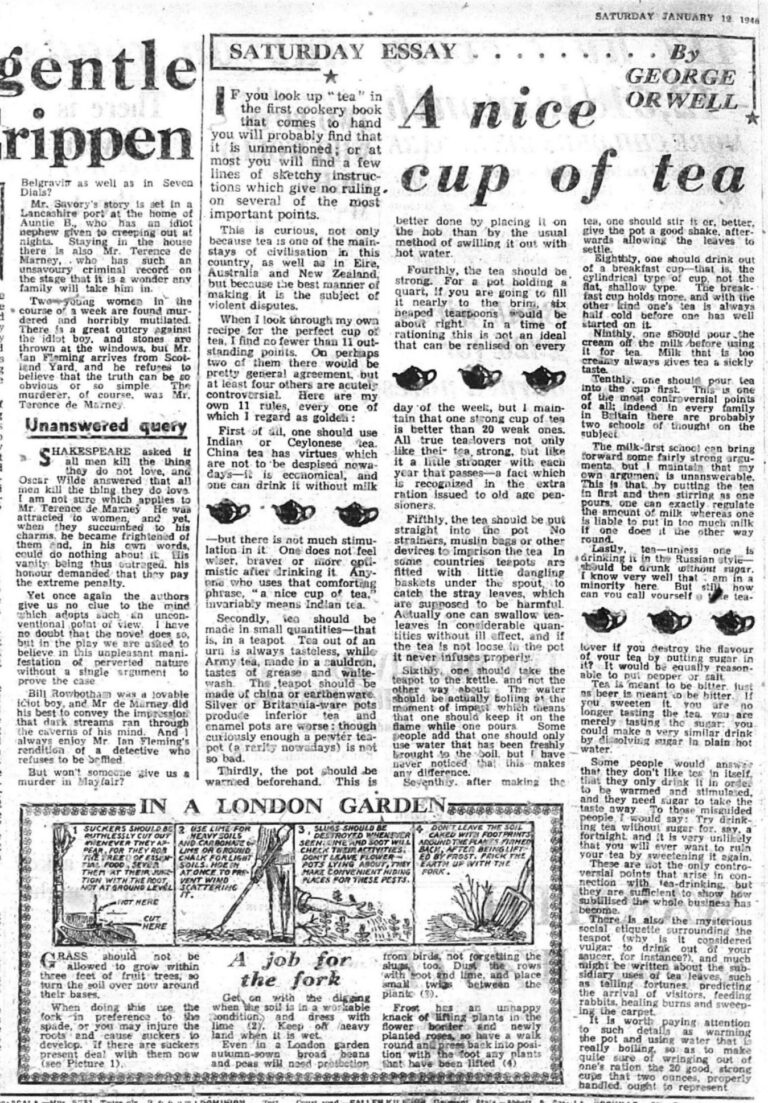
George Orwell’s Nice Cup of Tea

A Nice Cup of Tea
If you look up ‘tea’ in the first cookery book that comes to hand you will probably find that it is unmentioned; or at most you will find a few lines of sketchy instructions which give no ruling on several of the most important points.
This is curious, not only because tea is one of the main stays of civilisation in this country, as well as in Eire, Australia and New Zealand, but because the best manner of making it is the subject of violent disputes.
When I look through my own recipe for the perfect cup of tea, I find no fewer than eleven outstanding points. On perhaps two of them there would be pretty general agreement, but at least four others are acutely controversial. Here are my own eleven rules, every one of which I regard as golden:
First of all, one should use Indian or Ceylonese tea. China tea has virtues which are not to be despised nowadays — it is economical, and one can drink it without milk — but there is not much stimulation in it. One does not feel wiser, braver or more optimistic after drinking it. Anyone who has used that comforting phrase ‘a nice cup of tea’ invariably means Indian tea. Secondly, tea should be made in small quantities — that is, in a teapot. Tea out of an urn is always tasteless, while army tea, made in a cauldron, tastes of grease and whitewash. The teapot should be made of china or earthenware. Silver or Britanniaware teapots produce inferior tea and enamel pots are worse; though curiously enough a pewter teapot (a rarity nowadays) is not so bad.
Thirdly, the pot should be warmed beforehand. This is better done by placing it on the hob than by the usual method of swilling it out with hot water.
Fourthly, the tea should be strong. For a pot holding a quart, if you are going to fill it nearly to the brim, six heaped teaspoons would be about right. In a time of rationing, this is not an idea that can be realised on every day of the week, but I maintain that one strong cup of tea is better than twenty weak ones. All true tea lovers not only like their tea strong, but like it a little stronger with each year that passes — a fact which is recognised in the extra ration issued to old-age pensioners.
Fifthly, the tea should be put straight into the pot. No strainers, muslin bags or other devices to imprison the tea. In some countries teapots are fitted with little dangling baskets under the spout to catch the stray leaves, which are supposed to be harmful. Actually one can swallow tea-leaves in considerable quantities without ill effect, and if the tea is not loose in the pot it never infuses properly.
Sixthly, one should take the teapot to the kettle and not the other way about. The water should be actually boiling at the moment of impact, which means that one should keep it on the flame while one pours. Some people add that one should only use water that has been freshly brought to the boil, but I have never noticed that it makes any difference.
Seventhly, after making the tea, one should stir it, or better, give the pot a good shake, afterwards allowing the leaves to settle.
Eighthly, one should drink out of a good breakfast cup — that is, the cylindrical type of cup, not the flat, shallow type. The breakfast cup holds more, and with the other kind one’s tea is always half cold before one has well started on it.
Ninthly, one should pour the cream off the milk before using it for tea. Milk that is too creamy always gives tea a sickly taste.
Tenthly, one should pour tea into the cup first. This is one of the most controversial points of all; indeed in every family in Britain there are probably two schools of thought on the subject. The milk-first school can bring forward some fairly strong arguments, but I maintain that my own argument is unanswerable. This is that, by putting the tea in first and stirring as one pours, one can exactly regulate the amount of milk whereas one is liable to put in too much milk if one does it the other way round.
Lastly, tea — unless one is drinking it in the Russian style — should be drunk without sugar. I know very well that I am in a minority here. But still, how can you call yourself a true tea-lover if you destroy the flavour of your tea by putting sugar in it? It would be equally reasonable to put in pepper or salt. Tea is meant to be bitter, just as beer is meant to be bitter. If you sweeten it, you are no longer tasting the tea, you are merely tasting the sugar; you could make a very similar drink by dissolving sugar in plain hot water.
Some people would answer that they don’t like tea in itself, that they only drink it in order to be warmed and stimulated, and they need sugar to take the taste away. To those misguided people I would say: Try drinking tea without sugar for, say, a fortnight and it is very unlikely that you will ever want to ruin your tea by sweetening it again.
These are not the only controversial points to arise in connexion with tea drinking, but they are sufficient to show how subtilised the whole business has become. There is also the mysterious social etiquette surrounding the teapot (why is it considered vulgar to drink out of your saucer, for instance?) and much might be written about the subsidiary uses of tea leaves, such as telling fortunes, predicting the arrival of visitors, feeding rabbits, healing burns and sweeping the carpet. It is worth paying attention to such details as warming the pot and using water that is really boiling, so as to make quite sure of wringing out of one’s ration the twenty good, strong cups that two ounces, properly handled, ought to represent.

George Orwell’s recipe/method for a nice cup of tea was first published in the 12 Jan. 1946 issue of the Evening Standard. Image via the Orwell Society.

Walter M. Miller Jr.’s Gopher Tortoise Stew

Gopher Stew

A book of science fiction recipes should contain a few formulae for things to be cooked in a tin can in the forest after World War III. In the southeast, one such recipe might read simply: Catch, kill, and dress one 10-12 inch gopher, and boil meat until tender, adding any available herbs such as wild garlic and sabal palmetto hearts. The “gopher” of the recipe is not a rodent but a burrowing land tortoise, Gopherus polyphemus, common in this region and long a part of that swampland cuisine lately called “soul food.” In the summer and early fall, gophers are seen migrating across roads and through sandy clearings; when you approach, the animal’s only defense is to pull himself inside his shell and batten down the hatches. Because of the shell, a slow metabolism, and a subterranean abode, the gopher should have a better resistance to radiation than most hard-to-catch game. In the winter, you will find them underground, but dig with caution; the gopher sometimes shares his bole with a south-
eastern diamondback.

Calculate the position of the retracted head and kill either by putting a bullet through the shell just behind this point, or by breaking through the shell with hammer, hatchet, or pointed stone, and inserting a sharp knife to sever the neck. Chop all around the edges of the bottom shell plate, completely severing it from the top shell, insert a machete or long stiff butcher knife between the plate and the belly and slice the plate free. Dump the entrails, not bothering to look into the matter of reptilian giblets unless you’re really starving. By now you are feeling somewhat guilty because the headless beast keeps thrashing and waving its paws as it tries to crawl away: it’s not a mammal, so forget it. Reptilian meat is very persistent. Grasp the paws with a pair of pliers and stretch them out (against their will) while you cut around behind them and free the meat from the shell. A large gopher should yield about a quart of meat, including bone. Scrub the feet thoroughly, but do not attempt to skin or declaw, part of the backwoods charm of this dish is the sight of scaly reptilian feet floating with the onions and carrots in the tomatoey goop. Treat the meat with an ordinary papayin-based tenderizer, liquid or powder, and freeze it until you find another tortoise if one is not enough. (One does not ordinarily hunt the creatures, but encounters then while fishing, hunting, or walking in the woods.) Other types of turtle nay be substituted for gopher.

1 quart tortoise meat chunks
3-4 slices bacon
1. 1b. small peeled onions
4-5 carrots, sliced
4-5 small potatoes, if desired
8-9 pods of okra, sliced
3 large, red, ripe bell peppers (or large jar pimentos)
6 hot red peppers (meat only, discard seeds)
3 cloves garlic
1 small can tomato sauce
half glass of sherry, two bay leaves, several sprigs (or a teaspoon of dry) thyme, oregano, rosemary, salt and pepper

Fry out the bacon, then brown the gopher meat, trying not to let it jump out of the pan if recently killed (it’s less active if frozen). Mince the hot pepper meat, the garlic, one of the onions, and a small carrot, and add to the browning meat, along with the herbs. Add the tomato sauce and a little water, cover lightly, und Sumer until the meat is nearly tender. Add the sherry, herbs, and vegetables; cook until done. Okra is mucilaginous and has some thickening effect, but if there is too much liquid, thicken with a little brown roux or  preferably, with powdered sassafras leaves (or gumbo fillet).

Note: the fire in hot peppers is mostly in the seeds; if you use seeds and all, use only one pepper, not six.


Walter M. Miller’s recipe for “Gopher Stew” is collected in collected in Cooking Out of This World (ed. Anne McCaffrey, 1973).

Ursula K. Le Guin’s Valley Succotash

Líriv Metadí or Valley Succotash

Wash about two cups of small red beans (the Valley metadí is very like the Mexican frijole), and cook till done (a couple of hours) with half an onion, three or four garlic cloves, and a bay leaf.

Simmer about a cup and a half of parched corn until thoroughly cooked, and drain (or in season use fresh corn cut off the cob, uncooked).

Simmer a handful of dried black mushrooms for half an hour or so, and keep them in their cooking broth.

When all these ingredients are done combine them, along with:

the juice and pulp of a lemon, or some preserved tamarind pulp an onion chopped and fried in oil with some finely chopped garlic and a spoonful of cumin seeds

a large, mild green chile of the chile verde type, or a small, hot green chile (but not bell pepper), seeded and chopped fine

three or four tomatoes peeled and chopped coarsely

add, as seasoning, oregano, winter savory, and more lemon to taste

add dried red chile if you want it hot

To thicken the sauce, one dried tomato-paste ball was added; our equivalent would be two or three tablespoons of thick tomato paste. (If fresh tomatoes are not in season, double or triple the quantity of tomato paste.)

All this simmers for about an hour.

Serve with chopped raw onion to garnish, and a sour sauce or chutney made of green tomatoes or tomatillos, flavored with fresh or dry coriander leaf.

This dish, “too heavy for rice,” was accompanied by cornbreads, either of the hoe cake or the tortilla type.

From Ursula Le Guin’s 1985 novel Always Coming Home.

Samuel Beckett’s Assassination Custard

When Samuel Beckett went to Paris in 1930 he discovered his true home, a place of liberation in both the personal and professional sense. He became a member of James Joyce’s inner circle, and was one of the many accoucheurs at the prolonged delivery of Finnegans Wake.

In the early hours of 7 January 1939, Beckett was returning home with friends from a café when he was accosted by a pimp called Prudent. When Beckett repelled the pimp’s advances he stuck a flick knife straight into Beckett’s chest, missing the heart by a mere whisker. His companions roared for help and were assisted by a passing piano student, Suzanne Deschevaux-Dumesnil, and Beckett was rushed to hospital. Joyce insisted on paying for a private room for him, and lent him his favourite reading lamp. Nora made one of her special custard puddings to nourish the invalid. The cool and efficient piano student eventually became Mrs Beckett.

5 egg yolks loz (30g) castor sugar
1 pt (600ml) single cream
2 tbsp brandy
Preheat oven to 160°C (325°F, Gas mark 3).

Grease a shallow ovenproof dish (about 900ml or 1½ pt capacity). Beat the egg yolks and castor sugar together. Heat the cream gently, do not boil, and stir in the brandy. Very gradually add the warmed cream to the egg mixture, beating constantly. Pour into the dish. Place the dish in a baking tin and pour sufficient hot water into the tin to come half-way up the dish. Bake for 45 minutes or until set.
Serves four.

From A Trifle, a Coddle, a Fry: An Irish Literary Cookbook by Veronica Jane O’Mara and Fionnuala O’Reilly.

Walker Percy’s Cud’n Walker’s Uncle Will’s Favorite Mint Julep Receipt

As a postscript to his 1957 essay “Bourbon,” Walker Percy offers his favorite recipe for the drink:

Reader, just in case you don’t want to knock it back straight and would rather monkey around with perfectly good Bourbon, here’s my favorite recipe, “Cud’n Walker’s Uncle Will’s Favorite Mint Julep Receipt.”

You need excellent Bourbon whiskey; rye or Scotch will not do. Put half an inch of sugar in the bottom of the glass and merely dampen it with water. Next, very quickly—and here is the trick in the procedure—crush your ice, actually powder it, preferably in a towel with a wooden mallet, so quickly that it remains dry, and, slipping two sprigs of fresh mint against the inside of the glass, cram the ice in right to the brim, packing it with your hand. Finally, fill the glass, which apparently has no room left for anything else, with Bourbon, the older the better, and grate a bit of nutmeg on the top. The glass will frost immediately. Then settle back in your chair for half an hour of cumulative bliss.

Uncle Will shows up a few times in Signposts in a Strange Land, a collection of essays that includes “Bourbon” along with 1965’s “Uncle Will,” which offers this nugget:

Early each afternoon he made himself a pitcher of vodka martinis—no one had ever heard of such a drink in Mississippi in the 1930s—and set up shop in the pantry, listened and talked to any and all comers.

Also from “Bourbon”:

Bourbon does for me what the piece of cake did for Proust.

1926: As a child watching my father in Birmingham, in the exurbs, living next to number-6 fairway of the New Country Club, him disdaining both the bathtub gin and white lightning of the time, aging his own Bourbon in a charcoal keg, on his hands and knees in the basement sucking on a siphon, a matter of gravity requiring cheek pressed against cement floor, the siphon getting going, the decanter ready, the first hot spurt into his mouth not spat out.

1933: My uncle’s sun parlor in the Mississippi Delta and toddies on a Sunday afternoon, the prolonged and meditative tinkle of silver spoon against crystal to dissolve the sugar; talk, tinkle, talk; the talk mostly political: “Roosevelt is doing a good job; no, the son of a bitch is betraying his class.”

1934: Drinking at a Delta dance, the boys in bi-swing jackets and tab collars, tough-talking and profane and also scared of the girls and therefore safe in the men’s room. Somebody passes around bootleg Bourbon in a Coke bottle. It’s awful. Tears start from eyes, faces turn red. “Hot damn, that’s good!”

1935: Drinking at a football game in college. UNC versus Duke. One has a blind date. One is lucky. She is beautiful. Her clothes are the color of the fall leaves and her face turns up like a flower. But what to say to her, let alone what to do, and whether she is “nice” or “hot”—a distinction made in those days. But what to say? Take a drink, by now from a proper concave hip flask (a long way from the Delta Coke bottle) with a hinged top. Will she have a drink? No. But it’s all right. The taste of the Bourbon(Cream of Kentucky) and the smell of her fuse with the brilliant Carolina fall and the sounds of the crowd and the hit of the linemen in a single synesthesia.

1941: Drinking mint juleps, famed Southern Bourbon drink, though in the Deep South not really drunk much. In fact, they are drunk so seldom that when, say, on Derby Day somebody gives a julep party, people drink them like cocktails, forgetting that a good julep holds at least five ounces of Bourbon. Men fall facedown unconscious, women wander in the woods disconsolate and amnesiac, full of thoughts of Kahlil Gibran and the limber lost.

Would you believe the first mint julep I had I was sitting not on a columned porch but in the Boo Snooker bar of the New Yorker Hotel with a Bellevue nurse in 1941? The nurse, a nice upstate girl, head floor nurse, brisk, swift, good-looking; Bellevue nurses, the best in the world and this one the best of Bellevue, at least the best-looking. The julep, an atrocity, a heavy syrupy Bourbon and water in a small glass clotted with ice. But good!

Ernest Hemingway’s Campfire Trout

Ernest Hemingway’s recipe for campfire trout:

Outside of insects and bum sleeping the rock that wrecks most camping trips is cooking. The average tyro’s idea of cooking is to fry everything and fry it good and plenty. Now, a frying pan is a most necessary thing to any trip, but you also need the old stew kettle and the folding reflector baker.

A pan of fried trout can’t be bettered and they don’t cost any more than ever. But there is a good and bad way of frying them.

The beginner puts his trout and his bacon in and over a brightly burning fire; the bacon curls up and dries into a dry tasteless cinder and the trout is burned outside while it is still raw inside. He eats them and it is all right if he is only out for the day and going home to a good meal at night. But if he is going to face more trout and bacon the next morning and other equally well-cooked dishes for the remainder of two weeks he is on the pathway to nervous dyspepsia.

The proper way is to cook over coals. Have several cans of Crisco or Cotosuet or one of the vegetable shortenings along that are as good as lard and excellent for all kinds of shortening. Put the bacon in and when it is about half cooked lay the trout in the hot grease, dipping them in cornmeal first. Then put the bacon on top of the trout and it will baste them as it slowly cooks.

The coffee can be boiling at the same time and in a smaller skillet pancakes being made that are satisfying the other campers while they are waiting for the trout.

With the prepared pancake flours you take a cupful of pancake flour and add a cup of water. Mix the water and flour and as soon as the lumps are out it is ready for cooking. Have the skillet hot and keep it well greased. Drop the batter in and as soon as it is done on one side loosen it in the skillet and flip it over. Apple butter, syrup or cinnamon and sugar go well with the cakes.

While the crowd have taken the edge from their appetites with flapjacks the trout have been cooked and they and the bacon are ready to serve. The trout are crisp outside and firm and pink inside and the bacon is well done—but not too done. If there is anything better than that combination the writer has yet to taste it in a lifetime devoted largely and studiously to eating.

Hemingway’s article “Camping Out” first appeared in the Toronto Daily Star on 26 June 1920

William Faulkner’s Recipe for Curing Ham

The following is from a 1942 letter from William Faulkner to his son-in-law William Fielden, instructing the young man on the author’s preferences for curing recently-slaughtered pork. From The Faulkner Journal Vol. 2, No. 1, Fall, 1986.

Curing Hams Shoulders Bacon

After the pieces are trimmed and thoroughly cooled, either by 24 hours of natural temperature or by artificial temperature NOT LOW ENOUGH TO FREEZE IT, that is, about 35 degrees F.

Lay the pieces flat, flesh side up, cover thoroughly with plain salt, about ¼ inch deep. Work saltpeter into the bone-joints and into the ends where the feet were removed, and into any other crevices or abrasions. Do this well and carefully, to prevent “blowing.” A slightly higher temperature will help the salt penetrate. Leave 24 hours.

After 24 hours, turn the pieces over SKIN SIDE UP, to drain. Sprinkle skin side with salt. I punch holes through the skin with an ice pick, to help draining. Leave 24 hours.

After 24 hours, turn the pieces flesh side up again, make a paste

½ plain salt

½ molasses, sugar, red and black pepper

just moist enough to spread over the pieces without flowing off. Leave 7 days.

After 7 days, make a paste

¼ plain salt

¾ molasses, sugar, red and black pepper

slightly more fluid than the first mixture, so that it will flow slowly over the pieces, penetrating the remains of last week’s treatment, dripping down the sides. Leave 7 days.

After 7 days, make a paste WITHOUT SALT

molasses, sugar, red and black pepper

fluid enough to cover the pieces without flowing off too much, cover the pieces and the residue of the two former treatments, leave seven days.

Hang the pieces and smoke with hickory or oak chips, keep it in smoky atmosphere for 2 to 7 days. The meat may be treated either before smoking or afterward with a preparation to prevent blow flies. Then wrap or enclose in cloth or paper bags and leave hanging until used.

Ursula K. Le Guin’s Crab Nebula Recipe

Ursula K. Le Guin’s recipe for “Crab Nebula”–

Make a cream sauce with tablespoon butter, 2 tablespoons flour, 1 cup milk. Add about 1½ cup grated Tillamook cheese (or more—or less … if you are unable to obtain Tillamook, you may use any inferior American Cheddar, but the difference will be noticeable unless you have a calloused palate).

Now add about ½ pound? 2 cups?—Well, add enough crab. (If you are unable to obtain Pacific crab, you may use those flabby little Atlantic ones, or even lobster; but if you are reduced to King Crab, forget it.)

Flavor with sherry to taste, salt, pepper, parsley.

Serve on rice, or wild rice if you are J. Paul Getty, or English muffins, or whatever.

Le Guin’s recipe is collected in Cooking Out of This World (ed. Anne McCaffrey, 1973)

John Cage’s Homemade Bread

5 cups vegetable purée or gruel (see note)
5 cups stone-ground wholewheat flour
4 tablespoons fresh minced dill
1 teaspoon salt

1. Combine purée and flour in a large mixing bowl. Mix thoroughly. If the mixture is too liquid to knead add more flour. If too dry add more liquid.

2. Knead the mixture for 10 minutes. Turn into an 8½ -by–4½ -by–2½ breadpan.

3. Bake in a pre-heated 375 degree oven for 1 hour 15 minutes.

4. Turn out onto a rack and cool.

Note: Mr. Cage uses leftover cooked vegetables such as broccoli, kale, spinach, carrots, celery, celery root and squash, which he purées in a food processor with vegetable stock or water. The bread has the consistency of a dense German pumpernickel and goes well with smoked salmon.

John Cage’s homemade bread recipe was published as part of an 18 March 1981 New York Times feature.

F. Scott Fitzgerald’s Turkey Leftovers

From F. Scott Fitzgerald’s Notebooks

TURKEY REMAINS AND HOW TO INTER THEM WITH NUMEROUS SCARCE RECIPES
At this post holiday season the refrigerators of the nation are overstuffed with large masses of turkey, the sight of which is calculated to give an adult an attack of dizziness. It seems, therefore, an appropriate time to give the owners the benefit of my experience as an old gourmet, in using this surplus material. Some of the recipes have been in my family for generations. (This usually occurs when rigor mortis sets in.) They were collected over years, from old cook books, yellowed diaries of the Pilgrim Fathers, mail order catalogues, golfbags and trash cans. Not one but has been tried and proven—there are headstones all over America to testify to the fact.
Very well then: Here goes:

1. Turkey Cocktail
To one large turkey add one gallon of vermouth and a demijohn of angostura bitters. Shake.

2. Turkey at la Francais.
Take a large ripe turkey, prepare as for basting and stuff with old watches and chains and monkey meat. Proceed as with cottage-pudding.

3. Turkey and Water
Take one turkey and one pan of water. Heat the latter to the boiling point and then put in the refrigerator When it has jelled drown the turkey in it. Eat. In preparing this recipe it is best to have a few ham sandwiches around in case things go wrong.

4. Turkey Mongole
Take three butts of salami and a large turkey skeleton from which the feathers and natural stuffing have been removed. Lay them out on the table and call up some Mongole in the neighborhood to tell you how to proceed from there.

5. Turkey Mousee
Seed a large prone turkey, being careful to remove the bones, flesh, fins, gravy, etc. Blow up with a bicycle pump. Mount in becoming style and hang in the front hall.

6. Stolen Turkey
Walk quickly from the market and if accosted remark with a laugh that it had just flown into your arms and you hadn’t noticed it. Then drop the turkey with the white of one egg-well, anyhow, beat it.

7. Turkey a la Creme.
Prepare the creme a day in advance, or even a year in advance. Deluge the turkey with it and cook for six days over a blast furnace. Wrap in fly paper and serve.

8. Turkey Hash
This is the delight of all connoisseurs of the holiday beast, but few understand how really to prepare it. Like a lobster it must be plunged alive into boiling water, until it becomes bright red or purple or something, and then before the color fades, placed quickly in a washing machine and allowed to stew in its own gore as it is whirled around.
Only then is it ready for hash. To hash, take a large sharp tool like a nail-file or if none is handy, a bayonet will serve the purpose—and then get at it! Hash it well! Bind the remains with dental floss and serve.
And now we come to the true aristocrat of turkey dishes:

9. Feathered Turkey.
To prepare this a turkey is necessary and a one pounder cannon to compell anyone to eat it. Broil the feathers and stuff with sage brush, old clothes, almost anything you can dig up. Then sit down and simmer. The feathers are to be eaten like artichokes (and this is not to be confused with the old Roman custom of tickling the throat).

10. Turkey at la Maryland
Take a plump turkey to a barber’s and have him shaved, or if a female bird, given a facial and a water wave. Then before killing him stuff with with old newspapers and put him to roost. He can then be served hot or raw, usually with a thick gravy of mineral oil and rubbing alcohol. (Note: This recipe was given me by an old black mammy.)

11. Turkey Remnant
This is one of the most useful recipes for, though not, “chic”, it tells what to do with the turkey after the holiday, and extract the most value from it.
Take the remants, or if they have been consumed, take the various plates on which the turkey or its parts have rested and stew them for two hours in milk of magnesia. Stuff with moth-balls.

12. Turkey with Whiskey Sauce.
This recipe is for a party of four. Obtain a gallon of whiskey, and allow it to age for several hours. Then serve, allowing one quart for each guest.
The next day the turkey should be added, little by little, constantly stirring and basting.

13. For Weddings or Funerals. Obtain a gross of small white boxes such as are used for bride’s cake. Cut the turkey into small squares, roast, stuff, kill, boil, bake and allow to skewer. Now we are ready to begin. Fill each box with a quantity of soup stock and pile in a handy place. As the liquid elapses, the prepared turkey is added until the guests arrive. The boxes delicately tied with white ribbons are then placed in the handbags of the ladies, or in the men’s side pockets.

There I guess that’s enough turkey to talk. I hope I’ll never see or hear of another until—well, until next year.

Happy Thanksgiving! Here’s a bunch of literary recipes and a painting

Merry Family, Jan Steen, 1688

F. Scott Fitzgerald’s Turkey Twelve Ways

Gordon Lish’s Chicken Soup

Zora Neale Hurston’s Mulatto Rice

Roberto Bolaño’s Brussels Sprouts with Lemon

Ian McEwan’s Fish Stew

James Joyce’s Burnt Kidney Breakfast

Herman Melville’s Whale Steaks

Ernest Hemingway’s Absinthe Cocktail, Death in the Afternoon

Vladimir Nabokov’s Eggs à la Nabocoque

Thomas Pynchon’s Banana Breakfast

Cormac McCarthy’s Turtle Soup

Robert Crumb’s Macaroni Casserole

Truman Capote’s Caviar-Smothered Baked Potatoes with 80-Proof Russian Vodka

Emily Dickinson’s Cocoanut Cake

Thomas Jefferson’s Vanilla Ice Cream

Charles Dickens’s Own Punch

Ben Jonson’s Egg Wine

Willam Faulkner’s Hot Toddy

Christmas Bonus:  George Orwell’s Recipes for Plum Cake and Christmas Pudding

Happy Thanksgiving! Here’s a bunch of literary recipes and a Bosch painting

Enjoy Thanksgiving with this menu of literary recipes:

F. Scott Fitzgerald’s Turkey Twelve Ways

Gordon Lish’s Chicken Soup

Zora Neale Hurston’s Mulatto Rice

Ian McEwan’s Fish Stew

James Joyce’s Burnt Kidney Breakfast

Herman Melville’s Whale Steaks

Ernest Hemingway’s Absinthe Cocktail, Death in the Afternoon

Vladimir Nabokov’s Eggs à la Nabocoque

Thomas Pynchon’s Banana Breakfast

Cormac McCarthy’s Turtle Soup

Robert Crumb’s Macaroni Casserole

Truman Capote’s Caviar-Smothered Baked Potatoes with 80-Proof Russian Vodka

Emily Dickinson’s Cocoanut Cake

Thomas Jefferson’s Vanilla Ice Cream

Charles Dickens’s Own Punch

Ben Jonson’s Egg Wine

Willam Faulkner’s Hot Toddy

Christmas Bonus:  George Orwell’s Recipes for Plum Cake and Christmas Pudding

A Bunch of Literary Recipes

Enjoy Thanksgiving with this menu of literary recipes:

F. Scott Fitzgerald’s Turkey Twelve Ways

Gordon Lish’s Chicken Soup

Zora Neale Hurston’s Mulatto Rice

Ian McEwan’s Fish Stew

James Joyce’s Burnt Kidney Breakfast

Herman Melville’s Whale Steaks

Ernest Hemingway’s Absinthe Cocktail, Death in the Afternoon

Vladimir Nabokov’s Eggs à la Nabocoque

Thomas Pynchon’s Banana Breakfast

Cormac McCarthy’s Turtle Soup

Robert Crumb’s Macaroni Casserole

Truman Capote’s Caviar-Smothered Baked Potatoes with 80-Proof Russian Vodka

Emily Dickinson’s Cocoanut Cake

Thomas Jefferson’s Vanilla Ice Cream

Charles Dickens’s Own Punch

Ben Jonson’s Egg Wine

Willam Faulkner’s Hot Toddy

Christmas Bonus:  George Orwell’s Recipes for Plum Cake and Christmas Pudding

Literary Recipes

Fat Kitchen, Jan Steen

***

Enjoy Thanksgiving with our menu of literary recipes:

F. Scott Fitzgerald’s Turkey Twelve Ways

Zora Neale Hurston’s Mulatto Rice

Ian McEwan’s Fish Stew

James Joyce’s Burnt Kidney Breakfast

Herman Melville’s Whale Steaks

Ernest Hemingway’s Absinthe Cocktail, Death in the Afternoon

Vladimir Nabokov’s Eggs à la Nabocoque

Thomas Pynchon’s Banana Breakfast

Cormac McCarthy’s Turtle Soup

Robert Crumb’s Macaroni Casserole

Truman Capote’s Caviar-Smothered Baked Potatoes with 80-Proof Russian Vodka

Emily Dickinson’s Cocoanut Cake

Thomas Jefferson’s Vanilla Ice Cream

Charles Dickens’s Own Punch

Ben Jonson’s Egg Wine

Willam Faulkner’s Hot Toddy

Christmas Bonus:  George Orwell’s Recipes for Plum Cake and Christmas Pudding

Enjoy Thanksgiving with Our Literary Recipes Roundup

Fat Kitchen, Jan Steen

***

Enjoy Thanksgiving with our menu of literary recipes:

F. Scott Fitzgerald’s Turkey Twelve Ways

Zora Neale Hurston’s Mulatto Rice

Ian McEwan’s Fish Stew

James Joyce’s Burnt Kidney Breakfast

Herman Melville’s Whale Steaks

Ernest Hemingway’s Absinthe Cocktail, Death in the Afternoon

Vladimir Nabokov’s Eggs à la Nabocoque

Thomas Pynchon’s Banana Breakfast

Cormac McCarthy’s Turtle Soup

Robert Crumb’s Macaroni Casserole

Truman Capote’s Caviar-Smothered Baked Potatoes with 80-Proof Russian Vodka

Emily Dickinson’s Cocoanut Cake

Thomas Jefferson’s Vanilla Ice Cream

Charles Dickens’s Own Punch

Ben Jonson’s Egg Wine

Christmas Bonus:  George Orwell’s Recipes for Plum Cake and Christmas Pudding

Enjoy Thanksgiving with Our Literary Recipes Roundup

Happy Thanksgiving! Enjoy Turkey Day with Biblioklept’s menu of literary recipes:

F. Scott Fitzgerald’s Turkey Twelve Ways

Zora Neale Hurston’s Mulatto Rice

Ian McEwan’s Fish Stew

James Joyce’s Burnt Kidney Breakfast

Herman Melville’s Whale Steaks

Ernest Heminway’s Absinthe Cocktail, Death in the Afternoon

Vladimir Nabokov’s Eggs à la Nabocoque

Thomas Pynchon’s Banana Breakfast

Cormac McCarthy’s Turtle Soup

Robert Crumb’s Macaroni Casserole

Christmas Bonus:  George Orwell’s Recipes for Plum Cake and Christmas Pudding

“Turkey Remains and How to Inter Them with Numerous Scarce Recipes” — A Thanksgiving Treat from F. Scott Fitzgerald

We celebrated Thanksgiving last year by offering up various literary recipes (don’t worry, we’re fond of leftovers, so we’ll be reheating those posts for second helpings). And even though we had a diverse range of meals on the menu, we didn’t come up with a turkey recipe.

Thankfully, F. Scott Fitzgerald shares some turkey tips in his Notebooks, and although he presents his recipes as a way to handle leftovers, it never hurts to plan ahead. Turkey thirteen ways—

TURKEY REMAINS AND HOW TO INTER THEM WITH NUMEROUS SCARCE RECIPES by F. Scott Fitzgerald
At this post holiday season the refrigerators of the nation are overstuffed with large masses of turkey, the sight of which is calculated to give an adult an attack of dizziness. It seems, therefore, an appropriate time to give the owners the benefit of my experience as an old gourmet, in using this surplus material. Some of the recipes have been in my family for generations. (This usually occurs when rigor mortis sets in.) They were collected over years, from old cook books, yellowed diaries of the Pilgrim Fathers, mail order catalogues, golfbags and trash cans. Not one but has been tried and proven—there are headstones all over America to testify to the fact.
Very well then: Here goes:

1. Turkey Cocktail
To one large turkey add one gallon of vermouth and a demijohn of angostura bitters. Shake.

2. Turkey at la Francais.
Take a large ripe turkey, prepare as for basting and stuff with old watches and chains and monkey meat. Proceed as with cottage-pudding.

3. Turkey and Water
Take one turkey and one pan of water. Heat the latter to the boiling point and then put in the refrigerator When it has jelled drown the turkey in it. Eat. In preparing this recipe it is best to have a few ham sandwiches around in case things go wrong.

4. Turkey Mongole
Take three butts of salami and a large turkey skeleton from which the feathers and natural stuffing have been removed. Lay them out on the table and call up some Mongole in the neighborhood to tell you how to proceed from there.

5. Turkey Mousee
Seed a large prone turkey, being careful to remove the bones, flesh, fins, gravy, etc. Blow up with a bicycle pump. Mount in becoming style and hang in the front hall.

6. Stolen Turkey
Walk quickly from the market and if accosted remark with a laugh that it had just flown into your arms and you hadn’t noticed it. Then drop the turkey with the white of one egg-well, anyhow, beat it.

7. Turkey a la Creme.
Prepare the creme a day in advance, or even a year in advance. Deluge the turkey with it and cook for six days over a blast furnace. Wrap in fly paper and serve.

8. Turkey Hash
This is the delight of all connoisseurs of the holiday beast, but few understand how really to prepare it. Like a lobster it must be plunged alive into boiling water, until it becomes bright red or purple or something, and then before the color fades, placed quickly in a washing machine and allowed to stew in its own gore as it is whirled around.
Only then is it ready for hash. To hash, take a large sharp tool like a nail-file or if none is handy, a bayonet will serve the purpose—and then get at it! Hash it well! Bind the remains with dental floss and serve.
And now we come to the true aristocrat of turkey dishes:

9. Feathered Turkey.
To prepare this a turkey is necessary and a one pounder cannon to compell anyone to eat it. Broil the feathers and stuff with sage brush, old clothes, almost anything you can dig up. Then sit down and simmer. The feathers are to be eaten like artichokes (and this is not to be confused with the old Roman custom of tickling the throat).

10. Turkey at la Maryland
Take a plump turkey to a barber’s and have him shaved, or if a female bird, given a facial and a water wave. Then before killing him stuff with with old newspapers and put him to roost. He can then be served hot or raw, usually with a thick gravy of mineral oil and rubbing alcohol. (Note: This recipe was given me by an old black mammy.)

11. Turkey Remnant
This is one of the most useful recipes for, though not, “chic”, it tells what to do with the turkey after the holiday, and extract the most value from it.
Take the remants, or if they have been consumed, take the various plates on which the turkey or its parts have rested and stew them for two hours in milk of magnesia. Stuff with moth-balls.

12. Turkey with Whiskey Sauce.
This recipe is for a party of four. Obtain a gallon of whiskey, and allow it to age for several hours. Then serve, allowing one quart for each guest.
The next day the turkey should be added, little by little, constantly stirring and basting.

13. For Weddings or Funerals. Obtain a gross of small white boxes such as are used for bride’s cake. Cut the turkey into small squares, roast, stuff, kill, boil, bake and allow to skewer. Now we are ready to begin. Fill each box with a quantity of soup stock and pile in a handy place. As the liquid elapses, the prepared turkey is added until the guests arrive. The boxes delicately tied with white ribbons are then placed in the handbags of the ladies, or in the men’s side pockets.

There I guess that’s enough turkey to talk. I hope I’ll never see or hear of another until—well, until next year.