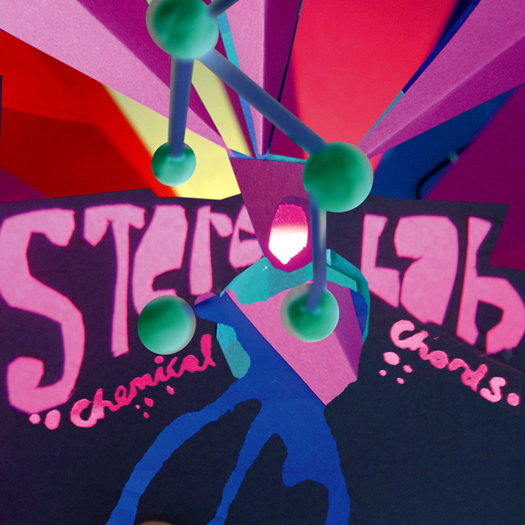
When “Valley Hi!” pops up roughly half way through Chemical Chords, Stereolab’s ninth studio album, the realization sinks in that on just about any new group’s new album the song would be a great achievement, a perfectly constructed pop song, fun, bouncy, a little sly even, with sexy lead vocals, effervescent harmonies, and tight but lush instrumentation. However, wedged into Stereolab’s nearly two-decade-long oeuvre, the song barely stands out, and that’s the problem. The band consistently delivers material like this, to the point that it all kinda sounds the same–a charge that’s been leveled at them by critics and fans alike for a few years now, starting more or less with 1999’s Cobra and Phases Group Play Voltage in the Milky Night, a record that some (maybe many) thought failed to live up to the radical revisionist pop tendencies of 1996’s Emperor Tomato Ketchup (it’s hard to top a perfect album, folks!) or the digital experiments of 1997’s Dots and Loops (my least favorite Stereolab album; sounds like marbles rolling on ice). I happen to like Cobra a lot: it’s warm (and literally fuzzy) and masterfully played–and kinda anonymous, a trend that Stereolab continues with Chemical Chords.
From the outset of the new album, Stereolab establishes a metronomic motortik pop vibe from which they rarely deviate. Opener “Neon Beanbag” flows into first single “Three Women” without much to differentiate the two besides a two second gap and a key change, and the third track, “One Finger Symphony,” only stands out due to its throwaway brevity. It isn’t until Sean O’Hagan’s slinky strings announce the title track that the album grabs onto something new. “Chemical Chords” approaches a ’70s blaxploitation vibe–think Curtis Mayfield or Bobby Womack here–but ends up being (you guessed it) just another Stereolab song, beautifully polished and meticulously executed with little or no risk to band or audience. The next track, “The Ecstatic Static” slides right into the same groove, and it becomes apparent that Stereolab have released yet another perfect ambient soundtrack for any polite social gathering. The rest of the album follows this mode of flawless and ultimately forgettable songwriting.
There are moments of exception, of course, but only moments. The countryfied swagger that initiates the penultimate track, “Daisy Click Clack,” is pretty great, if only for simply hitting a different rhythm and sound, and the song’s lyrics are about making music, which is always cool. It’s on “Pop Molecule (Molecular Pop 1),” where Stereolab employ backmasked drones and triumphant chugging guitars that recall the glory days of tracks like “Crest,” from ’93’s Transient Random-Noise Bursts with Announcements (or anything off of ’92’s dreampop singles collection, Switched On), that the band finally gets its hands a little dirty–with great results. Too bad they only play it out for about two minutes; the old groop would’ve droned those two chords for at least six–the listener doesn’t ever get a chance to get hypnotized.
It seems like I’m bashing the album, but I’m not. I love Stereolab. Really. And Chemical Chords is pretty good — it will hang out in my stereo for a month, maybe two, and then I’ll forget about it. Ultimately, it’s too polished, too precise, and too meticulous to make any long-term impact. We know Stereolab are fantastic arrangers and musicians, and their taste is impeccable, but when bands fail to take risks, the music gets stale.
Chemical Chords is available from 4AD Records in the US on August 19th.
A long long time ago, waaaaay back before all the cool kids had the internet, with its fancy bloggers and mp3s and hipster sites to tell them what bands were cool this week, we had to find out about indie music–which, at the time, simply meant music on independent labels, not some particular “sound”–in all sorts of arduous ways: from mixtapes handed down from someone’s older cousin, via thankyous and shoutouts in CD and tape liner notes, 120 Minutes (which meant being really drowsy on Monday), magazines like SPIN and Option, and, believe it or not, paper catalogs from labels like SST.
I had one of these paper catalogs from SST: they put them in the CDs and tapes that they sold. I think mine came from Sonic Youth’s Sister. That’s how I learned about Hüsker Dü and Bob Mould. I found New Day Rising on tape. This is easily one of the best “hardcore” records ever made–whatever that label means, I don’t know what it means, but some people call Hüsker Dü “hardcore” music–I don’t know. Sugar, Bob Mould’s other band, did some awesome stuff too.
Hang on, what was the point of all that stuff about the internet and record catalogs? I forget. Oh, yeah. Kids today have it too easy. Grrr. Arrgh.
Hüsker Dü covers The Byrd’s “Eight Miles High”:
37. J. Mascis
Speaking of SST guitar heroes…
I saw Dinosaur play a couple of years ago, the reunited version with Murph and Lou Barlow. They played at the House of Blues in Orlando, which is in this weird Disney-mall thing. I don’t know quite how to explain it. It was a Disneyfied downtown (although that also describes Orlando’s real downtown). I was pretty drunk and I couldn’t really get into. I really wanted them to play “In a Jar,” and they played it for like their third song, and that was kind of it for me. And then, when I went to the bathroom, there was a uniformed bathroom attendant, which was kind of depressing for me also. I mean, I just don’t think that’s very rock’n’roll. It didn’t bother me that J. Mascis looked like a really fat Edgar Winter.
38. Tim Gane
Most people don’t think of Stereolab as a guitar band. Actually, most people don’t think of Stereolab at all, probably. I really like Stereolab though. Tim Gane’s got this completely understated style, this mid-tone perfect rhythm that propels and leads the band. No solos.
39. Johnny Marr
Johnny Marr also has an understated style, and I really like that. His guitar lines for The Smiths were somehow melodic and rhythmic at the same time, and he always made room for Morrissey’s gorgeous voice and the killer rhythm section of Andy Rourke and Mike Joyce. And he was always careful to not rock too much.
40. Matt Friedberger
My love for Fiery Furnaces is well-documented on this site, so I won’t rant about their awesome albums and clever lyrics and seemingly unstoppable prolificness. I won’t! Matt’s guitar-playing has this squawky, nervous energy that resolves into moments of brief, assuaging beauty before going into more perfect awkwardness. Live, the man is a beast. He plays like Michael Jordan; id est, with his tongue hanging out.

 Biblioklept