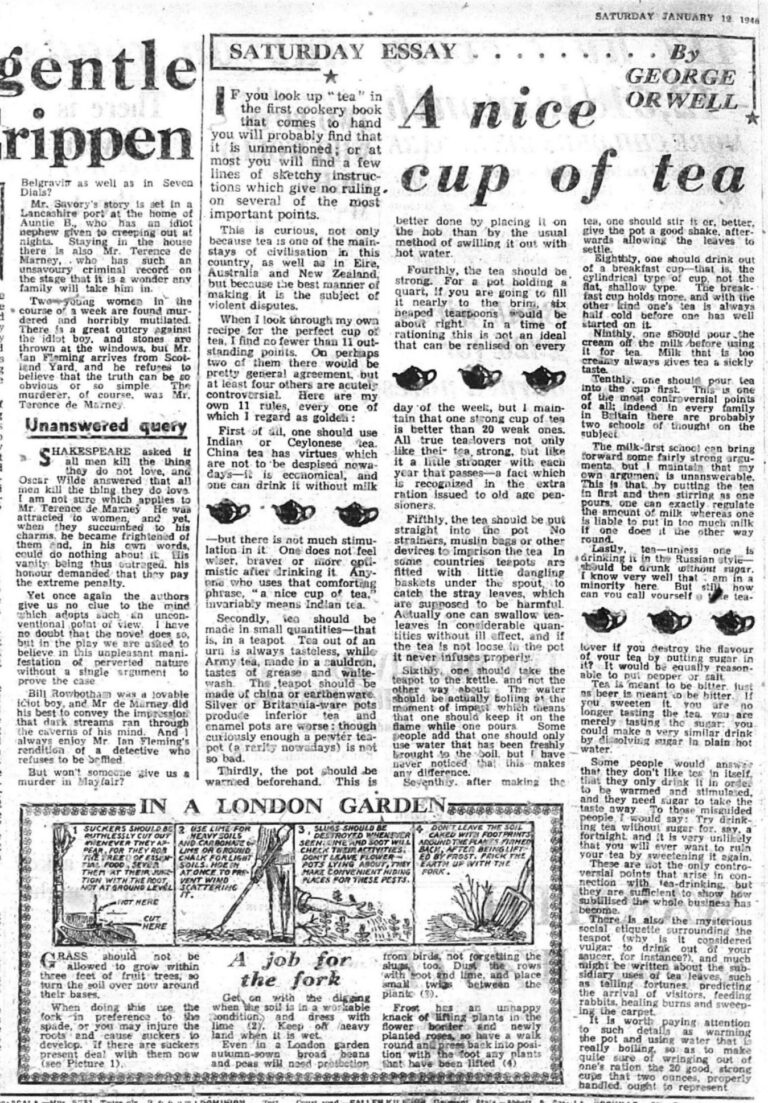
George Orwell’s Nice Cup of Tea

A Nice Cup of Tea
If you look up ‘tea’ in the first cookery book that comes to hand you will probably find that it is unmentioned; or at most you will find a few lines of sketchy instructions which give no ruling on several of the most important points.
This is curious, not only because tea is one of the main stays of civilisation in this country, as well as in Eire, Australia and New Zealand, but because the best manner of making it is the subject of violent disputes.
When I look through my own recipe for the perfect cup of tea, I find no fewer than eleven outstanding points. On perhaps two of them there would be pretty general agreement, but at least four others are acutely controversial. Here are my own eleven rules, every one of which I regard as golden:
First of all, one should use Indian or Ceylonese tea. China tea has virtues which are not to be despised nowadays — it is economical, and one can drink it without milk — but there is not much stimulation in it. One does not feel wiser, braver or more optimistic after drinking it. Anyone who has used that comforting phrase ‘a nice cup of tea’ invariably means Indian tea. Secondly, tea should be made in small quantities — that is, in a teapot. Tea out of an urn is always tasteless, while army tea, made in a cauldron, tastes of grease and whitewash. The teapot should be made of china or earthenware. Silver or Britanniaware teapots produce inferior tea and enamel pots are worse; though curiously enough a pewter teapot (a rarity nowadays) is not so bad.
Thirdly, the pot should be warmed beforehand. This is better done by placing it on the hob than by the usual method of swilling it out with hot water.
Fourthly, the tea should be strong. For a pot holding a quart, if you are going to fill it nearly to the brim, six heaped teaspoons would be about right. In a time of rationing, this is not an idea that can be realised on every day of the week, but I maintain that one strong cup of tea is better than twenty weak ones. All true tea lovers not only like their tea strong, but like it a little stronger with each year that passes — a fact which is recognised in the extra ration issued to old-age pensioners.
Fifthly, the tea should be put straight into the pot. No strainers, muslin bags or other devices to imprison the tea. In some countries teapots are fitted with little dangling baskets under the spout to catch the stray leaves, which are supposed to be harmful. Actually one can swallow tea-leaves in considerable quantities without ill effect, and if the tea is not loose in the pot it never infuses properly.
Sixthly, one should take the teapot to the kettle and not the other way about. The water should be actually boiling at the moment of impact, which means that one should keep it on the flame while one pours. Some people add that one should only use water that has been freshly brought to the boil, but I have never noticed that it makes any difference.
Seventhly, after making the tea, one should stir it, or better, give the pot a good shake, afterwards allowing the leaves to settle.
Eighthly, one should drink out of a good breakfast cup — that is, the cylindrical type of cup, not the flat, shallow type. The breakfast cup holds more, and with the other kind one’s tea is always half cold before one has well started on it.
Ninthly, one should pour the cream off the milk before using it for tea. Milk that is too creamy always gives tea a sickly taste.
Tenthly, one should pour tea into the cup first. This is one of the most controversial points of all; indeed in every family in Britain there are probably two schools of thought on the subject. The milk-first school can bring forward some fairly strong arguments, but I maintain that my own argument is unanswerable. This is that, by putting the tea in first and stirring as one pours, one can exactly regulate the amount of milk whereas one is liable to put in too much milk if one does it the other way round.
Lastly, tea — unless one is drinking it in the Russian style — should be drunk without sugar. I know very well that I am in a minority here. But still, how can you call yourself a true tea-lover if you destroy the flavour of your tea by putting sugar in it? It would be equally reasonable to put in pepper or salt. Tea is meant to be bitter, just as beer is meant to be bitter. If you sweeten it, you are no longer tasting the tea, you are merely tasting the sugar; you could make a very similar drink by dissolving sugar in plain hot water.
Some people would answer that they don’t like tea in itself, that they only drink it in order to be warmed and stimulated, and they need sugar to take the taste away. To those misguided people I would say: Try drinking tea without sugar for, say, a fortnight and it is very unlikely that you will ever want to ruin your tea by sweetening it again.
These are not the only controversial points to arise in connexion with tea drinking, but they are sufficient to show how subtilised the whole business has become. There is also the mysterious social etiquette surrounding the teapot (why is it considered vulgar to drink out of your saucer, for instance?) and much might be written about the subsidiary uses of tea leaves, such as telling fortunes, predicting the arrival of visitors, feeding rabbits, healing burns and sweeping the carpet. It is worth paying attention to such details as warming the pot and using water that is really boiling, so as to make quite sure of wringing out of one’s ration the twenty good, strong cups that two ounces, properly handled, ought to represent.

George Orwell’s recipe/method for a nice cup of tea was first published in the 12 Jan. 1946 issue of the Evening Standard. Image via the Orwell Society.

Taking Tea with Gordon Lish

Ready? I take my tea bag (or you take your teaspoon), one bag or one spoon for each five ounces of water, which is cold when I start and boiling up a rumpus before I pour, which I do, into a teapot that’s already hot, which condition of temperature is crucial.


So I pour furiously boiling water into good and hot teapot over bags or over loose tea or over bags or over tea bomb, slam top down, wrap entire business in dish towel, which is what I saw my mother do during the blizzard of ’46 and it made a tremendous impression on me, she being my mother and all. I understand some people are willing to buy a tea cosy—but, so far as I’m concerned, you’ve got to draw the line somewhere.


Anyhow, it sits for five minutes—you know, it steeps. If the waiting makes you edgy, go fold some paper bags. The next step is the last step, which is to hurry up and divide the product from its makings. Well, truth to tell, there is one more step—but that’s drinking it, drinking tea—which is a step I’m going to get around to, all in good time. When coffee scoots up over a sawbuck a can.

From Gordon Lish’s 1977 piece in The New York Times, “A Teaser on Tea, with a Footnote on Bags.” By way of context for that last line: the price of coffee soared in 1977 after a harsh freeze killed Brazilian crops. High coffee prices led to a coffee boycott. And tea drinking.

Coffee or tea? (Thomas Pynchon’s Mason & Dixon)

Mason is trying to wake up. The nearest coffee is in the cook-tent. “Pray you,” he whispers, “try not to be so damn’d,— did I say damn’d? I meant so fucking chirpy all the time, good chap, good chap,” stumbling out of the Tent trying to get his Hair into some kind of Queue. The Coffee is brew’d with the aid of a Fahrenheit’s Thermometer, unmark’d save at one place, exactly halfway between freezing and boiling, at 122°, where upon the Wood a small Arrow is inscrib’d, pointing at a Scratch across the glass Tube. ’Tis at this Temperature that the water receives the ground Coffee, the brew being stirr’d once or twice, the Pot remov’d from the fire, its Decoction then proceeding. Tho’ clarifying may make sense in London, out here ’tis a luxury, nor are there always Egg-shells to hand. If tasted early, Dixon has found, the fine suspended matter in the coffee lends it an undeniable rustick piquance. Later in the Pot, the Liquid charring itself toward Vileness appeals more to those looking for bodily stimuli,— like Dixon, who is able to sip the most degradedly awful pot’s-end poison and yet beam like an Idiot, “Mm-m m! Best Jamoke west o’ the Alleghenies!”— a phrase Overseer Barnes utters often, tho’ neither Surveyor quite understands it, especially as the Party are yet east of the Alleghenies. Howbeit, at this point in a Pot’s life-cycle, Mason prefers to switch over to Tea, when it is Dixon’s turn to begin shaking his head.

“Can’t understand how anyone abides that stuff.”

“How so?” Mason unable not to react.

“Well, it’s disgusting, isn’t it? Half-rotted Leaves, scalded with boiling Water and then left to lie, and soak, and bloat?”

“Disgusting? this is Tea, Friend, Cha,— what all tasteful London drinks,— that,” pollicating the Coffee-Pot, is what’s disgusting.”

“Au contraire,” Dixon replies, “Coffee is an art, where precision is all,— Water-Temperature, mean particle diameter, ratio of Coffee to Water or as we say, CTW, and dozens more Variables I’d mention, were they not so clearly out of thy technical Grasp,— ”

“How is it,” Mason pretending amiable curiosity, “that of each Pot of Coffee, only the first Cup is ever worth drinking,— and that, by the time I get to it, someone else has already drunk it?”

Dixon shrugs. “You must improve your Speed . . . ? As to the other, why aye, only the first Cup’s any good, owing to Coffee’s Sacramental nature, the Sacrament being Penance, entirely absent from thy sunlit World of Tay,— whereby the remainder of the Pot, often dozens of cups deep, represents the Price for enjoying that first perfect Cup.”

“Folly,” gapes Mason. “Why, ev’ry cup of Tea is perfect . . . ?”

“For what? curing hides?”

From chapter 48 of Thomas Pynchon’s novel Mason & Dixon.

Mystic Allegory or Tea — Maurice Denis

Morning Tea — Vladimir Makovsky

“Moral Effects of Tea-Tasting” (From Flann O’Brien’s At Swim-Two-Birds)

Moral Effects of Tea-Tasting.

The long-continued use of tea has a distinct effect upon the character. This has been too often noticed and remarked to be questioned. There are tea-sots in every great charitable institution – particularly those for the maintenance of the aged. Their symptoms are generally mental irritability, muscular tremors, and sleeplessness. The following is an account of one of the cases observed. The immediate effects upon him are as follows: In about ten minutes the face becomes flushed, the whole body feels warm and heated and a sort of intellectual intoxication comes on, much the same in character, it would seem, as that which occurs in the rarefied air of a mountain. He feels elated, exhilarated, troubles and cares vanish, everything seems bright and cheerful, his body feels light and elastic, his mind clear, his ideas abundant, vivid, and flowing fluently into words. At the end of an hour’s tasting a slight reaction begins to set in; some headache comes on, the face feels wrinkled and shrivelled, particularly about the eyes, which also get dark under the lids. At the end of two hours this reaction becomes firmly established, the flushed warm feeling has passed off, the hands and feet are cold, a nervous tremor comes on, accompanied with great mental depression. And he is now so excitable that every noise startles him; he is in a state of complete unrest; he can neither walk nor sit down, owing to his mental condition, and he settles into complete gloom. Copious and frequent urinations are always present, as also certain dyspeptic symptoms, such as eructations of wind, sour taste, and others. His mental condition is peculiar. He lives in a state of dread that some accident may happen to him; in the omnibus fears a collision; crossing the street, fears that he will be crushed by passing teams; walking on the sidewalks, fears that a sign may fall, or watches the eaves of houses, thinking that a brick may fall down and kill him; under the apprehension that every dog he meets is going to bite the calves of his legs, he carries an umbrella in all weathers as a defence against such an attack.

Conclusion of the foregoing.

From Flann O’Brien’s novel At Swim-Two-Birds.