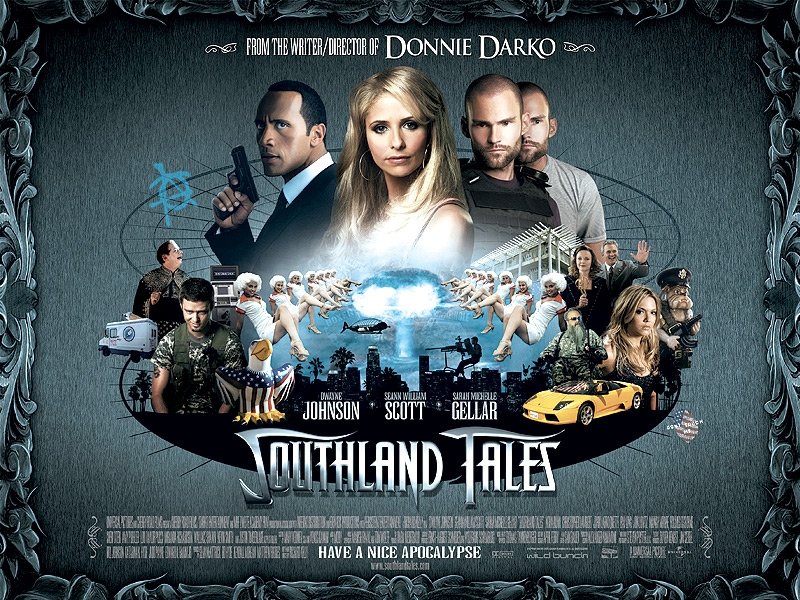
Southland Tales

Movies, Richard Kelly, Southland Tales, Confusion

OK. So. I’ve now aborted several attempts at properly reviewing Southland Tales so I figure I’ll just go for it. This might be a hack job; possibly one of the worst blogs I’ve ever written. In the spirit of Richard Kelly’s something-opus, I’ll do it anyway.

How much you love or hate (or are completely perplexed by) Southland Tales will rest on a number of factors:

How do you feel about overly-ambitious movies that sprawl in multiple directions? Are you OK with key plot lines not reaching resolution? Do you mind cartoonish violence and sophomoric humor mixed with biting satire? What about giant toilets? How would you feel about Dwayne “The Rock” Johnson relentlessly mugging for about 150 minutes? Would it bother you if thematic plot points hung on lines from poems by T.S. Eliot, Robert Frost, and lyrics from, uh, Perry Ferrell? Would you think that that was pretentious (or just plain dumb, perhaps)? Do you love to see ex-Saturday Night Live members in seemingly incongruous roles? What about watching a movie made a couple of years ago that intended to satirize the (then) near future, only the movie had major troubles getting distributed so when it finally got a national release the future it was satirizing was, like, now? How much did you love Donnie Darko (that won’t make a difference, actually…)? Can’t get enough Sarah Michelle Gellar? Are you OK with watching a movie that, like the original Star Wars trilogy, begins at part IV? How do you feel about Justin Timberlake? What about a “tell-don’t-show” voiceover courtesy of said JT? What about a soundtrack by Moby? SUVs humping? Are these fair questions? Is it fair to frame a movie review in a series of questions? No? Really?

OK. So. Now. How about this:

Philip K. Dick, crime noir, Neo-Marxism, Apocalypse Now, Natural Born Killers, David Lynch, Repo Man, comic books, Strange Days, Wim Wenders, psychotropic paranoia, Terry Gilliam, MAD magazine, epic confusion, Spring Break apocalypse, the Revelation to John, Disneyworld on acid, strange loops, Stanley Kubrick, bogus quantum theory, Los Angeles, nightmare comedy soap opera…

No? Just listing a bunch of references doesn’t qualify as decent critical appraisal? How about this, then:

–or this–

Wow. I was probably better off just not reviewing the damn thing. I want to see it again, like six or seven times, before deciding if I hate it or love it (my wife hated the parts that she didn’t sleep through, by the by. But she sleeps through about 75% of the movies we watch). Actually, after it was over, I immediately watched the whole last half hour again. Maybe you should just go here and read a bunch of real reviews of this movie. Or, better yet, just see it.

No Country for Old Men Reconsidered

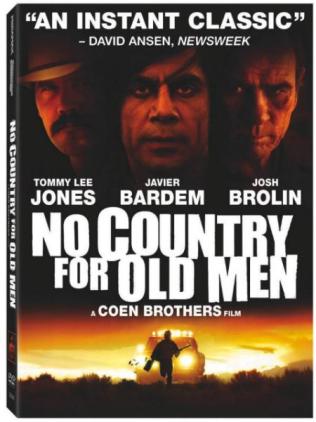
nocountryboxart.jpg

On my Superlatives list at the end of last year, I awarded No Country for Old Men “Most Disappointing Film of 2007.” Here’s what I wrote:

Although it was by no means bad, I was disappointed in the Coen’s adaptation of Cormac McCarthy’s No Country for Old Men. It was a good movie–Javier Badem was fantastic, great pacing and tone–but still it didn’t blow me away like, say, Fargo or Blood Simple or Miller’s Crossing did. Ditto Werner Herzog’s Rescue Dawn. Chalk it up to hyperbolic expectations, I guess. Maybe I need to watch these films again on DVD and reconsider.

Ok. So. I went back and watched No Country on DVD this weekend. One of my criteria for a great film is that it has to be great without the transfixing power of a huge screen and roaring sound system. The Lord of the Rings movies, for example, suffer greatly on TV; the epic magnitude is diminished, and you realize just how much the movies relied on the the modern movie screen. I still like them though. I just don’t think they work too well on small screens (god forbid you watch them on a phone). So how does No Country hold up?

I don’t think it fairs any worse, but I still have to argue that this movie is incredibly overrated. I’d read the book (listened to the audiobook, actually) before I’d seen the film the first time, and watching it again I was doubly-prepared for the film’s decidedly non-Hollywood ending (and non-Hollywood climax, to boot).

Oh, by the way, a few SPOILERS ARE COMING UP. Fair warning, right?

Ok. When I initially saw the film, many of the people of the audience were disappointed and angered at the end of the movie, including my mom’s cousin, a man in his sixties from South Carolina. My uncle zoned out at the end, during Tommy Lee Jones’s last speech. When the movie ended and we walked out of the theater, he asked me to explain what happened. He’d missed the end. Three young men overheard, came up, and started asking me questions– “Did that guy [Llewellyn Moss] die?” etc. My mom’s cousin summed up the way a lot of people probably felt about the end of this movie– “I didn’t like it that the bad guy got away and the good guy died. Why didn’t the Sheriff go get him?” That the film is deeply dissatisfying to our collective sense of justice is kind of a thematic point, and that’s not what bothers me about No Country–although I understand why it would bother many audience members.

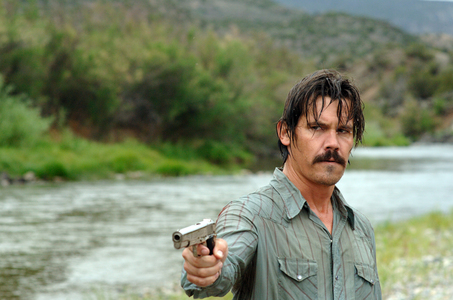
chigurh.jpg

The film omits the two scenes we ache to see–the initial massacre that sets events in motion, and the death of Llewellyn Moss. We barely get to identify Llewellyn’s body, in fact. The substitutions for these elisions all involve Anton Chigurh, who pretty much steals the show. His murder of a deputy at the beginning of the film enacts a sacrificial slaughter, a substitution for the greater violence of the drug massacre that we don’t witness. He murders Carson Wells, a silly and ultimately trivial character whose sense of self-importance is quickly put under erasure. Finally, he kills Carla Jean Moss, before becoming the victim of a random violent car accident. An accident–not a just punishment for the atrocities he’s committed. Despite the severe accident, Chigurh is able to get up and walk away; presumably, he will continue to wreak havoc. Before Chigurh leaves the screen he turns two boys against each other. They squabble over a bloodied piece of money, recapitulating the larger theme of the movie–an echo of Fargo–that greed is destructive. The message is not overstated, but plain nonetheless. So what’s wrong with this film? Nothing, really. It’s just not as good–and certainly not as profound–as everyone makes it out to be.

In the book, the third act rests mostly on the “old men”–Tommy Lee Jones’s Sheriff Ed Tom Bell, a fellow sheriff, and Ellis, Ed Tom’s uncle. The film omits much of the book here, including a scene where Ed Tom visits another “old man”–Llewellyn’s father. The film also omits a key story from Ed Tom’s past, an act of cowardice in war. The Coens were right to leave much of this stuff out–there are too many monologues from Ed Tom as it is. Still, the titular point of the book becomes eclipsed, subsumed into Chigurh’s violence. Chigurh is a “new man,” part of what Ed Tom perceives as a new direction in our country–a violent and impersonal world he doesn’t belong in. Ed Tom fails to realize that the country was founded and maintained in many ways via impersonal violence, despite the fact that his own past–as well as the past of his family–is entrenched in this violence. His real problem is with the lack of clear, absolute morality, pure right and wrong, good and evil, an attitude best summed up with his assertion that once people quit saying “Ma’am and Sir,” everything else goes to hell. He brushes off Ellis when the old man tells him that the country has always been violent and difficult. The movie ends the same as the novel, with Ed Tom relating two dreams he had about his father.

large_0288_2326.jpg

The film ultimately fails to relate the depth of the novel, opting instead for a competent depiction of the surface tensions at work. The Coens accurately captures the “men doing stuff” aspect of McCormac’s writing without getting to any of the meaning behind it all. And that’s fine. The movie’s fine. It’s just not as great as everyone is pretending it is. Perhaps we’re all just so happy that the Coens have stepped up from their previous lightweight projects–The Ladykillers and Intolerable Cruelty–that we feel the need to fawn all over No Country. Or maybe I’m wrong–maybe this is a profound thriller, a truly excellent movie; maybe this is the Coens’ masterpiece. But I think not.

His Dark Materials Trilogy — Philip Pullman

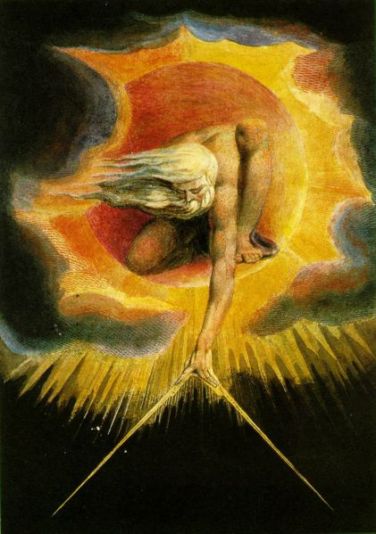
421px-blake_ancient_of_days.jpg
William Blake, “Ancient of Days”

Over the past three weeks, I read, and, alternately listened to, Philip Pullman’s fantastic His Dark Materials trilogy–The Golden Compass, The Subtle Knife, and The Amber Spyglass. Here’s the short review:

If it’s necessary to critically situate and compare a fantasy or sci-fi series against precursor series–namely, The Lord of the Rings, The Chronicles of Narnia, The Chronicles of Prydain, Harry Potter, etc.–and I don’t think it is necessary to critically situate and compare a fantasy or sci-fi series against its precursors, but that’s generally how these things are done–(this is turning into a monster of a “short review”)–but if it is necessary to critically situate and compare a fantasy or sci-fi series against precursor series, I think that Pullman’s His Dark Materials must be considered a new classic, an instantly-canonizable contribution to children’s literature, imaginative fiction, sci-fi, fantasy, or whatever genre you want to affix to these marvelous books.

His Dark Materials follows Lyra and Will, two children from different worlds (literally) who must work together to repair a damaged multiverse. Lyra comes from a world where people travel side by side with their daemons, spirit-images of their souls who take animal shapes. Will is an outsider in “our” world, a young fatherless boy who must take care of his mentally ill mother. The novels, in their simplest sense, detail the coming of age of these two as the traverse multiple parallel universes. In the backdrop there are witches and zeppelins, armored bears and dark specters, a compass that can point to the truth and a knife that can open all worlds, angels and scientists, and Lyra’s cruel and terrible parents, the cunning Mrs. Coulter, and Lord Asriel, whose will to kill God–The Authority–precipitates the action of the narrative.

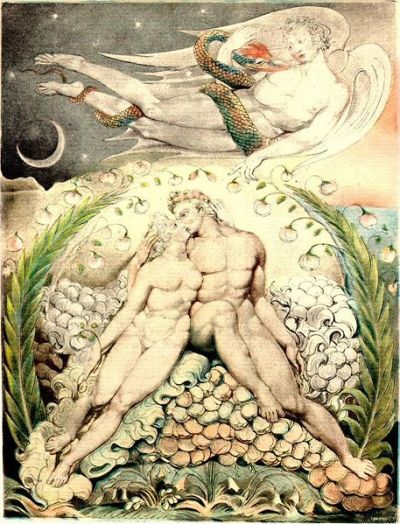
blake_satan_adam_eve.jpg
William Blake, “Satan Watching the Caress of Adam and Eve”

As many critics have pointed out, His Dark Materials recapitulates Milton’s Paradise Lost (the series takes its name from a line from that epic poem). However, the series really reinterprets the British Romantics’ assessment of Paradise Lost. Pullman engages a host of Romantic writers, foregrounding Keats’s idea of negative capability, and prefacing many of the chapters with quotes from Romantic poetry. In particular, Pullman cites William Blake. Indeed, it seems to me that His Dark Materials effectively synthesizes many of Blake’s poems and ideas, The Marriage of Heaven and Hell and Songs of Innocence and of Experience in particular. The novel also engages a number of Nietzsche’s ideas, and even, I believe, alludes to several concepts of Derrida’s (in particular, the idea of the gift of death). Additionally, Pullman weaves in the many-worlds theory, extended discussions of evolutionary anthropology, rampant infanticide, and auto-trepanation. Good stuff.

When the film of The Golden Compass (I didn’t see it) came out last year, it ignited a small controversy about the books. According to the Baptist Press, Pullman presents “a fantasy universe where witches are good, the church is bad, and at the end of it all, God dies.” This really isn’t the case, if you want to go with a precise reading of Pullman’s actual words, but, consider the source. I’m sure the controversy is healthy for Pullman’s sales; it certainly piqued my interest in the book, and I’m guessing that there are plenty of kids who, once their private Christian schools banned the books, couldn’t wait to get their hands on the verboten goods. And that’s a good thing.

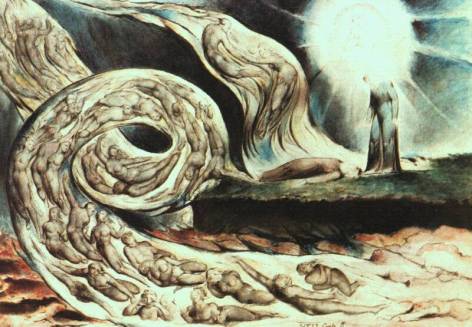
blake2.jpg
William Blake, “Whirlwind of Lovers”

His Dark Materials meets and surpasses my notions of good fantasy/sci-fi/imaginative fiction: the books engage multiple complex ideas in a new and often unsettling way. Unlike the Harry Potter series, which simply operates within familiar, preexisting archetypes of fantasy, Pullman’s work consistently disrupts reader expectations, pushing set ideas about religion and science, art and fantasy into new and fantastic places. Ultimately, although many will seek to suppress this book as an “amoral” work, His Dark Materials proposes a very real set of ethics inscribed in a world of moral relativity. The characters grow up and make good, selfless choices, decisions they make independent of absolute moral authority.

I very highly recommend these books.

50 Great Guitarists, All Better Than Slash (In No Particular Order)–Part VIII

36. Bob Mould

A long long time ago, waaaaay back before all the cool kids had the internet, with its fancy bloggers and mp3s and hipster sites to tell them what bands were cool this week, we had to find out about indie music–which, at the time, simply meant music on independent labels, not some particular “sound”–in all sorts of arduous ways: from mixtapes handed down from someone’s older cousin, via thankyous and shoutouts in CD and tape liner notes, 120 Minutes (which meant being really drowsy on Monday), magazines like SPIN and Option, and, believe it or not, paper catalogs from labels like SST.

I had one of these paper catalogs from SST: they put them in the CDs and tapes that they sold. I think mine came from Sonic Youth’s Sister. That’s how I learned about Hüsker Dü and Bob Mould. I found New Day Rising on tape. This is easily one of the best “hardcore” records ever made–whatever that label means, I don’t know what it means, but some people call Hüsker Dü “hardcore” music–I don’t know. Sugar, Bob Mould’s other band, did some awesome stuff too.

Hang on, what was the point of all that stuff about the internet and record catalogs? I forget. Oh, yeah. Kids today have it too easy. Grrr. Arrgh.

Hüsker Dü covers The Byrd’s “Eight Miles High”:

37. J. Mascis

Speaking of SST guitar heroes…

I saw Dinosaur play a couple of years ago, the reunited version with Murph and Lou Barlow. They played at the House of Blues in Orlando, which is in this weird Disney-mall thing. I don’t know quite how to explain it. It was a Disneyfied downtown (although that also describes Orlando’s real downtown). I was pretty drunk and I couldn’t really get into. I really wanted them to play “In a Jar,” and they played it for like their third song, and that was kind of it for me. And then, when I went to the bathroom, there was a uniformed bathroom attendant, which was kind of depressing for me also. I mean, I just don’t think that’s very rock’n’roll. It didn’t bother me that J. Mascis looked like a really fat Edgar Winter.

38. Tim Gane

Most people don’t think of Stereolab as a guitar band. Actually, most people don’t think of Stereolab at all, probably. I really like Stereolab though. Tim Gane’s got this completely understated style, this mid-tone perfect rhythm that propels and leads the band. No solos.

39. Johnny Marr

Johnny Marr also has an understated style, and I really like that. His guitar lines for The Smiths were somehow melodic and rhythmic at the same time, and he always made room for Morrissey’s gorgeous voice and the killer rhythm section of Andy Rourke and Mike Joyce. And he was always careful to not rock too much.

40. Matt Friedberger

My love for Fiery Furnaces is well-documented on this site, so I won’t rant about their awesome albums and clever lyrics and seemingly unstoppable prolificness. I won’t! Matt’s guitar-playing has this squawky, nervous energy that resolves into moments of brief, assuaging beauty before going into more perfect awkwardness. Live, the man is a beast. He plays like Michael Jordan; id est, with his tongue hanging out.

The Art of Modern Memory

From conscientious reader Dave C. ((very) minor editorial changes by the Biblioklept):

“The NY Times posted an article about an author who was outed as a fraud for writing a memoir about her life as a half-Native American, half-white gangbanger from South Central Los Angeles who escaped to the University of Oregon when she was really just an activist who at one point worked with gangs and created the characters in her memoir based on real people she had met in her real/fake life.The Times actually reviewed the book just last week and praised it.

I’ve just been pissed ever since that James Frey controversy about the idea that a supposed memoir has to be true. Does the fact that she made up portions of this book make her accomplishment any less significant? Isn’t a moving work of fiction a greater accomplishment than a moving autobiography? Are people really so concerned with whether someone actually did something that they are willing to ignore a touching, well-written narrative?

That James Frey novel, what I’ve read of it, was a tad overcooked, but about 10 people told me I had to read it because it was sooooo good. After Oprah (who made a gazillion dollars promoting his work) sold him down the river, he became a literary pariah.

Is the phrase “based on a true story” important in the appreciation of a story at all?”

I wrote a blog a few weeks ago about a few run-ins I had at an AP workshop, specifically related to teaching the canon. Anyway, that aside, during that workshop, this question came up. The mediator/instructor had the room show, by hands, their opinion on the issue. It was roughly a 70-30 split, with the majority favoring “authenticity” in their memoirs. I was, of course, in the minority.

Like Dave, I was steamed over the James Frey thing, not because I cared about the book–it looked like trash, frankly–but because he became a strange acid test for what America now thinks it needs from a memoir.

If we start from the assumption that genres impose a functional structure that inheres within the reading of a book, we’ve already made a strange, silly, and ultimately illusory set of distinctions to guide our reading. All one has to do is look at the travel literature of the sixteenth century or a science text book from the 1920s to see how quickly “validity” melts under context.

But even if we grant that genre has a meaningful or necessary purpose, and we work from this assumption, I think it’s a huge mistake to believe that “memoir” is the same as “nonfiction.” There are several simple reasons for this.

For one, to tell an effective and affecting story requires a manipulation of events–editing, hyperbole, recoloring, touch-ups, and so on. Events in life don’t necessarily unfold in a “readable” way. And I think that many, if not most readers go into a memoir understanding that the tale they read may be compressed or somehow aestheticized.

But I think a more fundamental reason that memoir shouldn’t be held to the strictest ideals of verity follows from the simple fact that memory is in no way perfect, absolute, or unchanging. We cannot perfectly record our memories, nor do they stay stable to us. Memories are always volatile, swirling; we forge our identity in every moment by reinterpreting and reimagining our past.

Any memoirist must literally reimagine their memories in order to write, and if they choose not to reimagine, but to instead imagine (invent and create) memories, what does it say about our expectations and needs as readers to judge their writing based solely on adherence to structural genre?

In the preface to Dave Eggers’s What is the What, Valentino Achak Deng foregrounds these problems. He says that the book–his “autobiography,” written by Dave Eggers (and hence not his autobiography)–must be considered a novel, as he was very, very young when many of the events recorded in the book happened. Similarly, Eggers’s own memoir, A Heartbreaking Work of Staggering Genius, repeatedly references its own flights of fiction, acknowledges its own need to invent a new imagined version of memories that never happened in order to better explain what really did happen. The Autobiography of Malcolm X was written by Alex Haley; The Interesting Narrative of Olaudah Equiano is rife with distortions, inaccuracies and completely fabricated events; in crafting A Portrait of the Artist as a Young Man–which may or may not be a memoir (although it is certainly a book…)–James Joyce wholly lifted entire passages of contemporary religious tracts.

James Weldon Johnson’s novel, The Autobiography of an Ex-Colored Man, illustrates how easily notions of genre–just like notions of race and stable identity–can be deconstructed. Johnson anonymously published the “autobiography” in 1912, and it was received as the true life story of an extraordinary “Negro” who shockingly was able to “pass” as a white man, to the extent that he (gasp!) married a white woman and became a major property owner. The book initiated a minor racial panic, causing some critics to insist that it must be fake because no black man could effectively “pass” as the unnamed narrator claimed to do. JWJ’s deconstruction of race and identity could not have worked in the same way had he presented it within the limits of a “true” memoir. It took fiction (masquerading as fact) to reveal a more profound reality.

A good writer makes stuff up and writes it down in a way that makes us want to read it and not put it down and keep reading it until we’ve read it all and want to read it again. If finding out the circumstances of the writing of the book do not match a set of expectations we had going into reading the book, we need to re-evaluate those expectations.

A Diddy in the Sun

I teach four sections of 11th grade AP English Language and Composition; I’m really hard on these kids. I also teach one section of 10th graders. I see these kids dark and early every morning, and I’m not very hard on them. It’s impossible to be, really. They–and I–are still sort of asleep. So, even though the FCAT is but a week away, when one assertive young lady in the class thought to tape record the new TV movie version of A Raisin in the Sun and bring it in, I agreed to let them watch it. After all, we’d read the play in class back in November, and watched the entire 1989 filmed stage production starring Danny Glover, as well as parts of the 1961 version starring Danny Glover.

glover.jpg

I’ve been using Lorraine Hansberry’s play in the classroom for years, with great success, I might add–the themes of race, economics, integration, assimilation, acculturation, generational change, and women’s rights continue to be as vital and thought-provoking as when the play was first produced a half-century ago. Which is why the early aughties revival starring Sean “Puff Daddy P-Diddy, No, Just Diddy (Diddy Dumb Diddy Do)” Combs seemed like a great idea. It was met with good reviews and ran to 88 performances. I know this play inside and out, and was excited to see a new version of it.

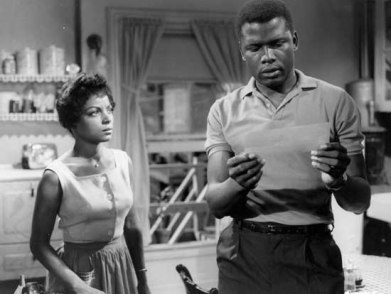
It was awful. Just plain awful. I can only hope that most of the people who saw it last week had some previous exposure. The depth of inter-generational conflict of Hansberry’s original text is drained of all energy and force, leaving only a weak trace of sappy melodrama. Both Poitier and Glover carried their versions, exploring the role of Walter Lee, a man whose dreams and ambitions are outmatched by the limited station thrust upon him. Walter Lee, properly, must be a man-child animal, lean and angry, a volcano ready to explode in rage and desperation. Walter Lee’s transformation into an adult man is painful; it almost undoes his family, metonymized neatly in the abortion his wife plans to have. Diddy, however, turns in one of the laziest one-note performances I’ve ever seen. He relies on every hackneyed trope of melodrama as a substitution for really emoting his part. In short, it’s impossible to believe that he’s Walter Lee. He’s just Diddy casually pretending to be Walter Lee. And the producers and director seem to know this. Whereas Walter Lee at least punctuates each scene of ARITS–and usually is at the forefront of catalytic action–the 2008 version reduces the scope of Diddy’s screen time, even omitting the famous “flaming spear” scene (my students were appalled at this elision–they determined that Diddy wouldn’t want to appear foolish). Furthermore, every single scene with Puffy Daddy (yes, I kept track) relies on the most saccharine of music to make sure the audience knows how to feel.


diddy.jpg

It’s left then to a chubbyish Phylicia Rashad to carry the movie, and while she’s a great actress, her Mama Younger is far too keenly self-aware. She’s simply not Hansberry’s Mama; instead, she’s Rashad’s late aughties update on what Rashad thinks a strong black woman should be. The original Mama’s ideology is defined (perhaps even limited) by the Great Migration; ARITS is largely the story of this mentality clashing with the artistic, educational, and economic aspirations inherent in the Civil Rights movement. Rashad’s Mama is never confused or even especially distraught over this changing ideology, and even some of the original lines that show her distress are cut. It just doesn’t work.

Maybe I gripe too much–my kids enjoyed it on the whole, but conceded that it wasn’t nearly as good as Glover’s take. I have to admit that I liked John “Uncle Jessie” Stamos as Mr. Lindner. He brought a silly unself-conscious humor to the role that exposed the inherent conflict of the original character: a guy whose actions are incredibly racist who can at no point recognize this racism because it’s so indelibly entrenched within him.

Still, if you’ve never seen the play before, I recommend going to the Danny Glover version, or at least the Poitier “classic.” Our inaugural post was about A Raisin in the Sun.

poitier.jpg