
The following selection is from William S. Burroughs’s “Hieroglyphic Silence,” collected in the totally out-of-print volume The Third Mind, a book of cut-ups Burroughs co-authored with Brion Gysin (you can access the book here via extralegal means). From “Hieroglyphic Silence”–
“I am the Egyptian,” he said, looking all flat and silly, and I said: “Really, Bradford, don’t be tiresome.”
All right, let’s put it apple-pie simple with a picture of a wedge of apple pie there, containing fifty-three grams of carbohydrates.(See the L-C diet.)
Well now, if you don’t know the word for apple pie where you happen to be and want it, you can point to it or you can draw it. So, when and why do you need a word for it? When and why do you need to say, I want apple pie, if you just don’t care how fat you get?
You need to say it when it isn’t there to point to and when you don’t have your drawing tools handy\ In short, words become necessary when the object they refer to is not there.
No matter what the spoken language may be, you can read hieroglyphs, a picture of a chair or what have you; makes no difference what you call it, right? You don’t need subvocal speech to register the meaning of hieroglyphs. Learning a hieroglyphic language is excellent practice in the lost art of inner silence. “It would be well, today, if children were taught a good many Chinese ideograms and Egyptian hieroglyphs as a means of enhancing their appreciation of our alphabet.” If you are able to look at what is in front of you in silence, you will be able to write about it from a more perceptive viewpoint.
What keeps you from seeing what is in front of you? Words for what is in front of you, which are not what is there. As Korzybski pointed out: whatever a chair may be, it is not a “chair.” That is,it is not the label “chair.”So, now try this: pick up your Easy Lessons in Egyptian Hieroglyphics, by Sir E. A. Wallis Budge, and copy out the following phrases:
p. 104; They fall down upon face their in land their own.
p. 173; Stood the prince alone in the presence of the gods.
p. 181; The lock of hair which was in.
p. 79; the wind
p. 202; Giver of winds is its name.
p. 190; coming forth waiting for thee from of old
p. 200; night that of the destruction of the enemies
p. 208; come thou to us not having thy memories of evil come thou in thy form
p. 103; In the writing of the god himself he writeth for thee the book of breathings with his fingers his own.
p. 195; Shall it be that thou wilt be silent about it.
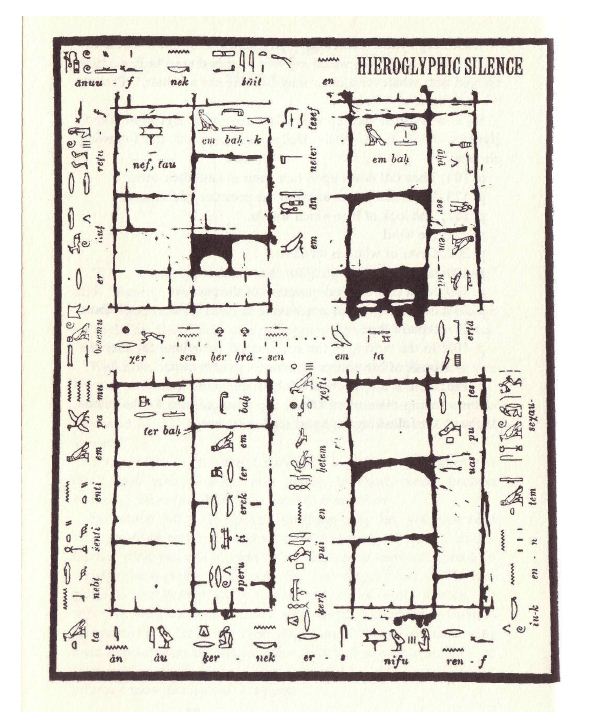
Now, having memorized the above passage, turn to the hieroglyphs on the following page and read in silence.



 Biblioklept