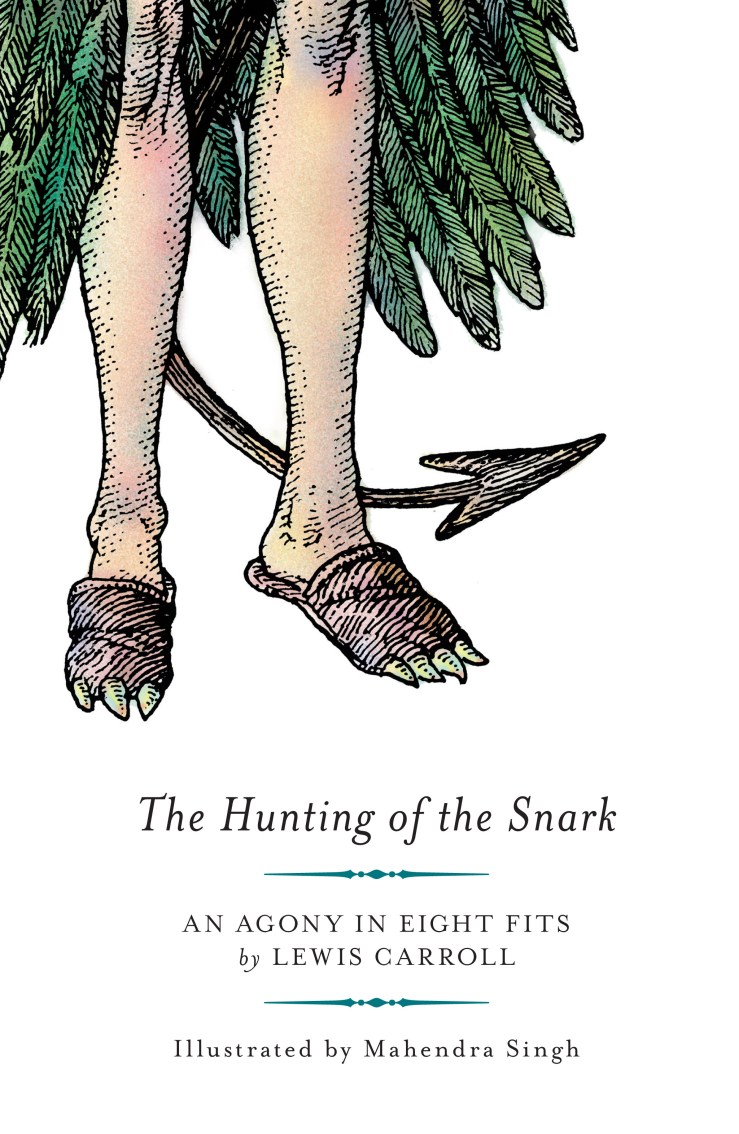
 I scrapped my first two drafts for a review of Melville House’s new edition of Lewis Carroll’s The Hunting of the Snark. The problem was that I was struggling to figure out Carroll’s Nonsense poem (subtitled An Agony in Eight Fits) about a ten man crew who take to the sea, to, you know, hunt a Snark. The Bellman seems to lead them. There’s the Banker, Baker, and other guys whose names start with “b” — including enemies the Beaver and the Butcher (who wind up tight allies). The poem is both silly and dense, rippling with weird wordplay and allusions that are, for the most part, beyond me. It’s often hard to follow, and sometimes has the effect of making the reader (or at least this reader) feel like he’s skating on the surface of some deeper profundities — or, alternately, maybe it’s just Nonsense, to use Carroll’s term.
Anyway. I solve my dilemma by retreating to the real occasion for reviewing the book, namely Mahendra Singh’s marvelous and strange illustrations. Singh, a member of the Lewis Carroll Society of North America (and an editor of their journal, Knight Letter), describes his illustrated version as “fitting Lewis Carroll into a proto-Surrealist straitjacket with matching Dada cufflinks.” In both its imagery and heavy, dark lines, Singh’s project readily recalls one of my favorite books, Max Ernst’s proto-graphic novel, Une Semaine de Bonté, as well as Henry Holiday’s original illustrations for the book. Singh lards his illustrations with visual paradoxes, puzzles, and puns, as well as references to artists ranging from de Chirico and Magritte to Dali and Bosch. There are also nods to pop culture (including the Beatles). And Freud, because, hey, why not. Observe–

Singh’s puzzles, like Lewis’s, do not immediately reveal their meaning, but of course this is part of the joy of the book. In his instructive afterword, Singh tells us that “each drawing should make some sort of sense of the verse it explains or at least, make Nonsense.” His greater goal though seems to be to share his love of Carroll with his readers (“in particular the younger ones”), who he hopes will “further pursue on their own that immense cultural heritage which silently — and so faithfully — awaits them.” My three year old daughter enjoyed the book very much, and had the good sense (Nonsense?) not to get too flummoxed over what Snark means. This is probably a wise course to follow. As Singh observes in his afterword, “whenever Carroll was asked what the poem meant, he always replied that he did not know. “Of course, just because its creator didn’t know its meaning (or at least claimed not to) doesn’t mean that Snark doesn’t have meaning–it’s just the kind of ambiguous meaning that floats around on dream logic, and Singh’s surrealism, with its playful, amorphous shifts, is the right choice to illustrate the poem. I’m not sure if “illustrate” is the right verb here, though. Certainly these are illustrations, but Singh’s goal isn’t so much to literally render Lewis’s words in pictures as it is to echo their spirit. Singh’s art works in tandem with the poem, accompanying it through symbolic and metaphorical transfers, arriving at times to weird conjunctions and discordances, and, perhaps, generating new meanings. Recommended.
The Hunting of the Snark is new in hardback this month from Melville House. More at Singh’s blog.


 Biblioklept