Granddad’s Eggnog

Hopefully everyone is happy and with loved ones and friends during these holidays–and what better way to show love and fellowship than sharing a draught of delicious eggnog (alternately, the sad and solitary can drown their lonely sorrows in this high-alcohol, high-calorie treat). This is an old recipe; I remember my cousin and I stealing sips of this nog during my grandparents’ Christmas parties.

You will need:

A bottle of fine bourbon

A bottle of fine rum

A liqueur of your choice (this is optional; coffee, cream, or amaretto all add a nice touch)

A gallon of vanilla ice cream (substitute frozen yoghurt if you’re concerned about calories)

A carton of store-bought eggnog (alternately, you can make your own eggnog from eggs, milk, and sugar, although it’s a genuine pain in the ass and no one will ever know the difference, unless you go around pointing it out to them, which will make you look like an asshole, and you don’t want to look like an asshole, do you?)

Nutmeg, cinnamon, mace, clove (Use whole spices! Any of your favorite holiday spices will do, but I consider these four essential)

To make a one gallon pitcher of eggnog:

Put about 6 cups of ice cream in the pitcher. Add some cinnamon sticks and cloves; grate some nutmeg and mace into the pitcher. Add 4 cups of the store-bought eggnog, stir mixture. Add about 3 and 1/2 cups of bourbon, 1 1/2 cups of rum, and liqueur (about 1/2 a cup will do) to taste; add more spices. Stir vigorously; cover and allow to set in the freezer for at least 12 hours before serving. Stir vigorously before serving.

To make your guests happy, I suggest serving the nog with both liquor and ice cream at hand; this way those inclined may add either as their taste dictates. (Note for heavy drinkers: if your intention is to get smashed, stop drinking the eggnog after two cups and begin drinking the bourbon straight! The high levels of cream and sugar in this nog will almost guarantee a hangover–don’t overdo it!)
 

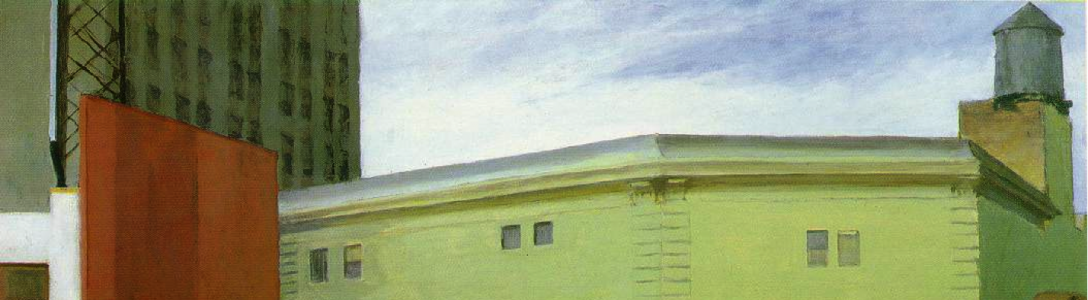
“Christmas Trees” — Robert Frost

“Christmas Trees” by Robert Frost–

A Christmas Circular Letter

The city had withdrawn into itself
And left at last the country to the country;
When between whirls of snow not come to lie
And whirls of foliage not yet laid, there drove
A stranger to our yard, who looked the city,
Yet did in country fashion in that there
He sat and waited till he drew us out
A-buttoning coats to ask him who he was.
He proved to be the city come again
To look for something it had left behind
And could not do without and keep its Christmas.
He asked if I would sell my Christmas trees;
My woods—the young fir balsams like a place
Where houses all are churches and have spires.
I hadn’t thought of them as Christmas Trees.
I doubt if I was tempted for a moment
To sell them off their feet to go in cars
And leave the slope behind the house all bare,
Where the sun shines now no warmer than the moon.
I’d hate to have them know it if I was.
Yet more I’d hate to hold my trees except
As others hold theirs or refuse for them,
Beyond the time of profitable growth,
The trial by market everything must come to.
I dallied so much with the thought of selling.
Then whether from mistaken courtesy
And fear of seeming short of speech, or whether
From hope of hearing good of what was mine,
I said, “There aren’t enough to be worth while.”
“I could soon tell how many they would cut,
You let me look them over.”

“You could look.
But don’t expect I’m going to let you have them.”
Pasture they spring in, some in clumps too close
That lop each other of boughs, but not a few
Quite solitary and having equal boughs
All round and round. The latter he nodded “Yes” to,
Or paused to say beneath some lovelier one,
With a buyer’s moderation, “That would do.”
I thought so too, but wasn’t there to say so.
We climbed the pasture on the south, crossed over,
And came down on the north.
He said, “A thousand.”

“A thousand Christmas trees!—at what apiece?”

He felt some need of softening that to me:
“A thousand trees would come to thirty dollars.”

Then I was certain I had never meant
To let him have them. Never show surprise!
But thirty dollars seemed so small beside
The extent of pasture I should strip, three cents
(For that was all they figured out apiece),
Three cents so small beside the dollar friends
I should be writing to within the hour
Would pay in cities for good trees like those,
Regular vestry-trees whole Sunday Schools
Could hang enough on to pick off enough.
A thousand Christmas trees I didn’t know I had!
Worth three cents more to give away than sell,
As may be shown by a simple calculation.
Too bad I couldn’t lay one in a letter.
I can’t help wishing I could send you one,
In wishing you herewith a Merry Christmas.


Heroes of 2010 — Bill Murray

Sure, Bill Murray didn’t make a movie this year (not a big one anyway), and sure, he’s a hero any year, but we loved his interview with GQ this summer. From the interview–

Okay. Well, how about Garfield? Can you explain that to me? Did you just do it for the dough?

No! I didn’t make that for the dough! Well, not completely. I thought it would be kind of fun, because doing a voice is challenging, and I’d never done that. Plus, I looked at the script, and it said, “So-and-so and Joel Coen.” And I thought: Christ, well, I love those Coens! They’re funny. So I sorta read a few pages of it and thought, Yeah, I’d like to do that. I had these agents at the time, and I said, “What do they give you to do one of these things?” And they said, “Oh, they give you $50,000.” So I said, “Okay, well, I don’t even leave the fuckin’ driveway for that kind of money.”

Bill Murray also did this in 2010–

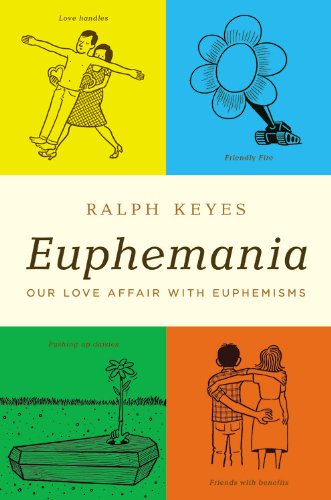
Euphemania — Ralph Keyes


In his new book Euphemania, a cultural history of euphemisms, Ralph Keyes takes a frank and often bawdy look at why we use euphemisms in social and political discourse, even when such evasions can degrade communication. “We all rely on euphemisms to tiptoe around what makes us uneasy, and have done so for most of recorded history,” writes Keyes, adding that “Euphemisms are a function of their times.” As such, Euphemania surveys different euphemisms throughout different cultures and times, from ancient Greece to the Roman republic, to Shakespeare’s England and the Victorian era (a treasure trove of euphemisms), to our modern age–which Keyes argues is not nearly as frank and open as we might like to think; indeed, one of his most intriguing arguments points out that modern discourse has simply opened up more topics to euphemism, including medicine, politics, and advertising.

Keyes doesn’t intend his book to be a straightforward history or dictionary of euphemisms; rather, he writes “it’s a consideration of the ways euphemisms enter our conversations and how they reflect their time and place. Euphemizing most often results from an excess of politeness and prudery, but it can also demonstrate creativity and high good humor.” Although Keyes always has a keen eye on the prudish mores of which ever age he’s discussing, he balances this analysis with plenty of humorous examples. His tone is fun and earthy, drawing examples from literature, film, TV, advertising, and political rhetoric. Between discussions of the Bowdlerization of Shakespeare, W.C. Fields’s difficulties with censors, or dialog from The Wire, Keyes also holds forth on the strange etymologies of our words. The root of the word bear (the mammal, not the verb) simply means “brown” or “the brown one” — the word bear is an unexpected euphemism, a refusal to name a lethal wild animal. Such examples can often magnify one’s awareness of how indebted our language is to euphemisms. Even when we reach for one of those Latinate technical words, we’ve really just picked up another culture’s euphemism. Our medical standby penis, for example, comes from the Latin word for “tail.” Vagina was a Roman synonym too–it means “sheath” or “scabbard.”

Euphemania is best when Keyes is riffing on naughty bits like these–or sex, or excretions, or violence, or all those things we’d like to otherwise gloss over. Most readers will likely gravitate to chapters like “Anatomy Class” or “Speaking of Sex.” Although Keyes is never dull (if anything, he’s at times too effervescent), his book is less convincing when discussing why we use euphemisms, simply because, at least to this reader, the answers are so obvious–euphemisms are part of the intrinsic codes of our culture. They make it easier to discuss unpleasant things; they build a sense of shared knowledge; they alleviate anxieties of race, place, and gender. At the same time, the cost of euphemisms–particularly in contemporary political discourse–can be astounding, leading to the evasion or outright denial of dramatic problems. Keyes doesn’t offer a pat solution to this problem, which is really better, if one thinks about it, because after all, wouldn’t an overly simplified, self-satisfied answer be just another dodge, another evasion, another euphemism? Good stuff.

Euphemania is new in hardback from Hatchette/Little, Brown and Company.