
What’s there to say? My two year old son and I are listening to Music from Big Pink right now; he’s humming along. He likes to sing. I got into The Band through Bob Dylan, like a lot of people my age—The Basement Tapes, of course—I guess, only to realize that I already knew a lot of the songs. Great music. Levon Helm was clearly the soul of the band (we know he sang all the best Band songs). Dude was rad. He and Garth Hudson played on Deserter’s Songs, Mercury Rev’s last good album. Such a distinctive voice—bright and soulful and deep. “The Night They Drove Old Dixie Down” is one of my favorite songs—complex and sad and strangely triumphant, as good as a Faulkner short story—really better than most—but apples and oranges. Great legacy and great work. RIP Levon Helm.
Day: April 19, 2012
Denis Johnson, Malcolm Lowry, Ben Marcus (Books Acquired, 4.18.2012)
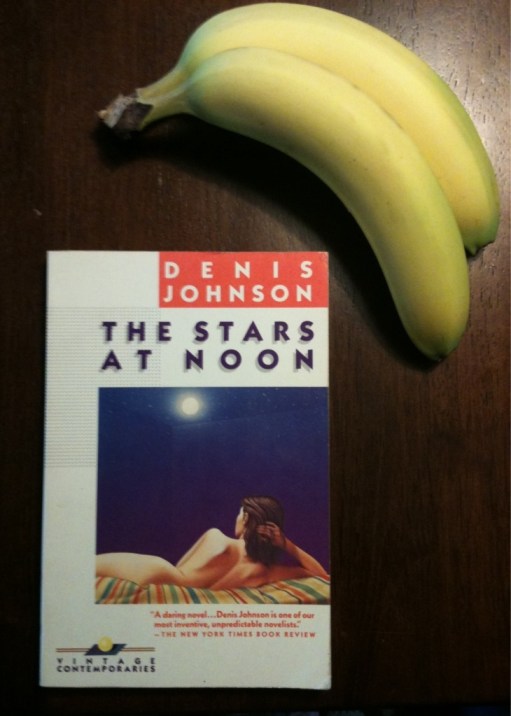
I went to the bookstore to pick up a graduation present and then spent too much time wandering the stacks. While looking for Mat Johnson’s Pym, I found a first printing paperback of Denis Johnson’s The Stars at Noon and had to have it—haven’t read it yet, and it makes a nice sister for my copy of Angels—but honestly, I’m just in love with these 1980s Vintage Contemporary editions with awful, awful covers.
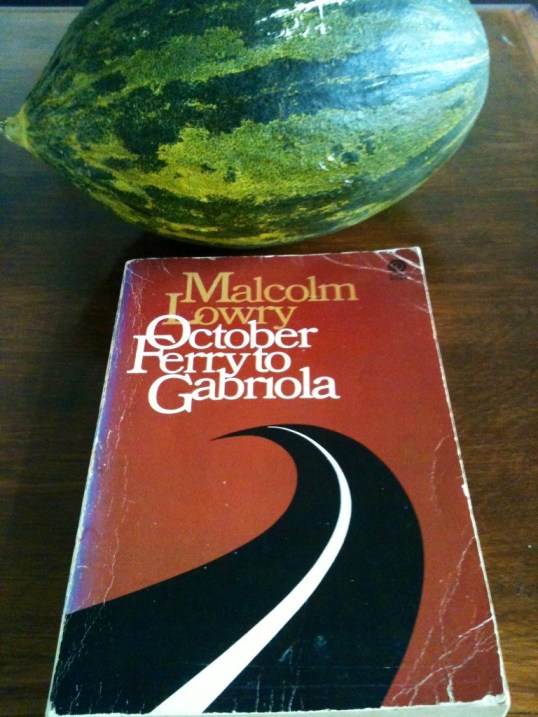
Malcolm Lowry’s last novel, the posthumously published October Ferry to Gabriola. Kind of a hideous cover.

I was looking for something by David Markson (no dice) when I came across The Age of Wire and String by Ben Marcus; I’ve been meaning to check out Marcus’s stuff, and a few minutes with the volume sold me—short vignettes, sort of like Lydia Davis or DFW or Dennis Cooper or William Burroughs (but probably not; I’m just using these as a short hand reference).
William Gaddis on the Pulitzer Prize: “The Ultimate Seal of Mediocrity”
In William Gaddis’s last novel Agapē Agape (2002), our embittered narrator excoriates the Pulitzer Prize:
. . . write what they want you’ll end up with a Pulitzer Prize follow you right to the grave. Maybe won the Medal of honor the George Cross even the Nobel but once you’ve been stigmatized with the ultimate seal of mediocrity your obit will read Pulitzer Prize Novelist Dies at whatever because they’re not advertising the winner no. No, like this whole plague of prizes wherever you look, it’s the prize givers promoting themselves, trying to rescue their thoroughly discredited profession of journalism. “The press is a school that serves to turn men into brutes,” Flaubert writes to George Sand “because it relieves them from thinking.” The prize winners? They’re just props, cartoonists, sports writers, political pundits, front page photos the bloodier the better for that instant of fame wrap the fish in tomorrow, good God how many Pulitzer Prizes are there? Over fifteen hundred entries, fourteen categories for journalists because if you started your bondage there you’re halfway home with that whole gang of sponsors, trustees, juries, God knows what who’ve survived that Slough of Despond and floated to the top. Just look at the next day’s New York Times, page after page bulging with self-congratulation with seven more categories to leech on, music, what they call drama and of course books where the Grey Lady finally got it both ways with their journalist who reviews books, like the misty-eyed ingenue but also destroys women writers and just for fairness crosses the gender line for an occasional assassination, give that lady a Pulitzer with oak leaf clusters! The books that are candidates are read by a jury whose decisions are passed up to the Olympian trustees with an eye to the multitude. We are thousands and they are millions, write the fiction they want or don’t write at all, ruling out Pound’s cry for the new, the challenging or what’s labeled difficult, so when Gravity’s Rainbow is being devoured by college youth everywhere and wins the National Book Award, its unanimous recommendation is overturned by the trustees for a double-talk spoof of academic vagaries by a bogus “Professor,” to everyone’s relief, and the author at peril escapes unblemished by the, no, no, no you can’t depend on it.
“People Got A Lotta Nerve” — Neko Case
Charles Dickens’s Traveling Cutlery Kit

(Via the Library of Congress).
“Intercourse with Resuscitated Wife” — Ben Marcus
Intercourse with resuscitated wife for particular number of days, superstitious act designed to insure safe operation of household machinery. Electricity mourns the absence of the energy from (wife) within the household’s walls by stalling its flow to the outlets. As such, an improvised friction need to take the place of electricity, to goad the natural currents back to their proper levels. This is achieved with the dead wife. She must be found, revived, and then penetrated until heat fills the room, until the toaster is shooting bread onto the floor, until she is smiling beneath you with black teeth and grabbing your bottom. Then the vacuum rides by and no one is pushing it, it is on full steam. Days flip past in chunks of fake light, and the intercourse is placed in the back of the mind. But it is always there, that moving into a static-ridden corpse that once spoke familiar messages in the morning when the sun was new.
― From Ben Marcus’s collection The Age of Wire and String
 Biblioklept