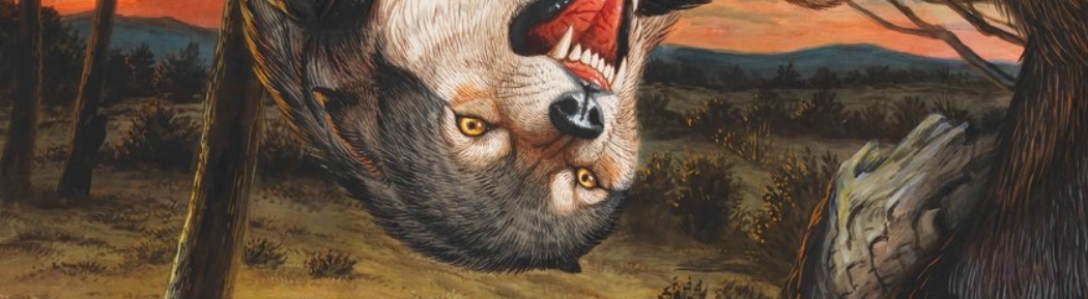
Snow White Playing with her Father’s Trophies — Paula Rego

20130427-213435.jpg

“A Happy Wanderer” — Joseph Conrad

“A Happy Wanderer” by Joseph Conrad

Converts are interesting people.  Most of us, if you will pardon me for betraying the universal secret, have, at some time or other, discovered in ourselves a readiness to stray far, ever so far, on the wrong road.  And what did we do in our pride and our cowardice?  Casting fearful glances and waiting for a dark moment, we buried our discovery discreetly, and kept on in the old direction, on that old, beaten track we have not had courage enough to leave, and which we perceive now more clearly than before to be but the arid way of the grave.

The convert, the man capable of grace (I am speaking here in a secular sense), is not discreet.  His pride is of another kind; he jumps gladly off the track—the touch of grace is mostly sudden—and facing about in a new direction may even attain the illusion of having turned his back on Death itself.

Some converts have, indeed, earned immortality by their exquisite indiscretion.  The most illustrious example of a convert, that Flower of chivalry, Don Quixote de la Mancha, remains for all the world the only genuine immortal hidalgo.  The delectable Knight of Spain became converted, as you know, from the ways of a small country squire to an imperative faith in a tender and sublime mission.  Forthwith he was beaten with sticks and in due course shut up in a wooden cage by the Barber and the Priest, the fit ministers of a justly shocked social order.  I do not know if it has occurred to anybody yet to shut up Mr. Luffmann in a wooden cage.I do not raise the point because I wish him any harm.  Quite the contrary.  I am a humane person.  Let him take it as the highest praise—but I must say that he richly deserves that sort of attention. Continue reading ““A Happy Wanderer” — Joseph Conrad”

The Fire Wheel — James McNeill Whistler

“Gifts” — Ralph Waldo Emerson

“Gifts” by Ralph Waldo Emerson

“Gifts of one who loved me,—
Twas high time they came;
When he ceased to love me,
Time they stopped for shame.”

IT is said that the world is in a state of bankruptcy, that the world owes the world more than the world can pay, and ought to go into chancery, and be sold. I do not think this general insolvency, which involves in some sort all the population, to be the reason of the difficulty experienced at Christmas and New Year, and other times, in bestowing gifts; since it is always so pleasant to be generous, though very vexatious to pay debts. But the impediment lies in the choosing. If, at any time, it comes into my head that a present is due from me to somebody, I am puzzled what to give until the opportunity is gone. Flowers and fruits are always fit presents; flowers, because they are a proud assertion that a ray of beauty outvalues all the utilities of the world. These gay natures contrast with the somewhat stern countenance of ordinary nature; they are like music heard out of a workhouse. Nature does not cocker us: we are children, not pets: she is not fond: everything is dealt to us without fear or favor, after severe universal laws. Yet these delicate flowers look like the frolic and interference of love and beauty. Men used to tell us that we love flattery, even though we are not deceived by it, because it shows that we are of importance enough to be courted. Something like that pleasure the flowers give us: what am I to whom these sweet hints are addressed? Fruits are acceptable gifts because they are the flower of commodities, and admit of fantastic values being attached to them. If a man should send to me to come a hundred miles to visit him, and should set before me a basket of fine summer fruit, I should think there was some proportion between the labor and the reward. Continue reading ““Gifts” — Ralph Waldo Emerson”

Girl at Desk — Kuzma Petrov-Vodkin