Andromeda — Tamara de Lempicka

Cioran’s Insomnia

How did your severe insomnia affect this attitude at the time?
 
It was really the profound cause of my break with philosophy.  I realized that in moments of great despair philosophy is no help at all, that it holds absolutely no answers.  And so I turned to poetry and literature, where I found no answers either, but states that were analogous to my own.  I can say that the white nights, the sleepless nights, brought about the break with my idolatry of philosophy.
 
When did these sleepless nights begin?
 
They began in my youth, at about nineteen.  It wasn’t simply a medical problem, it was deeper than that.  It was the fundamental period of my life, the most serious experience.  All the rest is secondary.  Those sleepless nights opened my eyes, everything changed for me because of that.
 
Do you suffer it still?
 
A lot less.  But that was a precise period, about six or seven years, where my whole perspective on the world changed.  I think it’s a very important problem.  It happens like this:  normally someone who goes to bed and sleeps all night, the next day he begins a new life almost.  It’s not simply another day, it’s another life.  And so, he can undertake things, he can express himself, he has a present, a future, and so on.  But for someone who doesn’t sleep, from the time of going to bed at night to waking up in the morning it’s all continuous, there’s no interruption.  Which means, there is no suppression of consciousness.  It all turns around that.  So, instead of starting a new life, at eight in the morning you’re like you were at eight the evening before.  The nightmare continues uninterrupted in a way, and in the morning, start what?  Since there’s no difference from the night before. That new life doesn’t exist.  The whole day is a trial, it’s the continuity of the trial.  While everyone rushes toward the future, you are outside.  So, when that’s stretched out for months and years, it causes the sense of things, the conception of life, to be forcibly changed.  You don’t see what future to look forward to, because you don’t have any future.  And I really consider that the most terrible, most unsettling, in short the principal experience of my life.  There’s also the fact that you are alone with yourself.  In the middle of the night, everyone’s asleep, you are the only one who is awake.  Right away I’m not a part of mankind, I live in another world.  And it requires an extraordinary will to not succumb.
 
Succumb to what, madness?
 
Yes.  To the temptation of suicide.  In my opinion, almost all suicides, about ninety percent say, are due to insomnia.  I can’t prove that, but I’m convinced.

From Jason Weiss’s 1983 interview with Emil Cioran, which is now available in full at his website, Itineraries of a Hummingbird. The interview was originally published in Weiss’s book, Writing at Risk, which is now out of print.

The Graf Zeppelin — Walton Ford

walton-ford-the-graf-zeppelin

Reviving Álvaro Mutis, Who Died One Year Ago Today

Homenaje-Alvaro-Mutis

The Colombian writer Álvaro Mutis died one year ago today.

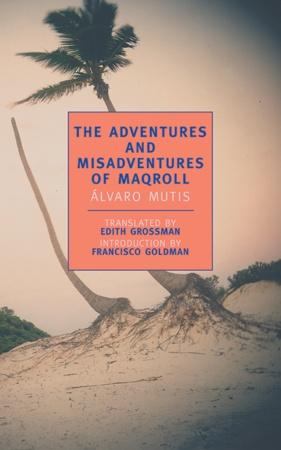
Mutis wasn’t on my radar until a few years ago, when a friend of mine, Dave Cianci, urged me to read the author’s opus, The Adventures and Misadventures of Maqroll, a collection of seven novellas that speak to each other in a loose, rich, intertextual poetics of adventure, romance, and loss. My friend Cianci was so enthusiastic about the book that he reviewed it for this blog (the review convinced me to read it). I’ll crib from that review:

The Adventures and Misadventures of Maqroll is difficult to categorize. It’s an outlaw adventure story populated by men and women who live where and how they must; these are the people who work near shipyards and the banks of unexplored river tributaries, people who value candor and honesty but for whom strict adherence to the law is often inconvenient. The book is a philosophical rumination on friendship and creation, romance and deception, obstinance and poverty.

Later in his review, Cianci characterizes the titular Maqroll—the Gaviero, the “lookout” —as “who we all dream of being when we contemplate throwing everything away.” In one of my own pieces on Maqroll, I described the world that Mutis offers, part fantasy, part nightmare, as

a life of picaresque adventures (and titular misadventures), of loss and gain, of love and despair, drinking, sailing, scheming and plotting—a life full of allusions and hints and digressions. Mutis’s technique is marvelous (literally; he made this reader marvel): he gives us an aging (anti-)hero, a hero whose life is overstuffed with stories and mishaps and feats and enterprises and hazards; he gives us one strand of that life at a time in each novella—but then he points to the other adventures, the other serials of Maqroll that we would love to tune into if only we could.
maq

John Updike explained the attraction to Mutis and Maqroll in his 2003 New Yorker review of NYRB’s Maqroll collection:

The problem of energy, in this enervated postmodern era, keeps arising in Mutis’s pursuit of a footloose, offhandedly erudite, inexplicably attractive shady character. A lowly seaman with some high-flying acquaintances on land, Maqroll is a drifter who tends to lose interest in his adventures before the dénouement is reached. Readers even slightly acquainted with Latin-American modernism will hear echoes of Borges’s cosmic portentousness, of Julio Cortázar’s fragmenting ingenuities, of Machado De Assis’s crisp pessimism, and of the something perversely hearty in Mutis’s fellow-Colombian and good friend Gabriel García Márquez—a sense of genial amplitude, as when a ceremonious host sits us down to a lunch provisioned to stretch into evening. Descriptions of food consumed and of drinks drunk, amid flourishes of cosmopolitan connoisseurship, are frequent in Mutis, even as the ascetic Maqroll goes hungry. North Americans may be reminded of Melville—more a matter, perhaps, of affinity than of influence.

Updike’s review is one of the only prominent and long English-language pieces about Álvaro Mutis that I’ve come across. There’s a good 2001 interview with Mutis in Bomb by Francisco Goldman (who wrote the NYRB edition’s introduction), and a few translated poems of Mutis’s can be found online, but on the whole, despite accolades throughout the Spanish-reading world, his reputation among English-readers seems relegated to “friend of Gabriel Garcia Marquez” (who called Mutis “one of the greatest writers of our time”).

Álvaro Mutis deserves a bigger English-reading audience. NYRB’s collection of his novellas in Edith Grossman’s translation bristles with energy. At once accessible and confounding, these tales that ask us to read them again, like Borges’s puzzles Bolaño’s labyrinths.

Is it tactless to name Bolaño here? Maybe—he’s perhaps too-easy an example: A Spanish-language author whose readership radically expanded after his death. Anyone who follows literary trends (ach!) will see how quickly a writer’s currency elevates after his or her death. (Ach! again). But I think that Mutis should attract fans of Bolaño, whose currency still spends (and will spend in the future, I think). Another comparison I would like to be able to make though would be John Williams’s sad novel Stoner, which, as any one who follows literary trends (ach!) could tell you became an unexpected best seller last yearStoner—also published by the good people at NYRB—had to wait half a century to get its due. I don’t see why the English-reading world should wait that long to embrace Mutis.

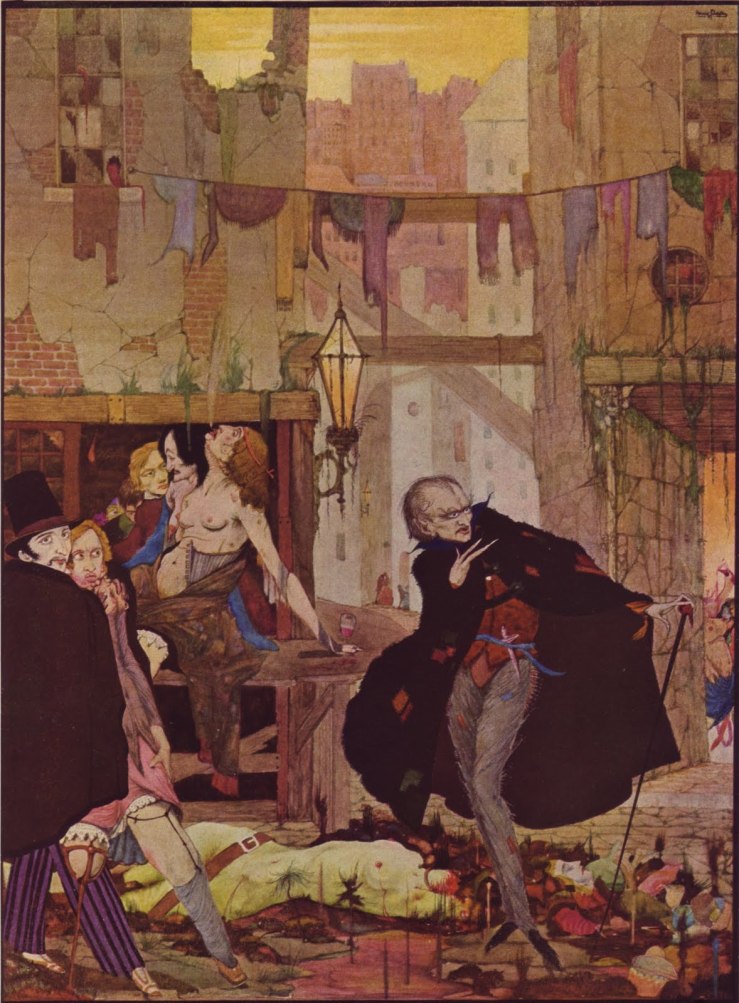
“The Man of the Crowd” — Edgar Allan Poe

 Harry Clarke's illustration for "The Man of the Crowd," 1923

Harry Clarke’s illustration for “The Man of the Crowd,” 1923

“The Man of the Crowd”

by

Edgar Allan Poe

     Ce grand malheur, de ne pouvoir être seul.

              La Bruyère.

IT was well said of a certain German book that “er lasst sich nicht lesen“—it does not permit itself to be read. There are some secrets which do not permit themselves to be told. Men die nightly in their beds, wringing the hands of ghostly confessors and looking them piteously in the eyes—die with despair of heart and convulsion of throat, on account of the hideousness of mysteries which will not suffer themselves to be revealed. Now and then, alas, the conscience of man takes up a burthen so heavy in horror that it can be thrown down only into the grave. And thus the essence of all crime is undivulged.

Not long ago, about the closing in of an evening in autumn, I sat at the large bow window of the D——- Coffee-House in London. For some months I had been ill in health, but was now convalescent, and, with returning strength, found myself in one of those happy moods which are so precisely the converse of ennui—moods of the keenest appetency, when the film from the mental vision departs—the [Greek phrase]—and the intellect, electrified, surpasses as greatly its every-day condition, as does the vivid yet candid reason of Leibnitz, the mad and flimsy rhetoric of Gorgias. Merely to breathe was enjoyment; and I derived positive pleasure even from many of the legitimate sources of pain. I felt a calm but inquisitive interest in every thing. With a cigar in my mouth and a newspaper in my lap, I had been amusing myself for the greater part of the afternoon, now in poring over advertisements, now in observing the promiscuous company in the room, and now in peering through the smoky panes into the street.

This latter is one of the principal thoroughfares of the city, and had been very much crowded during the whole day. But, as the darkness came on, the throng momently increased; and, by the time the lamps were well lighted, two dense and continuous tides of population were rushing past the door. At this particular period of the evening I had never before been in a similar situation, and the tumultuous sea of human heads filled me, therefore, with a delicious novelty of emotion. I gave up, at length, all care of things within the hotel, and became absorbed in contemplation of the scene without. Continue reading ““The Man of the Crowd” — Edgar Allan Poe”

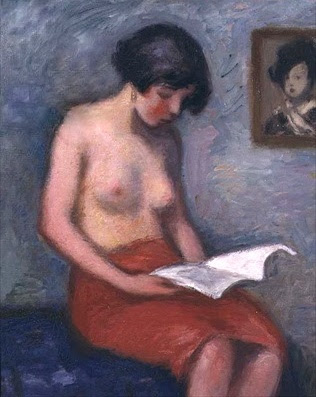
Nude Looking at Pictures — Georges d’Espagnat

Espagnat, George d' (1870-1950) Nude looking at pictures