The Short and Curlies, A Short Film by Mike Leigh

“Translation is dead. Long live translation!”

After my interview with Ilan Stavans for Biblioklept (Part 1; Part 2), I began working with him on Words in Transit: The Cultures of Translation, a year-long ‘festival’ of translation taking place at Amherst College. Events include a series of talks with translators, a Translation Film Series at the nearby cinema, a performance of monologues by ELL students, theatre and music performances, and more. Throughout the year, we are maintaining a blog devoted to translation at the Amherst College website. I will be posting excerpts from the blog here. 

Melih Levi, an Amherst student and Turkish translator, wrote this first blog post on the philosopher José Ortega y Gasset and poet Orhan Vali Kanik. Read below or check it out here. — Ryan Mihaly

Whenever I start thinking about translation as an enterprise, José Ortega y Gasset’s words come to my mind: “Translation is dead. Long live translation!” This playful maxim outlines the problems of translation in two different ways. First and foremost, it is a farewell to the practice of translation as we know it. The modern age and the technological advancements of today challenge the traditional practice of translation where translators work their way diligently through each word in a given text. Certainly, it is impossible to categorize all forms of traditional translation as one; after all, there can never be a single attitude towards translation. But if we look at how widely and deeply the print culture is influenced by the rapid technological changes of our times, it is perhaps acceptable to say that the cultures of translation, as we know it, are swiftly changing. The old ways are almost “dead.” But does this mean that there won’t be a new culture of translation in the future? Certainly not. Even if Google Translate ends up becoming a major tool in tomorrow’s translation world, a culture will develop. This is one of the ways in which Gasset’s maxim informs translation.

JoseOrtegayGasset.jpg
José Ortega y Gasset 

The second reading of Gasset’s words is perhaps more relevant and important. Gasset is thinking about the fate of literary works in general. That is, he is laying out his idea of what happens to a work when it goes through the process of translation. According to him, the work has to die before it can start to breathe again, in a different language or in a different medium. Thus, a translator is at once a gravedigger and a creator. Gasset poses a pivotal question: “Isn’t the act of translating necessarily a utopian task?”

Continue reading ““Translation is dead. Long live translation!””

“Talent” — Anton Chekhov

“Talent”

by

Anton Chekhov

AN artist called Yegor Savvitch, who was spending his summer holidays at the house of an officer’s widow, was sitting on his bed, given up to the depression of morning. It was beginning to look like autumn out of doors. Heavy, clumsy clouds covered the sky in thick layers; there was a cold, piercing wind, and with a plaintive wail the trees were all bending on one side. He could see the yellow leaves whirling round in the air and on the earth. Farewell, summer! This melancholy of nature is beautiful and poetical in its own way, when it is looked at with the eyes of an artist, but Yegor Savvitch was in no humour to see beauty. He was devoured by ennui and his only consolation was the thought that by to-morrow he would not be there. The bed, the chairs, the tables, the floor, were all heaped up with cushions, crumpled bed-clothes, boxes. The floor had not been swept, the cotton curtains had been taken down from the windows. Next day he was moving, to town.

His landlady, the widow, was out. She had gone off somewhere to hire horses and carts to move next day to town. Profiting by the absence of her severe mamma, her daughter Katya, aged twenty, had for a long time been sitting in the young man’s room. Next day the painter was going away, and she had a great deal to say to him. She kept talking, talking, and yet she felt that she had not said a tenth of what she wanted to say. With her eyes full of tears, she gazed at his shaggy head, gazed at it with rapture and sadness. And Yegor Savvitch was shaggy to a hideous extent, so that he looked like a wild animal. His hair hung down to his shoulder-blades, his beard grew from his neck, from his nostrils, from his ears; his eyes were lost under his thick overhanging brows. It was all so thick, so matted, that if a fly or a beetle had been caught in his hair, it would never have found its way out of this enchanted thicket. Yegor Savvitch listened to Katya, yawning. He was tired. When Katya began whimpering, he looked severely at her from his overhanging eyebrows, frowned, and said in a heavy, deep bass:

“I cannot marry.”

“Why not?” Katya asked softly.

“Because for a painter, and in fact any man who lives for art, marriage is out of the question. An artist must be free.” Continue reading ““Talent” — Anton Chekhov”

The Garden of Death — Hugo Simberg

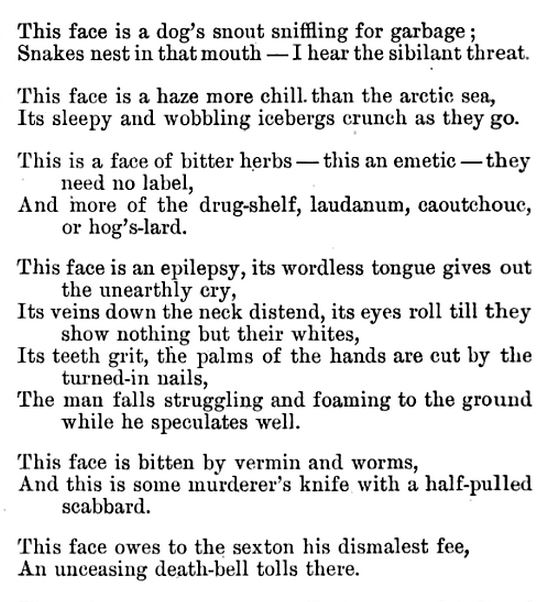
Snakes nest in that mouth (Walt Whitman)

Capture

The Mystical Body Defined — David Ruhlman

3. The mystical body defined