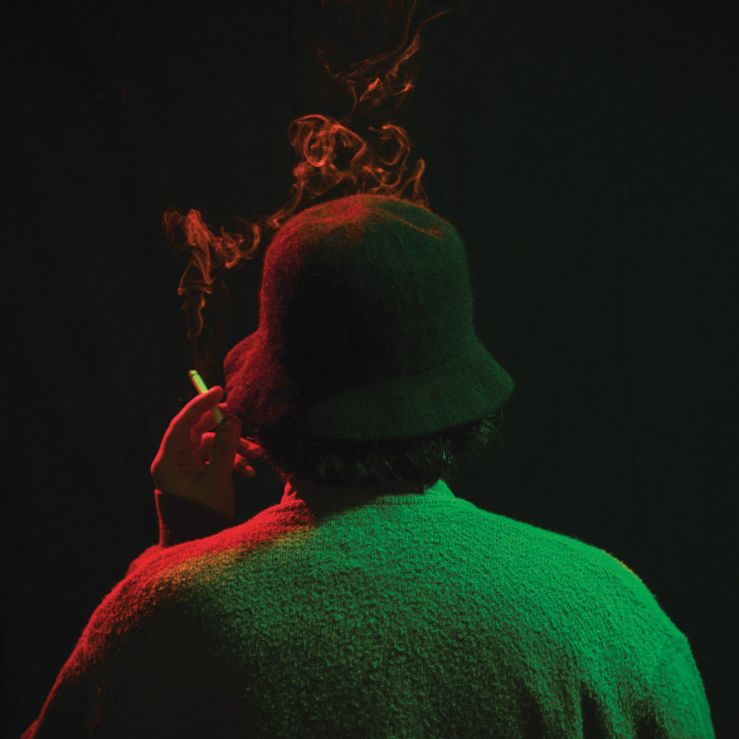
In the last minute of “Hotel Blue,” the fourth track on his new LP Simple Songs, Jim O’Rourke belts out his lines with an emotional directness we haven’t heard in his work before. He sings, and sings with a sincere presence and confidence perhaps previously absent from his fine work. The song builds from a few strums of acoustic guitar into a crescendo worthy of Harry Nilsson.
Like Nilsson (or Nilsson’s hero Randy Newman), O’Rourke’s work is saturated in a dark humor that’s perhaps easy to ignore because his music sounds so pretty. Simple Song’s first track “Friends with Benefits” reveals that welcoming-repulsing impetus in its opening lines: “Nice to see you once again / Been a long time, my friend / since you’ve crossed my mind at all.”
The initial moments of “Friends with Benefits” feel like an overture, unfurling in little episodes that recall O’Rourke’s 2009 suite The Visitor. The track eventually coalesces and climaxes in Terry Riley violin strokes, reverberating, decisive guitar lines, and stomping drums.
These musical elements continue throughout the album, which is often driven by piano riffs cribbed from all your favorite ’70s groups. Standout track “Half Life Crisis” bounces along in a Steely Dan strut, punctuated by Brian May guitar squiggles. Dissonant orchestral touches creep into the song’s final moments, recalling some of O’Rourke’s more “experimental” work—but also calling back to The Beatles.
Simple Songs feels like the culmination 0f some of O’Rourke’s projects over the past decade, and it made me revisit them. The Visitor sounds almost like a sketchbook for this record,and All Kinds of People, the record of Burt Bacharach songs O’Rourke recorded with various vocalists, feels in retrospect like a practice run at a personal pop record. Simple Songs builds on O’Rourke’s previous two “pop” records (Eureka and Insignificance), and even though it’s not named after a Nic Roeg film, it completes a trilogy of sorts. (But I hope this is more than a trilogy, to be clear).
The emotional intensity promised in “Hotel Blue” returns in the album’s closing tracks. “End of the Road” sees O’Rourke singing—not just talk-singing, but really singing—over McCartney piano and strings. “If you were at sea / They’d throw you overboard,” our misanthrope suggests. And in the final rousing track “All Your Love,” O’Rourke sings, “I’m so happy now / And I blame you,” before promising that “All your love / Will never change me.”
I’m not very good at writing about music, and really, writing is no substitute for listening. You can stream the album now at NPR—just do it over a real sound system or at least with some proper headphones. It sounds too good for your laptop’s tinny little noise holes.
Simple Songs is out on vinyl, etc., from Drag City next week.



 Biblioklept