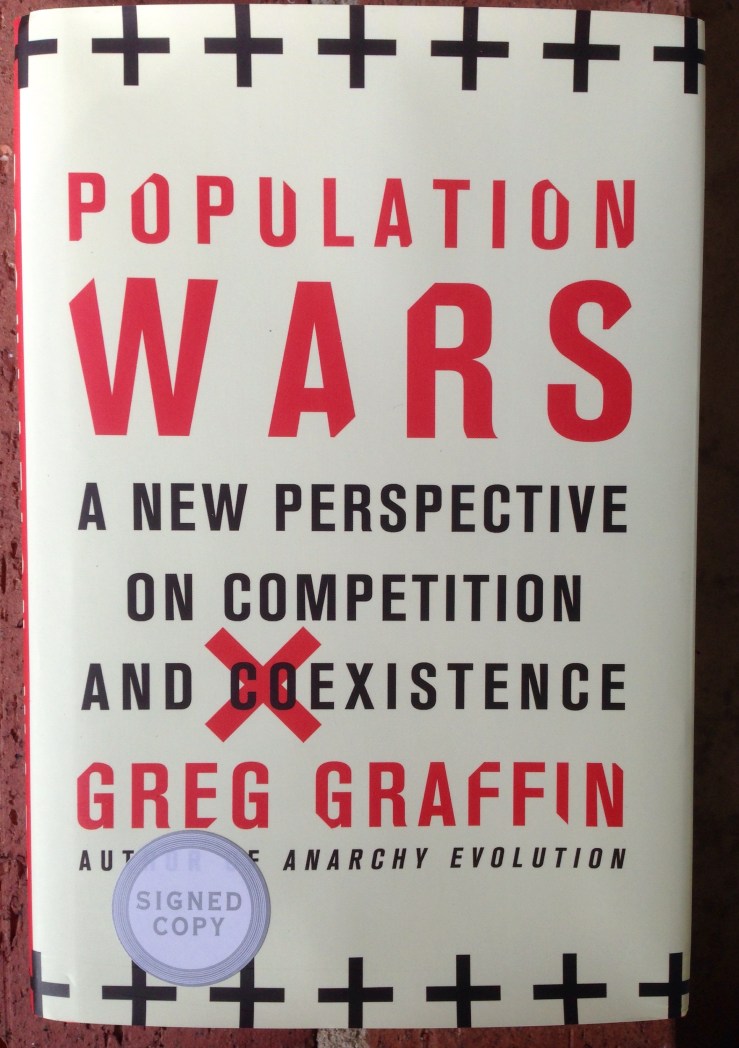
Greg Graffin is probably best known for his work as the leader of Bad Religion, a band he formed when he was 15. Graffin is also an academic and author. His latest book, Population Wars, makes a compelling argument for coexistence. It’s an accessible and persuasive read, rooted in biology and hope. (And of the three books I’ve read by indie rockers of yore this year, it’s easily the best). Publisher Thomas Dunne’s blurb:
From the very beginning, life on Earth has been defined by war. Today those first wars continue to be fought around and inside us, influencing our individual behavior and that of civilization as a whole. War between populations—whether between different species or between rival groups of humans—is seen as an inevitable part of the evolutionary process. The popular concept of survival of the fittest explains and often excuses these actions.
In Population Wars, Greg Graffin points to where the mainstream view of evolutionary theory has led us astray. That misunderstanding has allowed us to justify wars on every level, whether against bacterial colonies or human societies, even when other, less violent solutions may be available. Through tales of mass extinctions, developing immune systems, human warfare, the American industrial heartland, and our degrading modern environment, Graffin demonstrates how an oversimplified idea of war, with its victorious winners and vanquished losers, prevents us from responding to the real problems we face. Along the way, Graffin reveals a paradox: When we challenge conventional definitions of war, we are left with a new problem—how to define ourselves.
Population Wars is a paradigm-shifting book about why humans behave the way they do and the ancient history that explains that behavior. In reading it, you’ll see why we need to rethink the reasons for war, not only the human military kind but also Darwin’s “war of nature,” and find hope for a less violent future for mankind.



.jpg)

 Biblioklept