“How Jack O’Lanterns Came To Be” — Zora Neale Hurston

From Zora Neale Hurston’s novelization of folklore, Mules and Men:

It was slavery time, Zora, when Big Sixteen was a man. They called ‘im Sixteen  cause dat was de number of de shoe he wore. He was big and strong and Ole Massa looked to him to do everything.

One day Ole Massa said, “Big Sixteen, Ah b’lieve Ah want you to move dem sills Ah had hewed out down in de swamp.

“I yassuh, Massa.”

Big Sixteen went down in de swamp and picked up dem 12 X 12’s and brought ’em on up to de house and stack ,em. No one man ain’t never toted a 12 X 12 befo’ nor since.

So Ole Massa said one day, “Go fetch in de mules. Ah want to look ’em over.”

Big Sixteen went on down to, de pasture and caught dem mules by de bridle but they was contrary and balky and he tore de bridles to pieces pullin’ on ’em, so he picked one of ’em up under each arm and brought ’em up to Old Massa.

He says, “Big Sixteen, if you kin tote a pair of balky mules, you kin do anything. You kin ketch de Devil.”

“Yassuh, Ah kin, if you git me a nine-pound hammer and a pick and shovel!”

Ole Massa got Sixteen de things he ast for and tole ‘im to go ahead and bring him de Devil.

Big Sixteen went out in front of de house and went to diggin’. He was diggin’ nearly a month befo’ he got where he wanted. Then he took his hammer and went and knocked on de Devil’s door. Devil answered de door hisself.

“Who dat out dere?”

“It’s Big Sixteen.”

“What you want?”

“Wanta have a word wid you for a minute.”

Soon as de Devil poked his head out de door, Sixteen him over de head wid dat hammer and picked ‘im  up and carried ‘im back to Old Massa.

Ole Massa looked at de dead Devil and hollered, “Take dat ugly thing ‘way from here, quick! Ah didn’t think you’d, ketch de Devil sho ’nuff.”

So Sixteen picked up de Devil and throwed ‘im back down de hole.

Way after while, Big Sixteen died and went up to Heben. But Peter looked at him and tole ‘im to g’wan ‘way from dere. He was too powerful. He might git outa order and there wouldn’t be nobody to handle ‘im. But he had to, go somewhere so he went on to hell.

Soon as he got to de gate de Devil’s children was playin’ in de yard and they seen ‘im and run to de house, says, “Mama, mama! Dat man’s out dere dat kilt papa!”

So she called ‘im in de house and shet de door. When Sixteen got dere she handed ‘im a li’l piece of fire and said, “You ain’t comin’ in here. Here, take dis hot coal and g’wan off and start you a hell uh yo’ own.”

So when you see a Jack O’Lantern in de woods at night you know it’s Big Sixteen wid his piece of fire lookin’ for a  place to go.

Jack O’ Lanterns 2015

IMG_0263

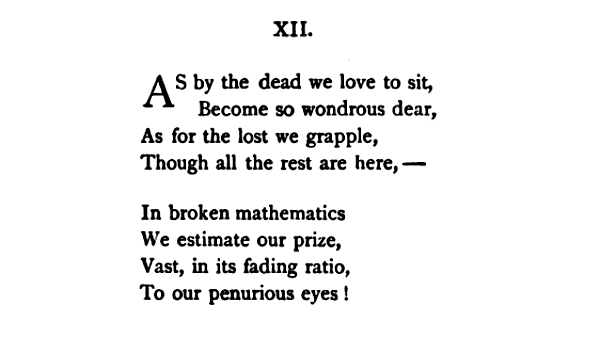
“As by the dead we love to sit” — Emily Dickinson

Screenshot 2015-10-26 at 3

“Berenice” — Edgar Allan Poe

berenice
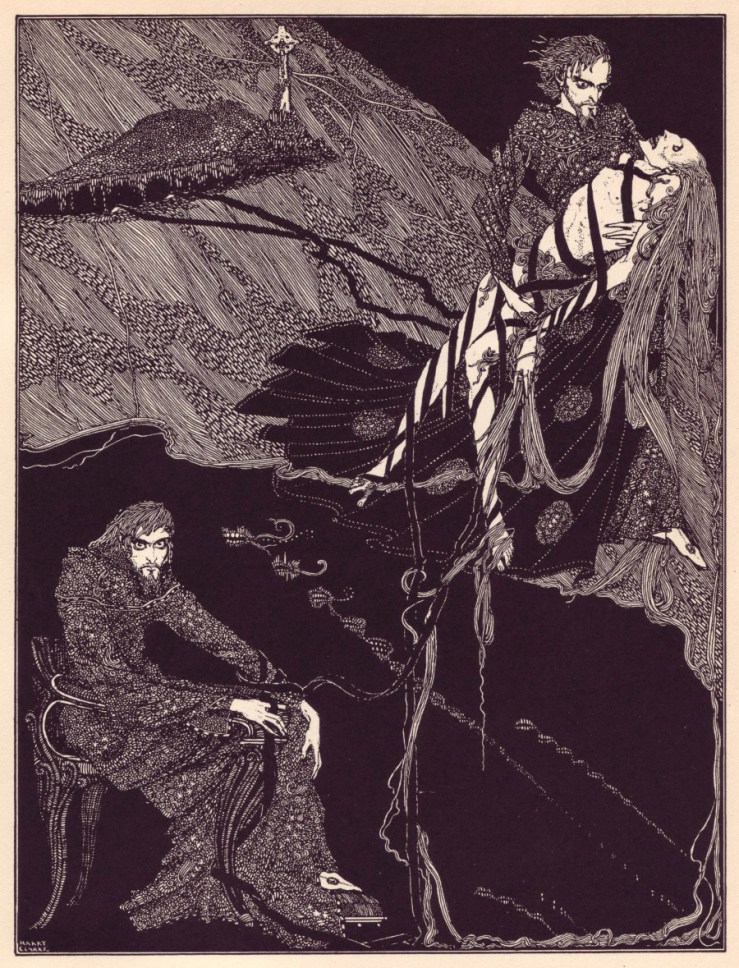
“It was a fearful page in the record of my existence” –Harry Clarke’s illustration for Edgar Allan Poe’s “Berenice”

“Berenice”

by

Edgar Allan Poe


Dicebant mihi sodales, si sepulchrum amicae visitarem, curas meas aliquantulum forelevatas. —Ebn Zaiat.

MISERY is manifold. The wretchedness of earth is multiform. Overreaching the wide horizon as the rainbow, its hues are as various as the hues of that arch—as distinct too, yet as intimately blended. Overreaching the wide horizon as the rainbow! How is it that from beauty I have derived a type of unloveliness?—from the covenant of peace, a simile of sorrow? But as, in ethics, evil is a consequence of good, so, in fact, out of joy is sorrow born. Either the memory of past bliss is the anguish of to-day, or the agonies whichare, have their origin in the ecstasies which might have been.

My baptismal name is Egaeus; that of my family I will not mention. Yet there are no towers in the land more time-honored than my gloomy, gray, hereditary halls. Our line has been called a race of visionaries; and in many striking particulars—in the character of the family mansion—in the frescos of the chief saloon—in the tapestries of the dormitories—in the chiselling of some buttresses in the armory—but more especially in the gallery of antique paintings—in the fashion of the library chamber—and, lastly, in the very peculiar nature of the library’s contents—there is more than sufficient evidence to warrant the belief.

The recollections of my earliest years are connected with that chamber, and with its volumes—of which latter I will say no more. Here died my mother. Herein was I born. But it is mere idleness to say that I had not lived before—that the soul has no previous existence. You deny it?—let us not argue the matter. Convinced myself, I seek not to convince. There is, however, a remembrance of aerial forms—of spiritual and meaning eyes—of sounds, musical yet sad—a remembrance which will not be excluded; a memory like a shadow—vague, variable, indefinite, unsteady; and like a shadow, too, in the impossibility of my getting rid of it while the sunlight of my reason shall exist.

In that chamber was I born. Thus awaking from the long night of what seemed, but was not, nonentity, at once into the very regions of fairy land—into a palace of imagination—into the wild dominions of monastic thought and erudition—it is not singular that I gazed around me with a startled and ardent eye—that I loitered away my boyhood in books, and dissipated my youth in reverie; but it is singular that as years rolled away, and the noon of manhood found me still in the mansion of my fathers—it is wonderful what stagnation there fell upon the springs of my life—wonderful how total an inversion took place in the character of my commonest thought. The realities of the world affected me as visions, and as visions only, while the wild ideas of the land of dreams became, in turn, not the material of my every-day existence, but in very deed that existence utterly and solely in itself.


Berenice and I were cousins, and we grew up together in my paternal halls. Yet differently we grew—I, ill of health, and buried in gloom—she, agile, graceful, and overflowing with energy; hers, the ramble on the hill-side—mine the studies of the cloister; I, living within my own heart, and addicted, body and soul, to the most intense and painful meditation—she, roaming carelessly through life, with no thought of the shadows in her path, or the silent flight of the raven-winged hours. Berenice!—I call upon her name—Berenice!—and from the gray ruins of memory a thousand tumultuous recollections are startled at the sound! Ah, vividly is her image before me now, as in the early days of her light-heartedness and joy! Oh, gorgeous yet fantastic beauty! Oh, sylph amid the shrubberies of Arnheim! Oh, Naiad among its fountains! And then—then all is mystery and terror, and a tale which should not be told. Disease—a fatal disease, fell like the simoon upon her frame; and, even while I gazed upon her, the spirit of change swept over her, pervading her mind, her habits, and her character, and, in a manner the most subtle and terrible, disturbing even the identity of her person! Alas! the destroyer came and went!—and the victim—where is she? I knew her not—or knew her no longer as Berenice. Continue reading ““Berenice” — Edgar Allan Poe”