Rédoine Faïd’s Outlaw, a crime memoir-in-interviews (Book acquired, 27 April 2020)

img_5690

I finally made some time this afternoon to dip into Rédoine Faïd’s memoir-in-interviews, Outlaw: Armed and Dangerous. It’s a propulsive, fast read so far–I put away the first 60 pages in one reading. Faïd, fresh out of prison, tells his life story to journalist Jérôme Pierrat. The book is newly-translated by John Galbraith Simmons and J.G. Barque, and available from Contra Mundum Press. Their blurb:

Memoirs of celebrated criminals purvey vivid personal stories while spawning sharp questions about the cultures that produced them. In Outlaw: Author Armed & Dangerous, Rédoine Faïd, of Algerian immigrant parents, born and raised in the housing projects surrounding Paris, recounts his career as an infamous and renowned bandit. Drawing inspiration and instruction from a host of films and television series, Faïd styled himself and was known to friends and accomplices as “Doc” — after Steve McQueen in the legendary suspense thriller, The Getaway.

With self-discipline and a striking ability to learn from experience, Faïd carried off his first robberies while still a teenager. He soon graduated from petty thievery to armed robbery, targeting computer component suppliers, jewelry stores, banks, and most memorably, armored trucks. A master of disguise, with bulletproof vest and a .357 Magnum as a prop to encourage compliance, he led a crew that operated with careful planning but eschewed bloodshed and physical violence.

In imitation of Michael Mann’s Heat, Faïd and his cohorts donned hockey masks for one job, sometimes even quoting from other famous heist films during their capers. When bold plans went wrong, he reacted with fast thinking that served him well — until it didn’t, and he was arrested and imprisoned in 1998.

Outlaw was first published in France in 2009, after which Faïd was imprisoned again. Subsequently, his dramatic escapes from jail, in 2013 and 2018, made front-page news in France and around the world.

Interviewed by journalist Jérôme Pierrat, who specializes in crime and investigative reportage, Rédoine Faïd tells his own story with panache and humor, darkened by introspection and cautionary tales. His story, like that of a character out of a Jean-Pierre Melville film or Dassin’s Rififi, is not only intriguing, it is also as compelling as any high-grade thriller. Three months after his daring helicopter escape from Réau Prison in 2018, Faïd was captured again. He currently remains in jail.
Postmodernist discourses are often exclusionary | bell hooks

Postmodernist discourses are often exclusionary even when, having been accused of lacking concrete relevance, they call attention to and appropriate the experience of “difference” and “otherness” in order to provide themselves with oppositional political meaning, legitimacy, and immediacy. Very few African-American intellectuals have talked or written about postmodernism. Recently at a dinner party, I talked about trying to grapple with the significance of postmodernism for contemporary black experience. It was one of those social gatherings where only one other black person was present. The setting quickly became a field of contestation. I was told by the other black person that I was wasting my time, that “this stuff does not relate in any way to what’s happening with black people.” Speaking in the presence of a group of white onlookers, staring at us as though this encounter was staged for their benefit, we engaged in a passionate discussion about black experience. Apparently, no one sympathized with my insistence that racism is perpetuated when blackness is associated solely with concrete gut level experience conceived either as opposing or having no connection to abstract thinking and the production of critical theory. The idea that there is no meaningful connection between black experience and critical thinking about aesthetics or culture must be continually interrogated.

My defense of postmodernism and its relevance to black folks sounded good but I worried that I lacked conviction, largely because I approach the subject cautiously and with suspicion. Disturbed not so much by the “sense” of postmodernism but by the conventional language used when it is written or talked about and by those who speak it, I find myself on the outside of the discourse looking in. As a discursive practice it is dominated primarily by the voices of white male intellectuals and/or academic elites who speak to and about one another with coded familiarity. Reading and studying their writing to understand postmodernism in its multiple manifestations, I appreciate it but feel little inclination to ally myself with the academic hierarchy and exclusivity pervasive in the movement today.

The first two paragraphs of bell hooks’ 1990 essay “Postmodern Blackness.” I encourage you to read the other thirteen paragraphs here.

Resolution — Yu Hong

facf2650004b57ebcbf59641d90ed922

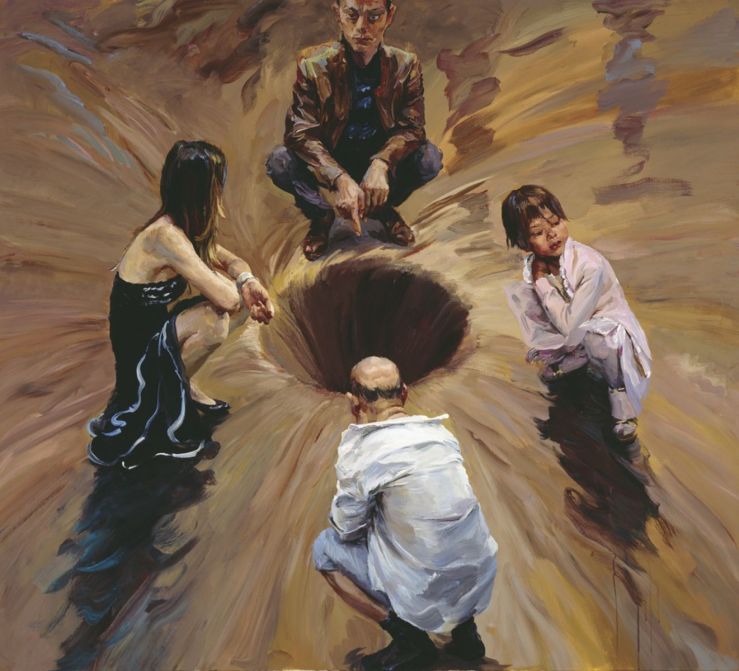
Resolution, 2015 by Yu Hong (b. 1966)