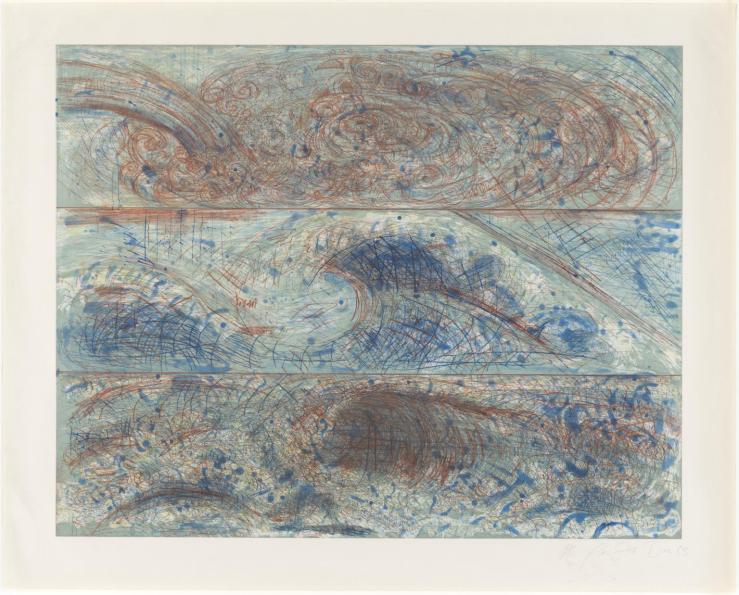
The Wave – From the Sea – After Leonardo, Hokusai and Courbet, 1985 by Pat Steir (b. 1940)

The Wave – From the Sea – After Leonardo, Hokusai and Courbet, 1985 by Pat Steir (b. 1940)
by

I. In this riff: Chapters 76-80 of Moby-Dick.
II. Ch. 76, “The Battering-Ram.”
Yet another hyphenated chapter title; yet another horny chapter title.
In this chapter, the titular battering ram is the sperm whale’s head—or, more accurately, the middle space of its huge head, that “dead, blind wall, without a single organ or tender prominence of any sort whatsoever.” Ishmael implores us to consider “this whole enormous boneless mass…as one wad.”
Ish continues, pointing out that the whale’s brain—and consciousness? soul?—are protected by this battering ram:
Now, mark. Unerringly impelling this dead, impregnable, uninjurable wall, and this most buoyant thing within; there swims behind it all a mass of tremendous life…So that when I shall hereafter detail to you all the specialities and concentrations of potency everywhere lurking in this expansive monster; when I shall show you some of his more inconsiderable braining feats; I trust you will have renounced all ignorant incredulity, and be ready to abide by this; that though the Sperm Whale stove a passage through the Isthmus of Darien, and mixed the Atlantic with the Pacific, you would not elevate one hair of your eye-brow. For unless you own the whale, you are but a provincial and sentimentalist in Truth.
That’s a long paragraph! Forgive! Ish ends it thus:
But clear Truth is a thing for salamander giants only to encounter; how small the chances for the provincials then? What befell the weakling youth lifting the dread goddess’s veil at Lais?
This last allusion refers to a Friedrich von Schiller poem, “The Veiled Image at Sais.” Isis’ veil here recalls the “hooded” whale heads aboard The Pequod. The “weakling youth” is forever mortified at this dare for truth. From Merivale’s translation:
But what he saw, or what did there befall,
His lips disclosed not.
Ever from his heart
Was fled the sweet serenity of life,
And the deep anguish dug the early grave:
“Woe, woe to him”—such were his warning words,
Answering some curious and impetuous brain,
“Woe—for she never shall delight him more!
Woe,—woe to him who treads through guilt to Truth!
III. Ch. 77, “The Great Heidelburgh Tun.”
“Now comes the Baling of the Case,” declares Ishmael, and then proceeds to explain how the “most precious of all his oily vintages…the highly-prized spermaceti, in its absolutely pure, limpid, and odoriferous state” shall be extracted from the sperm whale’s head. He tells us that,
A large whale’s case generally yields about five hundred gallons of sperm, though from unavoidable circumstances, considerable of it is spilled, leaks, and dribbles away, or is otherwise irrevocably lost in the ticklish business of securing what you can.
Moby-Dick is a Freudian field day.
IV. Ch. 78, “Cistern and Buckets.”
The Pequod’s crew, led by Tashtego, begin extracting the spermaceti from the whale’s head. The whole thing is a very phallic business:
Towards the end, Tashtego has to ram his long pole harder and harder, and deeper and deeper into the Tun, until some twenty feet of the pole have gone down.
Get a bucket and a mop.
In this slippery business, our man Tash falls into the hole in the whale’s head. Daggoo jumps into action, but the whale’s head falls from all but one hook, echoing “The Monkey-Rope,” the perilous, tenuous link of life between fellows. Luckily—repeating his actions way back in Ch. 13, “Wheelbarrow,” superhero Queequeg saves the day. Proud wife Ishmael proclaims, “my brave Queequeg had dived to the rescue.”
Tash’s rescue is announced as another resurrection in this novel of resurrections: “we saw an arm thrust upright from the blue waves; a sight strange to see, as an arm thrust forth from the grass over a grave.” Zombie vibes! It’s a tough resurrection though: “Tashtego was long in coming to, and Queequeg did not look very brisk.”
The rescue is coded as a birth scene:
And thus, through the courage and great skill in obstetrics of Queequeg, the deliverance, or rather, delivery of Tashtego, was successfully accomplished, in the teeth, too, of the most untoward and apparently hopeless impediments; which is a lesson by no means to be forgotten. Midwifery should be taught in the same course with fencing and boxing, riding and rowing.
The chapter ends with Ishmael praising the notion of drowning in a whale’s tun of spermaceti:
…had Tashtego perished in that head, it had been a very precious perishing; smothered in the very whitest and daintiest of fragrant spermaceti; coffined, hearsed, and tombed in the secret inner chamber and sanctum sanctorum of the whale.
V. Ch. 79, “The Prairie.”
Ishmael turns to pseudoscience: “To scan the lines of his face, or feel the bumps on the head of this Leviathan; this is a thing which no Physiognomist or Phrenologist has as yet undertaken.” By the end of the chapter though, Ish insists that “Physiognomy, like every other human science, is but a passing fable.” Still, his project remains the same—we are to read the whale—and the mystery of the whale—as Moby-Dick’s main text. He gives us the head: “I but put that brow before you. Read it if you can.”
VI. Ch. 80, “The Nut.”
Pseudoscience continues with phrenology, which Ish uses as a description, but not an answer to his driving question, What is the whale. “The Nut” concludes with the hump:
This august hump, if I mistake not, rises over one of the larger vertebræ, and is, therefore, in some sort, the outer convex mould of it. From its relative situation then, I should call this high hump the organ of firmness or indomitableness in the Sperm Whale. And that the great monster is indomitable, you will yet have reason to know.

Flower Shop, 2018 by Jansson Stegner (b. 1972)
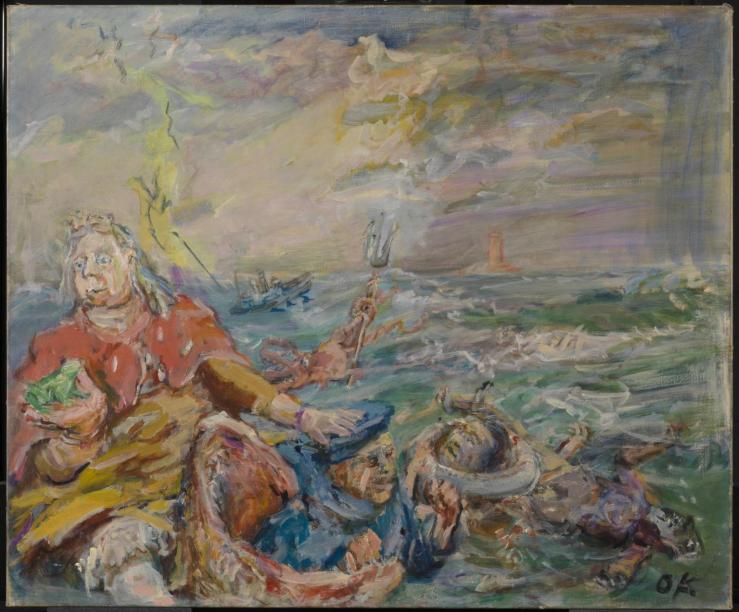
Loreley, 1942 by Oskar Kokoschka (1886-1980)
I. In this riff: Chapters 74 and 75 of Moby-Dick. (And I go back and pick up a little of Ch. 73.)
II. In my last riff, I glibly skipped over Ch. 73, “Stubb and Flask Kill a Right Whale; and Then Have a Talk over Him,” simply adding that, “In this chapter, Stubb and Flask kill a right whale and then have a talk over him.”
That chapter though is germane to the following pair of chapters, both of which focus on two massive but distinctly different whale heads. (The chapter also brims with Flask’s racism against Fedallah (he calls him a “gamboge ghost” at one point), whom he equates with the devil. More foreshadowing.)
Flask outlines the rationale for raising two whale heads to The Pequod’s sides:
…did you never hear that the ship which but once has a Sperm Whale’s head hoisted on her starboard side, and at the same time a Right Whale’s on the larboard; did you never hear, Stubb, that that ship can never afterwards capsize?
Can never afterwards capsize—more ironic foreshadowing.
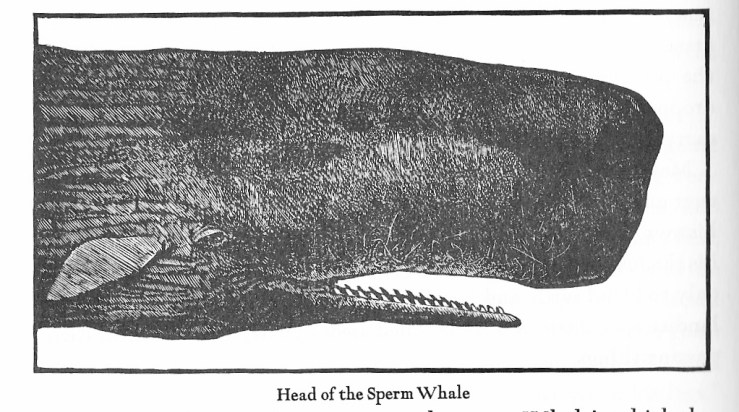
III. Ch. 74, “The Sperm Whale’s Head—Contrasted View.”
“Here, now, are two great whales, laying their heads together; let us join them, and lay together our own,” begins Ishmael. He continues, suggesting that “the Sperm Whale and the Right Whale are by far the most noteworthy” and “the only whales regularly hunted by man.” Additionally, “they present the two extremes of all the known varieties of the whale,” pointing again to Moby-Dick’s themes of duality and opposition. Pointing out that a head of each whale is currently hoisted to each side of The Pequod, our defensive narrator protests, “…where, I should like to know, will you obtain a better chance to study practical cetology than here?”
IV. So our practical cetologist is not exactly unbiased:
…there is a certain mathematical symmetry in the Sperm Whale’s which the Right Whale’s sadly lacks. There is more character in the Sperm Whale’s head. As you behold it, you involuntarily yield the immense superiority to him, in point of pervading dignity.
V. Ishmael then asks us to consider “the position of the whale’s eyes” which “corresponds to that of a man’s ears.” Abstract Ishmael becomes practical Ish:
You would find that you could only command some thirty degrees of vision in advance of the straight side-line of sight; and about thirty more behind it. If your bitterest foe were walking straight towards you, with dagger uplifted in broad day, you would not be able to see him, any more than if he were stealing upon you from behind. In a word, you would have two backs, so to speak; but, at the same time, also, two fronts (side fronts): for what is it that makes the front of a man—what, indeed, but his eyes?
Front/back—again, duality/opposition.
VI. Ish (and Melville, always Melville) then goes through the imaginative process of seeing how whales might see (boldfaced emphasis is mine, as always):
…in most other animals that I can now think of, the eyes are so planted as imperceptibly to blend their visual power, so as to produce one picture and not two to the brain; the peculiar position of the whale’s eyes, effectually divided as they are by many cubic feet of solid head, which towers between them like a great mountain separating two lakes in valleys; this, of course, must wholly separate the impressions which each independent organ imparts. The whale, therefore, must see one distinct picture on this side, and another distinct picture on that side; while all between must be profound darkness and nothingness to him. Man may, in effect, be said to look out on the world from a sentry-box with two joined sashes for his window. But with the whale, these two sashes are separately inserted, making two distinct windows, but sadly impairing the view. This peculiarity of the whale’s eyes is a thing always to be borne in mind in the fishery; and to be remembered by the reader in some subsequent scenes.
Again—duality/opposition.
VII. Ishmael turns his thought experiment from seeing to consciousness:
But if you now come to separate these two objects, and surround each by a circle of profound darkness; then, in order to see one of them, in such a manner as to bring your mind to bear on it, the other will be utterly excluded from your contemporary consciousness. How is it, then, with the whale? True, both his eyes, in themselves, must simultaneously act; but is his brain so much more comprehensive, combining, and subtle than man’s, that he can at the same moment of time attentively examine two distinct prospects, one on one side of him, and the other in an exactly opposite direction? If he can, then is it as marvellous a thing in him, as if a man were able simultaneously to go through the demonstrations of two distinct problems in Euclid.
I’m reminded of Keats’s negative capability: “when a man is capable of being in uncertainties, mysteries, doubts, without any irritable reaching after fact and reason.”
VIII. Ish then turns his attention to the sperm whale’s tiny ears, which have “no external leaf whatever; and into the hole itself you can hardly insert a quill, so wondrously minute is it.” Like the whale’s eyes, the whale’s ears are proportionally small to its massive body (when compared with humans, at least). Ishmael arrives at his own answer, his own negative capability:
Is it not curious, that so vast a being as the whale should see the world through so small an eye, and hear the thunder through an ear which is smaller than a hare’s? But if his eyes were broad as the lens of Herschel’s great telescope; and his ears capacious as the porches of cathedrals; would that make him any longer of sight, or sharper of hearing? Not at all.—Why then do you try to “enlarge” your mind? Subtilize it.
IX. Ishmael—and Melville—then moves the cinematographer’s camera about the whale skull “with whatever levers and steam-engines we have at hand…over the sperm whale’s head.” In this filmic tour, Ish takes us in particular through the jaws of the whale, noting that, when we “expose its rows of teeth, it seems a terrific portcullis; and such, alas! it proves to many a poor wight in the fishery, upon whom these spikes fall with impaling force.” The following lines are of greater interest to me than the poor dead fisherman in the previous sentence. Ish suggest that,
….far more terrible is it to behold, when fathoms down in the sea, you see some sulky whale, floating there suspended, with his prodigious jaw, some fifteen feet long, hanging straight down at right-angles with his body, for all the world like a ship’s jib-boom. This whale is not dead; he is only dispirited; out of sorts, perhaps; hypochondriac; and so supine, that the hinges of his jaw have relaxed, leaving him there in that ungainly sort of plight, a reproach to all his tribe, who must, no doubt, imprecate lock-jaws upon him.
Where did Ishmael encounter such a “dispirited” whale, out of sorts, fathoms down in the sea?
X. Ish concludes the chapter with concludes Ch. 74 with a practical business-person’s tone:
There are generally forty-two teeth in all; in old whales, much worn down, but undecayed; nor filled after our artificial fashion. The jaw is afterwards sawn into slabs, and piled away like joists for building houses.
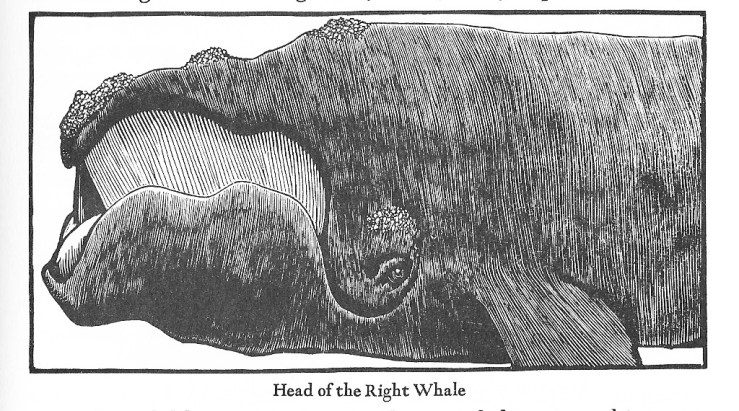
XI. Ch. 75, “The Right Whale’s Head—Contrasted View.”
“Crossing the deck, let us now have a good long look at the Right Whale’s head.”
Okay, Ish.
XII. Our boy starts off a bit mean:
As in general shape the noble Sperm Whale’s head may be compared to a Roman war-chariot (especially in front, where it is so broadly rounded); so, at a broad view, the Right Whale’s head bears a rather inelegant resemblance to a gigantic galliot-toed shoe.
Galliot-toed means square-toed, and as the owner of many pairs of Clark’s Wallabees over the years, I take exception to Ishmael’s slight.
XIII. He continues to lambaste the head with its “strange, crested, comb-like incrustation.” It is a “green, barnacled thing…you would take the head for the trunk of some huge oak, with a bird’s nest in its crotch.” He goes on to point out that crabs nestle in this “king’s” crown, and “that he is a very sulky looking fellow to grace a diadem.” Ish seems to take a particular glee in insulting this particular right whale’s face, noting that it’s a “great pity, now, that this unfortunate whale should be hare-lipped.” (Superstitious Ish suggests the harelip is the result of a curse: “Probably the mother during an important interval was sailing down the Peruvian coast, when earthquakes caused the beach to gape.” He then brings us into the right whale’s jaws, it’s mouth the size of “an Indian wigwam,” before going on about its “whiskers,” which “furnish to the ladies their busks and other stiffening contrivances” as well as more contemporary umbrellas.
XIV. Ish concludes by restating his position “that the Sperm Whale and the Right Whale have almost entirely different heads.”
He then implores,
Look your last, now, on these venerable hooded heads, while they yet lie together; for one will soon sink, unrecorded, in the sea; the other will not be very long in following.
Foreshadowing!
XV. Taking a final look at the whale’s faces, Ishmael moves again from the concrete/technical to the abstract/philosophical:
This Right Whale I take to have been a Stoic; the Sperm Whale, a Platonian, who might have taken up Spinoza in his latter years.
(I don’t remember, let alone know, much of Spinoza, so I could be wrong in suggesting that he proposed a godhead through which the concrete and abstract were indivisible, a metaphysics imprinted into physics.)

I have been rereading Moby-Dick.
I have also been reading things that are not Moby-Dick.
I have been reading emails.
I have been reading and very much enjoying Anakana Schofield’s novel Bina. I should have finished it by now—there’s just one remaining section—but I’ve been reading it exclusively in the bathtub. And I only take baths on Sunday. But I did not, unlike the narrator of Squeeze’s wonderful ditty “Up the Junction”, take a bath on Sunday. (After I get the weight of Moby-Dick off my conscience I will write a review.)
I have been reading student writing.
I have been reading more emails.
I have been rereading lots of (so-called) early American literature. I am teaching a course in early American literature for the first time in a long time, and I have read again, for the first time in a long time, stuff like A Short Account of the Destruction of the Indies by Bartolomé de Las Casas, and The Interesting Narrative of the Life of Olaudah Equiano; or, Gustavus Vassa, the African, Written by Himself and A Narrative of the Captivity and Restoration of Mrs. Mary Rowlandson. America is founded in blood and bounding, violence and strange hope.
I have been reading Twitter.
I have been reading Reddit.
(I cannot remember the last book review I read.)
I have been reading bits of The Posthumous Works of Thomas Pilaster by Éric Chevillard (translated from the French by Chris Clarke) and I like it so far.
I have been reading more student writing.
I have been reading news articles, particularly English-language news articles from non-U.S. news organizations; particularly articles focused on U.S. politics.
I have been reading poetry on the internet, somewhat at random.
I have not been reading Ann Quin’s novel Passages—it just showed up the other day—but it will be the next novel I read (after Moby-Dick; after Bina), and I am very excited about it.
I have been reading Wikipedia articles, very much at random. (Is there a greater 21st-century novel?)
I have not been reading the audiobook recording of Cormac McCarthy’s novel Blood Meridian narrated by Richard Poe. I have been falling asleep to it every night for the past forty or so nights. I set an hour timer and either fall asleep in five, ten, twenty minutes or not at all. One night I listened to the novel’s final third. Some nights I wonder into it disoriented—Where are we? Other nights I’m thrilled at the particular episode we start with—too thrilled. I’m supposed to be asleep. Last night I listened to most of Ch. 8—the bit in the bar where Toadvine, Bathcat, and the kid go drink in a bar and are accosted by an old man who declares that he two is “Texas.” A guy gets stabbed in the shadows, but remains moaning. Where would he go? The chapter ends with the Apache attacking, but I don’t recall getting there. What the fuck is wrong with me that I find Blood Meridian a comforting soporific to send me to my slumbers?
I have been reading Moby-Dick.
 Biblioklept