Mass-market Monday | Miguel de Unamuno’s Abel Sanchez and Other Stories

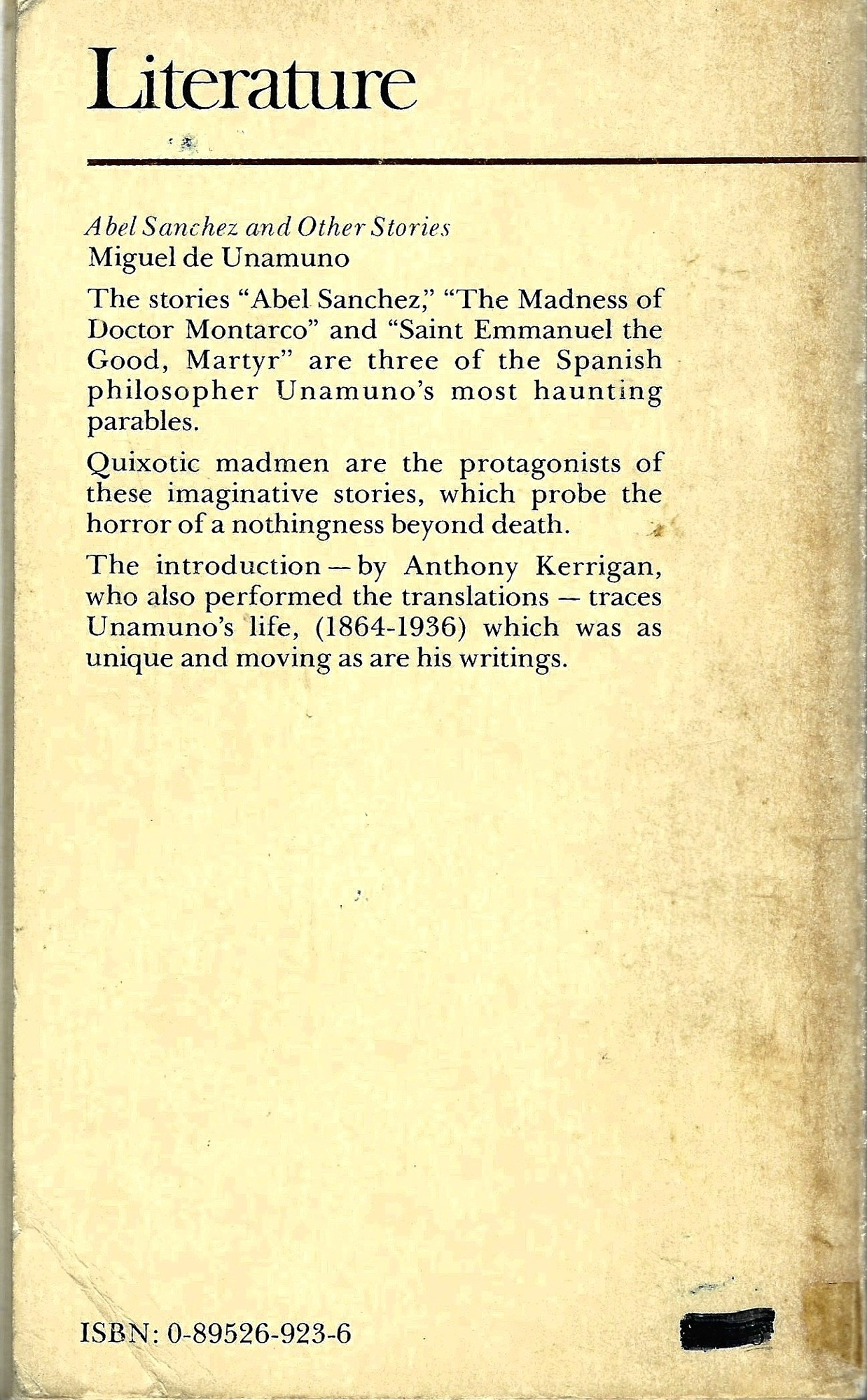
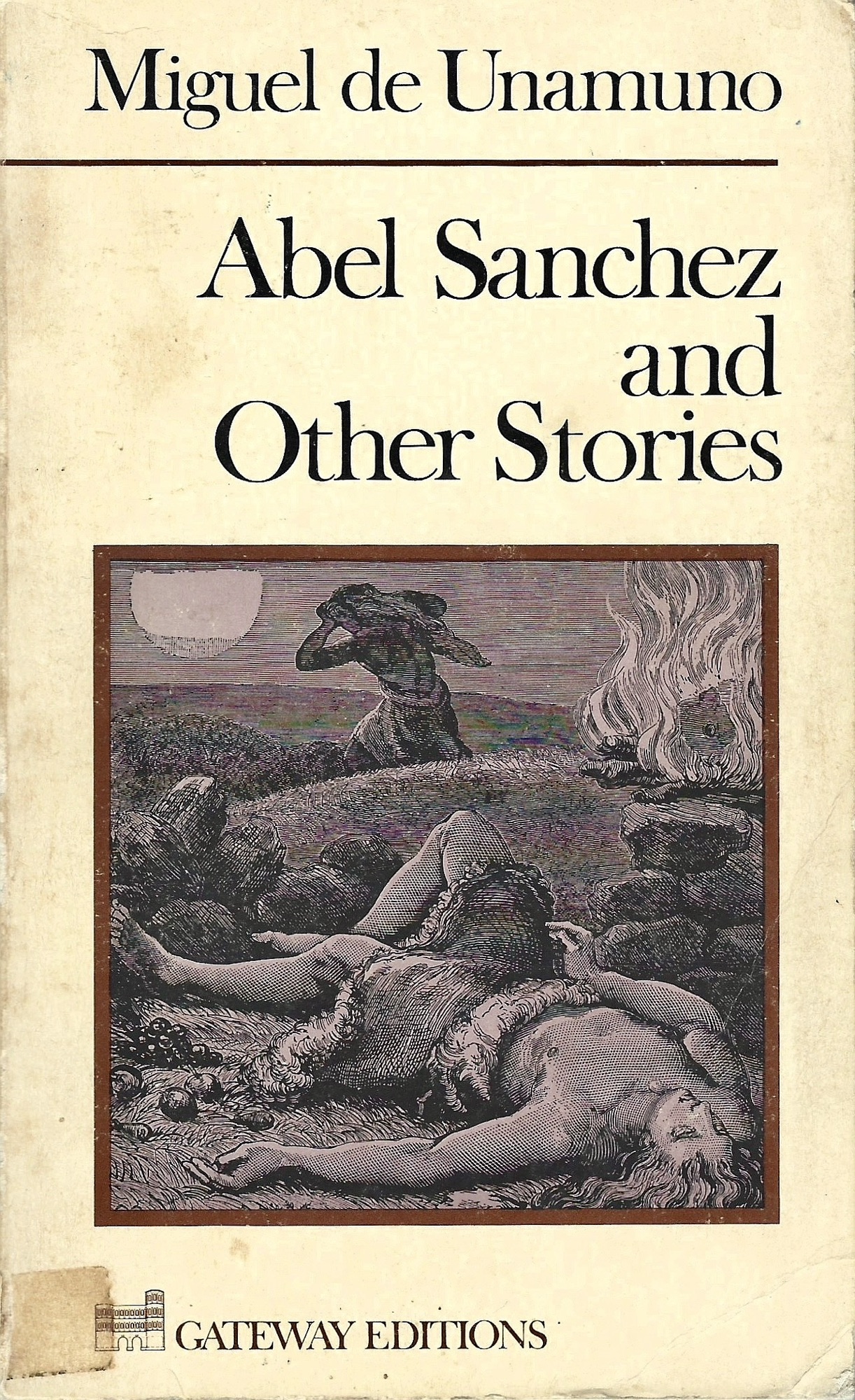
Abel Sanchez and Other Stories, Miguel de Unamuno. Translated by Anthony Kerrigan. Regnery Gateway (1956). No cover designer or artist credited; cover image credited to the Bettman Archive. 267 pages.

I wrote a bit about the collection back in February:

A few weeks ago, I picked up Anthony Kerrigan’s translation of Miguel de Unamuno’s Abel Sanchez and Other Stories based on its cover and the blurb on its back. I wound up reading the shortest of the three tales, “The Madness of Dr. Montarco,” that night. The story’s plot is somewhat simple: A doctor moves to a new town and resumes his bad habit of writing fiction. He slowly goes insane as his readers (and patients) query him about the meaning of his stories, and he’s eventually committed to an asylum. The tale’s style evokes Edgar Allan Poe’s paranoia and finds an echo in Roberto Bolaño’s horror/comedy fits. The novella that makes up the bulk of the collection is Abel Sanchez, a Cain-Abel story that features one of literature’s greatest haters, a doctor named Joaquin who grows to hate his figurative brother, the painter Abel. Sad and funny, this 1917 novella feels contemporary with Kafka and points towards the existentialist novels of Albert Camus. (I’m saving the last tale, “Saint Manuel Bueno, Martyr,” for a later day.)

7 Nov. 2024

On 5 Nov. 2024, or, really, technically, it was the very early hours of 6 Nov. 2024, I found myself unable to read, the distraction I had wanted, and instead found some respite from anxiety looking again at online copies (is copies the right word? digital reproductions? images, of course, but none of it is the real thing) of Francisco Goya’s Pinturas negras, his Black Paintings. Goya painted these strange, engrossing murals on the walls of his homestead the Quinta del Sordo, outside of Madrid, his last home in Spain before his exile in France.

I’m not sure how I got there. I have an impulse to return to his depiction of Saturn chomping on his son any time I feel the pain of a modern world that is always and forever ancient.

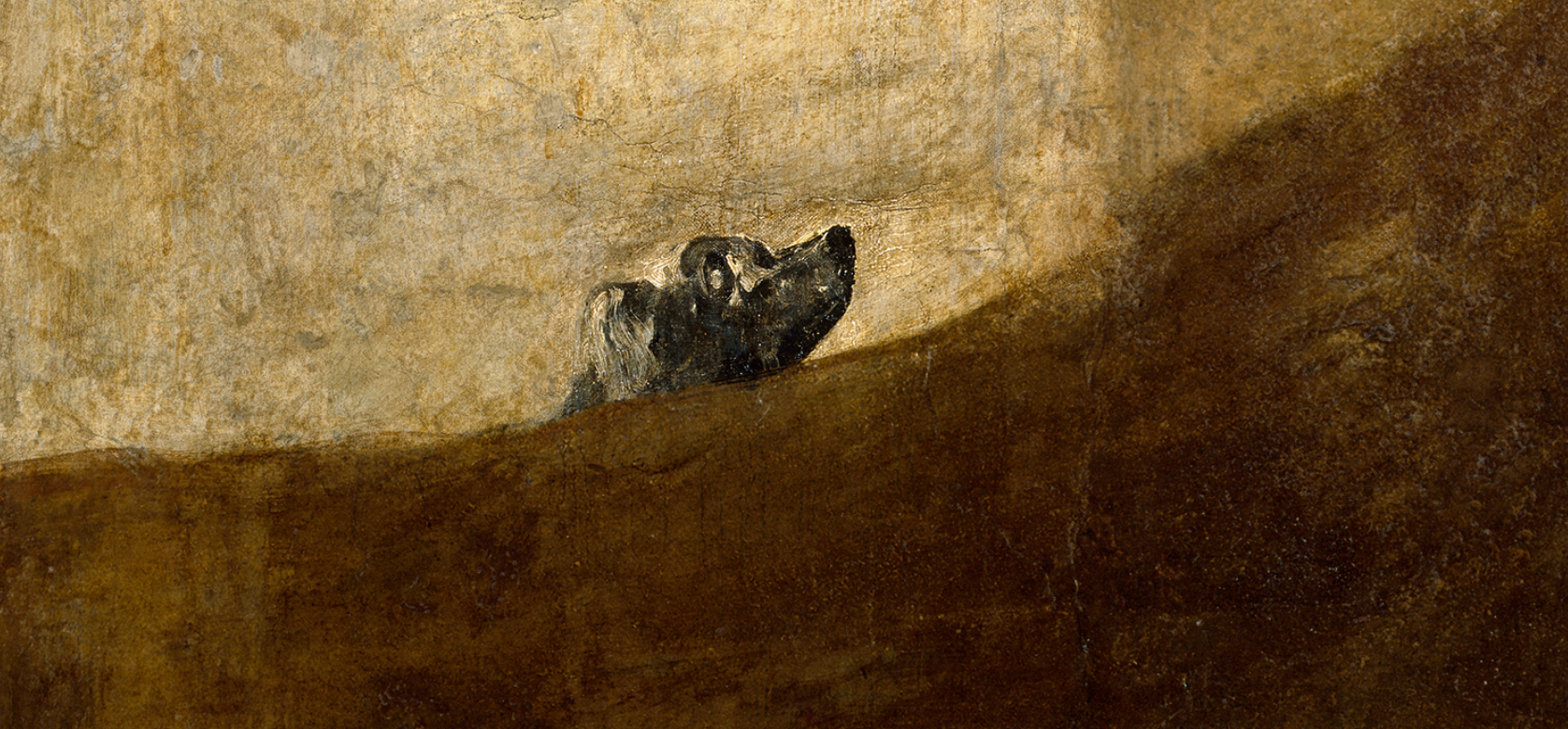
I have never seen another painting that makes as much sense to me, which means I’m a fucken sicko—I am sure that there are nicer paintings out there (I’ve seen so many). The idea that Goya would paint such paintings on the walls of his own home captivates me. The dog painting is my favorite; all negative space, which I’ll edit out, the negative space, here:

I stumbled out my bed that night to look for Robert Hughes’ wonderful biography Goya, which sheds no true light on the black paintings, as far as I can recall. Here is what he offers:

THE GREAT SERIES of paintings Goya made for his own pleasure at about the same time is equally enigmatic, and likely to remain so. These were the Pinturas negras, the so-called Black Paintings with which, in his last Madrid years, Goya was covering the walls of his farmhouse on the other side of the Manzanares outside the city, now converted into his studio and semi-solitary hermitage. Nothing, he felt, obliged him to be available to the court anymore; as for private clients, they could come to him. The new house, according to its title deed, was “beyond the Segovia bridge … on the site where the Hermitage of the Guardian Angel formerly stood.” It had twenty-two acres of arable land, and a vegetable garden. Comfortable but not palatial, and in need of some renovation, it was sturdily built of brick and adobe, with two stories divided into several rooms, two attics, a well by the garden, and another in the courtyard. Goya paid 60,000 reales for it, cash. By a peculiar coincidence, the property next door had been owned by a farmer who was deaf, and so was named the Quinta del Sordo, the Deaf Man’s House. This name passed to Goya’s own property, since he was the only notable deaf man around.

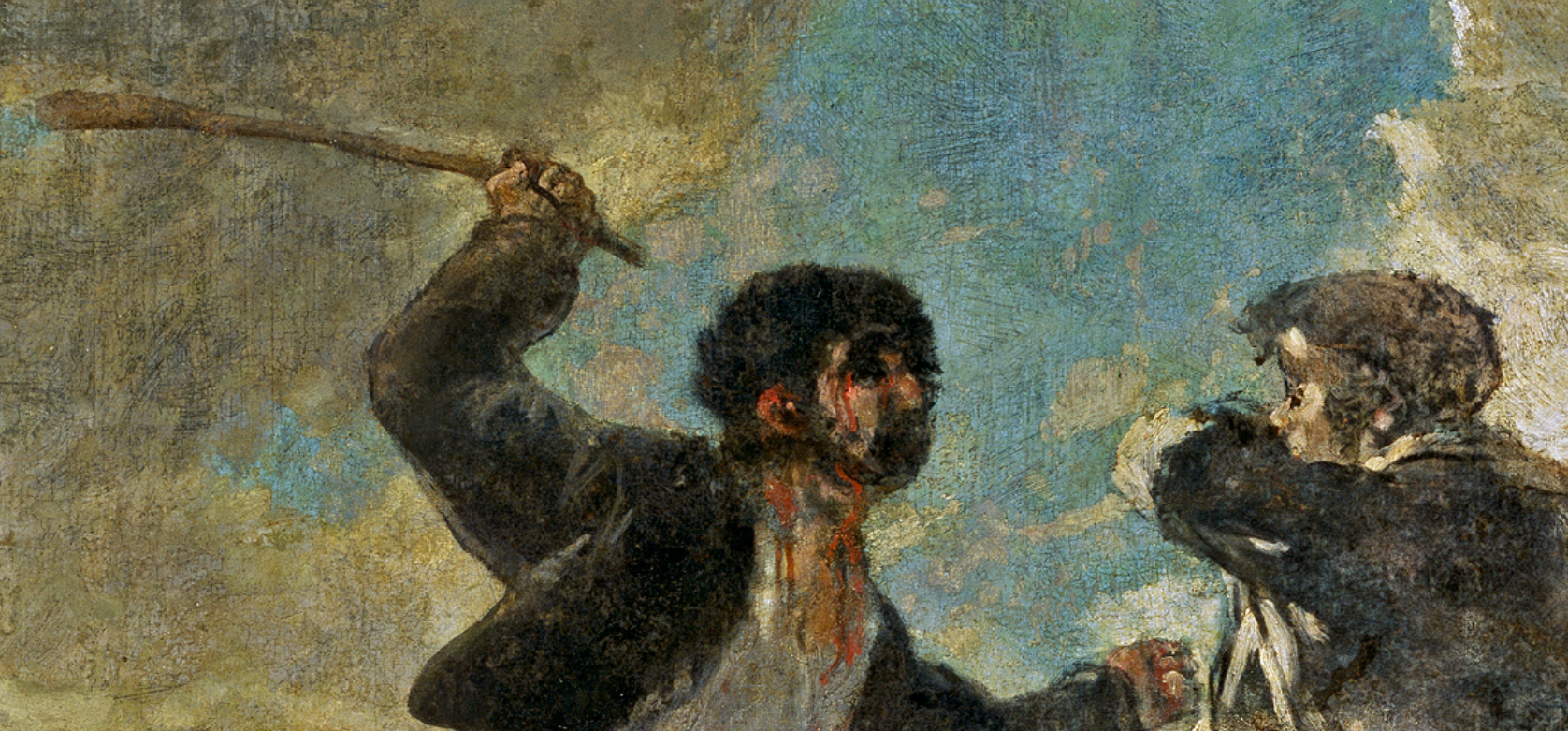
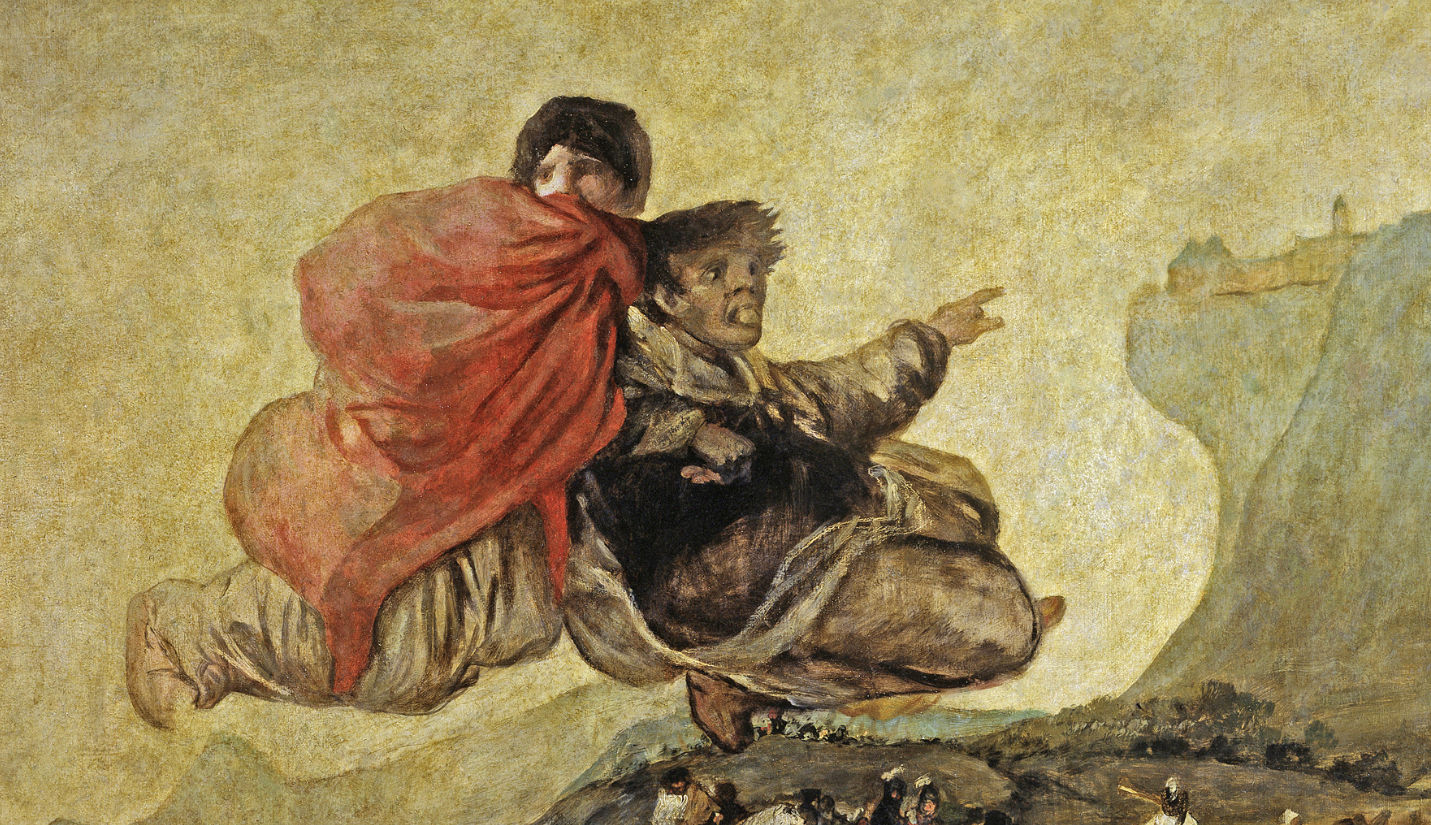
But Goya painted wild things on his walls—Judith and Holofrenes, flying mystics, a pilgrimage, a Satanic Sabbath, old people eating soup. Men hitting each other with sticks, red blood white clouds lovely blue sky:

I mean I think I guess that it’s he did what he did—the gross, rough, beautiful paintings—that he, Goya, did them for himself, the so-called Black Paintings—I think that’s what makes me drawn to him, beyond their aesthetic powers, which is really what I mean to say, the images, the colors, the contours, the phantasies—

6 Nov. 2024

Like a lot of US Americans I didn’t sleep too well last night. I went to bed too late and I rustled myself into some form of consciousness way too early. A veteran of past election eves, I did not overimbibe, but still felt groggy enough and well just plain like well disconcerted discombobulated discouraged enough to cancel meetings with my classes for the day. I didn’t have anything to give.

While I was in no way shocked by the results of the 2024 elections, I am nevertheless big-w Worried about all the things that may unfold, quickly, and without organized opposition, in the next six months. As has been the case for most of the presidential elections I’ve voted in, I voted against a candidate instead of for a candidate. I knew in Florida that my vote probably wouldn’t matter too much anyway.

I made myself go outside of my house into “Florida,” into Northeast Florida, which is, of course, also inside of my house, Florida, but I went outside early to take the air and look around. It was also garbage day in the neighborhood. I had a can with some nasty double-bagged rotten Jack O’Lanterns. We carved them on Halloween night and they wilted to a gray and black fuzz swarmed over with pestilence. I had to scrape their guts into the garden bed and hose the whole mess down. It’s not supposed to be this hot here this time of year, only it is and it has been, like regularly, consistently, predictably for well over a decade. The Florida air I stepped out into was gross: sticky, muggy, humidity near ninety percent and maybe 82° at nine in the morning. It did not feel like summer nor fall, but some other gross fifth season. None of this was colored by mood.

My mood was and is grim. I knew that voting for the incumbent’s proxy was simply kicking a can down the road; I knew that I was endorsing a system I had no belief in and that no one else I knew really seemed to believe in. I think I wanted just a little bit of the latter half of the 20th century to trickle down to my children, who are no longer really children. But it felt like a gross summer’s eve on this fall morning, and I remembered that climate change, which is to say global warming, which is to say the warming of the earth’s habitable surface as the result of fossil fuels—this so-called “climate change” didn’t even seem to be a blip in this election cycle. Again: kicking the can down the road, whistling past the graveyard, etc. Ostriches don’t really bury their heads in the sand though, and we all gotta know that the bill for the twentieth century is way past overdue.

But ostensibly this is a blog about literature or art; I don’t think anyone comes here for me to rant. So what am I reading?

I have been reading two books (three, really, or maybe more) and auditing two books. Audiobooks first: I am about half way through Dan Simmons’ Fall of Hyperion and I want to quit. I liked Hyperion but this one is just…I don’t have anything to say about it, except that I am sympathetic to Simmons’ anti-imperialist critique and I’m generally simpatico with his appropriation of the Romantics into a sci-fi epic (although, like, where the fuck is Blake?)—but the first book Hyperion was much better. Maybe it’s because he had a form to steal (Chaucer’s Canterbury Tales). I listen to this book in waking hours: drivingcooking, chores, etc.

The other audiobook is a fantastic rendition of John le Carré’s Tinker Tailor Soldier Spy. I do not listen to this book during waking hours; I fall asleep to it (or to Reich’s Music for Eighteen Musicians or to Sleep’s Holy Mountain or something else). Specifically, I’ve been falling asleep somewhere between chapters seven and eight this week. I love this book so much. I love the film version that came out like ten plus years ago, with Gary Oldman as Smiley. I used to love falling asleep to that film. I don’t actually know what happens in the narrative.
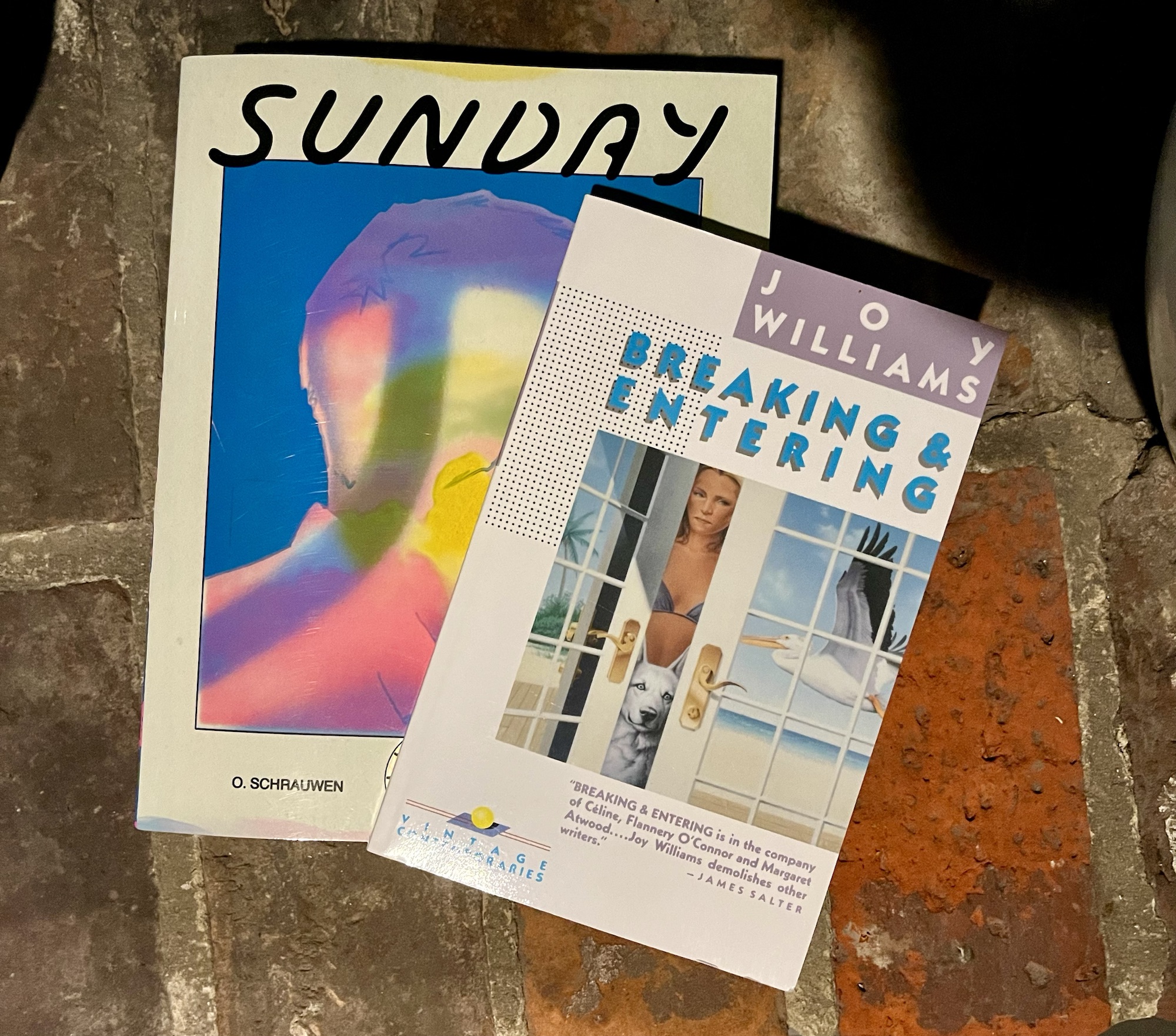

The two books I switch between before falling asleep to Tinker Tailor Soldier Spy:

Olivier Schrauwen’s Sunday and Joy Williams’ Breaking and Entering.

Sunday is a true graphic novel: that term, “graphic novel,” a marketing gambit I’m sure, gets appended to pretty much any cartoonists’ self-contained work of, say, fifty-plus pages. But a lot of what we (and we includes very much me) call graphic novels are really short stories in comix/cartooning form. Schrauwen’s effort is a real novel, a real graphic novel a la allah ah lah lah From Hell or Jimmy Corrigan. It’s really fucking great, and if this weren’t a low-effort I am writing this for me and not you post, I would tell you why I think it’s really fucking great (I would describe the story, the so-called story, such as it is; I would riff on all the motifs; I would get lost in the coloring. I would I would I would…)

The other book I’ve been reading, the one I read after I read a chapter of Sunday and before I fall asleep to Tinker Tailor Soldier Spy is Joy Williams’ 1988 novel Breaking and Entering, which is about a strange young couple who, like, break and enter and then live in other people’s houses. These other people are snowbirds, although I don’t think Williams actually employs the term: people who own houses on the barrier islands of Florida’s Gulf Coast which they, like, inhabit only a scant season or two a year. Breaking and Entering is very, very Florida, crammed with weirdos and tragedies, farcical, ironic, and thickly sauced in the laugh-cry flavor. I’m not sure exactly where it’s set, but I do know that I do know the general area—again, the barrier islands, skinny shining strips of weird between the Gulf and the Tampa Bay. Not my haunts, exactly, northeastern Florida man that I am, but still the locus of so many of my fondest memories, the places I return to, where my family is, where the cars and boats stacked up in the streets of Pass-a-Grille and Treasure Island and St. Pete Beach after the once-in-a-century storms that happen several times in a season, after Helene, after Milton, where the houses faltered folded soaked, where the snowbirds can defer their false falls and warm winters in favor of safer stabler climes, where the locals pledge a future allegiance against the heat, the water, the wind, the salt. A future against the future.

Mass-market Monday | Leslie A. Fiedler’s Waiting for the End

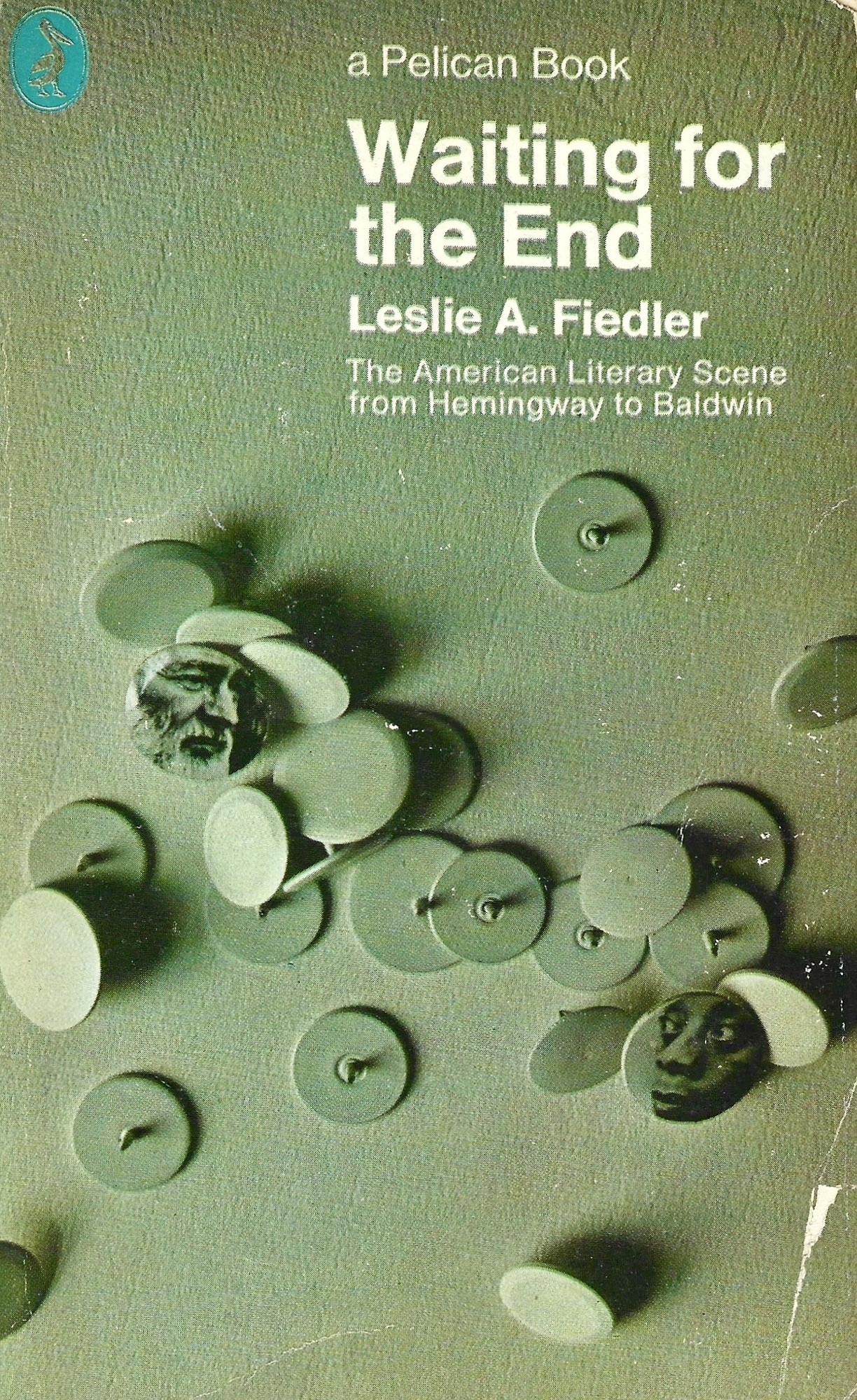
Waiting for the End, Leslie A. Fiedler. Penguin Books, Pelican imprint (1967). Cover design by Freda Morris. 274 pages.

From a riff a few years back:

Fiedler begins with the (then-recent) deaths of Hemingway and Faulkner. Fiedler uses the deaths of these “old men” to riff on the end of Modernism, although he never evokes the term. Neither does he use the term “postmodernism” in his book, although he edges towards it in his critiques of kitsch and middlebrow culture, and especially in his essay “The End of the Novel.” In parts of the book, he gets close to describing, or nearing a description of, an emergent postmodernist literature (John Barth and John Hawkes are favorite examples for Fiedler), but ultimately seems more resigned to writing an elegy for the avant garde. Other aspects of Waiting for the End, while well-intentioned, might strike contemporary ears as problematic, as the kids say, but Fiedler’s sharp and loose style are welcome over stodgy scholarship. Ultimately, I find the book compelling because of its middle position in its take on American literature. It’s the work of a critic seeing the beginnings of something that hasn’t quite emerged yet—but his eye is trained more closely on what’s disappearing into the past.

Donald Barthelme wants you to please tell David Markson that he’s not always coming out of that liquor store where you frequently see him

I lived over near Sixth, and so I’d frequently walk up West Eleventh and we’d run into each other. He was a famous writer, and I had no reputation at all, so I was always kind of quiet around him. He was the Donald Barthelme. Once, I was walking with my daughter, who was about sixteen at the time, and we bumped into him. Afterward, she asked me who he was and I told her, and she said, ‘Dad! You didn’t even introduce me! My friends and I love his work!’ One time, [Barthelme’s editor] Faith Sale passed this message on to my wife; she said, ‘Donald Barthelme wants you to please tell David Markson that he’s not always coming out of that liquor store where you frequently see him. . .It was very funny. I, of course, went to a different liquor store, and was probably there more often than Don was in his!

An anecdote from David Markson, recorded in Tracy Daugherty’s Donald Barthelme biography, Hiding Man.

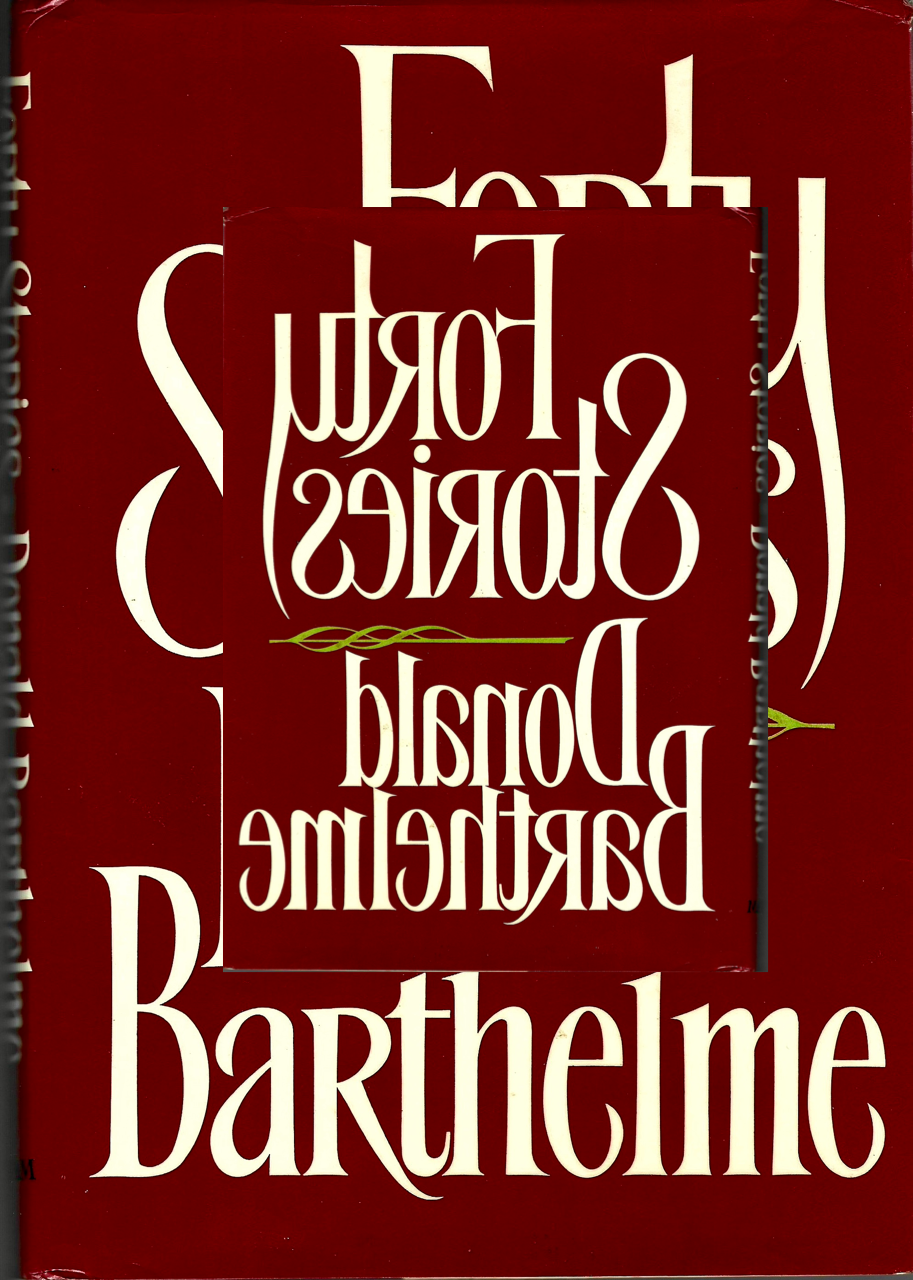
Donald Barthelme’s Forty Stories in reverse, Part II

Previously,

Stories 40-36

35. ” Overnight to Many Distant Cities” (Overnight to Many Distant Cities, 1983)

In Hiding Man, his 2010 Barthelme biography, Tracy Daugherty notes that Barthelme’s collection Overnight to Many Distant Cities was not particularly well-received by critics. Reviews were a mix of bafflement and derision, as Daugherty has it, which fits the tone near the end of Hiding Man: a career winding-down—Barthelme a happy father, content with a teaching gig, and committed to a new form for his stories, now pared down to spare and often oblique dialogues. Daugherty relays a detail from a rejection letter from Barthelme’s (one-time) champion at the New Yorker, Roger Angell: “Well, maybe we’ll learn to read you. It won’t be the first time that happened.”

In my estimation, Barthelme’s later stories do not diverge too radically from his earlier work. The techniques may have evolved (or devolved, if you like), but collage and pastiche are still a major mode, domestic themes prevail, and Our Bard is ever the ironist.

Barthelme sprinkles vignettes throughout Overnight to Many Distant Cities (like Hemingway’s In Our Time); its title track, coming at the end of the collection, is a travelogue in vignettes with our narrator and his family visiting places like Paris, London, Copenhagen… The story is essentially a series of anecdotes and arch asides (“Asked her opinion of Versailles, my daughter said she thought it was overdecorated”), and, as Barthelme’s wife Marion disclosed in Daugherty’s book, some of the material was directly drawn from their honeymoon in Barcelona (“In Barcelona the lights went out”). A taste:

In Stockholm we ate reindeer steak and I told the Prime Minister… That the price of booze was too high. Twenty dollars for a bottle of J&B! He (Olof Palme) agreed, most politely, and said that they financed the Army that way. The conference we were attending was held at a workers’ vacation center somewhat outside the city. Shamelessly, I asked for a double bed, there were none, we pushed two single beds together. An Israeli journalist sat on the two single beds drinking our costly whiskey and explaining the devilish policies of the Likud. Then it was time to go play with the Africans. A poet who had been for a time a Minister of Culture explained why he had burned a grand piano on the lawn in front of the Ministry. “The piano,” he said, “is not the national instrument of Uganda.”

Is it essential Barthelme? Of course not. But it’s nice enough.

34. ” The Film” (first published as “A Film” in the The New Yorker, September 26, 1970)

A nice little story that never quite transcends it’s marvelous opening lines:

Things have never been better, except that the child, one of the stars of our film, has just been stolen by vandals, and this will slow down the progress of the film somewhat, if not bring it to a halt. But might not this incident, which is not without its own human drama, be made part of the story line?

I just went back and read the last lines though, and they are also very good:

Truth! That is another thing they said our film wouldn’t contain. I had simply forgotten about it, in contemplating the series of triumphs that is my private life.

33. “110 West Sixty-First Street” (Amateurs, 1976)

An ugly tragic domestic comedy in just over a dozen paragraphs: Paul and Eugenie are trying to get over the death of their infant by going to erotic films. It doesn’t work; they take up cruelty–

“You are extremely self-righteous,” Eugenie said to Paul. “That is the one thing I can’t stand in a man. Sometimes I want to scream.”

“You are a slut without the courage to go out and be one,” Paul replied. “Why don’t you go to one of those bars and pick up somebody, for God’s sake?”

“It wouldn’t do any good,” Eugenie said.

32. “Captain Blood” (Overnight to Many Distant Cities, 1983)

So like one of my favorite things that Melville does in Moby-Dick is turn the whole thing into a drama, a play that is taking place in the narrator-cum-Ishmael’s consciousness, with Starbuck and Stubb milling and mulling on various decks, soliloquizing. And while the Captain Blood of “Captain Blood” is no Ahab, he’s still a compellingly goofy brooder:

Blood, at dawn, a solitary figure pacing the foredeck. The world of piracy is wide, and at the same time, narrow. One can be gallant all day long, and still end up with a spider monkey for a wife. And what does his mother think of him?

This isn’t Barthelme at his best—that stock was poured into Sixty Stories—but it’s still the jaunty, boyish fun flavor that I want when I dip into his stuff.

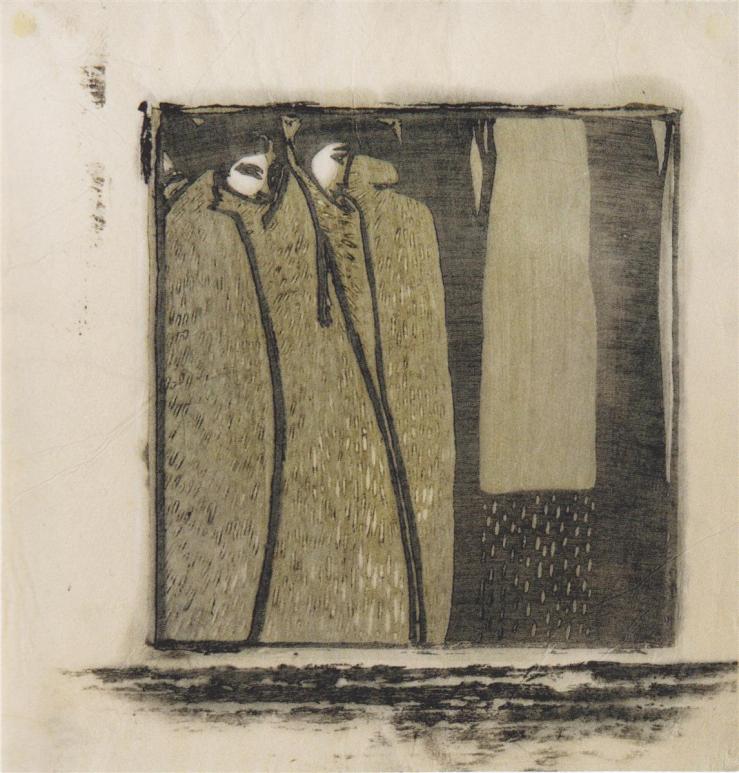
November — Koloman Moser

november-1902hd

November, 1902 by Koloman Moser (1868-1918)