
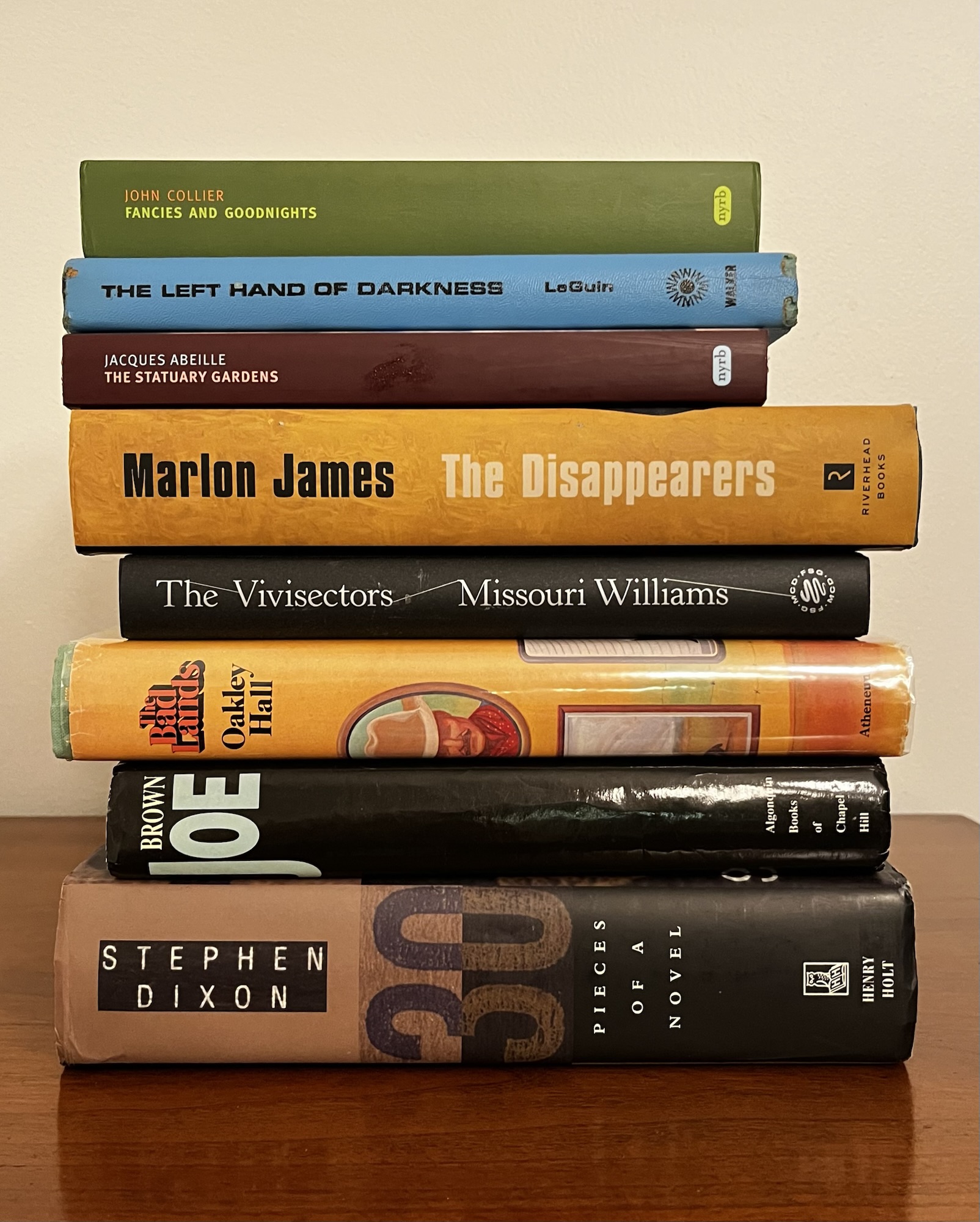
I picked up a copy of NYRB’s reprint of John Collier’s 1951 collection Fancies and Goodnights a few hours ago while browsing books in my favorite used bookstore. Collier’s never been on my radar. The book was on top of a stack on the floor (a common sight in this particular bookstore), and honestly the cover, featuring a painting by Neo Rauch, is what initially engaged me. The back cover claims Collier belongs to “the popular tradition of weird writing that includes E.T.A. Hoffmann and Charles Dickens as well as more recent masters like Jorge Luis Borges and Roald Dahl,” so I was sold. Then I realized that this is the guy who wrote The Monkey Wife, which I’ve been meaning to read for years.
I also left with a jacketless first printing of Ursula Le Guin’s The Left Hand of Darkness. (I have a first edition with a jacket, but it’s a book club edition).
I am about 100 pages into Jacques Abeille’s sci-fi cult classic The Statuary Gardens (new in translation by Alex Andriesse). Strong echoes of Calvino (especially Invisible Cities), and really that strand of sci-fi that’s heavily influenced by anthropology (like, uh, Le Guin’s The Left Hand of Darkness). The Statuary Gardens also reminds me of the last novel I read, Missouri Williams’s The Vivisectors — both feature “gardeners” as a specific social class, and both mix philosophy, anthropology, and literary criticism. The Vivisectors is also a campus novel, sort of. It’s a very weird book, set in a reality just a hair off from our own. The tone is icy and sharp, with a distancing quality similar to Anna Kavan or Ann Quin. The Vivisectors is at its best when engaging with aesthetics (of literature, of city-planning, of love…) — the end didn’t really work for me, but I appreciate the novel and will seek out Williams’s first book, The Doloriad.
Previous to The Vivisectors, I read Marlon James’s sad funny sweet sour bitter and often devastating novel The Disappearers. Set primarily in the late eighties and early nineties in Kingston, Jamaica, the novel follows a group of gay men — “batty men” — who meet secretly to rehearse John Herbert’s play Fortune and Men’s Eyes. A violent mob, led by a dancehall rapper and aided by both the clergy and the police, attacks the men in a brutal, horrifying episode. The rest of the novel traces the fallout of this attack over the years, exploring how the men respond to the violence and alienation they’ve suffered. I found The Disappearers simultaneously easy and difficult — James’s command of his characters’ voices and viewpoints is absorbing and addictive, even as the novel’s violence and depictions of homophobia are painful to experience. I also found the novel strangely nostalgic in its evocations of late eighties/early nineties pop culture. My favorite sections though were the least realistic — a subterranean episode that recalls Chris Claremont’s Morlocks in eighties X-Men and the revenge plot, which focuses on the character Jordan Brown who becomes a kind of dark avenger, reminiscent of Tracker, the protagonist of James’s fantasy novel Black Leopard, Red Wolf. Too, The Disappearers is a shaggy beast, like Black Leopard and its sequel Moon Witch, Spider King. Its conclusion is affecting, and if there are loose threads, well, it’s there in the title — folks will disappear, be disappeared. Mysteries will remain.
(Aside: I wonder if Marlon James was horrified when he read, or if he read, Dwight Garner’s incandescent review of The Disappearers at the end of August in The New York Times? Garner gushed that the book is “a masterpiece, the novel of the decade and possibly of the century thus far.” It’s a good book, but it’s none of these things!)
Bottom of the stack: three hardback novels that I picked up over the past three weeks, none of which I plan to read any time soon but each of which I know I would’ve regretted not picking up when I had the chance: Oakley Hall’s The Bad Lands, Larry Brown’s Joe, and Stephen Dixon’s 30 Pieces of a Novel.


