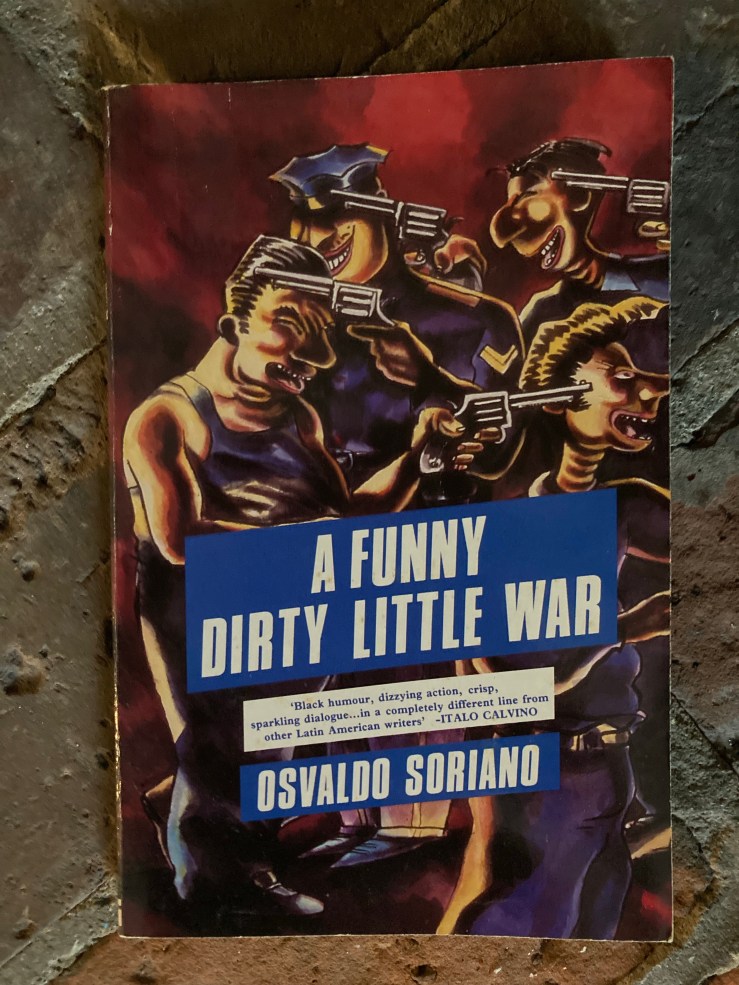
I had never heard of the Argentinian author Osvaldo Soriano, but I plucked his novel A Funny Dirty Little War from the bookstore shelf because of its title. The goofy, menacingly violent cover, featuring an illustration by Oscar Zarate, intrigued me, and the Italo Calvino blurb on the back sold me on the book before I’d even opened it.
Calvino’s blurb offers a succinct summary of the novel:
A Funny Dirty Little War tells the story of a political confrontation in a small village in Argentina. Obscure differences between Peronist supporters and leaders escalate in a crescendo of violence to the final massacre.
Those “obscure differences” first evince as absurd, petty eruptions between the various characters. “You’ve got infiltrators,” the novel opens, and from there accusations accumulate and intensify.
That first accuser is the Inspector, who tells Ignacio, the city’s Council Leader, to fire a mild mannered clerk for his Marxist sympathies. Ignacio refuses, and the early part of the novel casts his as the closest thing to the protagonist. To be clear though, Soriano’s journalistic style recalls Hemingway’s brevity. His camera rarely dips into the interior lives of his characters; most of the action is conveyed in short, punchy sentences and often-terse, often-humorous dialogue. As Calvino observes, the “characters, who with each chapter evolve from the comic and grotesque to the tragic, are observed by the author with a cool, dispassionate gaze.”
The initial grotesquerie lends the novel a farcical air at the outset. Ignacio quickly deputizes an ad hoc militia to square off against the Inspector and his goon squad, and the atmosphere is one of buffoonish amateurism, best encapsulated in the drunken agricultural pilot who takes to the sky to spray DDT on his adversaries. As the violence escalates, we get farther from any ideological differences. Both sides claim to be true Peronists, yet there’s no real politics here beyond grievances exploding into vengeance.
That vengeance and violence overtakes the farcical absurdity of the novel’s first half, sweeping into brusque tragedy. “[In} the end we are left with a feeling of bitter pity,” Calvino writes, and I agree. There is a punchline at the end of the novel, but that punchline isn’t the novel’s cumulative, explosive slaughter—an explosion, an abject corpse laid out on a toilet.
Nick Caistor’s translation telegraphs Soriano’s journalistic, clipped style. At times, I wished that the dialogue might be rougher. While the men do curse at each other, there’s a veneer of gentility that at times seems out of place (at times I found myself substituting words or phrases I thought one of Bolaño’s translators might have employed). A Funny Dirty Little War could be even dirtier.
I’m not sure if Caistor or an editor or even Soriano settled on the English title A Funny Dirty Little War, which, as I mentioned above, called for my attention. Soriano’s original title is No habrá más penas ni olvido: “Pain and longing shall be no more.” This original title (from a tango by Carlos Gardel and Alfredo Le Pera that expresses a longing to return to Argentina) suggests the deeper melancholy behind the narrative’s farcical, funny contours. The novel was first published in 1978, while Soriano was living in exile in Europe after the US-supported 1976 military coup in Argentina. He returned to Buenos Aires in 1984 after the junta’s collapse. Caistor’s English translation of No habrá más penas ni olvido published two years later.
A Funny Dirty Little War will in no way explain the Dirty War to those unfamiliar with its history. The causes and effects here unfold in the most basic way (all in a neat Aristotelian unity of action, place, and time). There is no introspection, no analysis—the violence just escalates. Absurd farce hurtles into absurd tragedy. Yet for all their outlandish, grotesque contours, Soriano’s characters are ultimately sympathetic. Or at least pathetic. In any case, this short novel will reward those who don’t mind their black humor extra bitter, with a heavy dose of violence.