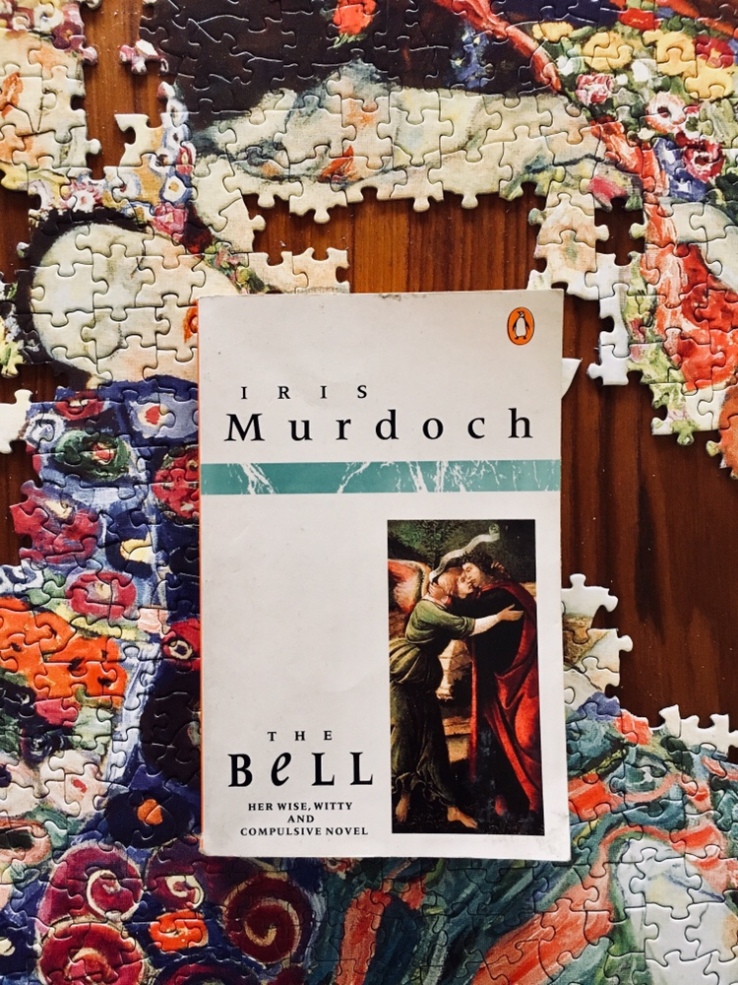
I have just finished Iris Murdoch’s 1958 novel The Bell. This is the first novel I have read by Murdoch and I now want to read more novels by Murdoch, which I suppose is the best praise I can offer the novel.
The Bell is set primarily in Imber House, a large old mansion in the English countryside. Imber House adjoins a Benedictine abbey; this nunnery is essentially closed off to the outside world. The residents of Imber House form a “brotherhood,” a laity of would-be acolytes who strive to find spiritual meaning in the commercial and often venal world of the postwar era. Various conflicts between these characters drive the plot of The Bell.
One of these conflicts, especially notable for a novel published in 1958, involves Michael, the leader of the Imber House community. A former schoolmaster who dreamed of joining the clergy, Michael lost his job in a small scandal for “seducing” one of his students, Nick, a teenage boy at the time. Over a decade later, circumstance brings Nick to Imber House, where his twin sister Katherine is staying. Katherine plans to join Imber Abbey; in the meantime, her family hopes that the religious solitude at Imber House will help Nick recover from his alcoholism. The conflict between Michael and Nick becomes further charged when the youngest member of Imber House, a teenager named Toby, befriends both of them.
I could go on about Michael and Nick and Toby and Katherine and etc., but the real star of The Bell is Dora Greenfield, a wonderfully complicatedly simple unassuming unpretentious flighty former art student who has recently left her demanding husband Paul. Through Murdoch’s precise free indirect style, we get to inhabit Dora’s constantly vacillating mind. Like many people, Dora does not know what she is going to do, and even when she thinks through a plan, she often ends up doing the opposite of what she had intended to do. There is a hilarious passage in the novel’s first chapter when Dora goes through a lengthy imaginative exercise about giving up her train seat to an elderly woman. Dora’s thought experiment ends like this:
She decided not to give up her seat.
She got up and said to the standing lady ‘Do sit down here, please. I’m not going very far, and I’d much rather stand anyway.’
The blank space between those sentences highlights a radical gap between contemplation and action.
The train-seat passage is one of many humorous episodes in The Bell, but Murdoch’s humor is underwritten by a deeper menacing anxiety, which can be neatly summed up in the novel’s opening sentences:
Dora Greenfield left her husband because she was afraid of him. She decided six months later to return to him for the same reason.
Those opening lines basically summarize the big thematic plot of The Bell—the conflict between controlling and ultimately abusive Paul and his much younger wife. (“She married him a little for his money,” Murdoch writes just a few paragraphs in, wedging the detail between more positive aspects of Paul’s character–the “a little” is just genius there, the slightest omission from Dora’s consciousness slipping into the third-person narrator for the briefest of moments). The opening lines of The Bell also showcase Murdoch’s rhetorical powers. Her comic precision here reverberates with a hazardous undertone.
Will Dora really return to her husband? Or will she become her own person—whatever that means? The Bell satisfies these questions with complex answers. The novel has every opportunity to veer toward pat conclusions. Murdoch fills her novel with images that suggest a conventional tragic conclusions, and then surpasses these conventions, turning them into something else. A death by drowning might be foreshadowed, but someone will learn to swim; an epiphany achieved in an art museum might not meet its achievement outside of aesthetic response; the Blakean contraries of innocence and experience might be synthesized into a new, original viewpoint. There’s something real about The Bell—it offers a realism that points outside of its own literary contours. The English novelist A.S. Byatt puts it far better than I can in her essay “Shakespearean Plot in the Novels of Irish Murdoch”:
…The Bell seems to me arguably Miss Murdoch‘s most successful attempt at realism, emotional and social—the tones of voice of the members of the religious community are beautifully caught, the sexual, aesthetic and religious passions and confusions of the three main characters, Dora, Michael, and, to a lesser extent, Toby, are delicately analysed with the combination of intellectual grasp and sensuous immediacy of George Eliot.
Byatt’s comparison to Eliot reminds me that I had intended to read Middlemarch some time this year—but to be fair to myself, I put The Bell on the same list. I won’t be reading Middlemarch next though; The Bell, with its story of a would-be utopian community, strongly reminded me of Nathaniel Hawthorne’s The Blithedale Romance, which I haven’t read in ages. And after I read that, I’d like to read another one by Iris Murdoch. Any recommendations?