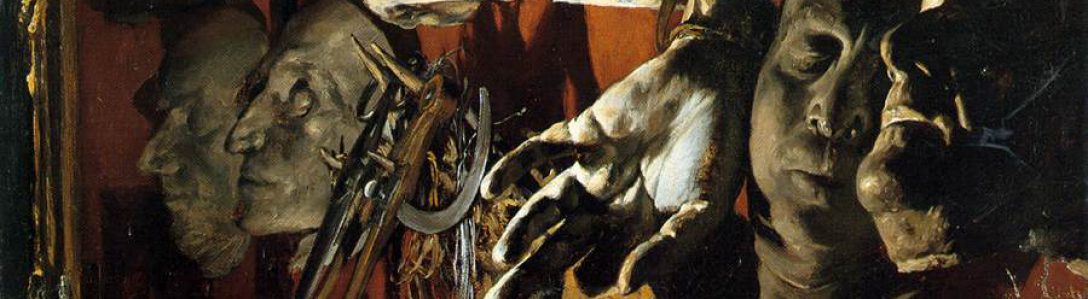
Sunday, 19 July, slept, awoke, slept, awoke, miserable life.
From Diaries, Franz Kafka; trans. by Joseph Kresh.
Sunday, 19 July, slept, awoke, slept, awoke, miserable life.
From Diaries, Franz Kafka; trans. by Joseph Kresh.
“Neglect”
by
Joy Williams
from 99 Stories of God
The Lord was asked if He believed in reincarnation.
I do, He said. It explains so much.
What does it explain, Sir? someone asked.
On your last Fourth of July festivities, I was invited to observe an annual hot-dog-eating contest, the Lord said, and it was the stupidest thing I’ve ever witnessed.
NEGLECT
“The Father”
by
Raymond Carver
The baby lay in a basket beside the bed, dressed in a white bonnet and sleeper. The basket had been newly painted and tied with ice-blue ribbons and padded with blue quilts. The three little sisters and the mother, who had just gotten out of bed and was still not herself, and the grandmother all stood around the baby, watching it stare and sometimes raise its fist to its mouth. He did not smile or laugh, but now and then he blinked his eyes and flicked his tongue back and forth through his lips when one of the girls rubbed his chin.
The father was in the kitchen and could hear them playing with the baby.
“Who do you love, baby?” Phyllis said and tickled his chin.
“He loves us all,” Phyllis said, “but he really loves Daddy because Daddy’s a boy too!”
The grandmother sat down on the edge of the bed and said, “Look at its little arm! So fat. And those little fingers! Just like its mother.”
“Isn’t he sweet?” the mother said. “So healthy, my little baby.” And bending over, she kissed the baby on its forehead and touched the cover over its arm. “We love him too.”
“But who does he look like, who does he look like?” Alice cried, and they all moved up closer around the basket to see who the baby looked like.
“He has pretty eyes,” Carol said.
“All babies have pretty eyes,” Phyllis said.
“He has his grandfather’s lips,” the grandmother said. “Look at those lips.”
“I don’t know . . .” the mother
said. “I wouldn’t say.”
“The nose! The nose!” Alice cried.
“What about his nose?” the mother asked.
“It looks like somebody’s nose,” the girl answered.
“No, I don’t know,” the mother said. “I don’t think so.”
“Those lips . . .” the grandmother murmured. “Those little fingers . . .” she said, uncovering the baby’s hand and spreading out its fingers.
“Who does the baby look like?”
“He doesn’t look like anybody,” Phyllis said. And they moved even closer.
“I know! I know!” Carol said. “He looks like Daddy!” Then they looked closer at the baby.
“But who does Daddy look like?” Phyllis asked.
“Who does Daddy look like?” Alice repeated, and they all at once looked through to the kitchen where the father was sitting at the table with his back to them.
“Why, nobody!” Phyllis said and began to cry a little.
“Hush,” the grandmother said and looked away and then back at the baby.
“Daddy doesn’t look like anybody!” Alice said.
“But he has to look like somebody,” Phyllis said, wiping her eyes with one of the ribbons. And all of them except the grandmother looked at the father, sitting at the table.
He had turned around in his chair and his face was white and without expression.
“A Continuity of Parks”
by
Julio Cortázar
translated by Paul Blackburn
He had begun to read the novel a few days before. He had put it down because of some urgent business conferences, opened it again on his way back to the estate by train; he permitted himself a slowly growing interest in the plot, in the characterizations. That afternoon, after writing a letter giving his power of attorney and discussing a matter of joint ownership with the manager of his estate, he returned to the book in the tranquility of his study which looked out upon the park with its oaks. Sprawled in his favorite armchair, its back toward the door—even the possibility of an intrusion would have irritated him, had he thought of it—he let his left hand caress repeatedly the green velvet upholstery and set to reading the final chapters. He remembered effortlessly the names and his mental image of the characters; the novel spread its glamour over him almost at once. He tasted the almost perverse pleasure of disengaging himself line by line from the things around him, and at the same time feeling his head rest comfortably on the green velvet of the chair with its high back, sensing that the cigarettes rested within reach of his hand, that beyond the great windows the air of afternoon danced under the oak trees in the park. Word by word, caught up in the sordid dilemma of the hero and heroine, letting himself be absorbed to the point where the images settled down and took on color and movement, he was witness to the final encounter in the mountain cabin. The woman arrived first, apprehensive; now the lover came in, his face cut by the backlash of a branch. Admirably, she stanched the blood with her kisses, but he rebuffed her caresses, he had not come to perform again the ceremonies of a secret passion, protected by a world of dry leaves and furtive paths through the forest. The dagger warmed itself against his chest, and underneath liberty pounded, hidden close. A lustful, panting dialogue raced down the pages like a rivulet of snakes, and one felt it had all been decided from eternity. Even to those caresses which writhed about the lovers body, as though wishing to keep him there, to disuade him from it; they sketched abominably the frame of that other body it was necessary to destroy. Nothing had been forgotten: alibis, unforeseen hazards, possible mistakes. From this hour on, each instant had its use minutely assigned. The cold-blooded, twice-gone-over reexamination of the details was barely broken off so that a hand could caress a cheek. It was beginning to get dark.
Not looking at one another now, rigidly fixed upon the task which awaited them, they separated at the cabin door. She was to follow the trail that led north. On the path leading in the opposite direction, he turned for a moment to watch her running, her hair loosened and flying. He ran in turn, crouching among the trees and hedges until, in the yellowish fog of dusk, he could distinguish the avenue of trees which led up to the house. The dogs were not supposed to bark, they did not bark. The estate manager would not be there at this hour, and he was not there. He went up the three porch steps and entered. The woman’s words reached him over the thudding of blood in his ears, first a blue chamber, then a hall, then a carpeted stairway. At the top, two doors. No one in the first room, no one in the second. The door of the salon, and then, the knife in hand, the light from the great windows, the high back of an armchair covered in green velvet, the head of the man in the chair reading a novel.
“Ape”
by
Russell Edson
You haven’t finished your ape, said mother to father, who had monkey hair and blood on his whiskers.
I’ve had enough monkey, cried father.
You didn’t eat the hands, and I went to all the trouble to make onion rings for its fingers, said mother.
I’ll just nibble on its forehead, and then I’ve had enough, said father.
I stuffed its nose with garlic, just like you like it, said mother.
Why don’t you have the butcher cut these apes up? You lay the whole thing on the table every night; the same fractured skull, the same singed fur; like someone who died horribly. These aren’t dinners, these are postmortem dissections.
Try a piece of its gum, I’ve stuffed its mouth with bread, said mother.
Ugh, it looks like a mouth full of vomit. How can I bite into its cheek with bread spilling out of its mouth? cried father.
Break one of the ears off, they’re so crispy, said mother.
I wish to hell you’d put underpants on these apes; even a jockstrap, screamed father.
Father, how dare you insinuate that I see the ape as anything more than simple meat, screamed mother.
Well, what’s with this ribbon tied in a bow on its privates? screamed father.
Are you saying that I am in love with this vicious creature? That I would submit my female opening to this brute? That after we had love on the kitchen floor I would put him in the oven, after breaking his head with a frying pan; and then serve him to my husband, that my husband might eat the evidence of my infidelity … ?
I’m just saying that I’m damn sick of ape every night, cried father.
“The Definition”
by
Russell Edson
He that puts suicide into his left ear pretends it is wax. His mother says, but it’s a bullet which you have shot yourself with.
Is that how I died? he said.
That’s when the funeral began, it was like a flower festival; your father asked me to marry him, and with much declining as to appear of greater value I agreed. Of the two of us, your father and I, so overlapping we blurred into three. I said, how is this? Your father said, this is this. And this was you. But for a time we could not tell who any of us were. Your father said, who am I? And I said, am I you? And he said, if you are me then I am the small one there and the small one is you. And after much declining I agreed to be anyone; I said, someone is passing the house, shall I be someone passing the house? … and so forth. Until we discovered that we had shadows; so that in the morning we would assemble and let the sun stencil us on the wall: The largest of the three we allowed would be the father, the next largest, the mother, and the smallest, the third one, which you were called as we did not know who you were …
And that you might be a wood god or the spirit of the house … So that we allowed
you to define yourself.
But of my suicide? …
But you see that is another definition of the first turning which was turned when I wasn’t looking …
And of my death? …
As a festival of flowers … declining as to appear of greater value …
“Actually”
by
Joy Williams
from 99 Stories of God
The child wanted to name the rabbit Actually, and could not be dissuaded from this.
It was the first time one of our pets was named after an adverb.
It made us uncomfortable. We thought it to be bad luck.
But no ill befell any of us nor did any ill befall the people who visited our home.
Everything proceeded beautifully, in fact, until Actually died.
ACTUALLY
“This Condition”
by
Lydia Davis
In this condition: stirred not only by men but by women, fat and thin, naked and clothed; by teenagers and children in latency; by animals such as horses and dogs; by certain vegetables such as carrots, zucchinis, eggplants, and cucumbers; by fruits such as melons, grapefruits, and kiwis; by certain plant parts such as petals, sepals, stamens, and pistils; by the bare arm of a wooden chair, a round vase holding flowers, a little hot sunlight, a plate of pudding, a person entering a tunnel in the distance, a puddle of water, a hand alighting on a smooth stone, a hand alighting on a bare shoulder, a naked tree limb; by anything curved, bare, and shining, as the limb or bole of a tree; by any touch, as the touch of a stranger handling money; by anything round and freely hanging, as tassels on a curtain, chestnut burrs on a twig in spring, a wet tea bag on its string; by anything glowing, as a hot coal; anything soft or slow, as a cat rising from a chair; anything smooth and dry, as a stone, or warm and glistening; anything sliding, anything sliding back and forth; anything sliding in and out with an oiled surface, as certain machine parts; anything of a certain shape, like the state of Florida; anything pounding, anything stroking; anything bolt upright, anything horizontal and gaping, as a certain sea anemone; anything warm, anything wet, anything wet and red, anything turning red, as the sun at evening; anything wet and pink; anything long and straight with a blunt end, as a pestle; anything coming out of anything else, as a snail from its shell, as a snail’s horns from its head; anything opening; any stream of water running, any stream running, any stream spurting, any stream spouting; any cry, any soft cry, any grunt; anything going into anything else, as a hand searching in a purse; anything clutching, anything grasping; anything rising, anything tightening or filling, as a sail; anything dripping, anything hardening, anything softening.
“A Society of Scoundrels”
by
Franz Kafka
Translated by Michael Hofmann
There was once a society of scoundrels, or rather not scoundrels per se, just ordinary, average people. They always stuck together. When one of them had perpetrated some rascally act, or rather, nothing really rascally, just averagely bad, he would confess it to the others, and they investigated it, condemned it, imposed penalties, forgave him, etc. This wasn’t corrupt — the interests of the individual and the society were kept in balance and the confessor received the punishment he asked for. So they always stuck together, and even after their death they didn’t abandon their society, but ascended to heaven in a troop. It was a sight of childlike innocence to see them flying. But since everything at heaven’s gate is broken up into its component parts, they plunged down like so many rocks.
“Old Movie”
by
William S. Burroughs
In the noon streets three men sitting on ash cans. One of the men looked up and saw Agent 23. Electric hate crackled between them. In a panic 23 tried to pull his eyes back. He could not do so. He held one point and felt the pilot land. Something cracked in his head like a red egg and the ground swayed beneath him then he could feel it pouring out his eyes. A crowd was gathering quick and silent eyes blazing hate. 23 ran toward them up the narrow street moving his head from side to side burning a path through charred flesh and shredded brains running very light on his feet up the steep stone street toward the skies of Marrakech the whole film tilted now the stones moving in waves under his feet a blaze of blue and he was stabbing two black holes in the blue sky smoking with a sound like falling mountains the sky ripped open and he was through the film barrier. Standing naked in front of a washstand copper luster basin the film jumped and shifted music across the golf course he was a caddy it seems looking for lost balls by the pond flickering silver buttocks in the dark room fading flickering all from an old movie that will give at his touch.
“Buried in Colorado All Alone”
by
Joy Williams
from 99 Stories of God
The girl from the pharmacy who delivered Darvon to Philip K. Dick, the science fiction writer, wore a golden fish necklace.
“What does that mean?” asked Dick.
She touched it and said, “This is a sign worn by the early Christians so that they would recognize one another.”
“In that instant,” Dick writes, “I suddenly experienced anamnesis, a Greek word meaning, literally, loss of forgetfulness.”
Anamnesis is brought on by the action of the Holy Spirit. The person remembers his true identity throughout all his lives. The person recognizes the world for what it is—his own prior thought formations—and this generates the flash. He now knows where he is.
BURIED IN COLORADO ALL ALONE
“Detective Novel”
by
Robert Walser
translated by Tom Whalen
HE PRETENDED to possess technical expertise. Anyway, the title seemed quite brilliant. I resolved to learn more and started reading him, but he left much to be desired. Both he and his author lacked a certain finesse. He seemed to have no place to call home. How can I cuddle up to someone who isn’t comfortable with himself? His sentences were laborious paths for those who tread on them. I remember far more beautiful rambles and gladly admit this, since I gain by this admission. He was viewed quite kindly. An attempt to create interesting situations was discovered with delight. Already the first chapter stretched out to the most accommodating length imaginable. Each paragraph elicited from me a grateful yawn. By the way, I think the time of the detective novel is over. The puzzling disappearance of refined, charming people doesn’t seem very fresh these days. Authors have operated more than enough with chemicals and the like. I did my best to succumb to his charms, but alas I failed in this endeavor. Perhaps I lack the openness, I said, smiling at one of those persons (I mean myself) unsympathetic to some new releases. In fact, I find it aggravating to say yes to everything. In the course of the events he let me gaze into a Russian female. It may be that I’m expressing myself a bit sloppily here. All in all, for what he was, I found him unable to live up to himself. I hold his father responsible that I’m pained by his existence. My contemporaries may note his innocuousness. But can a detective novel be innocuous? Doesn’t he fail when, instead of arousing suspense, he allows us to be bored in his presence? Ambitious lackey, it would be best if you vanished. That you were published was your misfortune. Whoever reads you pities you. Whoever investigates you has to laugh at you, though, alas, alas, you’re innocent! In any case, you’re not what you should be. What you could be if things had turned out right you aren’t, because things didn’t turn out right. Fare thee well, unwarranted detective novel.
“55 Miles to the Gas Pump”
by
Annie Proulx
Rancher Croom in handmade boots and filthy hat, that walleyed cattleman, stray hairs like the curling fiddle string ends, that warm-handed, quick-foot dancer on splintery boards or down the cellar stairs to a rack of bottles of his own strange beer, yeasty, cloudy, bursting out in garlands of foam, Rancher Croom at night galloping drunk over the dark plain, turning off at a place he knows to arrive at a canyon brink where he dismounts and looks down on tumbled rock, waits, then steps out, parting the air with his last roar, sleeves surging up, windmill arms, jeans riding over boot tops, but before he hits he rises again to the top of the cliff like a cork in a bucket of milk.
Mrs. Croom on the roof with a saw cutting a hole into the attic where she has not been for twelve years thanks to old Croom’s padlocks and warnings, whets to her desire, and the sweat flies as she exchanges the saw for a chisel and hammer until a ragged slab peak is free and she can see inside: just as she thought: the corpses of Mr. Croom’s paramours – she recognizes them from their photographs in the paper: MISSING WOMAN – some desiccated as jerky and much the same color, some moldy from lying beneath roof leaks, and, all of them used hard, covered with tarry handprints, the marks of boot heels, some bright blue with remnants of paint used on the shutters years ago, one wrapped in newspaper nipple to knee.
When you live a long way out you make your own fun.
“The Nobel Prize”
by
Robert Walser
translated by Tom Whalen
Today, thank God, I’m back in the pink again, which I definitely deserve because I’m a nice person. How was it for me yesterday? I was emotionally ill. Full of thoughts, I ran about vehemently and at the same time galled. And why was that? I believed my colleague Hopeful had won the Nobel Prize in Literature. A notice in the paper had fooled me. How gullible I am! I took my countryman High-hope for the happiest person and myself in consequence for the unhappiest. I imagined all the pretty girls had already composed the most talented satirical poems about me. Yet nevertheless, with what strength, what grandeur I conducted myself! With what composure I strode forth. I can barely describe it. In any case I’m satisfied with myself. I had received an apparently hard blow, but inwardly I did not refuse, not even for a minute, to accept the perfidy of fate. This morning I checked and learned that Persistence, not Hopeful, had received the Nobel Prize. Persistence is someone whom I do not begrudge the honor. The sensations one has. Regarding my dear compatriot Hopejoy, I can calm myself. This pleases me, and since I’m full of joy, I can allow myself to be seen again. Yesterday I thought I had become impossible to my countrymen. Thankfully this unpleasant notion had to retreat. My friend Hopeful is at work. I want to be as well. I can now. I’m capable of this anew. To the same extent that Persistence was crowned with the Nobel Prize, I am crowned with the most cheerful serenity. Yesterday I was like a snapped-off plant, while today I’m a sturdy tree. What illusions can do to us! Brain power, you’re weird! Now that this Nobel Prize business no longer weighs on me, how noble I seem. Yes, the world is gay and serious.
“Ghosts”
by
Robert Walser
translated by Tom Whalen
I don’t know if it can be to my advantage to review a kind of dime novel in which, as far as I can remember, there stood in a pretty little town a haunted tower.
In my opinion ghosts are very modern. It seems to me it’s become fashionable to believe, with a certain persistent willfulness, in inexplicable appearances.
One must admit this takes courage. As for me, I lived temporarily, if I dare say so straight out, in a bright, wide, two-windowed room. One night I awoke in bed and saw, on one of the armchairs or stools that came with the room, someone sitting.
Something nonexistent was existent, for when I had gone nearer to inspect or examine the place, the something (undoubtedly I was dealing with a ghost here) had evaporated.
To return to my little booklet in which, among other things, a young woman danced: it’s been quite some time since I perused this work, which dealt mainly with an ingenious Hans who, in all innocence and innocuousness, pulled off, as it were, a stroke of genius.
The landscape seemed to me delightfully sketched; the subject matter revolved as much around money as around love. A little river that stretched around the town the author had charmingly entrusted to blab mysterious things. The brooklet in this regard proved to be immensely talented, since it busily burbled and babbled night and day.
Attentively I listened in on the engaging story. Roles were swapped, young sophisticated girls sat in the pleasing interiors of music stores, into which one glanced in passing.
Hans proved to be a complications-disentangler.
I like to imagine my up-to-the-minute diction as tabloidish. I hope this will be judged kindly.
A beautiful woman sat interestingly ghostlike, I mean conspicuously thin, thus in fashion, at a window. Hans bestowed upon her his interest. In his eyes lay so much justifiable or baseless melancholy that the woman leapt up in bewilderment.
These and similar events occurred in the little volume whose author I don’t name because he hardly wishes it. There are little books we read as if we’re eating something delicious. We quickly forget them. After a certain amount of time, perhaps we recall them again. They’re like people we’re capable of loving because they’re not difficult. I also wish this for what I have written here.
“Legend” by Jorge Luis Borges
Translated by Andrew Hurley
Cain and Abel came upon each other after Abel’s death. They were walking through the desert, and they recognized each other from afar, since both men were very tall. The two brothers sat on the ground, made a fire, and ate. They sat silently, as weary people do when dusk begins to fall. In the sky, a star glimmered, though it had not yet been given a name. In the light of the fire, Cain saw that Abel’s forehead bore the mark of the stone, and he dropped the bread he was about to carry to his mouth and asked his brother to forgive him.
“Was it you that killed me, or did I kill you?” Abel answered. “I don’t re-member anymore; here we are, together, like before.”
“Now I know that you have truly forgiven me,” Cain said, “because forgetting is forgiving. I, too, will try to forget.”
“Yes,” said Abel slowly. “So long as remorse lasts, guilt lasts.”