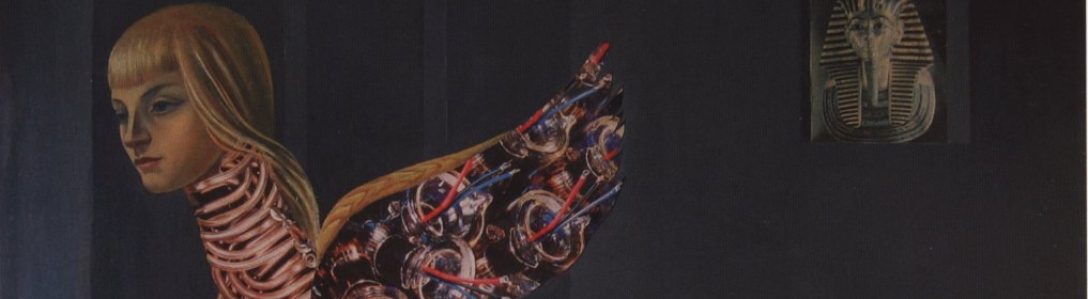
“A Sudden Story”
by
Robert Coover
Once upon a time, suddenly, while it still could, the story began. For the hero, setting forth, there was of course nothing sudden about it, neither about the setting forth, which he’d spent his entire lifetime anticipating, nor about any conceivable endings, which seemed, like the horizon, to be always somewhere else. For the dragon, however, who was stupid, everything was sudden. He was suddenly hungry and then he was suddenly eating something. Always, it was like the first time. Then, all of a sudden, he’d remember having eaten something like that before: a certain familiar sourness… And, just as suddenly, he’d forger. The hero, coming suddenly upon the dragon (he’d been trekking for years through enchanted forests, endless deserts, cities carbonized by dragonbreath, for him “suddenly” was not exactly the word), found himself envying, as he drew his sword (a possible ending had just loomed up before him, as though the horizon had, with the desperate illusion of suddenness, tipped), the dragon’s tenseless freedom. Freedom? the dragon might have asked, had he not been so stupid, chewing over meanwhile the sudden familiar sourness (a memory… ?) on his breath. From what?
(Forgotten.)
Category: microfiction
Robert Coover reads “The Fall Guy’s Faith”
“The Fall Guy’s Faith”
by
Robert Coover
Falling from favor, or grace, some high artifice, down he dropped like a discredited predicate through what he called space (sometimes he called it time) and with an earsplitting crack splattered the base earth with his vital attributes. Oh, I’ve had a great fall, he thought as he lay there, numb with terror, trying desperately to pull himself together again. This time (or space) I’ve really done it! He had fallen before of course: short of expectations, into bad habits, out with his friends, upon evil days, foul of the law, in and out of love, down in the dumps—indeed, as though egged on by some malevolent metaphor generated by his own condition, he had always been falling, had he not?—but this was the most terrible fall of all. It was like the very fall of pride, of stars, of Babylon, of cradles and curtains and angels and rain, like the dread fall of silence, of sparrows, like the fall of doom. It was, in a word, as he knew now, surrendering to the verb of all flesh, the last fall (his last anyway: as for the chips, he sighed, releasing them, let them fall where they may)—yet why was it, he wanted to know, why was it that everything that had happened to him had seemed to have happened in language? Even this! Almost as though, without words for it, it might not have happened at all! Had he been nothing more, after all was said and done, than a paraphrastic curiosity, an idle trope, within some vast syntactical flaw of existence? Had he fallen, he worried as he closed his eyes for the last time and consigned his name to history (may it take it or leave it), his juices to the soil (was it soil?), merely to have it said he had fallen? Ah! tears tumbled down his cheeks, damply echoing thereby the greater fall, now so ancient that he himself was beginning to forget it (a farther fall perhaps than all the rest, this forgetting: a fall as it were within a fall), and it came to him in these fading moments that it could even be said that, born to fall, he had perhaps fallen simply to be born (birth being less than it was cracked up to be, to coin a phrase)! Yes, yes, it could be said, what can not be said, but he didn’t quite believe it, didn’t quite believe either that accidence held the world together. No, if he had faith in one thing, this fallguy (he came back to this now), it was this: in the beginning was the gesture, and that gesture was: he opened his mouth to say it aloud (to prove some point or other?), but too late—his face cracked into a crooked smile and the words died on his lips . . .
“Marmosets,” a very short story by Clarice Lispector
“Marmosets”
by
Clarice Lispector
translated by Elizabeth Bishop
The first time we had a marmoset was just before New Year’s. We were without water and without a maid, people were lining up to buy meat, the hot weather had suddenly begun—when, dumfounded, I saw the present enter the house, already eating a banana, examining everything with great rapidity, and with a long tail. It looked like a monkey not yet grown; its potentialities were tremendous. It climbed up the drying clothes to the clothesline, where it swore like a sailor, and the banana-peelings fell where they would. I was exhausted already. Every time I forgot and absentmindedly went out on the back terrace, I gave a start: there was that happy man. My younger son knew, before I did, that I would get rid of this gorilla: “If I promise that sometime the monkey will get sick and die, will you let him stay? Or if you knew that sometime he’d fall out the window, somehow, and die down there?” My feelings would glance aside. The filthiness and blithe unconsciousness of the little monkey made me responsible for his fate, since he himself would not take any blame. A friend understood how bitterly I had resigned myself, what dark deeds were being nourished beneath my dreaminess, and rudely saved me: a delighted gang of little boys appeared from the hill and carried off the laughing man. The new year was devitalized but at least monkey-less.
A year later, at a time of happiness, suddenly there in Copacabana I saw the small crowd. I thought of my children, the joys they gave me, free, unconnected with the worries they also gave me, free, and I thought of a chain of joy: “Will the person receiving this pass it along to someone else,” one to another, like a spark along a train of powder. Then and there I bought the one who would be called Lisette.
She could almost fit in one hand. She was wearing a skirt, and earrings, necklace, and bracelet of glass beads. The air of an immigrant just disembarking in her native costume. Like an immigrant’s, too, her round eyes.
This one was a woman in miniature. She lived with us three days. She had such delicate bones. She was of such a sweetness. More than her eyes, her look was rounded. With every movement, the earrings shook; the skirt was always neat, the red necklace glinted. She slept a lot, but, as to eating, she was discreet and languid. Her rare caress was only a light bite that left no mark.
On the third day we were out on the back terrace admiring Lisette and the way she was ours. “A little too gentle,” I thought, missing the gorilla. And suddenly my heart said harshly: “But this isn’t sweetness. This is death.” The dryness of the message left me calm. I said to the children: “Lisette is dying.” Looking at her, I realized the stage of love we had already reached. I rolled her up in a napkin and went with the children to the nearest first-aid station, where the doctor couldn’t attend to her because he was performing an emergency operation on a dog. Another taxi—”Lisette thinks she’s out for a drive, mama”—another hospital. There they gave her oxygen.
And with the breath of life, a Lisette we hadn’t known was revealed. The eyes less round, more secretive, more laughing, and in the prognathous and ordinary face a certain ironic haughtiness. A little more oxygen and she wanted to speak so badly she couldn’t bear being a monkey; she was, and she would have had much to tell. More oxygen, and then an injection of salt solution; she reacted to the prick with an angry slap, her bracelet glittering. The male nurse smiled: “Lisette! Gently, my dear!”
The diagnosis: she wouldn’t live unless there was oxygen at hand, and even then it was unlikely. “Don’t buy monkeys in the street,” he scolded me; “sometimes they’re already sick.” No, one must buy dependable monkeys, and know where they came from, to ensure at least five years of love, and know what they had or hadn’t done, like getting married. I discussed it with the children a minute. Then I said to the nurse: “You seem to like Lisette very much. So if you let her stay a few days, near the oxygen, you can have her.” He was thinking. “Lisette is pretty!” I implored.
“She’s beautiful!” he agreed, thoughtfully. Then he sighed and said, “If I cure Lisette, she’s yours.” We went away with our empty napkin.
The next day they telephoned, and I informed the children that Lisette had died. The younger one asked me, “Do you think she died wearing her earrings?” I said yes. A week later the older one told me, “You look so much like Lisette!”
I replied, “I like you, too.”
“Ordinary Nudes,” a very short story by Stuart Dybek
“Ordinary Nudes”
by
Stuart Dybek
She stands before the full-length mirror that’s framed by the bedroom door, observing how her nipples, navel, and the delta of copper hair, which has grown back at the confluence of her thighs, shimmer in the dusky light. Her reflection dimples and ripples like the surface of a pond where fish rise to feed on a mayfly hatch. Imagine his wonder when in the years to come he’ll realize that she was not to be confused with ordinary nudes—not some nymph frolicking along the shore, or goddess ascending from sea foam, or ballerina poised to wade into her morning bath. Those photographs she let him take, kept in a drawer, beneath his underwear as if hidden in the depths, will age as she does.
“The Darlette” — Henri Michaux
“The Darlette”
by
Henri Michaux
translated by Richard Ellmann
The Darelette is found in dry and sandy terrain. It is not a plant but an agile beast, corseted and boned unlike any insect, fat as a rat and long as one, if the tail is included.
If a man jumps on her last segment (there are three), it may well break if the animal has not arrived at adult age.
Since the inside, under walls as thick as a little finger, does not contain any essential organs, the wounded beast continues her walk with her abdomen pounded to jelly and her walls breached. She is a beast who fears no one, eats snakes, and goes to suck the udders of cows which do not dare move.
The ditch spider makes war on her successfully; it winds around her, overwhelms her with threads; as soon as she is paralyzed, it pumps her out completely through the ears.
Her rosy ears and her eyes and her internal organs are the only tender parts of her body.
It pumps her out completely through the ears.
“In the Woods,” a very short story by Ron Loewinsohn
“In the Woods”
by
Ron Loewinsohn
The woodsman plods up the hill with his axe on his shoulder. He works for a lumber company and never sees the man who signs his checks, but his knowledge of the trees he euts down is their smells in the air become suddenly dusty around him, the squirrels and small birds who live in their branches, the squeak his axe makes as he pulls it out of the tree, the feel of his shoulders and arms as he swings, with his feet planted firmly and widely. This morning he saw the lovers lying on a bed of moss in the clearing behind him, but he didn’t stop. They were fully clothed and as they slept he saw the naked sward between them rusted to a sliver. They have been there forever, he knew, tho he’d never seen them before, with the light coming down thru the branches playing on them there as if they slept at the bottom of a lake. He will think of them once or twice as he climbs into the truck with the others, or just before he lifts a french fry to his mouth. Then someone will speak to him and he’ll answer with his mouth full, while we are haunted by the image, the two bodies filled with repose like a lake in the mountains. The two young people with perfect features fill our dreams, fill them to overflowing, even before we reach sleep, plodding toward it, shaking our heads on the pillow, reaching out to the watch, running our fingers thru our hair again, and hearing in the darkness the sound of our swallowing. And they the two lovers asleep on the mossy bank—what do they dream of? They dream of us. Their dreams are haunted by us straining our eyes in the dim light, our stomachs knotted with anxiety, spilling the drink and wiping it up, sweating and reaching for the branch, feeling the bark and smelling the sap, wanting each other in the empty room and letting our face fall into our hands, aching and hanging on. They dream of the woodsman, the actual woodsman and the dust be raises.
The woodsman plods up the hill with his axe on his shoulder. He works for a lumber company and never sees the man who signs his checks, but his knowledge of the trees he euts down is their smells in the air become suddenly dusty around him, the squirrels and small birds who live in their branches, the squeak his axe makes as he pulls it out of the tree, the feel of his shoulders and arms as he swings, with his feet planted firmly and widely. This morning he saw the lovers lying on a bed of moss in the clearing behind him, but he didn’t stop. They were fully clothed and as they slept he saw the naked sward between them rusted to a sliver. They have been there forever, he knew, tho he’d never seen them before, with the light coming down thru the branches playing on them there as if they slept at the bottom of a lake. He will think of them once or twice as he climbs into the truck with the others, or just before he lifts a french fry to his mouth. Then someone will speak to him and he’ll answer with his mouth full, while we are haunted by the image, the two bodies filled with repose like a lake in the mountains. The two young people with perfect features fill our dreams, fill them to overflowing, even before we reach sleep, plodding toward it, shaking our heads on the pillow, reaching out to the watch, running our fingers thru our hair again, and hearing in the darkness the sound of our swallowing. And they the two lovers asleep on the mossy bank—what do they dream of? They dream of us. Their dreams are haunted by us straining our eyes in the dim light, our stomachs knotted with anxiety, spilling the drink and wiping it up, sweating and reaching for the branch, feeling the bark and smelling the sap, wanting each other in the empty room and letting our face fall into our hands, aching and hanging on. They dream of the woodsman, the actual woodsman and the dust be raises.
“Wife in Reverse,” a very short story by Stephen Dixon
“Wife in Reverse”
by
Stephen Dixon
His wife dies, mouth slightly parted and one eye open. He knocks on his younger daughter’s bedroom door and says “You better come. Mom seems to be expiring.” His wife slips into a coma three days after she comes home and stays in it for eleven days. They have a little party second day she’s home: Nova Scotia salmon, chocolates, a risotto he made, brie cheese, strawberries, champagne. An ambulette brings his wife home. She says to him “Wheel me around the garden before I go to bed for the last time.” His wife refuses the feeding tube the doctors want to put in her and insists she wants to die at home. She says “I don’t want any more life support, medicines, fluid or food.” He calls 911 for the fourth time in two years and tells the dispatcher “My wife; I’m sure she has pneumonia again.” His wife has a trach put in. “When will it come out?” she says, and the doctor says “To be honest? Never.” “Your wife has a very bad case of pneumonia,” the doctor in ICU tells him and his daughters the first time, “and has a one to two percent chance of surviving.” His wife now uses a wheelchair. His wife now uses a motor cart. His wife now uses a walker with wheels. His wife now uses a walker. His wife has to use a cane. His wife’s diagnosed with MS. His wife has trouble walking. His wife gives birth to their second daughter. “This time you didn’t cry,” she says, and he says “I’m just as happy, though.” His wife says to him “Something seems wrong with my eyes.” His wife gives birth to their daughter. The obstetrician says “I’ve never seen a father cry in the birthing room.” The rabbi pronounces them husband and wife, and just before he kisses her, he bursts out crying. “Let’s get married,” he says to her, and she says “It’s all right with me,” and he says “It is?” and starts crying. “What a reaction,” she says, and he says “I’m so happy, so happy,” and she hugs him and says “So am I.” She calls and says “How are you? Do you want to meet and talk?” She drops him off in front of his building and says “It’s just not working.” They go to a restaurant on their first real date and he says “The reason I’m being so picky as to what to eat is that I’m a vegetarian, something I was a little reluctant to tell you so soon,” and she says “Why? It’s not peculiar. It just means we won’t share our entrees except for the vegetables.” He meets a woman at a party. They talk for a long time. She has to leave the party and go to a concert. He gets her phone number and says “I’ll call you,” and she says “I’d like that.” He says goodbye to her at the door and shakes her hand. After she leaves he thinks “That woman’s going to be my wife.”
“Daniela de Montecristo” — Roberto Bolaño
“Daniela de Montecristo”
by
Roberto Bolaño
translated by Chris Andrews
from Nazi Literature in the Americas
Daniela de Montecristo
Buenos Aires, 1918–Córdoba, Spain, 1970
Daniela de Montecristo was a woman of legendary beauty, surrounded by an enduring aura of mystery. The stories that have circulated about her first years in Europe (1938-1947) rarely concur and often flatly contradict one another. It has been said that among her lovers were Italian and German generals (including the infamous Wolff, SS and Police Chief in Italy); that she fell in love with a general in the Rumanian army, Eugenio Entrescu, who was crucified by his own soldiers in 1944; that she escaped from Budapest under siege disguised as a Spanish nun; that she lost a suitcase full of poems while secretly crossing the border from Austria into Switzerland in the company of three war criminals; that she had audiences with the Pope in 1940 and 1941; that out of unrequited love for her, a Uruguayan and then a Colombian poet committed suicide; and, that she had a black swastika tattooed on her left buttock.
Her literary work, leaving aside the juvenilia lost among the icy peaks of Switzerland, never to appear again, consists of a single book, with a rather epic title: The Amazons, published by Quill Argentina, with a preface by the widow Mendiluce, who could not be accused of restraint when it came to lavishing praise (in one paragraph, relying solely on her feminine intuition, she compared the legendary poems lost in the Alps to the work of Juana de Ibarbourou and Alfonsina Storni).
The Amazons is a torrential and anarchic blend of all the literary genres: romance, spy novel, memoir, play (there are even some passages of avant-garde dramatic writing), poetry, history, political pamphlet. The plot revolves around the life of the author and her grandmothers and great-grandmothers, sometimes going back as far as the period immediately following the foundation of Asunción and Buenos Aires.
The book contains some original passages, especially the descriptions of the Women’s Fourth Reich—with its headquarters in Buenos Aires and its training grounds in Patagonia—and the nostalgic, pseudo-scientific digressions about a gland that produces the feeling of love.
“Dangeresque,” a very short story by Diane Williams
“Dangeresque”
by
Diane Williams
Mrs. White at the Red Shop showed me the beady-eyed garment, but I can’t pay for it. I’m broke! I already own a gold ring and a gold-filled wristwatch and I am very uncomfortable with these. My eyes sweep the garment and its charms.
I am tempted to say this is how love works, burying everyone in the same style.
Through a fault of my own I set off as if I’m on a horse and just point and go to the next village.
This village is where flowers are painted on the sides of my house—big red dots, big yellow balls.
At home, stuck over a clock’s pretty face, is a note from my husband to whom I do not show affection. With a swallow of tap water, I take a geltab.
By this time I had not yet apologized for my actions. Last night my husband told me to get up out of the bed and to go into another room.
My husband’s a kind man, a clever man, a patient man, an honest man, a hard-working man.
Many people have the notion we live in an age where more people who behave just like he does lurk.
See, I may have a childlike attitude, but a woman I once read about attempted a brand new direction with a straight face.
“The Mechanics of an Audience’s Arousal” — David Berman
“The Mechanics of an Audience’s Arousal”
by
David Berman
A young lady patiently waits to cross the street. She is a philosophy student, and while waiting for the traffic light she considers its evenly changing mind.
The light goes green and she steps off the curb. The driver whose mind is wandering does not see the light, strikes the girl, flipping her onto the roof of the car, he brakes and she rolls off onto the street.
She is cut, unconscious, and not breathing. A man in a brown sweater with a book under his arm kneels beside her and begins performing CPR.
He has never touched a woman this beautiful before. Her lips are full and soft. He sends his breath deep down inside of her. Everyone at the rescue scene becomes vaguely uncomfortable.
“Lifeguard,” a very short story by Diane Williams
“Lifeguard”
by
Diane Williams
We had tried we had tried my mother and I to get someone to help us stop the flood in the house. We had tried to get some man. So that when my father and the man who guards my father returned, but when they were not yet inside the house, I went out to them.
That man who guards my father was sizing me up like he was wild. His head was on its side in midair bouncing, his shoulder all dipped down because I was forcing him to leave me alone with my father, and I was forcing him to go into the house to deal with the flood and with my mother, so that I was the one left guarding my father, who was wearing those shoes, who was taking those small steps toward the house. I was saying to my father, “It’s not so bad, the flood. You’ll see,” and I was talking as slowly as he was walking in those shoes.
Those shoes on my father were the worst things I saw when I was getting him into the house, not getting him into the house, guarding him while he inched his way toward it.
Those shoes did not look like shoes that could hold a foot. There did not look to be room for a foot of flesh inside them, just a foot of bone, long like a pipe and they were forcing their way to the door of his house which was open, but from which we could not hear yet the rushing of water that I had felt rushing inside of the pipe—the hot rushing that I had seen blur the floor so that the floor was no longer a clear thing to see, so that the ceiling of our house was shedding through its lights the way rain comes down out from under a bright sun.
So that of course we were wet, my mother and I, with water binding like bracelets on our wrists, up and down our arms, like extra hair on our foreheads, on our clothes extra shapes, in our shoes which made my feet feel larger and heavier than they had ever felt.
At the door with my father, it was as if everything was hotter and wetter and louder in the house than I had remembered and was getting more so, just with us about ready to enter—and my mother and the man who guards my father must have been the cause. They had had so much time, I thought they had, and together they had not stopped it.
And then, before we ever entered, my father was telling me what we should do, even though I could not make it out, not the words, but I knew he was telling me how to stop the flood, if we wanted to.
“Nothing at All,” a very short story by Robert Walser
“Nothing at All”
by
Robert Walser
Translated by Tom Whalen and Carol Gehrig
A woman who was only just a little flighty went to town to buy something good for supper for herself and her husband. Of course, many a woman has gone shopping and in so doing been just a little absentminded. So in no way is this story new; all the same, I shall continue and relate that the woman who had wanted to buy something good for supper for herself and her husband and for this reason had gone to town did not exactly have her mind on the matter. Over and over she considered what delights and delicacies she could buy for herself and her husband, but since she didn’t, as already mentioned, exactly have her mind on the matter and was a little absentminded, she came to no decision, and it seemed that she did not exactly know what she really wanted. “It must be something that can be made quickly since it’s already late, my time is limited,” she thought. God! She was, you know, only just a little flighty and did not exactly have her mind on the matter. Impartiality and objectivity are fine and good. But the woman here was not particularly objective, rather a little absentminded and flighty. Over and over she considered but came, as already mentioned, to no decision. The ability to make a decision is fine and good. But this woman possessed no such ability. She wanted to buy something really good and delicious for herself and her husband to eat. And for this fine reason she went to town; but she simply did not succeed, she simply did not succeed. Over and over she considered. She wasn’t lacking in good will, she certainly wasn’t lacking in good intentions, she was just a little flighty, didn’t have her mind on the matter, and therefore didn’t succeed. It isn’t good when minds aren’t on the matter, and, in a word, the woman finally got disgusted, and she went home with nothing at all.
“What delicious and good, exquisite and fine, sensible and intelligent food did you buy for supper?” asked the husband when he saw his good-looking, nice little wife come home.
She replied: “I bought nothing at all.”
“How’s that?” asked the husband.
She said: “Over and over I considered, but came to no decision, because the choice was too difficult for me to make. Also it was already late, and my time was limited. I wasn’t lacking in good will or the best of all intentions, but I just didn’t have my mind on the matter. Believe me, dear husband, it’s really terrible when you don’t keep your mind on a matter. It seems that I was only just a little flighty and because of that I didn’t succeed. I went to town and I wanted to buy something truly delicious and good for me and you, I wasn’t lacking in good will, over and over I considered, but the choice was too difficult and my mind wasn’t on the matter, and therefore I didn’t succeed, and therefore I bought nothing at all. We will have to be satisfied today with nothing at all for once, won’t we. Nothing at all can be prepared most quickly and, at any rate, doesn’t cause indigestion. Should you be angry with me for this? I can’t believe that.”
So for once, or for a change, they ate nothing at all at night, and the good upright husband was in no way angry, he was too chivalrous, too mannerly, and too well-behaved for that. He would never have dared to make an unpleasant face, he was much too cultivated. A good husband doesn’t do something like that. And so they ate nothing at all and were both satisfied, for it tasted exceptionally good to them. His wife’s idea to prefer nothing at all for a change the good husband found quite charming, and while he maintained that he was convinced she had had a delightful inspiration, he feigned his great joy, whereby he indeed concealed how welcome a nutritious, honest supper like, e.g., a hearty, valiant apple mash would have been.
Many other things would have probably tasted better to him than nothing at all.
“Little Racket” — Anne Carson
“Little Racket”
by
Anne Carson
Sunday evening, evening gray. All day the storm did not quite storm. Clouds closed in, sulked, spat. We put off swimming. Took in the chairs. Finally (about seven) a rumbling high up. A wind went round the trees tossing each once and releasing arbitrary rivulets of cool air downward, this wind which came apart, the parts swaying out, descending, bumping around the yard awhile not quite on the count then a single chord ran drenched across the roof, the porch and stopped. We all breathed. Maybe that’s it, maybe it’s over, the weatherman is often wrong these days, we can still go swimming (roll call? glimpse of sun?) when all at once the sluices opened, broke a knot and smashed the sky to bits, which fell and keep falling even now as dark comes on and fabled night is managing its manes and the birds, I can hear from their little racket, the birds are burning up and down like holy fools somewhere inside it—far in where they keep the victim, smeared, stinking, hence the pageantry, hence the pitchy cries, don’t keep saying you don’t hear it too.
“The Fall” — Russell Edson
“The Fall”
by
Russell Edson
There was a man who found two leaves and came indoors holding them out saying to his parents that he was a tree.
To which they said then go into the yard and do not grow in the living-room as your roots may ruin the carpet.
He said I was fooling I am not a tree and he dropped his leaves.
But his parents said look it is fall.
“I Don’t Need Anything from Here” — László Krasznahorkai
“I Don’t Need Anything from Here”
by
László Krasznahorkai
translated by Ottilie Mulzet
I would leave everything here: the valleys, the hills, the paths, and the jaybirds from the gardens, I would leave here the petcocks and the padres, heaven and earth, spring and fall, I would leave here the exit routes, the evenings in the kitchen, the last amorous gaze, and all of the city-bound directions that make you shudder, I would leave here the thick twilight falling upon the land, gravity, hope, enchantment, and tranquillity, I would leave here those beloved and those close to me, everything that touched me, everything that shocked me, fascinated and uplifted me, I would leave here the noble, the benevolent, the pleasant, and the demonically beautiful, I would leave here the budding sprout, every birth and existence, I would leave here incantation, enigma, distances, inexhaustibility, and the intoxication of eternity; for here I would leave this earth and these stars, because I would take nothing with me from here, because I’ve looked into what’s coming, and I don’t need anything from here.
“The Job Application” — Robert Walser
“The Job Application”
by
Robert Walser
translated by Christopher Middleton
ESTEEMED GENTLEMEN,
I am a poor, young, unemployed person in the business field, my name is Wenzel, I am seeking a suitable position, and I take the liberty of asking you, nicely and politely, if perhaps in your airy, bright, amiable rooms such a position might be free. I know that your good firm is large, proud, old, and rich, thus I may yield to the pleasing supposition that a nice, easy, pretty little place would be available, into which, as into a kind of warm cubbyhole, I can slip. I am excellently suited, you should know, to occupy just such a modest haven, for my nature is altogether delicate, and I am essentially a quiet, polite, and dreamy child, who is made to feel cheerful by people thinking of him that he does not ask for much, and allowing him to take possession of a very, very small patch of existence, where he can be useful in his own way and thus feel at ease. A quiet, sweet, small place in the shade has always been the tender substance of all my dreams, and if now the illusions I have about you grow so intense as to make me hope that my dream, young and old, might be transformed into delicious, vivid reality, then you have, in me, the most zealous and most loyal servitor, who will take it as a matter of conscience to discharge precisely and punctually all his duties. Large and difficult tasks I cannot perform, and obligations of a far-ranging sort are too strenuous for my mind. I am not particularly clever, and first and foremost I do not like to strain my intelligence overmuch. I am a dreamer rather than a thinker, a zero rather than a force, dim rather than sharp. Assuredly there exists in your extensive institution, which I imagine to be overflowing with main and subsidiary functions and offices, work of the kind that one can do as in a dream? —I am, to put it frankly, a Chinese; that is to say, a person who deems everything small and modest to be beautiful and pleasing, and to whom all that is big and exacting is fearsome and horrid. I know only the need to feel at my ease, so that each day I can thank God for life’s boon, with all its blessings. The passion to go far in the world is unknown to me. Africa with its deserts is to me not more foreign. Well, so now you know what sort of a person I am. —I write, as you see, a graceful and fluent hand, and you need not imagine me to be entirely without intelligence. My mind is clear, but it refuses to grasp things that are many, or too many by far, shunning them. I am sincere and honest, and I am aware that this signifies precious little in the world in which we live, so I shall be waiting, esteemed gentlemen, to see what it will be your pleasure to reply to your respectful servant, positively drowning in obedience,
Wenzel
“From Below, as a Neighbor” — Lydia Davis
“From Below, as a Neighbor”
by
Lydia Davis
If I were not me and overheard me from below, as a neighbor, talking to him, I would say to myself how glad I was not to be her, not to be sounding the way she is sounding, with a voice like her voice and an opinion like her opinion. But I cannot hear myself from below, as a neighbor, I cannot hear how I ought not to sound, I cannot be glad I am not her, as I would be if I could hear her. Then again, since I am her, I am not sorry to be here, up above, where I cannot hear her as a neighbor, where I cannot say to myself, as I would have to from below, how glad I am not to be her.

