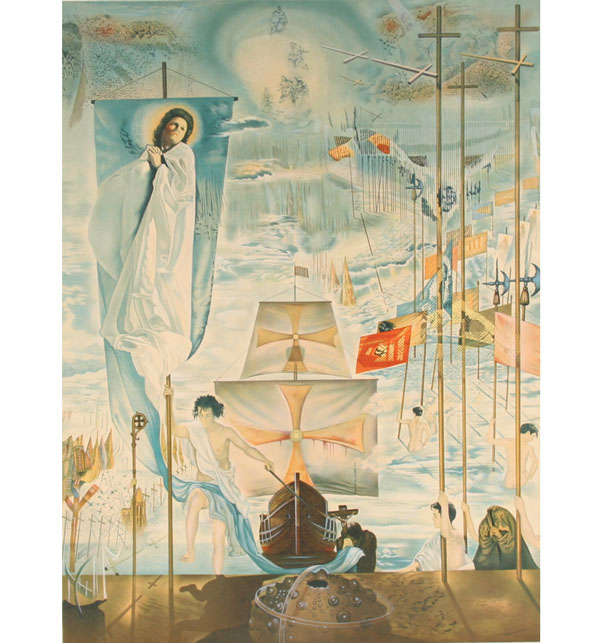
Anthems in New Tongues I Hear Saluting Me

Salvador Dali Museum.
Salvador Dalí, The Discovery of America by Christopher Columbus, 1959, oil on canvas, 410 x 284 cm, St. Petersburg, Florida: Salvador Dalí Museum.

“Prayer of Columbus” by Walt Whitman

A batter’d, wreck’d old man,
Thrown on this savage shore, far, far from home,
Pent by the sea and dark rebellious brows, twelve dreary months,
Sore, stiff with many toils, sicken’d and nigh to death,
I take my way along the island’s edge,
Venting a heavy heart.
I am too full of woe!
Haply I may not live another day;
I cannot rest O God, I cannot eat or drink or sleep,
Till I put forth myself, my prayer, once more to Thee,
Breathe, bathe myself once more in Thee, commune with Thee,
Report myself once more to Thee.
Thou knowest my years entire, my life,
My long and crowded life of active work, not adoration merely;
Thou knowest the prayers and vigils of my youth,
Thou knowest my manhood’s solemn and visionary meditations,
Thou knowest how before I commenced I devoted all to come to Thee,
Thou knowest I have in age ratified all those vows and strictly kept them,
Thou knowest I have not once lost nor faith nor ecstasy in Thee,
In shackles, prison’d, in disgrace, repining not,
Accepting all from Thee, as duly come from Thee.
All my emprises have been fill’d with Thee,
My speculations, plans, begun and carried on in thoughts of Thee,
Sailing the deep or journeying the land for Thee;
Intentions, purports, aspirations mine, leaving results to Thee.
O I am sure they really came from Thee,
The urge, the ardor, the unconquerable will,

The potent, felt, interior command, stronger than words,

A message from the Heavens whispering to me even in sleep,
These sped me on.
By me and these the work so far accomplish’d,
By me earth’s elder cloy’d and stifled lands uncloy’d, unloos’d,
By me the hemispheres rounded and tied, the unknown to the known.
The end I know not, it is all in Thee,
Or small or great I know not–haply what broad fields, what lands,
Haply the brutish measureless human undergrowth I know,
Transplanted there may rise to stature, knowledge worthy Thee,
Haply the swords I know may there indeed be turn’d to reaping-tools,
Haply the lifeless cross I know, Europe’s dead cross, may bud and
blossom there.
One effort more, my altar this bleak sand;
That Thou O God my life hast lighted,
With ray of light, steady, ineffable, vouchsafed of Thee,
Light rare untellable, lighting the very light,
Beyond all signs, descriptions, languages;
For that O God, be it my latest word, here on my knees,
Old, poor, and paralyzed, I thank Thee.
My terminus near,
The clouds already closing in upon me,
The voyage balk’d, the course disputed, lost,
I yield my ships to Thee.
My hands, my limbs grow nerveless,
My brain feels rack’d, bewilder’d,
Let the old timbers part, I will not part,
I will cling fast to Thee, O God, though the waves buffet me,
Thee, Thee at least I know.
Is it the prophet’s thought I speak, or am I raving?
What do I know of life? what of myself?
I know not even my own work past or present,
Dim ever-shifting guesses of it spread before me,
Of newer better worlds, their mighty parturition,
Mocking, perplexing me.
And these things I see suddenly, what mean they?
As if some miracle, some hand divine unseal’d my eyes,
Shadowy vast shapes smile through the air and sky,
And on the distant waves sail countless ships,
And anthems in new tongues I hear saluting me.

Palin’s Poetry

This was too good not to repost. A few selections from “The Poetry of Sarah Palin,” courtesy of today’s Slate:

“On Good and Evil”

It is obvious to me
Who the good guys are in this one
And who the bad guys are.
The bad guys are the ones
Who say Israel is a stinking corpse,
And should be wiped off
The face of the earth.

That’s not a good guy.

(To K. Couric, CBS News, Sept. 25, 2008)

“Challenge to a Cynic”

You are a cynic.
Because show me where
I have ever said
That there’s absolute proof
That nothing that man
Has ever conducted
Or engaged in,
Has had any effect,
Or no effect,
On climate change.

(To C. Gibson, ABC News, Sept. 11, 2008)

And my personal favorite:

“Secret Conversation”

I asked President Karzai:

“Is that what you are seeking, also?
“That strategy that has worked in Iraq?
“That John McCain had pushed for?
“More troops?
“A counterinsurgency strategy?”

And he said, “Yes.”

(To K. Couric, CBS News, Sept. 25, 2008)

Great stuff.

Also, if Palin’s incoherence in real interviews isn’t enough absurdity for you, check out the Sarah Palin Fictional Quote Generator. Sample:

I’m not one of those who feel like whether that is part of the solution or not and we’ve got to remember what the desire is in this nation at this time.

Icarus Falls, No Big Deal

“Landscape with the Fall of Icarus” by William Carlos Williams

According to Brueghel
when Icarus fell
it was spring

a farmer was ploughing
his field
the whole pageantry

of the year was
awake tingling
near

the edge of the sea
concerned
with itself

sweating in the sun
that melted
the wings’ wax

unsignificantly
off the coast
there was

a splash quite unnoticed
this was
Icarus drowning

“Musée de Beaux Arts” by W.H. Auden

About suffering they were never wrong,
The Old Masters: how well, they understood
Its human position; how it takes place
While someone else is eating or opening a window or just walking dully along;
How, when the aged are reverently, passionately waiting
For the miraculous birth, there always must be
Children who did not specially want it to happen, skating
On a pond at the edge of the wood:
They never forgot
That even the dreadful martyrdom must run its course
Anyhow in a corner, some untidy spot
Where the dogs go on with their doggy life and the torturer’s horse
Scratches its innocent behind on a tree.

In Brueghel’s Icarus, for instance: how everything turns away
Quite leisurely from the disaster; the ploughman may
Have heard the splash, the forsaken cry,
But for him it was not an important failure; the sun shone
As it had to on the white legs disappearing into the green
Water; and the expensive delicate ship that must have seen
Something amazing, a boy falling out of the sky,
had somewhere to get to and sailed calmly on.

25 Lines on Poetry

1. I do not like poetry.

2. I like folk songs, sea shanties, nursery rhymes, limericks, hymns, field hollers, riddles, epigrams, epigraphs, epitaphs, epithets, obituary notices, fortune cookie fortunes, square dance calls, confiscated notes, found diary entries, proverbs, anagrams, aphorisms, catcalls, insults, howls, air kisses, and handshakes, but I do not like poetry.

3. OK, maybe I like a poem or two. Or a poet or two.

4. I admit: I love the words of Walt Whitman. I unstop my throat to sing his praises. I lean and loafe at my ease with him. I laze it up.

5. Also, I admit: Emily Dickinson makes the good poems. Or made them (she is, I know, long dead). Her poems at first seem neat and tidy and even sparkly, but upon closer inspection bristle like riddles riddled with slant rhymes. Sex and death.

6. And, when I was younger: e.e. cummings (E.E. Cummings?). Later, I discovered that he was Not to be Taken Seriously as Serious Poet, Seriously.

7. But that was OK. Because I knew by then that I don’t like poetry.

8. I do like to read the occasional poem: William Carlos Williams, Langston Hughes, James Weldon Johnson, William Blake: all have written a verse or two worth pondering over for a few idle moments.

9. But I mistrust the reading of volumes of poetry.

10. I also mistrust contemporary poetry and contemporary poets (although I know very few poets, MFAs both of them, and they are very good people, but I don’t know where they get off calling themselves poets).

11. Rap lyrics are not poetry: I’m just saying.

12. I took a poetry class when I was in university. It was required. I didn’t enjoy it, not even a little. The only poem I remember liking even a little was Gerard Manley Hopkins’s “The Windhover.” I liked the alliteration, but I don’t remember what it was about. My teacher seemed to think it was a lesser poem and Hopkins was a lesser poet.

13. “Howl”–garbage? Garbage, am I right?

14. But then again, I didn’t care for On the Road.

15. I like to read a poem at random: perhaps in a periodical or a quarterly, sandwiched between factoids and graphics and fragments of narrative essay.

16. Poetry may or may not still be considered the highest art form: I think it is probably not considered the highest art form anymore: no one reads poetry anymore: not unless they have to: for school, y’know?

17. Ezra Pound and T.S. Eliot: Bob Dylan wrote about these guys: Bob Dylan: not a poet: Dylan Thomas: he wrote a poem or two I like: “Rage, rage against the dying of the light”: that’s a nice sentiment: a nice poem: but–

18. Ezra Pound and T.S. Eliot: hard to decipher: If I’m going to put that much effort into reading something, it’s going to be Derrida or Freud or James Joyce.

19. James Joyce: not much of a poet, strangely (maybe not strangely?) enough: not strangely, I’ve decided.

20. MFA programs now produce poets who write for an audience of other MFA poets. Meanwhile, school children sing the body electric and miss all the psychological subtlety of “The Raven.”

21. Poe: Poe is the Greatest American Writer Who Never Wrote a Great American Novel (maybe if he hadn’t died in the gutter at only 40…).

22. Poe: I like his poems, in small doses (like shots of syrupy night time cold medicine, thick and green).

23. You will now forget the awful simile above: we will all agree it was poorly written: a bad idea.

24. Also, let’s forget all about points 1-21 as well, and we might as well forget about point 23 to boot.

25. In fact, the whole post has been ridiculous and ridiculous: mea culpa.