“Christmas Trees” — Robert Frost

“Christmas Trees” by Robert Frost–

A Christmas Circular Letter

The city had withdrawn into itself
And left at last the country to the country;
When between whirls of snow not come to lie
And whirls of foliage not yet laid, there drove
A stranger to our yard, who looked the city,
Yet did in country fashion in that there
He sat and waited till he drew us out
A-buttoning coats to ask him who he was.
He proved to be the city come again
To look for something it had left behind
And could not do without and keep its Christmas.
He asked if I would sell my Christmas trees;
My woods—the young fir balsams like a place
Where houses all are churches and have spires.
I hadn’t thought of them as Christmas Trees.
I doubt if I was tempted for a moment
To sell them off their feet to go in cars
And leave the slope behind the house all bare,
Where the sun shines now no warmer than the moon.
I’d hate to have them know it if I was.
Yet more I’d hate to hold my trees except
As others hold theirs or refuse for them,
Beyond the time of profitable growth,
The trial by market everything must come to.
I dallied so much with the thought of selling.
Then whether from mistaken courtesy
And fear of seeming short of speech, or whether
From hope of hearing good of what was mine,
I said, “There aren’t enough to be worth while.”
“I could soon tell how many they would cut,
You let me look them over.”

“You could look.
But don’t expect I’m going to let you have them.”
Pasture they spring in, some in clumps too close
That lop each other of boughs, but not a few
Quite solitary and having equal boughs
All round and round. The latter he nodded “Yes” to,
Or paused to say beneath some lovelier one,
With a buyer’s moderation, “That would do.”
I thought so too, but wasn’t there to say so.
We climbed the pasture on the south, crossed over,
And came down on the north.
He said, “A thousand.”

“A thousand Christmas trees!—at what apiece?”

He felt some need of softening that to me:
“A thousand trees would come to thirty dollars.”

Then I was certain I had never meant
To let him have them. Never show surprise!
But thirty dollars seemed so small beside
The extent of pasture I should strip, three cents
(For that was all they figured out apiece),
Three cents so small beside the dollar friends
I should be writing to within the hour
Would pay in cities for good trees like those,
Regular vestry-trees whole Sunday Schools
Could hang enough on to pick off enough.
A thousand Christmas trees I didn’t know I had!
Worth three cents more to give away than sell,
As may be shown by a simple calculation.
Too bad I couldn’t lay one in a letter.
I can’t help wishing I could send you one,
In wishing you herewith a Merry Christmas.


“The Savior must have been a docile Gentleman” — Emily Dickinson

Emily Dickinson’s nativity poem, “The Savior must have been a docile Gentleman”–

The Savior must have been
A docile Gentleman—
To come so far so cold a Day
For little Fellowmen—

The Road to Bethlehem
Since He and I were Boys
Was leveled, but for that ‘twould be
A rugged Billion Miles—

“A Christmas Greeting” — Walt Whitman

“A Christmas Greeting” by Walt Whitman

Welcome, Brazilian brother–thy ample place is ready;
A loving hand–a smile from the north–a sunny instant hall!
(Let the future care for itself, where it reveals its troubles,
impedimentas,
Ours, ours the present throe, the democratic aim, the acceptance and
the faith;)
To thee to-day our reaching arm, our turning neck–to thee from us
the expectant eye,
Thou cluster free! thou brilliant lustrous one! thou, learning well,
The true lesson of a nation’s light in the sky,
(More shining than the Cross, more than the Crown,)
The height to be superb humanity.

So Much Depends on the Hideous William Carlos Williams Tattoo

(Via).

“Ballad of Birmingham” — Dudley Randall

“Ballad of Birmingham” by Dudley Randall

(On the bombing of a church in Birmingham, Alabama, 1963)

“”Mother dear, may I go downtown
Instead of out to play,
And march the streets of Birmingham
In a Freedom March today?”

“No, baby, no, you may not go,
For the dogs are fierce and wild,
And clubs and hoses, guns and jails
Aren’t good for a little child.”

“But, mother, I won’t be alone.
Other children will go with me,
And march the streets of Birmingham
To make our country free.”

“No baby, no, you may not go
For I fear those guns will fire.
But you may go to church instead
And sing in the children’s choir.”

She has combed and brushed her night-dark hair,
And bathed rose petal sweet,
And drawn white gloves on her small brown hands,
And white shoes on her feet.

The mother smiled to know that her child
Was in the sacred place,
But that smile was the last smile
To come upon her face.

For when she heard the explosion,
Her eyes grew wet and wild.
She raced through the streets of Birmingham
Calling for her child.

She clawed through bits of glass and brick,
Then lifted out a shoe.
“O, here’s the shoe my baby wore,
But, baby, where are you?”

Learn more about the September 15th, 1963 terrorist attack in Birmingham, Alabama.

Bill Murray Reads Emily Dickinson (and Other Poets)

Bill Murray reads poems by Billy Collins, Lorine Niedecker, and Emily Dickinson to the workers who built the Poets House literary center in museum. The applause after “I dwell in possibility” is golden.

“Two Views of a Cadaver Room” — Sylvia Plath

(1)
The day she visited the dissecting room
They had four men laid out, black as burnt turkey,
Already half unstrung. A vinegary fume
Of the death vats clung to them;
The white-smocked boys started working.
The head of his cadaver had caved in,
And she could scarcely make out anything In that rubble of skull plates and old leather.
A sallow piece of string held it together. In their jars the snail-nosed babies moon and glow.
He hands her the cut-out heart like a cracked heirloom.
(2)
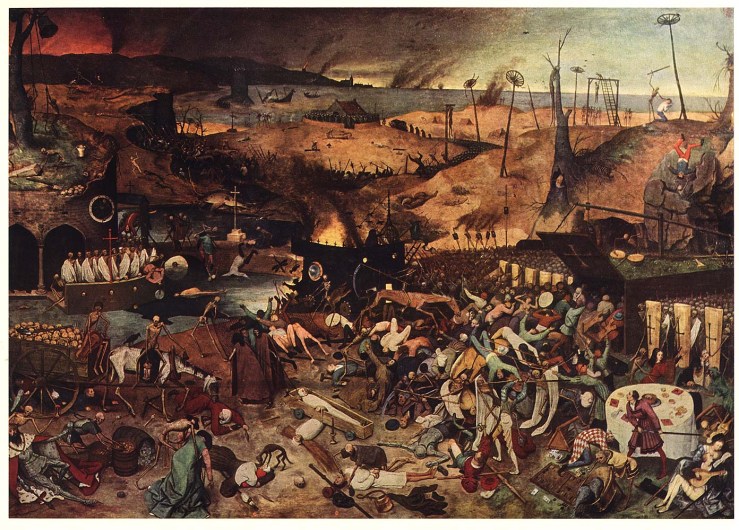
In Brueghel’s panorama of smoke and slaughter
Two people only are blind to the carrion army:
He, afloat in the sea of her blue satin
Skirts, sings in the direction Of her bare shoulder, while she bends,
Finger a leaflet of music, over him, Both of them deaf to the fiddle in the hands
Of the death’s-head shadowing their song.
These Flemish lovers flourish; not for long.
Yet desolation, stalled in paint, spares the little country
Foolish, delicate, in the lower right hand corner.

“Fast Anchor’d Eternal O Love!” — Walt Whitman

FAST-ANCHOR’D eternal O love! O woman I love!
O bride! O wife! more resistless than I can tell, the thought of
you!
Then separate, as disembodied or another born,
Ethereal, the last athletic reality, my consolation,
I ascend, I float in the regions of your love O man,
O sharer of my roving life.

“little tree” — e.e. cummings

little tree
little silent Christmas tree
you are so little
you are more like a flower
who found you in the green forest
and were you very sorry to come away?
see          i will comfort you
because you smell so sweetly
i will kiss your cool bark
and hug you safe and tight
just as your mother would,
only don’t be afraid
look          the spangles
that sleep all the year in a dark box
dreaming of being taken out and allowed to shine,
the balls the chains red and gold the fluffy threads,
put up your little arms
and i’ll give them all to you to hold
every finger shall have its ring
and there won’t be a single place dark or unhappy
then when you’re quite dressed
you’ll stand in the window for everyone to see
and how they’ll stare!
oh but you’ll be very proud
and my little sister and i will take hands
and looking up at our beautiful tree
we’ll dance and sing
“Noel Noel”

“The Old Flame” — Robert Lowell

robertlowell

Listening to Robert Lowell read his poem “The Old Flame” is way better than just reading it yourself. Really.

“Saturday’s Child” — Countee Cullen

counteecullen

We’d never read this poem until earlier today when a student brought it to our attention. We love all the double-edged wordplay, the caustic tone, and the recontextualization of a Mother Goose classic. Great stuff.

“Saturday’s Child” by Countee Cullen–

Some are teethed on a silver spoon,
With the stars strung for a rattle;
I cut my teeth as the black racoon–
For implements of battle.

Some are swaddled in silk and down,
And heralded by a star;
They swathed my limbs in a sackcloth gown
On a night that was black as tar.

For some, godfather and goddame
The opulent fairies be;
Dame Poverty gave me my name,
And Pain godfathered me.

For I was born on Saturday–
“Bad time for planting a seed,”
Was all my father had to say,
And, “One mouth more to feed.”

Death cut the strings that gave me life,
And handed me to Sorrow,
The only kind of middle wife
My folks could beg or borrow.

No Poets Don’t Own Words

brion-gysin

No Poets Don’t Own Words” from Brion Gysin’s Recordings 1960-1981. A very cool record, featuring lots of tape manipulation, cut-ups, poetry, and interviews with Gysin on a variety of subjects including censorship, surrealism, and art. We like it much. Much we like. It. Like much it we.

Langston Hughes Reads Three Poems

langstonhughes

Renaissance man Langston Hughes reads three of his poems–

The Negro Speaks of Rivers

Ballad of the Gypsy

Mulatto

Also, read one of our favorite Hughes poems, “I, Too, Sing America” (a response, we believe, to Walt Whitman’s “I Hear America Singing” (Elizabeth Alexander’s inauguration poem, “Praise Song for the Day” seems to respond to both of these poems))–

I, too, sing America.

I am the darker brother.
They send me to eat in the kitchen
When company comes,
But I laugh,
And eat well,
And grow strong.

Tomorrow,
I’ll be at the table
When company comes.
Nobody’ll dare
Say to me,
“Eat in the kitchen,”
Then.

Besides,
They’ll see how beautiful I am
And be ashamed–

I, too, am America.

Whitman Hearts Tebow

walt_whitman_hearts_tebow

Liquefied Brain So Backs, It

bee

When Biblioklept’s Chief Science Reporter Nicky Longlunch sent us this article about coked-up bees from The New York Times, we knew we had to give it the old Dada treatment, or in this case, the new Dada treatment. In 1920, Tristan Tzara gave the following directions:

TO MAKE A DADAIST POEM
Take a newspaper.
Take some scissors.
Choose from this paper an article of the length you want to make your poem.
Cut out the article.
Next carefully cut out each of the words that makes up this article and put them all in a bag.
Shake gently.
Next take out each cutting one after the other.
Copy conscientiously in the order in which they left the bag.
The poem will resemble you.
And there you are—an infinitely original author of charming sensibility, even though unappreciated by the vulgar herd.

Of course, scissors and cutting and actual papers and bags can be messy and tiresome, not to mention terribly old fashioned. Luckily for us, there’s a hypertext version, and we used this Dada poem generator to make our own poem out of the NYT article. Here is our poem:

liquefied brain so backs, it

liquefied brain so backs, it
scientists Australia dropped freebase cocaine
freebase liquefied brain so in
in Australia freebase cocaine bees’
circulatory backs, dropped it brain
freebase on bees’ backs, so

much judgment, their behavior makes
like stimulates their behavior and
humans much their enthusiastic them
much humans cocaine judgment, their
much like alters their their
react bees makes like enthusiastic

its odor exhibit plummets syrup
exhibit coked-up bee cold turkey
bees symptoms stop test of
bee its score standard test
turkey its test associate syrup
exhibit turkey test of bee

The real article’s actually kinda sorta better. Try this (any of it) at home.

A Desolation, A Simplicity, to Which the Trappings of a Gaudy World Make a Strange Back-ground

Drawing of Adrian Jones by Michael Fay

In Section IV of his Prelude, William Wordsworth evokes the most moving encounter with a veteran of war that I have ever read. At first reticent to be anything but a voyeur, the narrator (Wordsworth, in all likelihood), slips “into the shade/ Of a thick hawthorn” to spy on the “meagre man” with a “ghastly” mouth “in military garb” resting on a “mile-stone.” As the poor ex-soldier, “Companionless,” begins to issue “low muttered sounds, as if of pain / Or some uneasy though,” the narrator shakes his “heart’s specious cowardice” and hails the veteran as a human being, asking for his story. It turns out that the guy is slowly–and with great difficulty–returning to his “native home.” Wordsworth takes the veteran to a nearby friend’s house for companionship and rest, before returning to his own home in a contemplative mood. Full text of the “Discharged Soldier” episode after the jump–

Continue reading “A Desolation, A Simplicity, to Which the Trappings of a Gaudy World Make a Strange Back-ground”

A Swordless Conflict

Flag -- Jasper Johns (1954)

“Election Day, November, 1884” by Walt Whitman

If I should need to name, O Western World, your powerfulest scene and
show,
‘Twould not be you, Niagara–nor you, ye limitless prairies–nor
your huge rifts of canyons, Colorado,
Nor you, Yosemite–nor Yellowstone, with all its spasmic
geyser-loops ascending to the skies, appearing and disappearing,
Nor Oregon’s white cones–nor Huron’s belt of mighty lakes–nor
Mississippi’s stream:
–This seething hemisphere’s humanity, as now, I’d name–the still
small voice vibrating–America’s choosing day,
(The heart of it not in the chosen–the act itself the main, the
quadriennial choosing,)
The stretch of North and South arous’d–sea-board and inland–
Texas to Maine–the Prairie States–Vermont, Virginia, California,
The final ballot-shower from East to West–the paradox and conflict,
The countless snow-flakes falling–(a swordless conflict,
Yet more than all Rome’s wars of old, or modern Napoleon’s:) the
peaceful choice of all,
Or good or ill humanity–welcoming the darker odds, the dross:
–Foams and ferments the wine? it serves to purify–while the heart
pants, life glows:
These stormy gusts and winds waft precious ships,
Swell’d Washington’s, Jefferson’s, Lincoln’s sails.