Hunter S. Thompson’s Open Face Cigarette Special Hot and Cold Sandwich with Artichoke Appetizer

I’m pretty sure there should be some hyphens in the title of Hunter S. Thompson’s recipe for “open face cigarette special hot and cold sandwich with artichoke appetizer.”  From The Great American Writers’ Cookbook (ed. Dean Faulkner Wells, 1981).

OPEN FACE CIGARETTE SPECIAL HOT AND COLD SANDWICH WITH ARTICHOKE APPETIZER

Ingredients

1 Artichoke

1 stalk of celery

1 onion

1 tomato

one quarter lb. butter

1 container cottage cheese

1 can Ortega whole green chilis

1 lemon

mayonnaise

vinegar

4 strips of bacon

1 slice dill rye bread

La Victoria green taco sauce

Directions

Fill a large pot three quarters full with water and add celery and half of the onion. Bring to a boil.

Add artichoke, cover and boil for 45 minutes. While you are waiting for the artichoke to cook you can prepare the sauce for it and the sandwich.

Sauce:

Mix 3 heaping tablespoons of mayonnaise with one table spoon of Dijon mustard. Add a splash of vinegar and a squeeze of lemon.

Cigarette Special

Cook bacon and put aside.

Butter the slice of rye bread generously and toast until the bread is light brown and the butter is sizzling.

Spread cottage cheese exactly one quarter inch thick on the toast.

Cut Ortega whole green chilis into 4 one quarter inch strips and place lengthwise on top of cottage cheese.

Add bacon to sandwich.

Cut 3 or 4 thin slices of tomato and place on top of bacon.

Cut 2 or 3 very thin slices of onion and put those on top of the tomatoes.

Then spread another one quarter inch thick layer of cottage cheese.

Salt and pepper and garnish with La Victoria green taco sauce.

Then cover the open face sandwich with Reynolds Wrap, leaving the bottom of the toast uncovered. Timing is crucial at this point. The artichoke should be well-boiled and ready to eat and all sandwich ingredients prepared for the final mix before the bread is toasted for the first time.

The sandwich must be lashed together and toasted (twice) in less than 5 minutes, or the toast will get limp and soggy.

When you have finished eating your artichoke appetizer and are ready to eat the Cigarette Special, place the sandwich back into the toaster oven and toast for about one minute. Remove Reynolds Wrap and you will now have a hot buttered toast cold cottage cheese cigarette special.

The procedure by steps:

Drink good whiskey while boiling artichoke and frying bacon.

Prepare sandwich ingredients.

Eat artichoke leaves

Mix sandwich and toast.

Eat artichoke heart, with good beer.

Eat sandwich.

Drink coffee and good whiskey, with sharp chocolate.
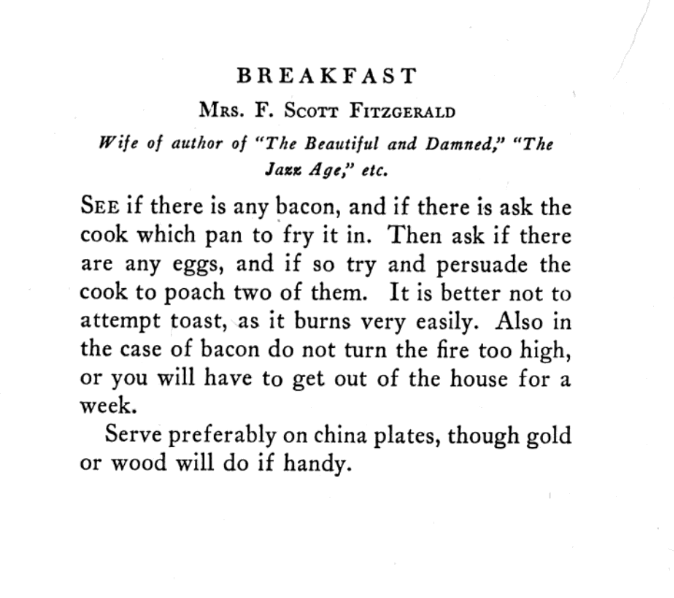
Zelda Fitzgerald’s Bacon n’ Eggs

Zelda Fitzgerald’s “recipe” for breakfast:

See if there is any bacon, and if there is ask the cook which pan to fry it in. Then ask if there are any eggs, and if so try and persuade the cook to poach two of them. It is better not to attempt toast, as it burns very easily. Also in the case of bacon do not turn the fire too high, or you will have to get out of the house for a week. Serve preferably on china plates, though gold or wood will do if handy.

From Famous Recipes of Famous Women (ed. Florence Stratton, 1925)

John Brunner’s Squid with Pine Nuts

John Brunner’s recipe for squid with pine nuts:

1 1b. baby squid

1 large onion

1 oz. pine nuts (pinon nuts)

2 oz. butter

1 clove garlic

salt and pepper

2 sherry-glasses dry sherry

water

Chop the onion and garlic fine, brown in the butter. Clean squid, cut into rings, add to pan and add nuts. Season lightly. Stir over low heat until everything is coated with the butter. Add the sherry. Simmer for 2-3 minutes. Add water to barely cover. Simmer until squid is tender-approximately 20 minutes, but this depends on the age of the squid: the older, the longer. Serve hot. Keep the breadsticks coming.

Try and finish off the white wine at the same time the last bit of squid disappears. (It will. I’ve seen people who were convinced they didn’t like the stuff come back for seconds of this dish, then ask optimistically for thirds-too late.)

Then we get down to the really serious item on the agenda, a member of that family of classic peasant dishes which runs from Normandy to Yugoslavia and can probably be found in recognizable form in the New World, too. What they amount to, basically, is a means of making stored beans taste wonderful when that’s all you’ve got for a large family. Any number of changes can be rung on the fundamental principle.

Brunner’s recipe is collected in Cooking Out of This World (ed. Anne McCaffrey, 1973)

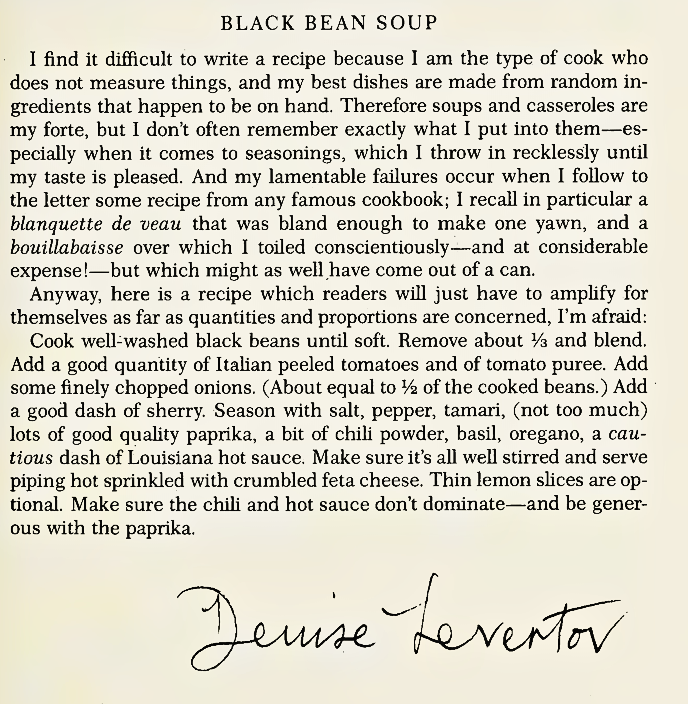
Denise Levertov’s Black Bean Soup

Denis Levertov’s recipe for black bean soup:

I find it difficult to write a recipe because I am the type of cook who does not measure things, and my best dishes are made from random ingredients that happen to be on hand. Therefore soups and casseroles are my forte, but I don’t often remember exactly what I put into them—especially when it comes to seasonings, which I throw in recklessly until my taste is pleased. And my lamentable failures occur when I follow to the letter some recipe from any famous cookbook; I recall in particular a blanquette de veau that was bland enough to make one yawn, and a bouillabaisse over which I toiled conscientiously–and at considerable expense!–but which might as well have come out of a can.

Anyway, here is a recipe which readers will just have to amplify for themselves as far as quantities and proportions are concerned, I’m afraid:

Cook well-washed black beans until soft. Remove about ⅛ and blend. Add a good quantity of Italian peeled tomatoes and of tomato puree.”Add some finely chopped onions. (About equal to ½ of the cooked beans.) Add a good dash of sherry. Season with salt, pepper, tamari, (not too much) lots of good quality paprika, a bit of chili powder, basil, oregano, a cautious dash of Louisiana hot sauce. Make sure it’s all well stirred and serve piping hot sprinkled with crumbled feta cheese. Thin lemon slices are optional. Make sure the chili and hot sauce don’t dominate—and be generous with the paprika.

From The Great American Writers’ Cookbook (ed. Dean Faulkner Wells, 1981).

Marjorie Kinnan Rawlings’ Recipes for Coot Surprise, Jugged Rabbit, and Jellied Tongue

The following recipes are from Marjorie Kinnan Rawlings’ 1942 cookbook Cross Creek Cookery, which was published the same year as her seminal Florida memoir Cross Creek. If you ever find yourself in north central Florida, you might dine at The Yearling, where some of the dishes from Rawlings’ cookbook are still served.

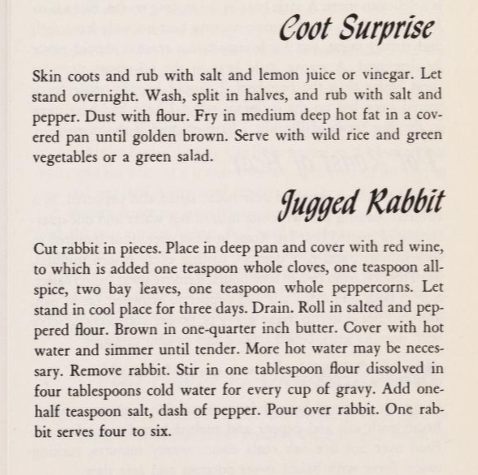
Coot Surprise

Skin coots and rub with salt and lemon juice or vinegar. Let stand overnight. Wash, split in halves, and rub with salt and pepper. Dust with flour. Fry in medium deep hot fat in a covered pan until golden brown. Serve with wild rice and green vegetables or a green salad.


Jugged Rabbit

Cut rabbit in pieces. Place in deep pan and cover with red wine, to which is added one teaspoon whole cloves, one teaspoon all-spice, two bay leaves, one teaspoon whole peppercorns. Let stand in cool place for three days. Drain. Roll in salted and peppered four. Brown in one-quarter inch butter. Cover with hot water and simmer until tender. More hot water may be necessary. Remove rabbit. Stir in one tablespoon flour dissolved in four tablespoons cold water for every cup of gravy. Add one-half teaspoon salt, dash of pepper. Pour over rabbit. One rabbit serves four to six.

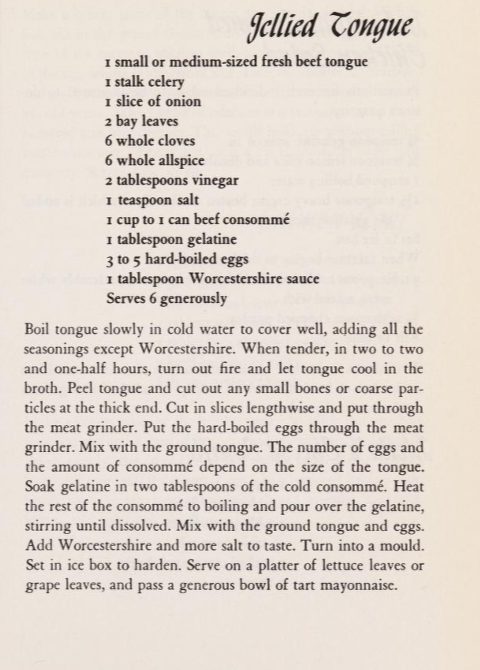
Jellied Tongue

1 small or medium-sized fresh beef tongue 1 stalk celery 

1 slice of onion

2 bay leaves

6 whole cloves

6 whole allspice

2 tablespoons vinegar

1 teaspoon salt

1 cup to 1 can beef consommé

1 tablespoon gelatine

3 to 5 hard-boiled eggs

1 tablespoon Worcestershire sauce

Serves 6 generously

Boil tongue slowly in cold water to cover well, adding all the seasonings except Worcestershire. When tender, in two to two and one-half hours, turn out fire and let tongue cool in the broth. Peel tongue and cut out any small bones or coarse particles at the thick end. Cut in slices lengthwise and put through the meat grinder. Put the hard-boiled eggs through the meat grinder. Mix with the ground tongue. The number of eggs and the amount of consommé depend on the size of the tongue. Soak gelatine in two tablespoons of the cold consommé. Heat the rest of the consommé to boiling and pour over the gelatine, stirring until dissolved. Mix with the ground tongue and eggs. Add Worcestershire and more salt to taste. Turn into a mould. Set in ice box to harden. Serve on a platter of lettuce leaves or grape leaves, and pass a generous bowl of tart mayonnaise.

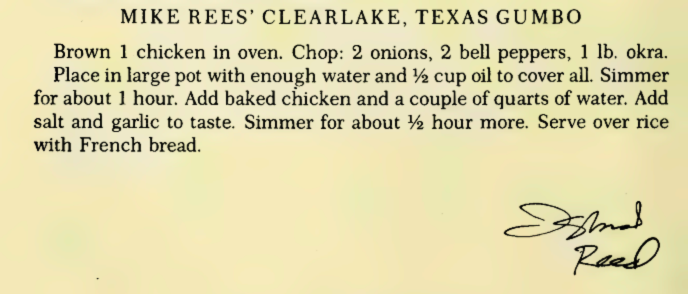
Ishmael Reed’s Texas Gumbo

Ishmael Reed’s Mike Rees’ Clearlake, Texas Gumbo:

Brown 1 chicken in oven. Chop: 2 onions, 2 bell peppers, 1 lb. okra. Place in large pot with enough water and 1/2 oil to cover all. Simmer for about an hour. Add baked chicken and a couple of quarts of water. Add salt and garlic to taste. Simmer for about 1/2 hour more. Serve over rice with French bread.

From The Great American Writers’ Cookbook (ed. Dean Faulkner Wells, 1981).

Ernest Hemingway’s Campfire Trout

Ernest Hemingway’s recipe for campfire trout:

Outside of insects and bum sleeping the rock that wrecks most camping trips is cooking. The average tyro’s idea of cooking is to fry everything and fry it good and plenty. Now, a frying pan is a most necessary thing to any trip, but you also need the old stew kettle and the folding reflector baker.

A pan of fried trout can’t be bettered and they don’t cost any more than ever. But there is a good and bad way of frying them.

The beginner puts his trout and his bacon in and over a brightly burning fire; the bacon curls up and dries into a dry tasteless cinder and the trout is burned outside while it is still raw inside. He eats them and it is all right if he is only out for the day and going home to a good meal at night. But if he is going to face more trout and bacon the next morning and other equally well-cooked dishes for the remainder of two weeks he is on the pathway to nervous dyspepsia.

The proper way is to cook over coals. Have several cans of Crisco or Cotosuet or one of the vegetable shortenings along that are as good as lard and excellent for all kinds of shortening. Put the bacon in and when it is about half cooked lay the trout in the hot grease, dipping them in cornmeal first. Then put the bacon on top of the trout and it will baste them as it slowly cooks.

The coffee can be boiling at the same time and in a smaller skillet pancakes being made that are satisfying the other campers while they are waiting for the trout.

With the prepared pancake flours you take a cupful of pancake flour and add a cup of water. Mix the water and flour and as soon as the lumps are out it is ready for cooking. Have the skillet hot and keep it well greased. Drop the batter in and as soon as it is done on one side loosen it in the skillet and flip it over. Apple butter, syrup or cinnamon and sugar go well with the cakes.

While the crowd have taken the edge from their appetites with flapjacks the trout have been cooked and they and the bacon are ready to serve. The trout are crisp outside and firm and pink inside and the bacon is well done—but not too done. If there is anything better than that combination the writer has yet to taste it in a lifetime devoted largely and studiously to eating.

Hemingway’s article “Camping Out” first appeared in the Toronto Daily Star on 26 June 1920

William Faulkner’s Recipe for Curing Ham

The following is from a 1942 letter from William Faulkner to his son-in-law William Fielden, instructing the young man on the author’s preferences for curing recently-slaughtered pork. From The Faulkner Journal Vol. 2, No. 1, Fall, 1986.

Curing Hams Shoulders Bacon

After the pieces are trimmed and thoroughly cooled, either by 24 hours of natural temperature or by artificial temperature NOT LOW ENOUGH TO FREEZE IT, that is, about 35 degrees F.

Lay the pieces flat, flesh side up, cover thoroughly with plain salt, about ¼ inch deep. Work saltpeter into the bone-joints and into the ends where the feet were removed, and into any other crevices or abrasions. Do this well and carefully, to prevent “blowing.” A slightly higher temperature will help the salt penetrate. Leave 24 hours.

After 24 hours, turn the pieces over SKIN SIDE UP, to drain. Sprinkle skin side with salt. I punch holes through the skin with an ice pick, to help draining. Leave 24 hours.

After 24 hours, turn the pieces flesh side up again, make a paste

½ plain salt

½ molasses, sugar, red and black pepper

just moist enough to spread over the pieces without flowing off. Leave 7 days.

After 7 days, make a paste

¼ plain salt

¾ molasses, sugar, red and black pepper

slightly more fluid than the first mixture, so that it will flow slowly over the pieces, penetrating the remains of last week’s treatment, dripping down the sides. Leave 7 days.

After 7 days, make a paste WITHOUT SALT

molasses, sugar, red and black pepper

fluid enough to cover the pieces without flowing off too much, cover the pieces and the residue of the two former treatments, leave seven days.

Hang the pieces and smoke with hickory or oak chips, keep it in smoky atmosphere for 2 to 7 days. The meat may be treated either before smoking or afterward with a preparation to prevent blow flies. Then wrap or enclose in cloth or paper bags and leave hanging until used.

Donald Barthelme’s Fine Homemade Soups

DONALD BARTHELME’S FINE HOMEMADE SOUPS

My fine homemade soups are interesting, economical, and tasty. To make them, one proceeds in the following way:

Fine Homemade Leek Soup

Take one package Knorr Leek Soupmix. Prepare as directed. Take two live leeks. Chop leeks into quarter-inch rounds. Throw into Soupmix.

Throw in ½ cup Tribuno Dry Vermouth. Throw in chopped parsley.

Throw in some amount of salt and a heavy bit of freshly-ground pepper.

Eat with good-quality French bread, dipped repeatedly in soup.

Fine Homemade Mushroom Soup

Take one package Knorr Mushroom Soupmix. Prepare as directed.

Take four large mushrooms. Slice. Throw into Soupmix. Throw in ⅛ cup Tribuno Dry Vermouth, parsley, salt, pepper. Stick bread as above into soup at intervals. Buttering bread enhances taste of the whole.

Fine Homemade Chicken Soup

Take Knorr Chicken Soupmix, prepare as directed, throw in leftover chicken, duck, or goose as available. Add enhancements as above.

Fine Homemade Oxtail Soup

Take Knorr Oxtail Soupmix, decant into same any leftover meat (sliced or diced) from the old refrigerator. Follow above strategies to the letter.

The result will make you happy. Knorr’s Oxtail is also good as a basic gravy-maker and constituent of a fine fake cassoulet about which we can talk at another time. Knorr is a very good Swiss outfit whose products can be found in both major and minor cities. The point here is not to be afraid of the potential soup but to approach it with the attitude that you know what’s best for it. And you do. The rawness of the vegetables refreshes the civilization of the Soupmixes. And there are opportunities for mercy-if your ox does not wish to part with his tail, for example, to dress up your fine Oxtail Soup, you can use commercial products from our great American supermarkets, which will be almost as good. These fine homemade recipes work! Use them with furious enthusiasm.

From The Great American Writers’ Cookbook (ed. Dean Faulkner Wells, 1981).

Ursula K. Le Guin’s Crab Nebula Recipe

Ursula K. Le Guin’s recipe for “Crab Nebula”–

Make a cream sauce with tablespoon butter, 2 tablespoons flour, 1 cup milk. Add about 1½ cup grated Tillamook cheese (or more—or less … if you are unable to obtain Tillamook, you may use any inferior American Cheddar, but the difference will be noticeable unless you have a calloused palate).

Now add about ½ pound? 2 cups?—Well, add enough crab. (If you are unable to obtain Pacific crab, you may use those flabby little Atlantic ones, or even lobster; but if you are reduced to King Crab, forget it.)

Flavor with sherry to taste, salt, pepper, parsley.

Serve on rice, or wild rice if you are J. Paul Getty, or English muffins, or whatever.

Le Guin’s recipe is collected in Cooking Out of This World (ed. Anne McCaffrey, 1973)

John Cage’s Homemade Bread

5 cups vegetable purée or gruel (see note)
5 cups stone-ground wholewheat flour
4 tablespoons fresh minced dill
1 teaspoon salt

1. Combine purée and flour in a large mixing bowl. Mix thoroughly. If the mixture is too liquid to knead add more flour. If too dry add more liquid.

2. Knead the mixture for 10 minutes. Turn into an 8½ -by–4½ -by–2½ breadpan.

3. Bake in a pre-heated 375 degree oven for 1 hour 15 minutes.

4. Turn out onto a rack and cool.

Note: Mr. Cage uses leftover cooked vegetables such as broccoli, kale, spinach, carrots, celery, celery root and squash, which he purées in a food processor with vegetable stock or water. The bread has the consistency of a dense German pumpernickel and goes well with smoked salmon.

John Cage’s homemade bread recipe was published as part of an 18 March 1981 New York Times feature.

Thirty-one Literary Recipes for Thanksgiving (Or Any Other Time)

Breakfast

James Joyce’s Burnt Kidney Breakfast

Thomas Pynchon’s Banana Breakfast

Vladimir Nabokov’s Eggs à la Nabocoque

Soup

Donald Barthelme’s Fine Oxtail Soup and Lentil Soup

Gordon Lish’s Chicken Soup

Ian McEwan’s Fish Stew

Cormac McCarthy’s Turtle Soup

Charles Dickens’ Hare Soup

Sides

William Carlos Williams’ Fried Onion on Rye Bread with Beer

Sharon Olds’ Bread

Zora Neale Hurston’s Mulatto Rice

Italo Calvino’s Love Noodles

Ntozake Shange’s Rice Casserole 

Roberto Bolaño’s Brussels Sprouts with Lemon

Robert Crumb’s Macaroni Casserole

Truman Capote’s Caviar-Smothered Baked Potatoes with 80-Proof Russian Vodka

Mains

Ntozake Shange’s Turkey Hash 

Gordon Lish’s Chopped Liver

Thomas Pynchon’s European Pizza

F. Scott Fitzgerald’s Turkey Twelve Ways

Herman Melville’s Whale Steaks

Donald Barthelme’s Meal of a Certain Elegance

Don DeLillo’s Chicken Parts

Libations

Ernest Hemingway’s Absinthe Cocktail, Death in the Afternoon

Charles Dickens’s Own Punch

Nathaniel Hawthorne’s Sherry Cobbler

Ben Jonson’s Egg Wine

Willam Faulkner’s Hot Toddy

Dessert

Emily Dickinson’s Cocoanut Cake

Thomas Jefferson’s Vanilla Ice Cream

George Orwell’s Plum Cake and Christmas Pudding

William Carlos Williams’ fried onion on rye bread with beer

“To Be Hungry Is to Be Great”

by

William Carlos Williams


The small, yellow grass-onion,
spring’s first green, precursor
to Manhattan’s pavements, when
plucked as it comes, in bunches,
washed, split and fried in
a pan, though inclined to be
a little slimy, if well cooked
and served hot on rye bread
is to beer a perfect appetizer——
and the best part
of it is they grow everywhere.

Donald Barthelme’s meal of a certain elegance

Food

I was preparing a meal for Celeste-a meal of a certain elegance, as when arrivals or other rites of passage are to be celebrated.
First off there were Saltines of the very best quality and of a special crispness, squareness, and flatness, obtained at great personal sacrifice by making representations to the National Biscuit Company through its authorized nuncios in my vicinity. Upon these was spread with a hand lavish and not sitting Todd’s Liver Pate, the same having been robbed from geese and other famous animals and properly adulterated with cereals and other well-chosen extenders and the whole delicately spiced with calcium propionate to retard spoilage. Next there were rare cheese products from Wisconsin wrapped in gold foil in exquisite tints with interesting printings thereon, including some very artful representations of cows, the same being clearly in the best of health and good humor. Next there were dips of all kinds including clam, bacon with horseradish, onion soup with sour cream, and the like, which only my long acquaintance with some very high-up members of the Borden company allowed to grace my table. Next there were Fritos curved and golden to the number of 224 (approx.), or the full contents of the bursting 53c bag. Next there were Frozen Assorted Hors d’Oeuvres of a richness beyond description, these wrested away from an establishment catering only to the nobility, the higher clergy, and certain selected commoners generally agreed to be comers in their particular areas of commonality, calcium propionate added to retard spoilage. In addition there were Mixed Nuts assembled at great expense by the Planters concern from divers strange climes and hanging gardens, each nut delicately dusted with a salt that has no peer. Furthermore there were cough drops of the manufacture of the firm of Smith Fils, brown and savory and served in a bowl once the property of Brann the Iconoclast. Next there were young tender green olives into which ripe red pimentos had been cunningly thrust by underpaid Portuguese, real and true handwork every step of the way. In addition there were pearl onions meticulously separated from their nonstandard fellows by a machine that had caused the Board of Directors of the S&W concern endless sleepless nights and had passed its field trails just in time to contribute to the repast I am describing. Additionally there were gherkins whose just fame needs no further words from me. Following these appeared certain cream cheeses of Philadelphia origin wrapped in costly silver foil, the like of which a pasha could not have afforded in the dear dead days. Following were Mock Ortolans Manques made of the very best soybean aggregate, the like of which could not be found on the most sophisticated tables of Paris, London and Rome. The whole washed down with generous amounts of Tab, a fiery liquor brewed under license by the Coca-Cola Company which will not divulge the age-old secret recipe no matter how one begs and pleads with them but yearly allows a small quantity to circulate to certain connoisseurs and bibbers whose credentials meet the very rigid requirements of the Cellarmaster. All of this stupendous feed being a mere scherzo before the announcement of the main theme, chilidogs.
“What is all this?” asked sweet Celeste, waving her hands in the air. “Where is the food?”
“You do not recognize a meal spiritually prepared,” I said, hurt in the self-love.
“We will be very happy together,” she said. “I cook.”

From “Daumier” by Donald Barthelme.

Sharon Olds’ bread

“Bread”

by

Sharon Olds


When my daughter makes bread, a cloud of flour

hangs in the air like pollen. She sifts and

sifts again, the salt and sugar

close as the grain of her skin. She heats the

water to body temperature

with the sausage lard, fragrant as her scalp

the day before hair-wash, and works them together on a

floured board. Her broad palms

bend the paste toward her and the heel of her hand

presses it away, until the dough

begins to snap, glossy and elastic as the torso bending over it,

this ten-year-old girl, random specks of yeast

in her flesh beginning to heat,

her volume doubling every month now, but still

raw and hard. She slaps the dough and it crackles under her palm, sleek and

ferocious and still leashed, like her body, no

breasts rising like bubbles of air toward the surface

of the loaf. She greases the pan, she is

shaped, glazed, and at any moment goes

into the oven, to turn to that porous

warm substance, and then under the

knife to be sliced for the having, the tasting, and the

giving of life.


Don DeLillo’s chicken parts and brownies

  No one wanted to cook that night. We all got in the car and went out to the commercial strip in the no man’s land beyond the town boundary. The never-ending neon. I pulled in at a place that specialized in chicken parts and brownies. We decided to eat in the car. The car was sufficient for our needs. We wanted to eat, not look around at other people. We wanted to fill our stomachs and get it over with. We didn’t need light and space. We certainly didn’t need to face each other across a table as we ate, building a subtle and complex cross-network of signals and codes. We were content to eat facing in the same direction, looking only inches past our hands. There was a kind of rigor in this. Denise brought the food out to the car and distributed paper napkins. We settled in to eat. We ate fully dressed, in hats and heavy coats, without speaking, ripping into chicken parts with our hands and teeth. There was a mood of intense concentration, minds converging on a single compelling idea. I was surprised to find I was enormously hungry. I chewed and ate, looking only inches past my hands. This is how hunger shrinks the world. This is the edge of the observable universe of food. Steffie tore off the crisp skin of a breast and gave it to Heinrich. She never ate the skin. Babette sucked a bone. Heinrich traded wings with Denise, a large for a small. He thought small wings were tastier. People gave Babette their bones to clean and suck. … We sent Denise to get more food, waiting for her in silence. Then we started in again, half stunned by the dimensions of our pleasure.

From Don DeLillo’s novel White Noise.

Italo Calvino’s love noodles

And all of this, which was true of me, was true also for each of the others. And for her: she contained and was contained with equal happiness, and she welcomed us and loved and inhabited all equally.

We got along so well all together, so well that something extraordinary was bound to happen. It was enough for her to say, at a certain moment: “Oh, if I only had some room, how I’d like to make some noodles for you boys!” And in that moment we all thought of the space that her round arms would occupy, moving backward and forward with the rolling pin over the dough, her bosom leaning over the great mound of flour and eggs which cluttered the wide board while her arms kneaded and kneaded, white and shiny with oil up to the elbows; we thought of the space that the flour would occupy, and the wheat for the flour, and the fields to raise the wheat, and the mountains from which the water would flow to irrigate the fields, and the grazing lands for the herds of calves that would give their meat for the sauce; of the space it would take for the Sun to arrive with its rays, to ripen the wheat; of the space for the Sun to condense from the clouds of stellar gases and burn; of the quantities of stars and galaxies and galactic masses in flight through space which would be needed to hold suspended every galaxy, every nebula, every sun, every planet, and at the same time we thought of it, this space was inevitably being formed, at the same time that Mrs. Ph(i)Nk0 was uttering those words: “… ah, what noodles, boys!” the point that contained her and all of us was expanding in a halo of distance in light-years and light-centuries and billions of light-millennia, and we were being hurled to the four corners of the universe (Mr. Mr. PbertPbertd all the way to Pavia), and she, dissolved into I don’t know what kind of energy-light-heat, she, Mrs. Ph(i)Nk0, she who in the midst of our closed, petty world had been capable of a generous impulse, “Boys, the noodles I would make for you!,” a true outburst of general love, initiating at the same moment the concept of space and, properly speaking, space itself, and time, and universal gravitation, and the gravitating universe, making possible billions and billions of suns, and of planets, and fields of wheat, and Mrs. Ph(i)Nk0, scattered through the continents of the planets, kneading with floury, oil-shiny, generous arms, and she lost at that very moment, and we, mourning her loss.

From Italo Calvino’s “All at One Point,” part of Cosmicomics. Translation by William Weaver.