Ishmael Reed’s Texas Gumbo

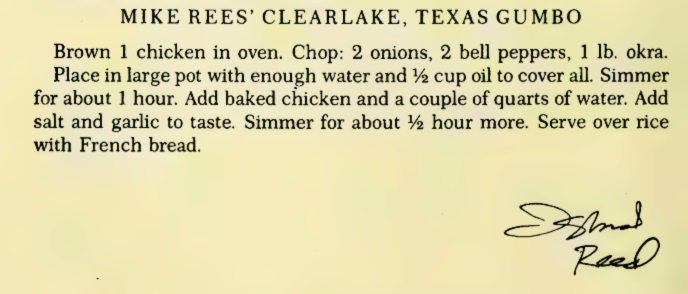
Ishmael Reed’s Mike Rees’ Clearlake, Texas Gumbo:

Brown 1 chicken in oven. Chop: 2 onions, 2 bell peppers, 1 lb. okra. Place in large pot with enough water and 1/2 oil to cover all. Simmer for about an hour. Add baked chicken and a couple of quarts of water. Add salt and garlic to taste. Simmer for about 1/2 hour more. Serve over rice with French bread.

From The Great American Writers’ Cookbook (ed. Dean Faulkner Wells, 1981).

Ernest Hemingway’s Campfire Trout

Ernest Hemingway’s recipe for campfire trout:

Outside of insects and bum sleeping the rock that wrecks most camping trips is cooking. The average tyro’s idea of cooking is to fry everything and fry it good and plenty. Now, a frying pan is a most necessary thing to any trip, but you also need the old stew kettle and the folding reflector baker.

A pan of fried trout can’t be bettered and they don’t cost any more than ever. But there is a good and bad way of frying them.

The beginner puts his trout and his bacon in and over a brightly burning fire; the bacon curls up and dries into a dry tasteless cinder and the trout is burned outside while it is still raw inside. He eats them and it is all right if he is only out for the day and going home to a good meal at night. But if he is going to face more trout and bacon the next morning and other equally well-cooked dishes for the remainder of two weeks he is on the pathway to nervous dyspepsia.

The proper way is to cook over coals. Have several cans of Crisco or Cotosuet or one of the vegetable shortenings along that are as good as lard and excellent for all kinds of shortening. Put the bacon in and when it is about half cooked lay the trout in the hot grease, dipping them in cornmeal first. Then put the bacon on top of the trout and it will baste them as it slowly cooks.

The coffee can be boiling at the same time and in a smaller skillet pancakes being made that are satisfying the other campers while they are waiting for the trout.

With the prepared pancake flours you take a cupful of pancake flour and add a cup of water. Mix the water and flour and as soon as the lumps are out it is ready for cooking. Have the skillet hot and keep it well greased. Drop the batter in and as soon as it is done on one side loosen it in the skillet and flip it over. Apple butter, syrup or cinnamon and sugar go well with the cakes.

While the crowd have taken the edge from their appetites with flapjacks the trout have been cooked and they and the bacon are ready to serve. The trout are crisp outside and firm and pink inside and the bacon is well done—but not too done. If there is anything better than that combination the writer has yet to taste it in a lifetime devoted largely and studiously to eating.

Hemingway’s article “Camping Out” first appeared in the Toronto Daily Star on 26 June 1920

William Faulkner’s Recipe for Curing Ham

The following is from a 1942 letter from William Faulkner to his son-in-law William Fielden, instructing the young man on the author’s preferences for curing recently-slaughtered pork. From The Faulkner Journal Vol. 2, No. 1, Fall, 1986.

Curing Hams Shoulders Bacon

After the pieces are trimmed and thoroughly cooled, either by 24 hours of natural temperature or by artificial temperature NOT LOW ENOUGH TO FREEZE IT, that is, about 35 degrees F.

Lay the pieces flat, flesh side up, cover thoroughly with plain salt, about ¼ inch deep. Work saltpeter into the bone-joints and into the ends where the feet were removed, and into any other crevices or abrasions. Do this well and carefully, to prevent “blowing.” A slightly higher temperature will help the salt penetrate. Leave 24 hours.

After 24 hours, turn the pieces over SKIN SIDE UP, to drain. Sprinkle skin side with salt. I punch holes through the skin with an ice pick, to help draining. Leave 24 hours.

After 24 hours, turn the pieces flesh side up again, make a paste

½ plain salt

½ molasses, sugar, red and black pepper

just moist enough to spread over the pieces without flowing off. Leave 7 days.

After 7 days, make a paste

¼ plain salt

¾ molasses, sugar, red and black pepper

slightly more fluid than the first mixture, so that it will flow slowly over the pieces, penetrating the remains of last week’s treatment, dripping down the sides. Leave 7 days.

After 7 days, make a paste WITHOUT SALT

molasses, sugar, red and black pepper

fluid enough to cover the pieces without flowing off too much, cover the pieces and the residue of the two former treatments, leave seven days.

Hang the pieces and smoke with hickory or oak chips, keep it in smoky atmosphere for 2 to 7 days. The meat may be treated either before smoking or afterward with a preparation to prevent blow flies. Then wrap or enclose in cloth or paper bags and leave hanging until used.

Donald Barthelme’s Fine Homemade Soups

DONALD BARTHELME’S FINE HOMEMADE SOUPS

My fine homemade soups are interesting, economical, and tasty. To make them, one proceeds in the following way:

Fine Homemade Leek Soup

Take one package Knorr Leek Soupmix. Prepare as directed. Take two live leeks. Chop leeks into quarter-inch rounds. Throw into Soupmix.

Throw in ½ cup Tribuno Dry Vermouth. Throw in chopped parsley.

Throw in some amount of salt and a heavy bit of freshly-ground pepper.

Eat with good-quality French bread, dipped repeatedly in soup.

Fine Homemade Mushroom Soup

Take one package Knorr Mushroom Soupmix. Prepare as directed.

Take four large mushrooms. Slice. Throw into Soupmix. Throw in ⅛ cup Tribuno Dry Vermouth, parsley, salt, pepper. Stick bread as above into soup at intervals. Buttering bread enhances taste of the whole.

Fine Homemade Chicken Soup

Take Knorr Chicken Soupmix, prepare as directed, throw in leftover chicken, duck, or goose as available. Add enhancements as above.

Fine Homemade Oxtail Soup

Take Knorr Oxtail Soupmix, decant into same any leftover meat (sliced or diced) from the old refrigerator. Follow above strategies to the letter.

The result will make you happy. Knorr’s Oxtail is also good as a basic gravy-maker and constituent of a fine fake cassoulet about which we can talk at another time. Knorr is a very good Swiss outfit whose products can be found in both major and minor cities. The point here is not to be afraid of the potential soup but to approach it with the attitude that you know what’s best for it. And you do. The rawness of the vegetables refreshes the civilization of the Soupmixes. And there are opportunities for mercy-if your ox does not wish to part with his tail, for example, to dress up your fine Oxtail Soup, you can use commercial products from our great American supermarkets, which will be almost as good. These fine homemade recipes work! Use them with furious enthusiasm.

From The Great American Writers’ Cookbook (ed. Dean Faulkner Wells, 1981).

Ursula K. Le Guin’s Crab Nebula Recipe

Ursula K. Le Guin’s recipe for “Crab Nebula”–

Make a cream sauce with tablespoon butter, 2 tablespoons flour, 1 cup milk. Add about 1½ cup grated Tillamook cheese (or more—or less … if you are unable to obtain Tillamook, you may use any inferior American Cheddar, but the difference will be noticeable unless you have a calloused palate).

Now add about ½ pound? 2 cups?—Well, add enough crab. (If you are unable to obtain Pacific crab, you may use those flabby little Atlantic ones, or even lobster; but if you are reduced to King Crab, forget it.)

Flavor with sherry to taste, salt, pepper, parsley.

Serve on rice, or wild rice if you are J. Paul Getty, or English muffins, or whatever.

Le Guin’s recipe is collected in Cooking Out of This World (ed. Anne McCaffrey, 1973)

John Cage’s Homemade Bread

5 cups vegetable purée or gruel (see note)
5 cups stone-ground wholewheat flour
4 tablespoons fresh minced dill
1 teaspoon salt

1. Combine purée and flour in a large mixing bowl. Mix thoroughly. If the mixture is too liquid to knead add more flour. If too dry add more liquid.

2. Knead the mixture for 10 minutes. Turn into an 8½ -by–4½ -by–2½ breadpan.

3. Bake in a pre-heated 375 degree oven for 1 hour 15 minutes.

4. Turn out onto a rack and cool.

Note: Mr. Cage uses leftover cooked vegetables such as broccoli, kale, spinach, carrots, celery, celery root and squash, which he purées in a food processor with vegetable stock or water. The bread has the consistency of a dense German pumpernickel and goes well with smoked salmon.

John Cage’s homemade bread recipe was published as part of an 18 March 1981 New York Times feature.

Thirty-one Literary Recipes for Thanksgiving (Or Any Other Time)

Breakfast

James Joyce’s Burnt Kidney Breakfast

Thomas Pynchon’s Banana Breakfast

Vladimir Nabokov’s Eggs à la Nabocoque

Soup

Donald Barthelme’s Fine Oxtail Soup and Lentil Soup

Gordon Lish’s Chicken Soup

Ian McEwan’s Fish Stew

Cormac McCarthy’s Turtle Soup

Charles Dickens’ Hare Soup

Sides

William Carlos Williams’ Fried Onion on Rye Bread with Beer

Sharon Olds’ Bread

Zora Neale Hurston’s Mulatto Rice

Italo Calvino’s Love Noodles

Ntozake Shange’s Rice Casserole 

Roberto Bolaño’s Brussels Sprouts with Lemon

Robert Crumb’s Macaroni Casserole

Truman Capote’s Caviar-Smothered Baked Potatoes with 80-Proof Russian Vodka

Mains

Ntozake Shange’s Turkey Hash 

Gordon Lish’s Chopped Liver

Thomas Pynchon’s European Pizza

F. Scott Fitzgerald’s Turkey Twelve Ways

Herman Melville’s Whale Steaks

Donald Barthelme’s Meal of a Certain Elegance

Don DeLillo’s Chicken Parts

Libations

Ernest Hemingway’s Absinthe Cocktail, Death in the Afternoon

Charles Dickens’s Own Punch

Nathaniel Hawthorne’s Sherry Cobbler

Ben Jonson’s Egg Wine

Willam Faulkner’s Hot Toddy

Dessert

Emily Dickinson’s Cocoanut Cake

Thomas Jefferson’s Vanilla Ice Cream

George Orwell’s Plum Cake and Christmas Pudding

William Carlos Williams’ fried onion on rye bread with beer

“To Be Hungry Is to Be Great”

by

William Carlos Williams


The small, yellow grass-onion,
spring’s first green, precursor
to Manhattan’s pavements, when
plucked as it comes, in bunches,
washed, split and fried in
a pan, though inclined to be
a little slimy, if well cooked
and served hot on rye bread
is to beer a perfect appetizer——
and the best part
of it is they grow everywhere.

Donald Barthelme’s meal of a certain elegance

Food

I was preparing a meal for Celeste-a meal of a certain elegance, as when arrivals or other rites of passage are to be celebrated.
First off there were Saltines of the very best quality and of a special crispness, squareness, and flatness, obtained at great personal sacrifice by making representations to the National Biscuit Company through its authorized nuncios in my vicinity. Upon these was spread with a hand lavish and not sitting Todd’s Liver Pate, the same having been robbed from geese and other famous animals and properly adulterated with cereals and other well-chosen extenders and the whole delicately spiced with calcium propionate to retard spoilage. Next there were rare cheese products from Wisconsin wrapped in gold foil in exquisite tints with interesting printings thereon, including some very artful representations of cows, the same being clearly in the best of health and good humor. Next there were dips of all kinds including clam, bacon with horseradish, onion soup with sour cream, and the like, which only my long acquaintance with some very high-up members of the Borden company allowed to grace my table. Next there were Fritos curved and golden to the number of 224 (approx.), or the full contents of the bursting 53c bag. Next there were Frozen Assorted Hors d’Oeuvres of a richness beyond description, these wrested away from an establishment catering only to the nobility, the higher clergy, and certain selected commoners generally agreed to be comers in their particular areas of commonality, calcium propionate added to retard spoilage. In addition there were Mixed Nuts assembled at great expense by the Planters concern from divers strange climes and hanging gardens, each nut delicately dusted with a salt that has no peer. Furthermore there were cough drops of the manufacture of the firm of Smith Fils, brown and savory and served in a bowl once the property of Brann the Iconoclast. Next there were young tender green olives into which ripe red pimentos had been cunningly thrust by underpaid Portuguese, real and true handwork every step of the way. In addition there were pearl onions meticulously separated from their nonstandard fellows by a machine that had caused the Board of Directors of the S&W concern endless sleepless nights and had passed its field trails just in time to contribute to the repast I am describing. Additionally there were gherkins whose just fame needs no further words from me. Following these appeared certain cream cheeses of Philadelphia origin wrapped in costly silver foil, the like of which a pasha could not have afforded in the dear dead days. Following were Mock Ortolans Manques made of the very best soybean aggregate, the like of which could not be found on the most sophisticated tables of Paris, London and Rome. The whole washed down with generous amounts of Tab, a fiery liquor brewed under license by the Coca-Cola Company which will not divulge the age-old secret recipe no matter how one begs and pleads with them but yearly allows a small quantity to circulate to certain connoisseurs and bibbers whose credentials meet the very rigid requirements of the Cellarmaster. All of this stupendous feed being a mere scherzo before the announcement of the main theme, chilidogs.
“What is all this?” asked sweet Celeste, waving her hands in the air. “Where is the food?”
“You do not recognize a meal spiritually prepared,” I said, hurt in the self-love.
“We will be very happy together,” she said. “I cook.”

From “Daumier” by Donald Barthelme.

Sharon Olds’ bread

“Bread”

by

Sharon Olds


When my daughter makes bread, a cloud of flour

hangs in the air like pollen. She sifts and

sifts again, the salt and sugar

close as the grain of her skin. She heats the

water to body temperature

with the sausage lard, fragrant as her scalp

the day before hair-wash, and works them together on a

floured board. Her broad palms

bend the paste toward her and the heel of her hand

presses it away, until the dough

begins to snap, glossy and elastic as the torso bending over it,

this ten-year-old girl, random specks of yeast

in her flesh beginning to heat,

her volume doubling every month now, but still

raw and hard. She slaps the dough and it crackles under her palm, sleek and

ferocious and still leashed, like her body, no

breasts rising like bubbles of air toward the surface

of the loaf. She greases the pan, she is

shaped, glazed, and at any moment goes

into the oven, to turn to that porous

warm substance, and then under the

knife to be sliced for the having, the tasting, and the

giving of life.


Don DeLillo’s chicken parts and brownies

  No one wanted to cook that night. We all got in the car and went out to the commercial strip in the no man’s land beyond the town boundary. The never-ending neon. I pulled in at a place that specialized in chicken parts and brownies. We decided to eat in the car. The car was sufficient for our needs. We wanted to eat, not look around at other people. We wanted to fill our stomachs and get it over with. We didn’t need light and space. We certainly didn’t need to face each other across a table as we ate, building a subtle and complex cross-network of signals and codes. We were content to eat facing in the same direction, looking only inches past our hands. There was a kind of rigor in this. Denise brought the food out to the car and distributed paper napkins. We settled in to eat. We ate fully dressed, in hats and heavy coats, without speaking, ripping into chicken parts with our hands and teeth. There was a mood of intense concentration, minds converging on a single compelling idea. I was surprised to find I was enormously hungry. I chewed and ate, looking only inches past my hands. This is how hunger shrinks the world. This is the edge of the observable universe of food. Steffie tore off the crisp skin of a breast and gave it to Heinrich. She never ate the skin. Babette sucked a bone. Heinrich traded wings with Denise, a large for a small. He thought small wings were tastier. People gave Babette their bones to clean and suck. … We sent Denise to get more food, waiting for her in silence. Then we started in again, half stunned by the dimensions of our pleasure.

From Don DeLillo’s novel White Noise.

Italo Calvino’s love noodles

And all of this, which was true of me, was true also for each of the others. And for her: she contained and was contained with equal happiness, and she welcomed us and loved and inhabited all equally.

We got along so well all together, so well that something extraordinary was bound to happen. It was enough for her to say, at a certain moment: “Oh, if I only had some room, how I’d like to make some noodles for you boys!” And in that moment we all thought of the space that her round arms would occupy, moving backward and forward with the rolling pin over the dough, her bosom leaning over the great mound of flour and eggs which cluttered the wide board while her arms kneaded and kneaded, white and shiny with oil up to the elbows; we thought of the space that the flour would occupy, and the wheat for the flour, and the fields to raise the wheat, and the mountains from which the water would flow to irrigate the fields, and the grazing lands for the herds of calves that would give their meat for the sauce; of the space it would take for the Sun to arrive with its rays, to ripen the wheat; of the space for the Sun to condense from the clouds of stellar gases and burn; of the quantities of stars and galaxies and galactic masses in flight through space which would be needed to hold suspended every galaxy, every nebula, every sun, every planet, and at the same time we thought of it, this space was inevitably being formed, at the same time that Mrs. Ph(i)Nk0 was uttering those words: “… ah, what noodles, boys!” the point that contained her and all of us was expanding in a halo of distance in light-years and light-centuries and billions of light-millennia, and we were being hurled to the four corners of the universe (Mr. Mr. PbertPbertd all the way to Pavia), and she, dissolved into I don’t know what kind of energy-light-heat, she, Mrs. Ph(i)Nk0, she who in the midst of our closed, petty world had been capable of a generous impulse, “Boys, the noodles I would make for you!,” a true outburst of general love, initiating at the same moment the concept of space and, properly speaking, space itself, and time, and universal gravitation, and the gravitating universe, making possible billions and billions of suns, and of planets, and fields of wheat, and Mrs. Ph(i)Nk0, scattered through the continents of the planets, kneading with floury, oil-shiny, generous arms, and she lost at that very moment, and we, mourning her loss.

From Italo Calvino’s “All at One Point,” part of Cosmicomics. Translation by William Weaver.

Thomas Pynchon’s recipe for the first British pizza

“Lud wishes to know,” Whike relays at last, “Mr. Emerson’s Cousin’s Views, upon the Structure of the World.”
“A Spheroid, the last I heard of it, Sir.”
“Ahr Ahr ahr, ’ahr ahhrr!”
“ ’And I say, ’tis Flat,’” the Jesuit smoothly translates. “Why of course, Sir, flat as you like, flat as a Funnel-Cake, flat as a Pizza, for all that,— ”
“Apologies, Sir,—” Whike all Unctuosity, “the foreign Word again, was . . . ?”
“The apology is mine,— Pizza being a Delicacy of Cheese, Bread, and Fish ubiquitous in the region ’round Mount Vesuvius. . . . In my Distraction, I have reach’d for the Word as the over-wrought Child for its Doll.”
“You are from Italy, then, sir?” inquires Ma.
“In my Youth I pass’d some profitable months there, Madam.”
“Do you recall by chance how it is they cook this ‘Pizza’? My Lads and Lasses grow weary of the same Daily Gruel and Haggis, so a Mother is ever upon the Lurk for any new Receipt.”
“Why, of course. If there be a risen Loaf about . . . ?”
Mrs. Brain reaches ’neath the Bar and comes up with a Brown Batch-Loaf, rising since Morning, which she presents to “Cousin Ambrose,” who begins to punch it out flat upon the Counter-Top. Lud, fascinated, offers to assault the Dough himself, quickly slapping it into a very thin Disk of remarkable Circularity.
“Excellent, Sir,” Maire beams, “I don’t suppose anyone has a Tomato?”
“A what?”
“Saw one at Darlington Fair, once,” nods Mr.”“Brain.
“No good, in that case,— eaten by now.”
“The one I saw, they might not have wanted to eat . . . ?”
Dixon, rummaging in his Surveyor’s Kit, has come up with the Bottle of Ketjap, that he now takes with him ev’rywhere. “This do?”
“That was a Torpedo, Husband.”
“That Elecktrickal Fish? Oh . . . then this thing he’s making isn’t elecktrical?”
“Tho’ there ought to be Fish, such as those styl’d by the Neopolitans, Cicinielli. . . .”
“Will Anchovy do?” Mrs. Brain indicates a Cask of West Channel ’Chovies from Devon, pickl’d in Brine.
“Capital. And Cheese?”
“That would be what’s left of the Stilton, from the Ploughman’s Lunch.”
“Very promising indeed,” Maire wringing his Hands to conceal their trembling. “Well then, let us just . . .”
By the Time what is arguably the first British Pizza is ready to come out of the Baking-Oven beside the Hearth, the Road outside has gone quiet and the Moorland dark, several Rounds have come and pass’d, and Lud is beginning to show signs of Apprehension. “At least ’tis cloudy tonight, no Moonlight’ll be getting thro’,” his Mother whispers to Mr. Emerson.”

From Thomas Pynchon’s novel Mason & Dixon.

Gordon Lish’s chopped liver for gentiles

From “Chopped Liver for Gentiles” by Gordon Lish, published in Esquire, 1 March 1977.


Go get your scissors. Here goes.

Take chicken livers. Take as many as you want— because I never consider proportions. Engineers measure ; the nephew gropes, with eyes closed tight to better illumine the inner vision. So take chicken livers. Rinse in cold water. Put chicken fat in skillet. Salt it. Get good and hot and add liver. Sauté twelve minutes with cover on. Set drained liver aside, scarf out skillet, ladle in bacon grease (you heard me!), again get good and hot, then lay in your sliced onions. At instant they threaten to brown, remove onions and drain. Hard-boil yourself some eggs. In total number, use one and a half as many eggs as you used livers. Ditto with the onions. (Don’t talk to me about sizes: I can’t think at this point.) Now what you have is your sautéed liver and your translucent onions and your hard-boiled eggs. All this goes into your wooden chopping bowl that is supposed to be roomy enough to let you really go to town without later having to hose down everything in sight. All set? Now here’s where you separate the nephews from the tantes. In goes beer, a couple of good splashes; in goes more chicken fat, nothing stingy; the same with butter. Follow with dry mustard, garlic powder, pepper, salt, chive, a notable dash of cinnamon (you heard me again, hoss!), a shy spritz of Worcestershire, a little ground dillweed, and you’re in business—start chopping. But you’re not chopping up a bowl of gold unless you went heavy on the ingredients I didn’t tell you to go light on. That means I’m looking for an expansive nature when you reach for the mustard and the garlic and the chive—salt and pepper being one of life’s large problems every nephew must solve for himself.

…Now here’s the rest. If you can’t get corn rye bread to accompany this epistle from God, I’ll understand—but I will also know they’ll never count you in when they number up the chosen.

Roberto Bolaño’s Brussels sprouts with lemon

In Roberto Bolaño’s sprawling opus 2666 (specifically, in “The Part About Fate”), founding member of the Black Panthers/cookbook author Barry Seaman offers the following recipe during a lecture at a Detroit church–

The name of the recipe is: Brussels Sprouts with Lemon. Take note, please. Four servings calls for: two pounds of brussels sprouts, juice and zest of one lemon, one onion, one sprig of parsley, three tablespoons of butter, black pepper, and salt. You make it like so. One: Clean sprouts well and remove outer leaves. Finely chop onion and parsley. Two: In a pot of salted boiling water, cook sprouts for twenty minutes, or until tender. Then drain well and set aside. Three: Melt butter in frying pan and lightly sauté onion, add zest and juice of lemon and salt and pepper to taste. Four: Add brussels sprouts, toss with sauce, reheat for a few minutes, sprinkle with parsley, and serve with lemon wedges on the side. So good you’ll be licking your fingers, said Seaman. No cholesterol, good for the liver, good for the blood pressure, very healthy.

F. Scott Fitzgerald’s turkey leftovers

From F. Scott Fitzgerald’s Notebooks—

TURKEY REMAINS AND HOW TO INTER THEM WITH NUMEROUS SCARCE RECIPES
At this post holiday season the refrigerators of the nation are overstuffed with large masses of turkey, the sight of which is calculated to give an adult an attack of dizziness. It seems, therefore, an appropriate time to give the owners the benefit of my experience as an old gourmet, in using this surplus material. Some of the recipes have been in my family for generations. (This usually occurs when rigor mortis sets in.) They were collected over years, from old cook books, yellowed diaries of the Pilgrim Fathers, mail order catalogues, golfbags and trash cans. Not one but has been tried and proven—there are headstones all over America to testify to the fact.
Very well then: Here goes:

1. Turkey Cocktail
To one large turkey add one gallon of vermouth and a demijohn of angostura bitters. Shake.

2. Turkey at la Francais.
Take a large ripe turkey, prepare as for basting and stuff with old watches and chains and monkey meat. Proceed as with cottage-pudding.

3. Turkey and Water
Take one turkey and one pan of water. Heat the latter to the boiling point and then put in the refrigerator When it has jelled drown the turkey in it. Eat. In preparing this recipe it is best to have a few ham sandwiches around in case things go wrong.

4. Turkey Mongole
Take three butts of salami and a large turkey skeleton from which the feathers and natural stuffing have been removed. Lay them out on the table and call up some Mongole in the neighborhood to tell you how to proceed from there.

5. Turkey Mousee
Seed a large prone turkey, being careful to remove the bones, flesh, fins, gravy, etc. Blow up with a bicycle pump. Mount in becoming style and hang in the front hall.

6. Stolen Turkey
Walk quickly from the market and if accosted remark with a laugh that it had just flown into your arms and you hadn’t noticed it. Then drop the turkey with the white of one egg-well, anyhow, beat it.

7. Turkey a la Creme.
Prepare the creme a day in advance, or even a year in advance. Deluge the turkey with it and cook for six days over a blast furnace. Wrap in fly paper and serve.

8. Turkey Hash
This is the delight of all connoisseurs of the holiday beast, but few understand how really to prepare it. Like a lobster it must be plunged alive into boiling water, until it becomes bright red or purple or something, and then before the color fades, placed quickly in a washing machine and allowed to stew in its own gore as it is whirled around.
Only then is it ready for hash. To hash, take a large sharp tool like a nail-file or if none is handy, a bayonet will serve the purpose—and then get at it! Hash it well! Bind the remains with dental floss and serve.
And now we come to the true aristocrat of turkey dishes:

9. Feathered Turkey.
To prepare this a turkey is necessary and a one pounder cannon to compell anyone to eat it. Broil the feathers and stuff with sage brush, old clothes, almost anything you can dig up. Then sit down and simmer. The feathers are to be eaten like artichokes (and this is not to be confused with the old Roman custom of tickling the throat).

10. Turkey at la Maryland
Take a plump turkey to a barber’s and have him shaved, or if a female bird, given a facial and a water wave. Then before killing him stuff with with old newspapers and put him to roost. He can then be served hot or raw, usually with a thick gravy of mineral oil and rubbing alcohol. (Note: This recipe was given me by an old black mammy.)

11. Turkey Remnant
This is one of the most useful recipes for, though not, “chic”, it tells what to do with the turkey after the holiday, and extract the most value from it.
Take the remants, or if they have been consumed, take the various plates on which the turkey or its parts have rested and stew them for two hours in milk of magnesia. Stuff with moth-balls.

12. Turkey with Whiskey Sauce.
This recipe is for a party of four. Obtain a gallon of whiskey, and allow it to age for several hours. Then serve, allowing one quart for each guest.
The next day the turkey should be added, little by little, constantly stirring and basting.

13. For Weddings or Funerals. Obtain a gross of small white boxes such as are used for bride’s cake. Cut the turkey into small squares, roast, stuff, kill, boil, bake and allow to skewer. Now we are ready to begin. Fill each box with a quantity of soup stock and pile in a handy place. As the liquid elapses, the prepared turkey is added until the guests arrive. The boxes delicately tied with white ribbons are then placed in the handbags of the ladies, or in the men’s side pockets.

There I guess that’s enough turkey to talk. I hope I’ll never see or hear of another until—well, until next year.

“Food” — Donald Barthelme

Food

I was preparing a meal for Celeste-a meal of a certain elegance, as when arrivals or other rites of passage are to be celebrated.
First off there were Saltines of the very best quality and of a special crispness, squareness, and flatness, obtained at great personal sacrifice by making representations to the National Biscuit Company through its authorized nuncios in my vicinity. Upon these was spread with a hand lavish and not sitting Todd’s Liver Pate, the same having been robbed from geese and other famous animals and properly adulterated with cereals and other well-chosen extenders and the whole delicately spiced with calcium propionate to retard spoilage. Next there were rare cheese products from Wisconsin wrapped in gold foil in exquisite tints with interesting printings thereon, including some very artful representations of cows, the same being clearly in the best of health and good humor. Next there were dips of all kinds including clam, bacon with horseradish, onion soup with sour cream, and the like, which only my long acquaintance with some very high-up members of the Borden company allowed to grace my table. Next there were Fritos curved and golden to the number of 224 (approx.), or the full contents of the bursting 53c bag. Next there were Frozen Assorted Hors d’Oeuvres of a richness beyond description, these wrested away from an establishment catering only to the nobility, the higher clergy, and certain selected commoners generally agreed to be comers in their particular areas of commonality, calcium propionate added to retard spoilage. In addition there were Mixed Nuts assembled at great expense by the Planters concern from divers strange climes and hanging gardens, each nut delicately dusted with a salt that has no peer. Furthermore there were cough drops of the manufacture of the firm of Smith Fils, brown and savory and served in a bowl once the property of Brann the Iconoclast. Next there were young tender green olives into which ripe red pimentos had been cunningly thrust by underpaid Portuguese, real and true handwork every step of the way. In addition there were pearl onions meticulously separated from their nonstandard fellows by a machine that had caused the Board of Directors of the S&W concern endless sleepless nights and had passed its field trails just in time to contribute to the repast I am describing. Additionally there were gherkins whose just fame needs no further words from me. Following these appeared certain cream cheeses of Philadelphia origin wrapped in costly silver foil, the like of which a pasha could not have afforded in the dear dead days. Following were Mock Ortolans Manques made of the very best soybean aggregate, the like of which could not be found on the most sophisticated tables of Paris, London and Rome. The whole washed down with generous amounts of Tab, a fiery liquor brewed under license by the Coca-Cola Company which will not divulge the age-old secret recipe no matter how one begs and pleads with them but yearly allows a small quantity to circulate to certain connoisseurs and bibbers whose credentials meet the very rigid requirements of the Cellarmaster. All of this stupendous feed being a mere scherzo before the announcement of the main theme, chilidogs.
“What is all this?” asked sweet Celeste, waving her hands in the air. “Where is the food?”
“You do not recognize a meal spiritually prepared,” I said, hurt in the self-love.
“We will be very happy together,” she said. “I cook.”

From “Daumier” by Donald Barthelme.