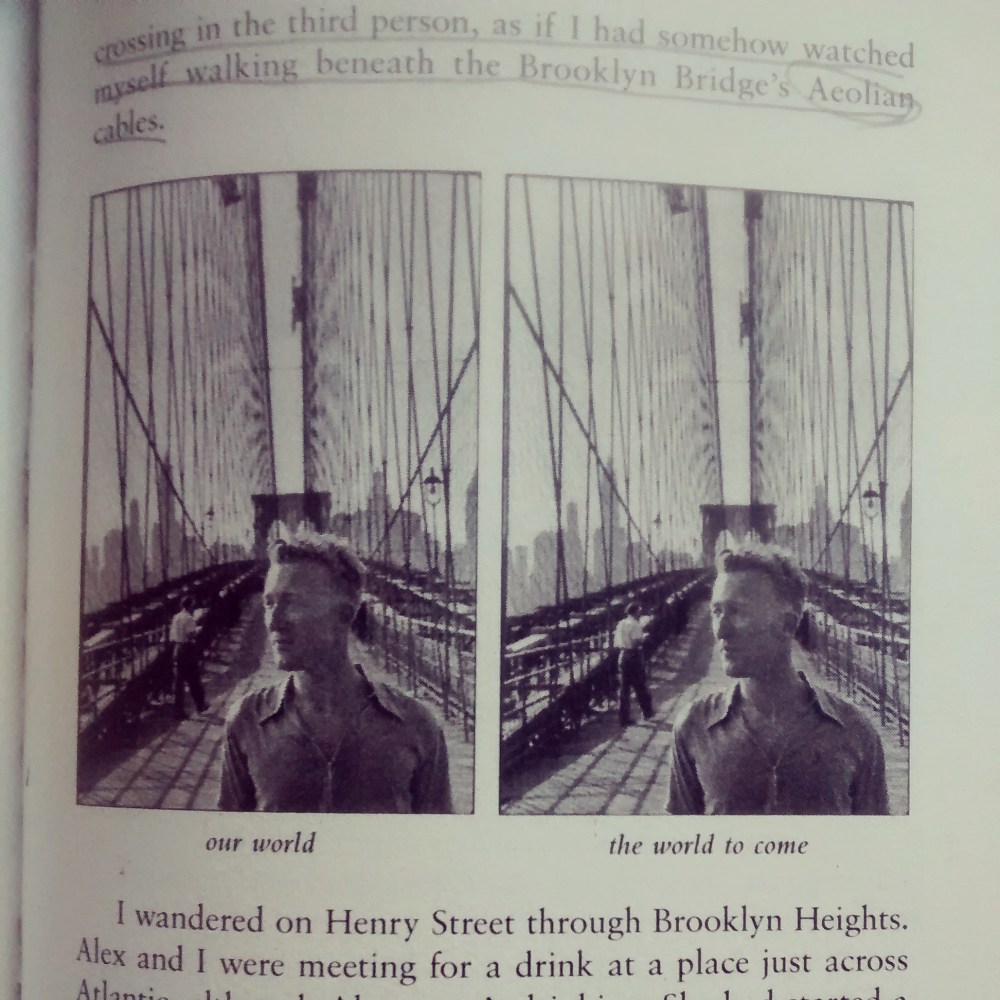
A Conversation about Ben Lerner’s Novel 10:04 (Part 2)

IMG_20140920_084354

[Context/editorial noteThis is the second and final part of a discussion between Biblioklept contributor Ryan Chang and myself about Ben Lerner’s new novel 10:04. You can read the first part of the discussion here, if you like—the gist of that conversation is that I am kinda sorta hating the book, while Ryan makes a strong case for my finishing it. Which I did. — ET].

Edwin Turner: Okay, Ryan, so I’m still having a hard time with the book, and I think that Hari Kunzru pins down why in his (diplomatic) review at The New York Times:

Does [the novel’s] ironic tone (which often feels like a reflex, a tic) preclude sincerity? Is all this talk of community no more than an artful confection, the purest kind of cynicism? The question is impossible to resolve, so each of these episodes — and indeed the book as a whole — takes on a sort of hermetic undecidability.

I find the “hermetic undecidability” not so much unsettling—the proper rhetorical gambit to match the novel’s themes—but rather a dodge, an escape hatch even, to avoid adequately answering to the model that the narrator wants to find in Whitman. There’s this wonderful moment where the narrator says “Art has to offer something other than stylized despair” — and I take this to be something like the mission of the book — but the archness, the cleverness of the book, its frequent retreats away from (what I take to be) Whitman’s project (the kosmos, the roughneck with the unstopped throat) — I just don’t see much but a kind of stylized ennui (if not despair) about the “bad forms of collectivity” our narrator is forced (forces himself) to partake in.

My favorite moments of the book continue to be the essay passages, the art or literary theory that he spackles in—the riff on Peggy Noonan writing Reagan’s Challenger-explosion speech, the elements of borrowed language, etc. (Again, I’m almost the same age as Lerner. I was in Young Astronauts, and our field trip to Cape Canaveral was canceled because of inclement weather, so we watched it in the cafeteria—live. I did not understand what happened, but I remember my teachers crying).

Ryan Chang: Hey man, I just skimmed the NYT review—per the excerpt you provided—because I don’t want Kunzru clouding any of my response. It’s certainly a question I too grapple with, and I think Kunzru is right insofar that the question is “undecidable” but not for the reason(s) he suggests. I agree with you that he dodges the question, whether or not from editorial pressure or a reticence to actually address “hermetic undecidability.”

For one, I’m not sure myself if The Author ever arrives at the Whitmanic model of democracy he posits. I’m also not sure if he is supposed to “arrive” in the sense that a finality is set. I guess I also want to riff a bit on how finality might be described. Is finality then something static; as in, somehow 10:04 transmits–electrocutes, reverberates–through its readership, now coeval (the when negligent, the position of the reader enmeshed in the text is the same at 10 PM here as it is at 5 AM there), the novel’s theses and everything is suddenly Whitmanic? Community successfully reimagined and cemented? That sounds too easy, too convenient, too short-sighted. Or is it a kind of arrival into an embodiment of time that exists outside of conventional literary clocks, which is also a Market-based clock — it’s my sense that the kind of democracy Whitman envisions in his work is one constantly in flux, a “reality in process” and thus in opposition to the capitalist clock? That is, we know we are supposed to “stop” working at 5, the embodiment of the currency-based clock disappears after 5, but it’s a contrasting relationship. Our time outside of the currency then absorbs a negative value (I think The Author only mentions once or twice how we are all connected by our debt, a negativity projected into the future), though the illusion of the clock is that we are “free” in our time. OK: in a literary sense, wouldn’t this be a sense of a text’s world stopping, a suspension that retroactively pauses the whole book? That 10:04 ends not only with a dissolution of prose into poetry, but also The Author into Whitman and thus recasting the first-/third-person narrator into a lyric-poet mode suggests the book’s integration into our, the reader’s, time (and also, retroactively, the entirety of the text). In that sense, for me, the issue whether or not The Author of 10:04 integrates the book fully into a Whitmanic model is not necessarily the point — it is that he, and also we hopefully through him — actively participate in remaking a “bad form of collectivity” less so. Continue reading “A Conversation about Ben Lerner’s Novel 10:04 (Part 2)”

A Conversation about Ben Lerner’s Novel 10:04 (Part 1)

1004

[Context/editorial note: Ben Lerner’s new novel 10:04 wasn’t on my radar until Ryan Chang, who has been contributing reviews, riffs, citations, and other good stuff to this blog for the some time now, brought it up. He digs it, I don’t—but in fairness, I haven’t finished it yet. I was determined to abandon it, but Ryan’s emails kept me interested enough to continue; our conversation of the past five days is presented below. The book frustrates and rewards; at times I’ve laughed out loud and at other moments I’ve sprained my eyeballs by rolling them. More to come, because this is pretty long—but I think Ryan, who offers the bulk of the analysis here, makes a strong case for Lerner’s book. — ET].   

Edwin Turner: Got an e-galley of the Lerner book. I don’t know if it’s that I’m almost exactly the same age as Lerner/the narrator or what, but I really really hate it so far! He’s very smart and the sentences are often great, but I find myself rolling my eyes at a lot of what he’s doing—it’s probably me not him. The narrative voice strikes me as so thoroughly inauthentic that I want to grab the narrator by the lapels and shout, Quit aping Sebald, quit trying to show how clever you are, and just observe and report! Again, it’s probably me not him.

Ryan Chang: I know what you mean; though it won’t bear any difference to your reading, I can attest personally to the diction & syntax of the narrator and Lerner himself (indeed, he does speak like that). I don’t think it’s an affectation, but I think it’s real “poet-y.” It is a criticism I forgive b/c I see that the tension between authenticity (of time) and inauthenticity (of time; especially exemplified in the Whole Foods/Instant coffee scene — which narrative context of time determines the Real, the Market (or its interpretation of Universal time) or our intuition (something like Whitmanic time, where time is experienced not on a linear, progressive plane but a circular, lateral one?)) is a crucial thread that runs throughout 10:04 and in Lerner’s other work. That said, I know  that in reviews to come of the book he’ll get slammed for that (I think the Kirkus review already did this).

A lot of my friends echo your distaste for Lerner for those exact same reasons, and I totally see why, and I’m kind of annoyed by it too. For me, the success of the book lies in the reclamation of fiction as a communal space from fetish book object/commercial futurity (author advances, agents, contracts, etc. — you already get some of this early on but there is more to come in a beautifully scathing scene of the NYC literary scene) And also, a kind of shiv to the Standard American Novelistic Form that reinforces traditional forms of American identity-making that Gass/Gaddis/Markson et al. have been doing for years and, I think, a poisonous strain of American political sentimentality that keeps most of us “depressed.” I think, too, because I’ve read it twice now, that there is an acknowledgment of his complicity in the very machines he participates in, and an inability, at least on his own, to dismantle those systems. Not sure if we should forgive him for criticizing the bourgeois Food Co-Op while being a member, albeit begrudgingly or tolerate his admission. There’s a lot of celebration of Whitmanic politics in that book, a return to a kind of Whitmanic democratic person is a return to a democratic reading is a return to a “real” democracy shared through the space of the book, of the position of the reader looking at an object and knowing that her “I” is shared amongst several. I’m not sure if you’ve gotten here yet, but he keeps intoning this phrase “bad forms of collectivity” as a better solution than nothing, than “modernist difficulty as resistance to the market.”

The Sebald comparison is apt, esp. with the form & diction & syntax, and I agree with you–Sebald is the master. There’s also something to be said, though, that this kind of fiction-making is badly needed in contemporary American letters on the Big 5 Publishing scene. I mean, I can’t read another fucking book about Brooklyn parents or mid-career Manhattan artist crises without wringing my neck. The kind of book Sebald innovated, too, is able to dismantle received ideas of art/history/writing/identity etc.;  I may be being too generous here, but I think it’s a form that will see continued adoption on this side of the pond.

ET: So your response made me return to the book, Ryan. The line that made me quit was something like, “The place was so quiet I could hear the bartender mixing our artisanal cocktails” or something like that—-I’m still not sure how to read that line as anything but a parody, but I think that the narrator, author, and writer are all sincere in trying to capture or document a particular time/feeling with the phrase. And as I continued reading, I was rewarded by the episode of the older poets/mentors, and their “daughter,” whom the narrator obsessed over—a very fine passage—humorous, reflective, a kind of parodic-but-sincere take on wanting to belong to a particular artistic scene. (What continues to unsettle me is the narrator’s assurance of his own achievement, although I could be wrong).

Continue reading “A Conversation about Ben Lerner’s Novel 10:04 (Part 1)”