I have always loved the month of May. Spring semester is usually over and done by the last week of April and I seem to breathe a little easier. I love May Day and there’s always been a neat little run of interesting dates in the first week, including my wedding anniversary. (My silly ass has taken to including Thomas Pynchon’s birthday as the capstone to the first week of Merry May). I get that May the Fourth is stupid, but it seemed fun when my kids were little, and I get that Cinco de Mayo, even with its roots in the Chicano movement, is probably now just a marketing tool for amateurs to do it up, a la St. Paddy’s Day and NYE. But it’s fun to have a little treat. My best friend died on 5 May 2025 though and I was dreading the date, although the anxiety over it was worse than the actual day. But then I dreamed about him for a few weeks straight. The month seemed incredibly long but at least the terrible drought in Florida broke with heavy heavy rains.
The wife and I make a point to sneak in an anniversary trip in early May. We spent a few nights in the Wynwood neighborhood of Miami and saw Belle & Sebastian perform their 1996 album If You’re Feeling Sinister in full. I felt incredibly old but it was magical. I’ve never been a big fan of Miami, but we had some good meals and enjoyed talking to a few of the artists at the Bakehouse Art Complex. This is the closest I actually got to a bookstore in Miami. Bookleggers is not actually a bookstore, it’s a free library, and it wasn’t open, although there was a loaded library cart full of titles out for offer. I love the idea and if I lived down there I’d pop in to donate at least once a month.
But on to books!
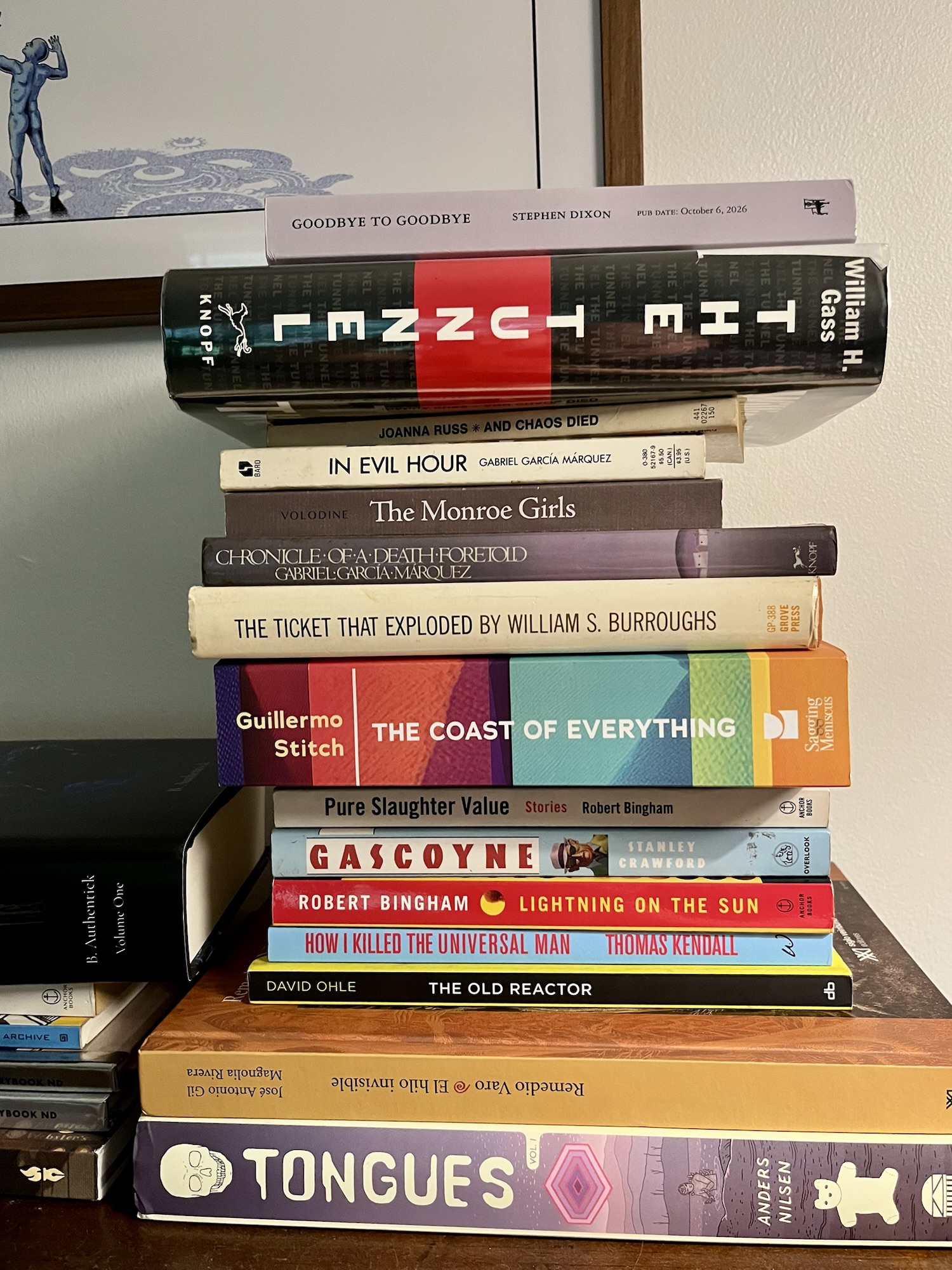
I’ve wormed into William H. Gass’s massive novel The Tunnel again. This is like my fourth or fifth serious attempt. I love Gass’s essays and shorter fiction, but I find that I stall out. My tactic this time has been to read one section a day, or at least to try to. I’m somewhere around page 160 now, and I think I’ve finally gotten into the “story,” or whatever, but it’s all pretty damn windy, and Gass’s penchant for alliteration, which I enjoy in short doses, is, like, too much (there’s a moment where the narrator remarks his wife’s calling him out on all the alliteration; I didn’t dogear it though).
I’ve also stalled a bit on Guillermo Stitch’s The Coast of Everything; I was attempting the same approach as that I’ve taken to The Tunnel — a section a day — but I keep getting distracted by shorter morsels, like Gabriel García Márquez’s In Evil Hour and Chronicle of a Death Foretold (both in translation by Gregory Rabassa, of course). Chronicle was even better than I’d remembered; In Evil Hour was rough, mean, and short.
The pictured stack is not all May reading, although I did read and review Antoine Volodine’s novel The Monroe Girls (tr. Alyson Waters) in early May. I read and reviewed Thomas Kendall’s How I Killed the Universal Man in April; I then read Joanna Russ’s And Chaos Died and meant to review it and kept moving it up the stack and then eventually lost track. On Bluesky, I tweeted that I was “baffled by the whole thing. Like if Kathy Acker wrote a sci-fi psionic satire. Very weird, I think I loved it, it might not be a ‘good’ novel.” That’s still basically my memory. I picked up a first edition Grove Press copy of WSB’s The Ticket That Exploded and I now have to reshelve all the Burroughs which means I have to reshelve a whole bookcase. So it can hang there for awhile.
I gave up pretty quickly on Stanley Crawford’s Gascoyne — probably too quickly — but I wanted the weirder flavor of his slim 1972 novel Log of the S.S. The Mrs. Unguentine. I ended up reading Crawford’s 2005 novel Petroleum Man over two nights and loving every minute of the experience. I highly recommend the novel, as well as Dan Visel’s 2010 review of the novel at his blog With Hidden Noise. I also recommend the blog With Hidden Noise, which was somehow not on my radar fifteen or some such years ago, but which I have very much enjoyed browsing now, which is to say over the past few days. There’s a rich backlog there. I lament too often that There Aren’t Any Good Websites Anymore, but maybe I don’t look enough; maybe I’m guilty of spending too much of my internet time on social media sites. The first book I mentioned here was by William H. Gass; I’ll take my offramp from this cursed blog by suggesting you read a real blog post, this With Hidden Noise post on Gass’s On Being Blue, Maggie Nelson’s Bluets, and Thomas Browne.
First off–yes, the entire list could be comprised of Dylan songs. I choose this one simply because it’s one of my favorites, and also from the first Dylan album I ever bought. Dylan visits a psychiatrist and tells him about the awful dreams he’s been having. Dylan is “down in the sewer with some little lover” when the bomb goes off; upon surfacing he discovers a post-apocalyptic world where the survivors aren’t to friendly–in fact, he’s even accused of being a Commie at one point. Even the abandoned Cadillac he finds–a “good car to drive after a war”–brings him no pleasure, and in his loneliness, he takes to calling the automated time update service, but it’s no longer being updated. The doctor cuts him off, saying that he’s been having similar dreams, only he was the only one left alive in his dreams. Dylan ends the song by declaring “I’ll let you be in my dreams if I can be in yours,” the subtlest anti-war slogan I’ve ever heard.
2. Stephen Malkmus, “Jenny and the Ess-Dog”
The tragic story of Jennifer, an 18 year “rich girl,” and her 31 year old boyfriend, “the Ess-dog, or Sean if you wish.” The Ess-Dog plays in a 60s cover band, drives a Volvo, and loves to play frisbee with their dog Trey (um, shades of Malkmus himself?) They love to make out to Dire Straits’ Brothers in Arms and do cocaine (Trey observes their “baby talk voices and post Class-A nasal drip”). Of course, such a romance can’t last: Jenny heads up to college in Boulder and pledges Kappa; the poor Ess-Dog starts waiting tables and even “sells his guitar.” Sad, sad, sad.
3. Roy Orbison, “Running Scared”
In just three verses and under two and a half minutes, Orbison captures all of the paranoia, fear, and triumph of teenage romance. The narrator is always “running scared, feeling low,” afraid that his girl’s ex might show up and try to get her back. Sure enough, his shaky confidence is put to the test: the ex shows up, “so sure of himself, his head up in the air.” The poor narrator’s heart is breaking, but in the final glorious moments, his girl chooses to stay with him. Classic.
4. Kate Bush, “Wuthering Heights”
So you’ve always wanted to read Emily Brontë’s Gothic romance Wuthering Heights but you just don’t have the time? And you don’t even have time to read the Sparknotes version? Or even the Wikipedia entry? Well, never fear–singer-songwriter/space alien Kate Bush recorded a chilling version of the story (okay a tiny little fragment of the story), told from the perspective of poor dead Cathy, pining for Heathcliff–the adoptive brother she spurned (ooh! Incest! uh…sorta). Even if it’s just a take on one part of the novel, it’s still a good story, a great song, and a truly ethereal vocal.
Pretty much every song by my favorite band Fiery Furnaces is some kind of zany adventure narrative, full of places and names and numbers. Blueberry Boat in particular has any number of good narratives–the title track, “Chris Michaels,” “Quay Cur”–but my personal favorite is the rivalry between two brothers at the end of “Chief Inspector Blancheflower.” “Blancheflower,” like many Furnaces’ songs, is a suite; the final segment of the suite is cleverly framed within the rest of the narrative as part of a story told over a “Woodpecker cider with a local fratricider” to the previous narrator. Despite “Mom’s oxycontin and the Amstel light,” the narrator finds that he’s doing all of the talking during a visit to his “younger brother Michael,” prompting him to get “both remotes and turn off the DVD” and confront his brother. It turns out that little Michael is now dating the narrator’s ex, Jenny. “My Jenny?” he asks, dumbfounded, to which little brother replies: “You know damn well she ain’t your Jenny no more.” He confronts Jenny the next day outside her “dad’s bakery,” accusing her of messing with Michael’s head as “some kind of revenge” against him. In the end though, it’s futile. He winds up at a bar, telling the story to the previous narrator.
6. De La Soul, “Millie Pulled a Pistol on Claus”
Dillon, the seemingly benevolent social worker who mentors the fellas in De La Soul, is actually a monster who molests his teenage daughter Millie. She takes her revenge at the local mall, coldly executing her pop who is volunteering as Santa Claus: “Millie bucked him with the quickness/ It was over.” Classic track, classic album.
Unfortunately, no vid for “Millie,” but you can still enjoy “A Rollerskating Jam Named “Saturdays”” (with a sweet Chicago sample, to boot):
7. Public Enemy, “Black Steel in the Hour of Chaos”
“I got a letter from the government the other day/ I opened and read it/ It said they were suckers/ They wanted me for their army or whatever/ Picture me givin’ a damn–I said never.” This is possibly the best opening in the history of rap, but Chuck D only keeps upping the ante: the narrator soon realizes that “the suckers had authority,” and before you can blink, he’s “sittin’ in the state pen,” planning his escape. He attacks a “C-O,” steals his gun, and goes on a prison rampage, “52 brothers” behind him. The faithful S1Ws arrive (with bazookas!) to escort the escapees to northern freedom. Great stuff.
Tricky’s version is pretty good too:
8. Leonard Cohen, “The Partisan”
Cohen adapted “The Partisan” from an old WWII French Resistance song, “La Complainte du Partisan” by Emmanuel D’Astier de la Vigerie and Anna Marly. The historical significance only adds to the song’s haunting melody and diffident spirit. “The Partisan” recounts the sad story of a freedom fighter who has lost his wife and children, but keeps on fighting. “There were three of us this morning,” he says, ominously adding, “I’m the only one this evening.” Grim stuff.
9. Johnny Cash, “Cocaine Blues”
“Cocaine Blues” begins with narrator Willy Lee telling us: “I took a shot of cocaine and I shot my woman down” for messing around on him. He sleeps on the murder, then wakes up the next morning and “takes a shot of cocaine” before taking off. Unfortunately, the cops catch up with him down in Juarez, Mexico. He’s sent to trial, and the “little judge” hands him his sentence “in about five minutes”–“99 years in the Folsom pen.” He laments that he can’t forget the day he “shot that bad bitch down,” warning the listener to “lay off that whiskey, and let that cocaine be.”
I couldn’t find footage of Cash doing the song, but this isn’t so bad:
And if you insist on seeing Cash sing a narrative song:
10. Tom Waits, “Christmas Card from a Hooker in Minneapolis”
The saddest Christmas song ever begins with a junkie whore’s plaintive salutation to her ex-lover: “Hey Charlie I’m pregnant.” She goes on to explain that life now isn’t so bad: her old man, who “works out at the track” knows that the kid isn’t his but promises to “raise him up like he would his own son”; he even gives her a ring that was “worn by his mother” and takes her out dancing “every Saturday night.” Still though, things aren’t great. The hapless narrator delivers one of the saddest lines in any song I’ve ever heard: “I still have that record of Little Anthony and the Imperials/ But someone stole my record player/ How do you like that?” Things get even sadder when the narrator laments: “I wish I had all the money we used to spend on dope.” By the end of the song she comes clean, admitting that she doesn’t have a husband, and that she’s writing because she needs to borrow money. It turns out she’s in prison, and she’ll be “eligible for parole come Valentine’s Day.”
11. New Order, “Love Vigilantes”
“Love Vigilantes” is now over twenty years old and just as relevant as it ever was. This is a love song, a protest song, and a ghost story all in one. The biggest irony isn’t the O. Henry-by-way-of-Poe twist ending, it’s the discrepancy between the ebullient rhythm and pop melody of the music clashing against the mournful lyrics.
12. Belle and Sebastian, “Jonathan David”
On the surface, “Jonathan David” appears to be a song about two guys who like the same girl: “I know you like her/ Well I like her too/ I know she likes you.” However, pick up the Biblical allusion to find the subtext. The narrator says, “I was Jonathan to your David/ You’re still king.” In the Old Testament Book of Samuel, Jonathan takes an extreme liking to future-king David, pledging his undying service to the handsome young hero. For centuries, whether the relationship was platonic, romantic, or sexual has been under debate. Read more here. In the light of the Book of Samuel, Belle and Sebastian’s “Jonathan David” is still about a friendship split by a girl, only it becomes clear now that the narrator is really in love with his friend. In typical B&S fashion, the narrator wavers between hope and despair, declaring at one point that “It’s not like we’ll be parted/ It’s not like we’ll never know love,” before ending on a melancholy note: “You and her in the local newspaper/ You will be married and you’ll be gone.” In the end, his adolescent homosexual infatuation has to give way to public expectation (“local newspaper”), and the simple fact that his friend digs girls.