End of merry month of May blog

I have always loved the month of May. Spring semester is usually over and done by the last week of April and I seem to breathe a little easier. I love May Day and there’s always been a neat little run of interesting dates in the first week, including my wedding anniversary. (My silly ass has taken to including Thomas Pynchon’s birthday as the capstone to the first week of Merry May). I get that May the Fourth is stupid, but it seemed fun when my kids were little, and I get that Cinco de Mayo, even with its roots in the Chicano movement, is probably now just a marketing tool for amateurs to do it up, a la St. Paddy’s Day and NYE. But it’s fun to have a little treat. My best friend died on 5 May 2025 though and I was dreading the date, although the anxiety over it was worse than the actual day. But then I dreamed about him for a few weeks straight. The month seemed incredibly long but at least the terrible drought in Florida broke with heavy heavy rains.

The wife and I make a point to sneak in an anniversary trip in early May. We spent a few nights in the Wynwood neighborhood of Miami and saw Belle & Sebastian perform their 1996 album If You’re Feeling Sinister in full. I felt incredibly old but it was magical. I’ve never been a big fan of Miami, but we had some good meals and enjoyed talking to a few of the artists at the Bakehouse Art Complex. This is the closest I actually got to a bookstore in Miami. Bookleggers is not actually a bookstore, it’s a free library, and it wasn’t open, although there was a loaded library cart full of titles out for offer. I love the idea and if I lived down there I’d pop in to donate at least once a month.

But on to books!

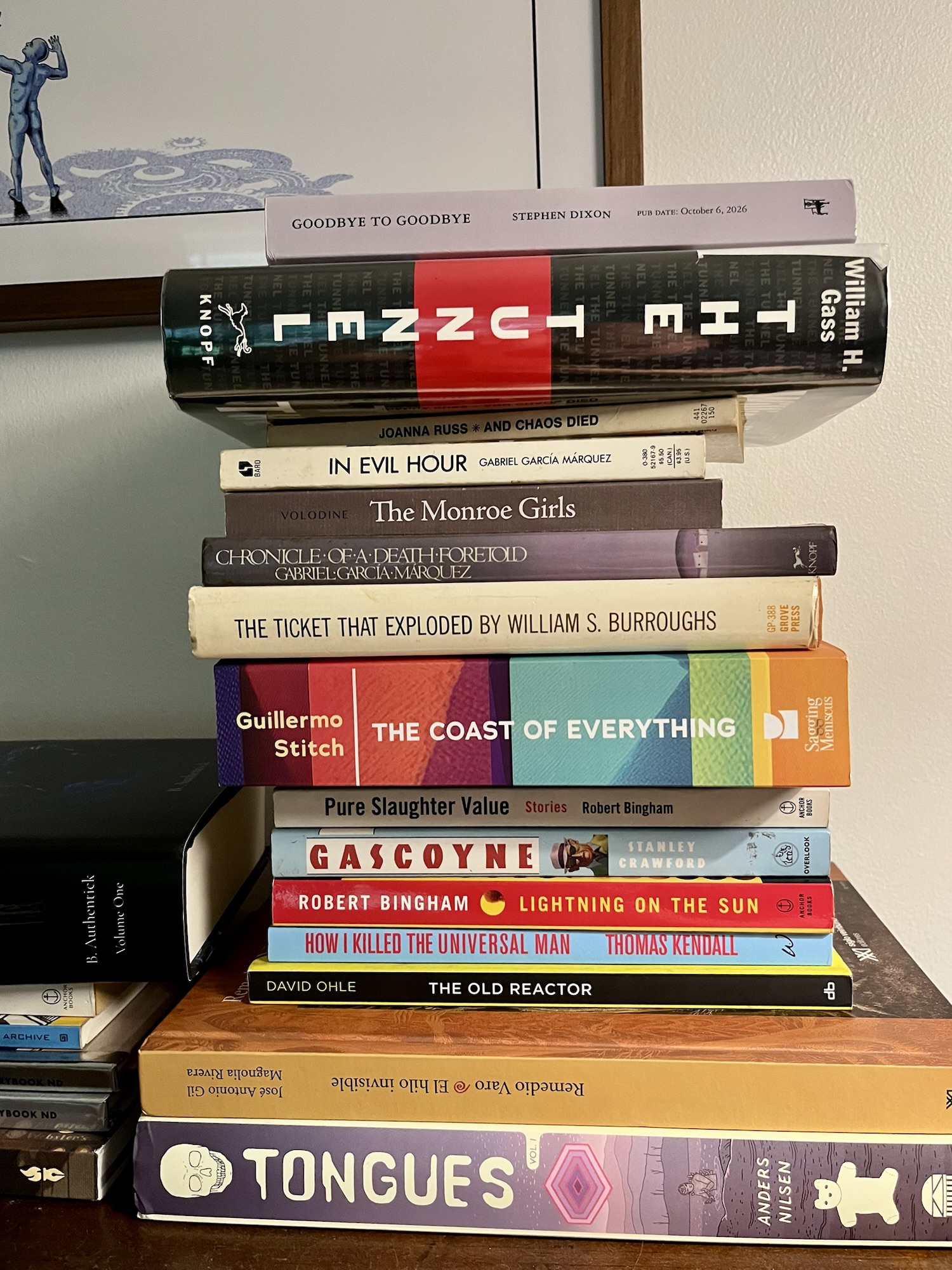
I’ve wormed into William H. Gass’s massive novel The Tunnel again. This is like my fourth or fifth serious attempt. I love Gass’s essays and shorter fiction, but I find that I stall out. My tactic this time has been to read one section a day, or at least to try to. I’m somewhere around page 160 now, and I think I’ve finally gotten into the “story,” or whatever, but it’s all pretty damn windy, and Gass’s penchant for alliteration, which I enjoy in short doses, is, like, too much (there’s a moment where the narrator remarks his wife’s calling him out on all the alliteration; I didn’t dogear it though).

I’ve also stalled a bit on Guillermo Stitch’s The Coast of Everything; I was attempting the same approach as that I’ve taken to The Tunnel — a section a day — but I keep getting distracted by shorter morsels, like Gabriel García Márquez’s In Evil Hour and Chronicle of a Death Foretold (both in translation by Gregory Rabassa, of course). Chronicle was even better than I’d remembered; In Evil Hour was rough, mean, and short.

The pictured stack is not all May reading, although I did read and review Antoine Volodine’s novel The Monroe Girls (tr. Alyson Waters) in early May.  I read and reviewed Thomas Kendall’s How I Killed the Universal Man in April; I then read Joanna Russ’s And Chaos Died and meant to review it and kept moving it up the stack and then eventually lost track. On Bluesky, I tweeted that I was “baffled by the whole thing. Like if Kathy Acker wrote a sci-fi psionic satire. Very weird, I think I loved it, it might not be a ‘good’ novel.” That’s still basically my memory. I picked up a first edition Grove Press copy of WSB’s The Ticket That Exploded and I now have to reshelve all the Burroughs which means I have to reshelve a whole bookcase. So it can hang there for awhile.

I gave up pretty quickly on Stanley Crawford’s Gascoyne — probably too quickly — but I wanted the weirder flavor of his slim 1972 novel Log of the S.S. The Mrs. Unguentine. I ended up reading Crawford’s 2005 novel Petroleum Man over two nights and loving every minute of the experience. I highly recommend the novel, as well as Dan Visel’s 2010 review of the novel at his blog With Hidden Noise. I also recommend the blog With Hidden Noise, which was somehow not on my radar fifteen or some such years ago, but which I have very much enjoyed browsing now, which is to say over the past few days. There’s a rich backlog there. I lament too often that There Aren’t Any Good Websites Anymore, but maybe I don’t look enough; maybe I’m guilty of spending too much of my internet time on social media sites. The first book I mentioned here was by William H. Gass; I’ll take my offramp from this cursed blog by suggesting you read a real blog post, this With Hidden Noise post on Gass’s On Being Blue, Maggie Nelson’s Bluets, and Thomas Browne.
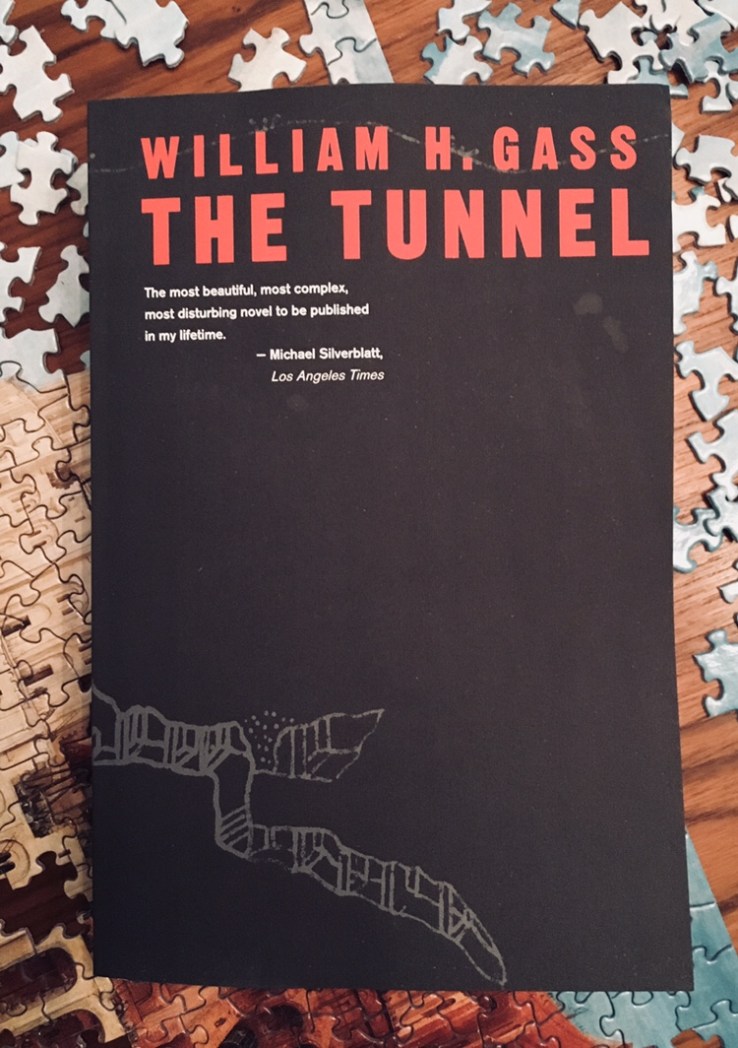
William H. Gass’s The Tunnel (Book acquired, 22 Jan. 2018)

img_8960

The great late great William H. Gass’s very big novel The Tunnel was one of four books I put on my 2018 Good Intentions Reading List that I didn’t previously own. (I did check it out from the library a few years back and download the audiobook—read by Gass himself–but I didn’t make a big dent). I ordered it from my favorite bookstore and it came in yesterday. The Tunnel is one of three Great Big Books I plan to (attempt to) read this year, including Middlemarch and some novel called War & Peace. I’ll probably start The Tunnel first.

Here are two selections from The Tunnel:

img_8962

An Invocation to the Muse

O brood O muse upon my mighty subject like a holy hen upon the nest of night.
O ponder the fascism of the heart.
Sing of disappointments more repeated than the batter of the sea, of lives embittered by resentments so ubiquitous the ocean’s salt seems thinly shaken, of let-downs local as the sofa where I copped my freshman’s feel, of failures as frequent as first love, first nights, last stands; do not warble of arms or adventurous deeds or shepherds playing on their private fifes, or of civil war or monarchies at swords; consider rather the slightly squinkered clerk, the soul which has become as shabby and soiled in its seat as worn-out underwear, a life lit like a lonely room and run like a laddered stocking.
Behold the sagging tit, the drudge-gray mopped-out cunt-corked wife, stale as yesterday’s soapy water or study the shiftless kind, seedy before any bloom, thin and mean as a weed in a walk;
Smell the grease that stands rancid in the pan like a second skin, the pan aslant on some fuel-farting stove, the stone in its corner contributing what it can to the brutal conviviality of close quarters,
Let depression like time-payments weigh you down; feel desperation and despair like dust thick in the rug and the ragged curtains, or carry puppy pee and plate-scrapings, wrapped in the colored pages of the Sunday paper, out to the loose and blowing, dog-jawed heap in the alley;
Spend your money on large cars, loud clothes, sofa-sized paintings, excursions to Hawaii, trinkets, knicknacks, fast food, golf clubs, call girls, slimming salons, booze;
Suffer shouting, heat rash, chilblains, beatings, betrayal, guilt, impotence, jail, jealousy, humiliation, VD, vermin, stink.
Sweat through a St. Louis summer and sing of that.
O muse, I cry, as loudly as I can, while still commanding a constricted scribble, hear me! help me! but my nasty echo answers: one muse for all the caterwauling you have called for! where none was in that low-life line of work before?
It’s true. I’ll need all nine for what I want to do—perhaps brand new—all nine whom Hesiod must have frigged to get his way, for he first spoke their secret names and hauled their history by the snout into his poem. For what I want to do …
Which is what—exactly? to deregulate Descartes like all the rest of the romancers? to philosophize while performing some middle-age adultery? basically enjoying your anxieties like raw lickker when it’s gotten to the belly? I know—you want to make the dull amazing, you want to Heidegger some wholesome thought, darken daytime for the TV, grind the world into a grain of Blake.
O, I deny it! On the contrary! I shall not abuse your gift. I pledge to you, if you should choose me, not to make a mere magician’s more of less, to bottle up a case of pop from a jigger of scotch. I have no wish to wine water or hand out loaves and fishes like tickets on a turkey. It is my ambition to pull a portent—not a rabbit but a raison d’être—from anything—a fish pond, top hat, fortune cookie—you just name it—a prophecy in Spengler’s fanciest manner, a prediction of a forlorn future for the world from—oh, the least thing, so long as it takes a Teutonic tone—a chewed-over, bubble-flat wad of baseball gum, say, now hard and sour in the street, with no suggestion of who the player’s picture was, impersonal despite its season in someone’s spit, like a gold tooth drawn from a Jew’s jaw.
Misfits, creeps, outcasts of every class; these are my constituents—the disappointed people—and if I could bring my fist down hard on the world they would knot together like a muscle, serve me, strike as hard as any knuckle.
Hey Kohler—hey Koh—whistle up a wind. Alone, have I the mouth for it? the sort of wind I want? Imagine me, bold Kohler, calling out for help—and to conclude, not to commence—to end, to bait, to 30, stop, leave off, to hush a bye forever … to untick tock.

William H. Gass reads from The Tunnel

“A Fugue” — William H. Gass

My dad wouldn’t let me have a dog. A dog? A dog we don’t need. My mom made the neighbor’s spitz her pal by poisoning it with the gin she sprinkled on the table scraps. Feed it somewhere else, my dad said. A dog we don’t need. My dad wouldn’t let me have a dog. Our neighbor’s spitz–that mutt–he shits in the flower beds. Dog doo we don’t need. At least feed it somewhere else, my dad said. My mom made the table scraps tasty for her pal, the neighbor’s spitz– that mutt–by sprinkling them with gin. You’re poisoning Pal, my dad said, but never mind, we don’t need that mutt. My mom thought anything tasted better with a little gin to salt it up. That way my mom made the neighbor’s spitz her pal, and maddened dad who wouldn’t let me have a dog. He always said we didn’t need one, they crapped on the carpet and put dirty paws on the pant’s leg of guests and yapped at cats or anyone who came to the door. A dog? A dog we don’t need. We don’t need chewed shoes and dog hairs on the sofa, fleas in the rug, dirty bowls in every corner of the kitchen, dog stink on our clothes. But my mom made the neighbor’s spitz her pal anyway by poisoning it with the gin she sprinkled on the table scraps like she was baptising bones. At least feed it somewhere else, my dad said. My dad wouldn’t let me have a pal. Who will have to walk that pal, he said. I will. And it’s going to be snowing or it’s going to be raining and who will be waiting by the vacant lot at the corner in the cold wet wind, waiting for the damn dog to do his business? Not you, Billy boy Christ, you can’t even be counted on to bring in the garbage cans or mow the lawn. So no dog. A mutt we don’t need, we don’t need dog doo in the flower beds, chewed shoes, fleas; what we need is the yard raked, like I said this morning. No damn dog. No mutt for your mother either even if she tries to get around me by feeding it when my back is turned, when I’m away at work earning her gin money so the sick thing can shit in a stream on the flower seeds; at least she should feed it somewhere else; it’s always hanging around; is it a light string in the hall or a cloth on the table to be always hanging around? No. Chewed shoes, fleas, muddy paws and yappy daddle, bowser odor: a dog we don’t need. Suppose it bites the postman: do you get sued? No. I am the one waiting at the corner vacant lot in the rain, the snow, the cold wet wind, waiting for the dog to do his damn business, and I get sued. You don’t. Christ, you can’t even be counted on to clip the hedge. You know: snicksnack. So no dog, my dad said. Though we had a dog nevertheless. That is, my mom made the neighbor’s pal her mutt, and didn’t let me have him for mine, either, because it just followed her around–yip nip–wanting to lap gin and nose its grease-sogged bread. So we did have a dog in the house, even though it just visited, and it would rest its white head in my mother’s lap and whimper and my father would throw down his paper and say shit! and I would walk out of the house and neglect to mow or rake the yard, or snicksnack the hedge or bring the garbage cans around. My dad wouldn’t let me have a dog. A dog? A dog we don’t need, he said. So I was damned if I would fetch.

From William H. Gass’s novel The Tunnel.

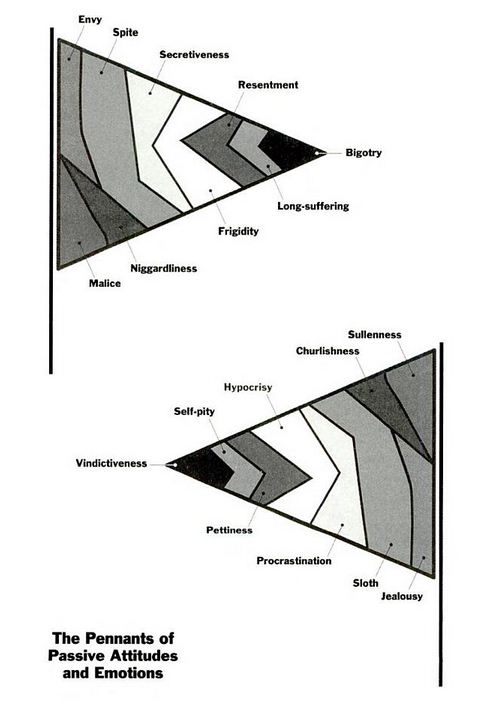
The Pennants of Passive Attitudes and Emotions (William H. Gass)

(From William Gass’s 1995 novel The Tunnel; The Quarterly Conversation will lead a Big Read of The Tunnel starting next week).

William H. Gass Reads from His Novel The Tunnel (Video)

So this weekend I started auditing William Gass’s novel The Tunnel on mp3, read by the author: Sonorous, strange, ugly, beautiful, poetic, abyssal, phallic, anal, fragmented, rich. Here he is in 2007 reading from the beast of a book at The Village Voice Bookshop in Paris (RIP). More on The Tunnel.