Paul Valéry’s Monsieur Teste (Book acquired, 14 Nov. 2024)

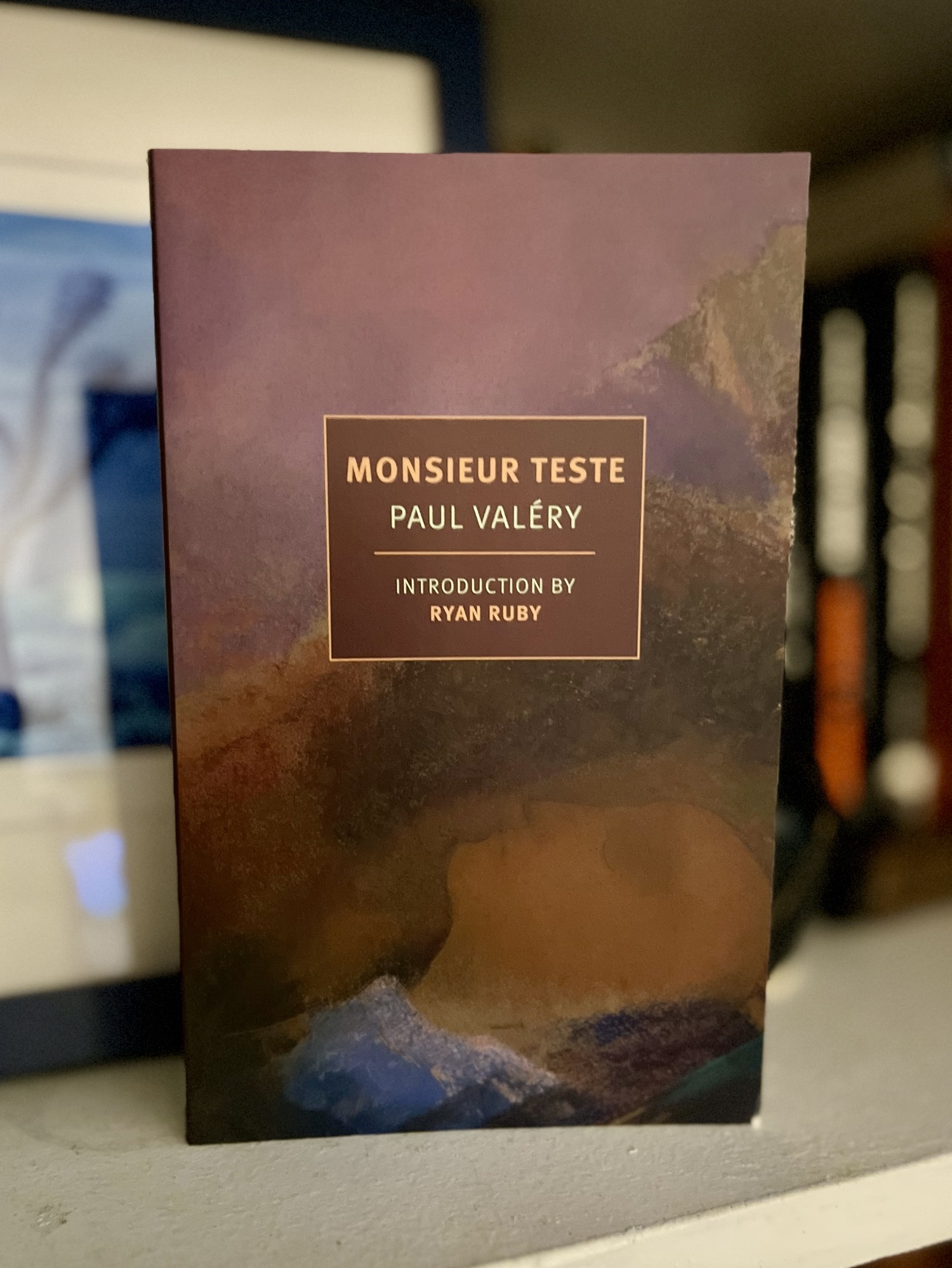
Got a review copy of Paul Valéry’s Monsieur Teste, a slim lil fellow from NYRB in translation by Charlotte Mandell. The back cover includes a blurb from William H. Gass—

Monsieur Teste is a monster, and is meant to be—an awesome, wholly individualized machine—yet in a sense he is also the sort of inhuman being Valéry aimed to become himself: a Narcissus of the best kind, a scientific observer of consciousness, a man untroubled by inroads of worldly trivia, who vacations in his head the way a Platonist finds his Florida in the realm of Forms.

What the fuck does Gass mean by “Florida” here? I really want to know.


This style of post, the book acquired post, is an established, which is to say tired, blog post format on this blog, Biblioklept, probably going back a decade now, born from a glut of review copies piling up, mostly unasked for but many asked for, books that stack up their own measures of guilt, unread, or then maybe read, months, years later—but the post style is ephemeral, yes, fluffy, sure, embarrassing even maybe. The form is stale; I apologize. I do think the Valéry book seems pretty cool.


I have a not-insubstantial stack of newly acquired new (and used books) stacked on the cherry side table by the black leather couch that I should have made book acquired posts about. These have piled up over the last few weeks. These are not interesting sentences (several of the books seem very interesting).


I am not going to find the new form I want here, am I?


When I was a freshman in high school, my then-girlfriend’s older brother gave me a mixtape that a girl had given him. He didn’t like anything on the mixtape; he liked Buddy Holly. I can’t remember why he gave me the tape—I think I saw it in his car and asked about it. But it ended up changing my life in some ways, as small giant things like songs or books or films can do when they come over you at the right time and place.

There were a few bands on the tape that I knew or had heard of, and even some I owned albums by, like the Cure and the Smiths. But for the most part, the tape opened a new aural world to me. I heard My Bloody Valentine, Big Star, Ride, the Cocteau Twins, and This Mortal Coil, among others, for the first time. There were also two songs by one band: Slowdive’s “When the Sun Hits” and “Dagger.”


(This particular blog post is no longer about acquiring a Valéry translation; it is about something else.)


Those songs are from Slowdive’s 1993 classic Souvlaki. I owned it on cassette. That cassette melted, just slightly, on the top of my 1985 Camry’s dashboard in like August of 1995. The tape was just warped enough not to fit into a cassette deck. I liked to imagine how it would sound. The next year, my lucky privileged ass found a used CD of Slowdive’s follow-up, Pygmallion on a school trip to London. Slowdive kinda sorta broke up after that.


I have always been a proponent of bands breaking up. I think a decade is long enough; get what you need done in five or six albums and move on. There are many many exceptions to this rule. But generally, I don’t think beloved bands—by which I means bands beloved by me—should keep going on too long. And if they break up, they should stay broken.


But I bought Slowdive’s 2017 reunion album Slowdive used at a St. Petersburg record store and listened to it again and again, amazed at how strong it was, how true to form. My kids liked it a lot. And then they put out a record last year, Everything Is Alive—I like that one too (not as good as the self titled one).


(There’s no point to any of this; I might’ve had some wine; I might just feel like writing.)


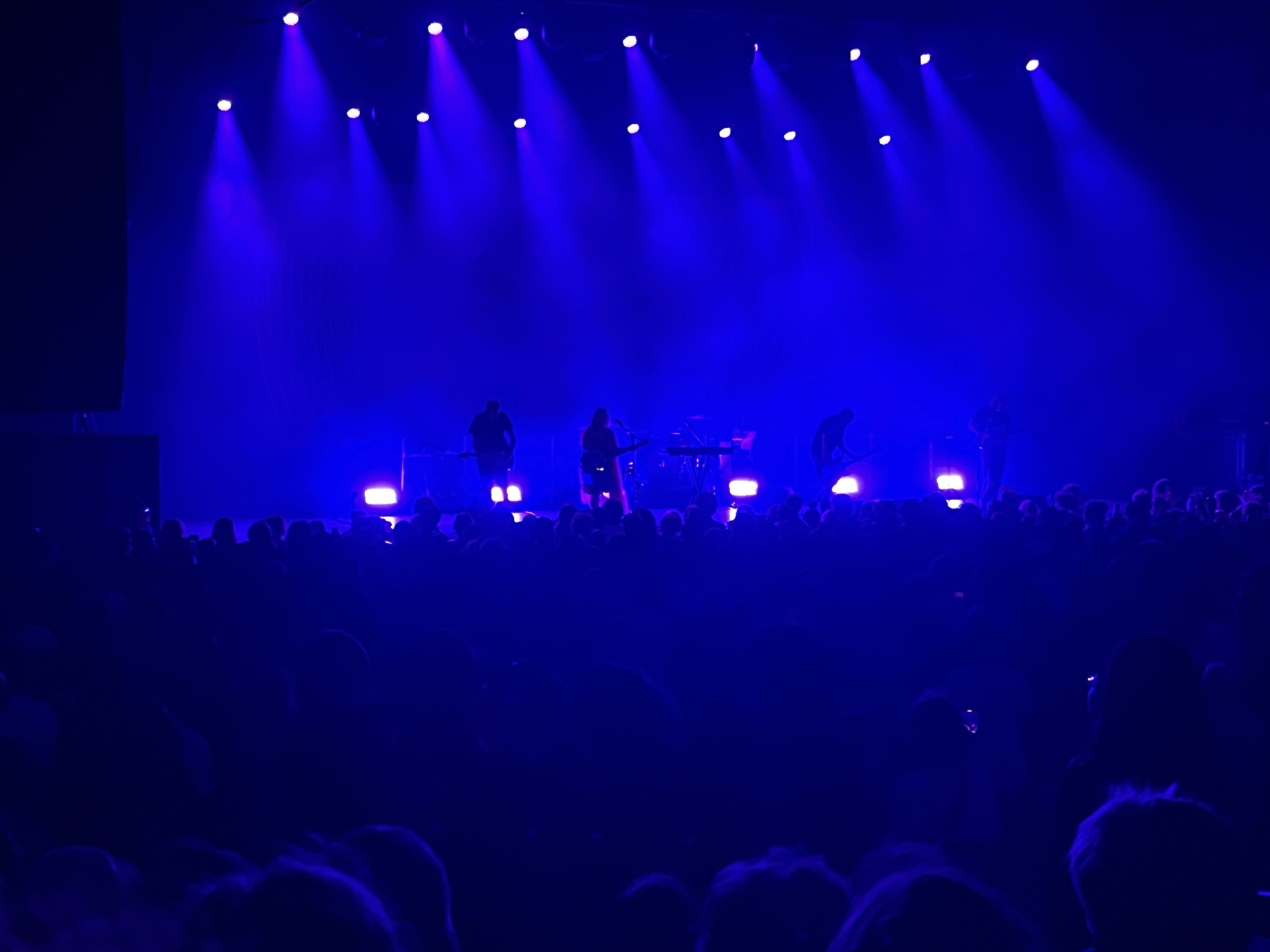
I guess if you’d told me back in ’95 or ’05 or even ’15 that I’d see a reunited Slowdive twice in one year I’d say that that sounded silly. (The ’15 version of me that had seen Dinosaur Jr.’s dinosaur act wouldn’t have been interested.) But we went out into the woods to see Slowdive this Sunday. They played the St. Augustine Amphitheatre to a large, strange, diverse crowd, out there in the Florida air. A band named Wisp, TikTok famous I’m told, opened, and they were pretty good. But Slowdive was perfect—better than back in May in Atlanta—echo and reverb ringing out into Anastasia State Park.


We stayed in a cheap motel off of AIA that night—another sign of my age. When I was younger, I could drive six hours, watch a band, and drive the six hours back without blinking. We are about 45 minutes from St. Augustine. It was a nice night out.


A younger version of me could’ve read the 80 pages of Paul Valéry’s Monsieur Teste in the time it took to twiddle my thumbs in this post and write a real (and likely bad) review to boot. Again, apologies. I’m getting old, a dinosaur act. But I can’t break up, not now.


Slowdive, St. Augustine Amphitheatre, 10 Nov. 2024 Slowdive, St. Augustine Amphitheatre, 10 Nov. 2024

Simon Critchley’s Mysticism (Book acquired, 17 Oct. 2024)

Simon Critchley’s Mysticism is new from NYRB. Their blurb:

Why mysticism? It has been called “experience in its most intense form,” and in his new book the philosopher Simon Critchley poses a simple question to the reader: Wouldn’t you like to taste this intensity? Wouldn’t you like to be lifted up and out of yourself into a sheer feeling of aliveness, both your life and those of the creatures that surround you? If so, it might be well worthwhile trying to learn what is meant by mysticism and how it can shift, elevate, and deepen the sense of our lives.

Mysticism is not primarily a theoretical issue. It’s not a question of religious belief but of felt experience and daily practice. A rough and ready definition of mysticism is that it is a way of systematically freeing yourself of your standard habits, your usual fancies and imaginings so as to see what is there and stand with what is there ecstatically. Mysticism is the practical possibility of the achievement of a fluid openness between thought and existence.

This is a book about trying to get outside oneself, to lose oneself, while knowing that the self is not something that can ever be fully lost. It is also a book about Julian of Norwich, Anne Carson, Annie Dillard, T.S. Eliot, and Nick Cave. It shows how listening to music can be secular worship. It is a book full of learning, puzzlement, pleasure, and wonder. It opens the door to mysticism not as something unworldly and unimaginable, but as a way of life.

Benjamin Swett’s The Photograph Not Taken (Book acquired early October, 2024)

Benamin Swett’s The Picture Not Taken is forthcoming from NYRB. Their blurb:

In The Picture Not Taken, the photographer and writer Benjamin Swett considers the intersections between photography, memory, the natural world, and the course of life in essays on subjects that include family snapshots, images of racial violence, the shape of abiding love, and the experience of unforseen and irremediable loss. In these beautifully written, deeply affecting pages, Swett moves with a wonderful improvisatory freedom among his chosen themes. The Picture Not Taken is a book of transfixing pieces that possesses the intensity and integrity and heft of the wholly new.

The Oceans of Cruelty (Book acquired, 23 Sept. 2024)

This is an interesting one: The Oceans of Cruelty: Twenty-Five Tales of a Corpse Spirit: A Retelling by Douglas Penick: I think I’ll just keep using the colon the way I use garlic: The book will be out in October, in time for Halloween: Here is publisher NYRB’s blurb: (No colons in their blurb):

One of the oldest books in the world, The Oceans of Cruelty is a sequence of twenty-five tales from India whose central theme is the dark power of storytelling. At the start, a young king falls into the hands of a wicked sorcerer, who orders him to find a vetala, or corpse spirit, to serve him; the young king must do as he is told, and soon enough he is also under the sway of the no less malevolent spirit. Like a bat, the spirit hangs from the branches of a tree, and the king is condemned to bear it on his back through a dark forest as it whispers a riddling story in his ear. These are tales of suicidal passion, clever deceit, patriarchal oppression, and narrow escapes from death, and as long as the king can resolve the problems they pose, his bondage continues; the vampiric creature goes on commanding his attention in the dark. Only when the king is out of answers will he at last be free, though when that comes to pass—well, that’s when the whole story takes a new turn.

Douglas Penick’s re-creation of this ancient work brings out all its humor and horror and vitality, as well its unmistakable relevance in a world of stories gone viral.

Ron Loewinsohn’s Magnetic Field(s) (Book acquired, 20 Sept. 2024)

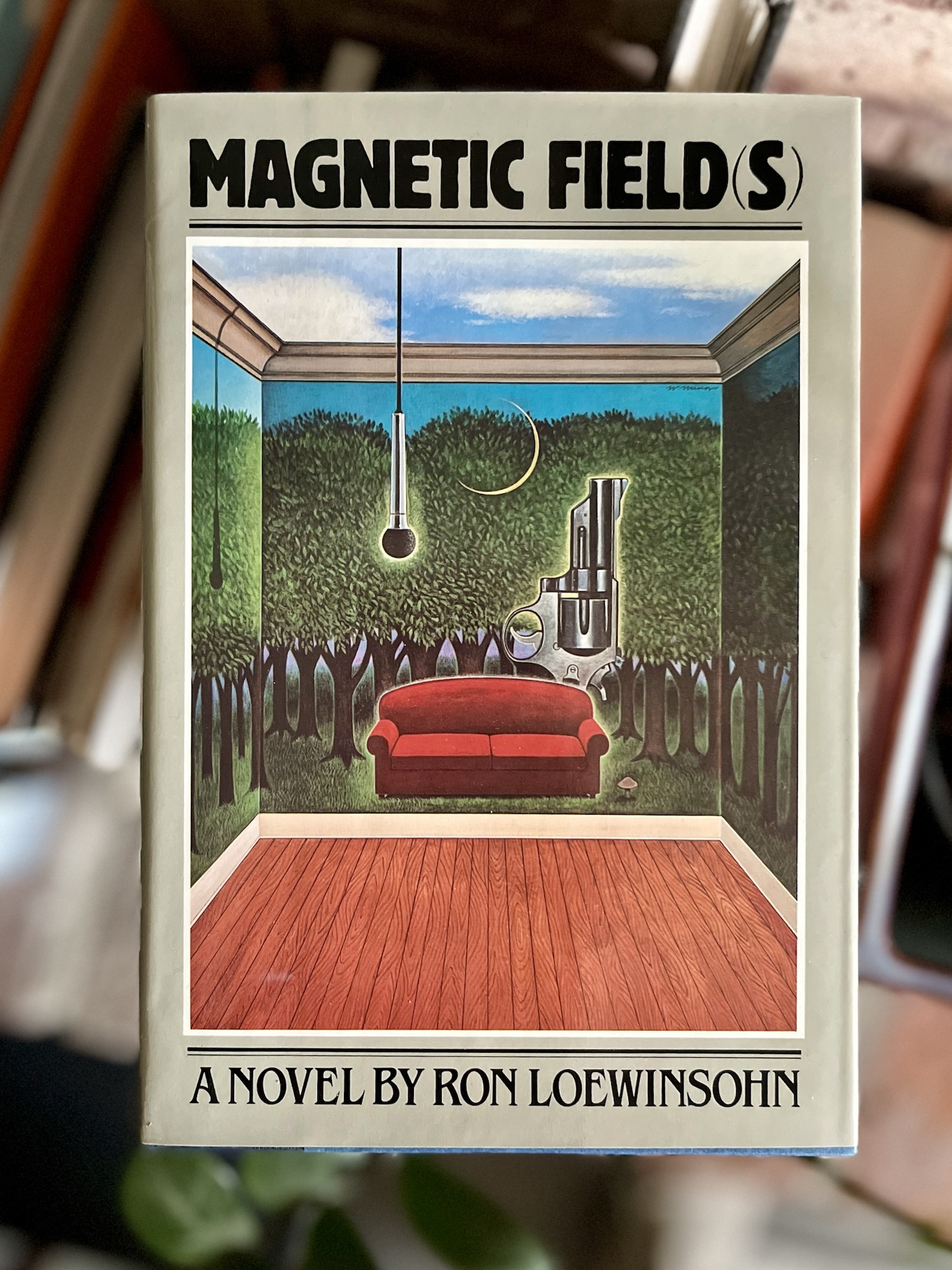
I finally came across a copy of Ron Loewinsohn’s 1983 novel Magnetic Field(s). 

First three paragraphs, which I read a few minutes ago in a sweat:

Killing the animals was the hard part. “All you’ve got to do,” Jerome had told him, “is keep your cool. There isn’t anybody else’s cool you’ve got to keep, and there isn’t anybody else who will keep yours.” The first time it happened—he had already gone with Jerome five or six times—they were in this backyard when this little black dog (a Scottie?) started yapping up at them and he froze in the first moment and in the next felt his body want to move back over the fence, the way they’d come. But Jerome had simply reached down to pick up a brick that formed part of a kind of border around some flowers—it was all one smooth motion—and bashed in the dog’s head with one good one, and then gave it one more to make sure, the second one making an awful sound as it went into what was left of the dog’s head. There were just these four little legs attached to this furry black body, and where the head had been was just this turmoil of hair and blood and meat and one piece of jagged bone and one eye where it shouldn’t have been, not even not looking at anything, just there; and he looking down at it till Jerome touched him on the chest and then motioned toward the window with one jerk of his thumb.

The first time he’d had to do it himself, they had just stepped into this backyard at the end of the driveway and suddenly there was this big setter—just as surprised as they were. He started to feel himself wanting to turn back out of there, hearing the blood rushing in his ears and thinking he did not want to do this as he reached back, his hand closing around the cold shaft of the tire iron in his back pocket. Behind him Jerome had stopped. He reached out his left hand, offering “something” to the dog, which leaned forward to check it out at the same time that it began to pull its lips back away from its teeth. He brought the tire iron out and down in one sweeping arc into the animal’s head. It actually made a dent in the head and felt something, at first, like hitting a rolled-up rug, except that now there was this dog lying there with its different legs crumpled under it or sticking out in a way that nothing that was alive would lie that way. He just stood there a long moment, looking down at that furry body, hearing himself breathing and hearing the dog not.

Killing the animals was the hard part because they tended to get under his skin; they reminded him of him. Their bodies were complicatedly thick, so that hitting this skull was nothing at all like hitting a rolled-up rug, or a log, things that were solid, the same all the way through. They were made of all those layers of skin and bone and organs, all of which he thought of as easily bruised, especially the organs. They moved like him, they wanted things, they wanted, and they were scared and furious.

Lutz Seiler’s Star 111 (Book acquired, early Sept. 2024)

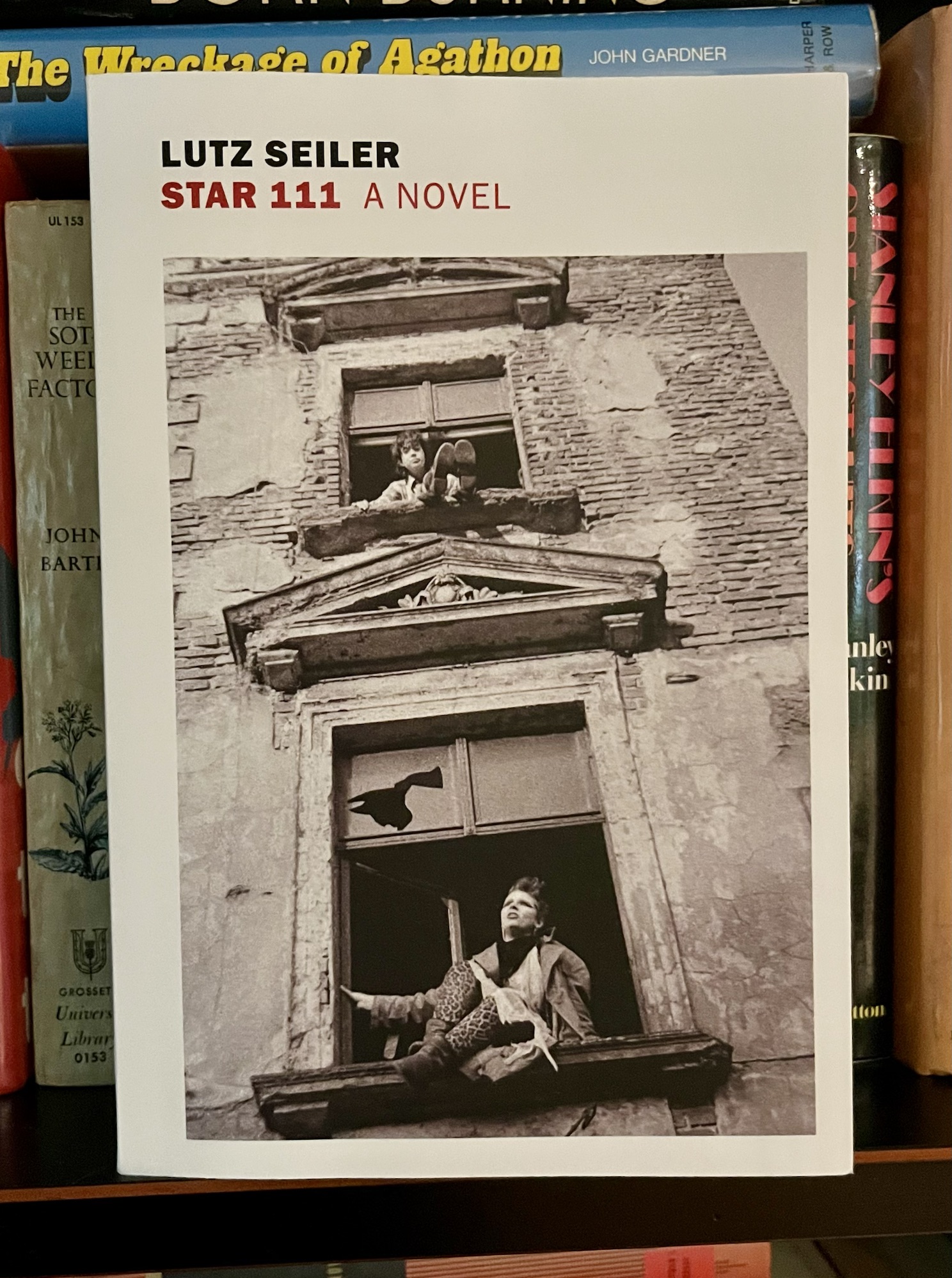
I have a big pile of books recently acquired that I haven’t made enough time to attend to; the most recent of these is Lutz Seiler’s Star 111, forthcoming in English translation by Tess Lewis from NYRB. Here’s their blurb:

Star 111 (the name of a popular East German transistor radio) begins with the world turned upside down. It is the fall of 1989. The communist government of the GDR is losing its grip on power. Carl Bischoff, a very young man, trained as a bricklayer, now a college student, is abruptly recalled by his parents to the small town in the middle of nowhere where he grew up. His hardworking unprotesting parents inform him, that with the border open, they intend to leave the country and check into a West German refugee camp. Will Carl to look after the house and take in the mail? They promise at some point to be in touch.

Deserted by his parents, Carl has no idea what to do. Then he packs the family car and heads to Berlin, where he joins a group of squatters led by a shepherd with a goat. Carl participates in the anarchic life of an anarchist commune, and keeps his distance too. He has all sorts of things to learn about himself and others. He is hungry for sex and love and sometimes simply hungry. He worries about his parents. He wants to be a poet.

Star 111 is a story about unforeseen ends and new beginnings, about different kinds of families, biological and improvised, and one innocent young aspiring poet in pursuit of experience at a moment in history when everything is about to change and nobody knows how. A tender, entrancing, and comic tale of youth and adventure, it is a book that looks back on the history of our time to ask the most fundamental of questions: what does it mean to lead a good life?


Dinah Brooke’s Death Games (Book acquired, 8 Aug. 2024)

I broke down and bought an inexpensive copy of Dinah Brooke’s 1976 novel Death Games from an internet vendor. I absolutely loved her 1973 novel Lord Jim at Home, which never got a U.S. release (until a year or two ago). Death Games did get a U.S. release—I guess because it involves the Vietnam War?—and was reviewed by Jane Larkin Crain in The New York Times. She wrote:

Pornographic brutality dominates this distasteful tale of carnage, corruption and colonialism in Indochina, starring young, beautiful, demented Elspeth Waterhouse, who pursues her impeccably detached tycoon of a father from Bangkok to Vientiane to Saigon, hungering after his recognition and love. Also featured are maimed and traumatized American war veteran who conducts an unlikely affair with Elspeth and Veronique, Waterhouse’s business associate and mistress, whose son is relegated to boarding school so that she may go globe‐trotting with her lover. . .

Death Games . . . largely dispenses with the mechanics of plot, pacing and characterization. In the course of a very short novel, scenes of debauchery, rape, murder, cannibalistic fantasy, suicide, bloodshed follow so quickly one upon the other, with so little sense or modulation…

I think Crain hated it!

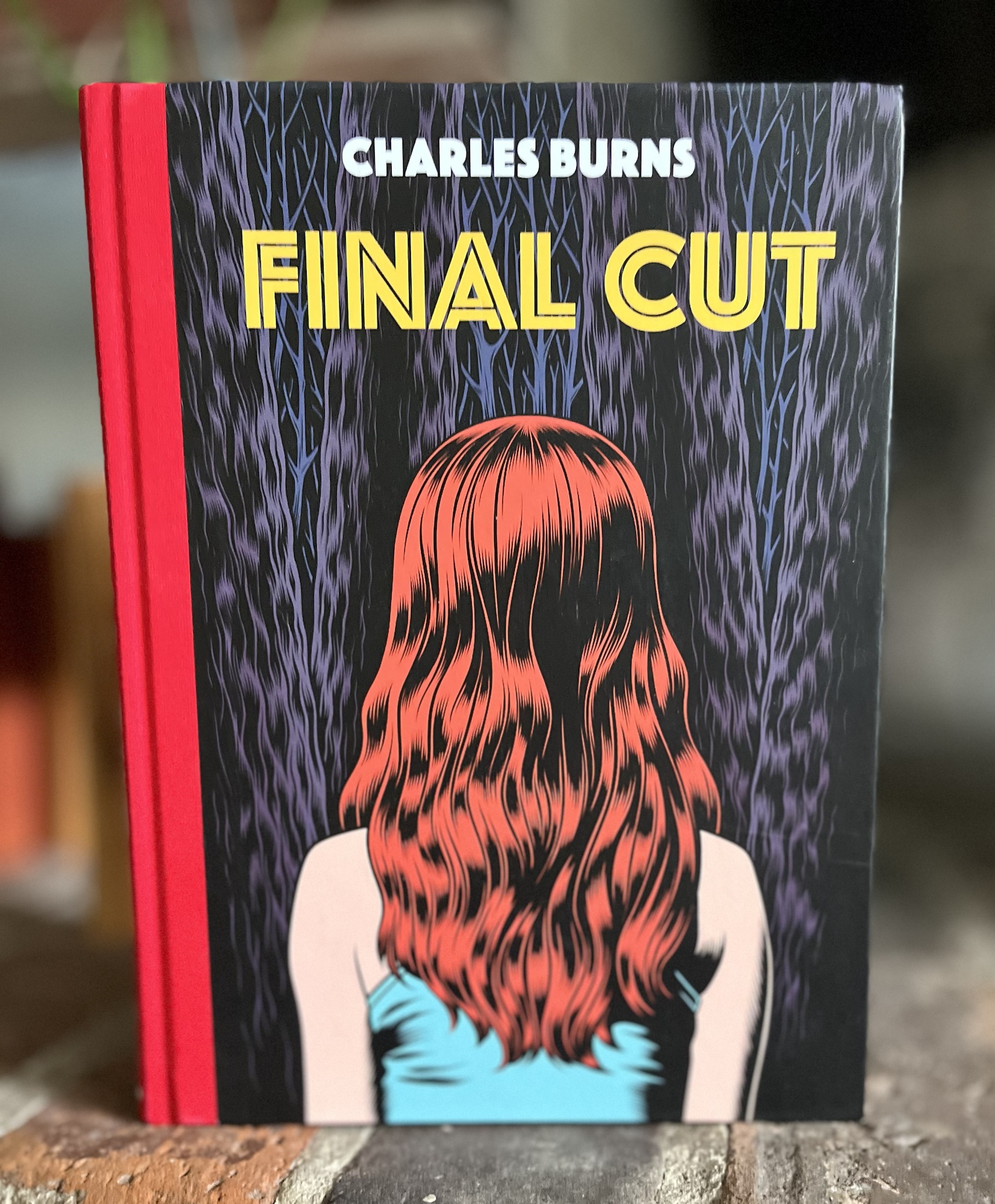
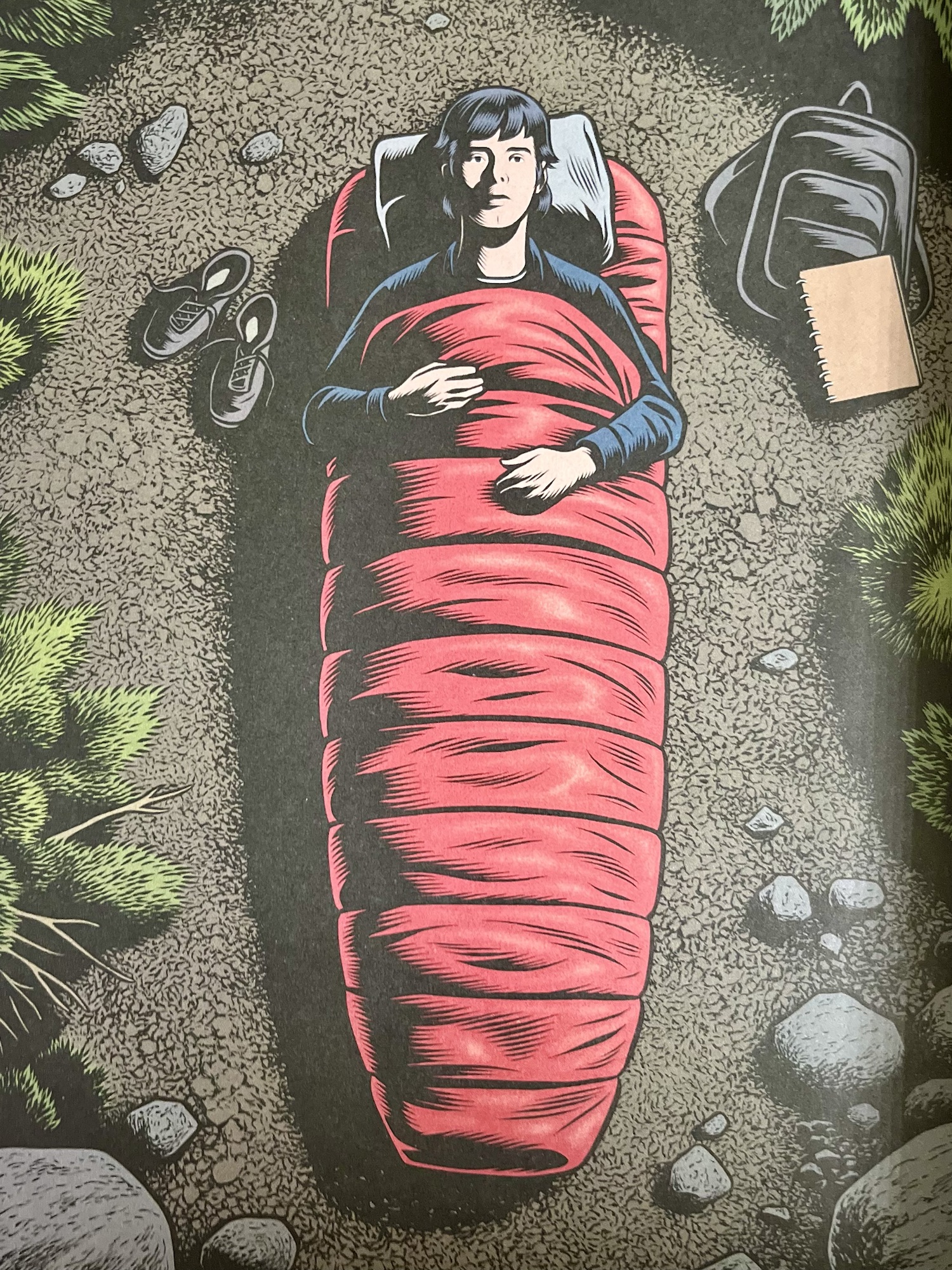
Charles Burns’s Final Cut (Book acquired, 23 July 2024)

I’m excited about this one. Charles Burns’s novel Final Cut is out in late September. I’ll have a review around that time. For now, here’s publisher Pantheon’s blurb:

Biblioklept Does Seattle (Books acquired, some time last week)

We visited Seattle over the fourth week of June 2024, our first time there.

We met up with some old friends and took our son to see his favorite band play at the Woodland Park Zoo. Unlike my last getaway (to Atlanta) I was carless and a bit more encumbered (kids, friends, friends’ kids, etc.), so I wasn’t able to get to as many bookstores as I would have liked to—but I still got to quite a few.

We stayed in the Belltown neighborhood. Full of restaurants, bars, and independent shops, Belltown’s about a ten or fifteen minute walk to the famous and touristy Pike Place Market, which, despite being famous and touristy also boasts some really cool little shops—including Left Bank Books which features “anti-authoritarian, anarchist, independent, radical and small-press titles.” They also have a section devoted to “Transgressive Literature/Weird Shit.”

Left Bank’s collection of used stuff is impressive, as are the myriad and diverse offering of zines. My son picked up a bunch of art zines and comix and I left with anarcho-surrealist Ron Sakolsky’s prose mixtape Scratching the Tiger’s Belly.

Also impressive at Pike Place is BLMF Literary Saloon, brimming with towers of reasonably-priced used books. Lionheart Bookstore is a bit less chaotic than BLMF and sells newer titles, with fewer used books. (Less chaotic is not a knock on BLMF, by the way.) I didn’t succumb to picking up a first-(US)-edition of J.G. Ballard’s The Day of Creation there, maybe because I was already carrying around some LPs my son bought at Holy Cow Records. We also stopped by Chin Music Press. They make some beautiful books.

I think my favorite spot at Pike Place though was Lamplight Books. There was a nice collection of used literature (including a lot of so-called weird shit). The proprietor patiently let me handle first editions of  Ballard, Barthelme, Borges, and Burroughs books (among other non-B titles). They were happy when I picked up Jacob Siefring’s translation of Rabelais’s Doughnuts by Pierre Senges, proudly letting me know that I was supporting not just a local indie bookshop but a local indie press, Sublunary Editions.

Despite the crowds of tourists in Pike Place lining up to go into the world’s oldest Starbucks (which, as my pal pointed out, is no different than lining up to gawk at the first CVS or first Harbor Freight), Pike Place has some nice niche shops. (Our lunch at the terrace of The Pink Door was lovely, too.)

While thrifting and record shopping in the so-called “hipster” Capitol Hill neighborhood, my crew indulged me in a too-long browse at The Elliot Bay Book Company. I’m generally a used-bookstore guy–I tend to order new titles from my local used bookshop, and I’m mostly out looking for the weird shit–but I’m always impressed by stores like Elliot Bay, which features the kind of odd and out of the way stuff you won’t find at a Barnes & Noble. I have silly little “tests” I like to do in stores that sell new books, checking to see if they stock certain authors, and, if so, which titles, and Elliot Bay excelled. (No Antoine Volodine, though, but I assume someone picked up the last copy of Radiant Terminus.) There, I picked up Lord Jim at Home by Dinah Brooke. The lovely evocative cover was facing outward and appended with a bookseller’s note. The flap copy notes that when “Lord Jim at Home, was first published in 1973, it was described as ‘squalid and startling,’ ‘nastily horrific,’ and a ‘monstrous parody’ of upper-middle class English life” so I figured I could get down with that.

I suppose I could remark more on Seattle itself.

We were there for six days and seven nights, which is clearly not long enough to take the measure of any major city. The weather was wonderful—sunny with maximum temps of around 80 degrees Fahrenheit, a relief after weeks of a Florida heatwave mired in a humid and insufferable drought. Even a day hiking on Mt. Ranier was warmer than we expected. (We had a nice early dinner in Enumclaw that day; a charming town, we all agreed. Curious about this quaint hamlet, I read the Enumclaw Wikipedia page aloud to my crew as we drove back to our Belltown digs before stopping, aghast, thinking of the children.) Seattle itself was more touristy than I expected, and perhaps a bit more depressing. In both Belltown and Capitol Hill we witnessed far more addicts nodding than I might have expected, although no one bothered us. Most of the patrons in the bars, restaurants, and shops we visited in these neighborhoods seemed like they were from Some Other Place, transplants to this big city who might also move at any time to Some Other Place. Even in the warm weather it was a bit cold.

We did some of the touristy things, too: The Museum of Pop Culture (the Nirvana exhibit was depressing; I loved looking at their guitar collection and jamming with my wife and son in their Sound Lab space. The stop-motion-animation exhibit was cool); the Chihuly Garden and Glass museum was unexpectedly beautiful and curated in a way that made me appreciate the glass anew (we saw a baby rabbit, wholly unafraid, snacking in the garden); the Space Needle views were amazing (its history, an optimistic ideal of American progression, brought me down before I got on the fast elevator up). I’m not sure if any of it really cohered for me into the kernel of angst I get when I fall in love with a city—a city like Mexico City or New Orleans or Tokyo or Los Angeles—but that’s fine. We shouldn’t be falling in love all the time.

The show at the zoo provides a nice addendum to what I’ve written (even if it happened in the middle of the week). My son loved seeing the band with the awful name that I am Too Old to really get and I loved seeing him get to see them and loving them. What I loved was seeing the crowd of freaks and weirdos and nerds and normies, all so unconcerned, it seemed to me, with being hip or being seen as hip, so unconcerned with doing anything aside from taking the sensual summer solstice air. Everyone seemed so chill, so unuptight.

Maybe it was the overpriced zoo beers coursing in my ugly veins, but I loved the city a little bit right then, forgiving it for any of the ways it had failed to live up to the imaginary picture of Seattle that my twelve-year-old brain had manifested over three decades ago. Maybe I was seeing the fruition of the dream I’d latched onto, so so long ago, a dream for a place where people didn’t have to struggle so hard just to like, be who they are. I think I remember, for maybe a good half hour or so then, loving Seattle.

Ariane Koch’s Overstaying (Book acquired, 13 June 2024)

Ariane Koch’s Overstaying is forthcoming this fall from Dorothy, in translation by Damion Searls. Dorothy’s blurb:

Winner of the aspekte Prize, the most prestigious German prize for debut fiction, Swiss playwright and visual artist Ariane Koch’s Overstaying is an absurdist tour de force.

“I don’t see my writing as chronological or classically narrative, but as spatial—a kind of architecture. I keep adding rooms, and readers can take different paths through the rooms,” writes Ariane Koch of Overstaying, her anarchically comic debut. Koch’s narrator is an impudent young woman, a contemporary Bartleby living alone in her parents’ old house in the small hometown she hates but can’t bring herself to leave. When a visitor turns up, promisingly new, she takes him in, and instantly her life revolves around him. Yet it is hard to tell what, exactly, this visitor is. A mooch, a lover, an absence, a presence—possibly a pet? Mostly, he is a set of contradictions, an occasion for Koch’s wild imagination to take readers in brilliant and unexpected directions.

Jean-Baptise Del Amo’s The Son of Man (Book acquired, 8 June 2024)

The day after my birthday, I got the review copy I’d requested of Jean-Baptiste Del Amo’s novel The Son of Man. It was a nice late gift, hungover as I was from a surprise party for my sister-in-law’s 40th, a surprise party which usurped a rare Friday birthday of my own (meet me in 2030 on a Friday (or don’t)). I loved Frank Wynne’s translation of Del Amo’s previous novel, Animalia, suggesting in a 2020 reading round up that the novel “is a visceral, naturalistic, and very precise rendering of humans as animals. . . . Animalia made me physically ill at times. It’s an excellent novel.”

I read the first forty pages of The Son of Man this afternoon; the opening fifteen pages in particular foreground the humans-as-animals dynamic that Animalia worked through. These pages seem like an overture for the novel. They focus on a prehistoric troop of hunter-gatherers, like, hunting and gathering. It’s marvelous. The novel then pivots, I dunno, a couple of thousand years or so to a contemporary scene. We’re somewhere in France; a man and a woman and a boy leave a city in a car and go into the mountains, eventually pressing towards a ruined estate. A dread starts to thicken. The anxiety congeals more from the gaps in the standard cerebral cause-and-effect that we might expect from a novel which isn’t so much replaced as supplanted by precise, lucid detailing of the physical world. Consider this description of the mother:

She lights a cigarette, exhales a first plume of smoke — she holds the filter between the distal phalanges of her index and middle fingers, close to the nails — walks down the central reservation of yellowed grass, then retraces her steps. She brings the cigarette to her lips, darting brief glances that linger on the shadows nesting in the branches of trees and in privet hedges.

Del Amo’s prose, via Wynne’s limpid translation, works like a camera. More thoughts to come. Publisher’s blurb here if you like.

Dino Buzzati’s The Singularity (Book acquired, 23 May 2024)

NYRB has another new translation of an old Dino Buzzati novel on deck—it’s a 1960 sci-fi called The Singularity in translation by Anne Milano Appel. NYRB’s blurb:

At the beginning of Dino Buzzati’s The Singularity, Ermanno Ismani, an unassuming university professor, is summoned by the minister of defense to accept a two-year, top-secret mission at a mysterious research center, isolated from the world among forests, plunging cliffs, and high mountains. What’s he supposed to do there? Not clear. How long will he be there? No saying.

Still, Ismani takes the mystifying job and, accompanied by his no-nonsense wife, Elisa, heads to the so-called Experimental Camp of Military Zone 36, wondering whether, in the midst of the Cold War, it’s some sort of nuclear project he’s been assigned to. But no, the colleagues the couple meets on arrival assure them, it’s nothing like that. It’s much, much more powerful.

At the center of the research complex is strange, shining, at times murmurous, white wall. Behind it, a deep gorge drops away, full of wires and radio towers and mobile sensors and a host of eccentric structures. A question begins to dawn: Could this be the shape of consciousness itself? And if so, whose?

Buzzati’s novella of 1960, a pioneering work of Italian science fiction, is published here in a brisk new translation by Anne Milano Appel. In it, Buzzati explores his favorite themes of love and longing while offering a startlingly prescient parable of artificial intelligence.

Oğuz Atay’s Waiting for the Fear (Book acquired, 7 May 2024)

A new translation of Oğuz Atay’s story collection Waiting for the Fear by Ralph Hubbell is forthcoming later this year from NYRB. Their blurb:

Adored in Turkey for his post-modern fiction and regarded internationally as one of Turkey’s greatest writers, Oğuz Atay remains largely untranslated into English. First published in 1975, Waiting for the Fear is Atay’s only collection of short stories, a book that is routinely praised in Turkey, by, among others, the Nobel Prize winner Orhan Pamuk, for having transformed the art of short fiction.

The eight stories that the book contains, all of them focused on characters living on the margins of society, are dramatic and even tragic, while also being shot through with irony and a humor. In the title story, a nameless young man, of a thoughtful and misanthropic turn of mind, returns to his home on the outskirts of an enormous nameless city to find waiting for him a letter in a foreign language of which he has no knowledge at all, and from this anomalous, if seemingly trivial, turn of events, one thing after another unfolds with stark inevitablity. Another story nods to Gogol’s “The Overcoat”: its hero is a speechless beggar wandering around the back streets of Istanbul dressed in a woman’s fur coat who will end up stuck in a shop window like a manikin. Elsewhere, a professional story peddler lives in a hut beside a train station in a country that is at war—unless it isn’t. He can’t remember. What do such life and death realities matter, however, so long as there are stories to tell? Atay’s stories are full of a vivid sense of life’s absurdities while also being psychologically true to life; his characters, oddballs and losers all, are also utterly individual with distinctive voices of their own, now plainspoken, wistful, womanly, now sophisticated and acerbic, with a dangerous swagger. And if Atay is a brilliant examiner of the inner life, he is no less aware of the flawed social world in which his people struggle to make their way.

Waiting for the Fear is a book that, page by beguiling page, holds the reader’s attention from beginning to end, the rare collection of short stories that not only reflects a unique authorial vision but reads like a page-turner. Ralph Hubbell’s new translation will introduce readers of English to a still insufficiently known giant of modern Turkish and world literature.

More Remedios Varo in English translation via Margaret Carson (Book acquired, 7 May 2024)

I’m very happy to have a copy of On Homo rodans and Other Writings, a collection of Remedios Varo’s writings translated and edited by Margaret Carson. This collection expands on the 2018 compendium Letters, Dreams and Other Writings.

Margaret told me via email that On Homo rodans and Other Writings “includes a few new stories and other interesting things that [she] found in the archive in Mexico City in 2022, and also has a rearranged presentation of everything (as requested by the estate).” I hope to have a second interview with Margaret on this new collection soon; in the meantime, check out our conversation from 2019.

Blog about some books acquired, other stuff

My family and I took our Florida asses to the West Coast for a wonderful week earlier this month. We flew into LA, stayed in Santa Monica for a few days and nights, riding bikes up and down the beautiful coast and visiting proximal neighborhoods. We later drove east to Joshua Tree, where we stayed in a lovely little house for a few days, visiting the National Park as well as nearby towns and sites, like Twentynine Palms, Palm Springs, and Mt. San Jacinto State Park. We saw coyotes and roadrunners and lots of little desert cottontails. Famous times.

While in Santa Monica, I could not convince my family (or frankly myself) to trek the hour or so south to visit Thomas Pynchon’s old apartment in Manhattan Beach. We did, however, stop by Small World Books in Venice Beach. Small World is right across from the Venice Beach Skatepark, where we watched kids of all ages skate for almost an hour while someone blasted nineties hip-hop from a boombox (one of the nicest hours of the trip for me).

Small World is a well-stocked bookshop with an emphasis on literature and the arts; it carries plenty of indie titles and a handsome stable of standards. There was a nice cat in there too. Founded in 1969 by Mildred Gates and Mary Goodfader, Small World seems to retain some of the older vibes of Venice Beach, which is generally pretty touristy (in a fun, tacky way). It seems a bit out of place among the keychains and bad art and nasty tee shirts of Venice, what with its stock of NYRB translations, poetry zines, and novels by indie imprints like And Other Stories. But it’s clear that locals come to buy books there.

I picked up three: Lydia Davis’s Our Strangers, June-Alison Gibbons’s The Pepsi-Cola Addict, and Ann Quin’s Three. I’d been looking to buy Davis’s collection for a while now–you can buy it online, but I wanted to get it from an indie bookshop, per Davis’s intentions. Three is the only Ann Quin book I haven’t read yet; I loved her novels Berg and Passages, and I guess I wanted to leave something in the Quin take for later. The highlight purchase though for me has been Gibbons’s The Pepsi-Cola Addict, which was Small World’s featured book (I think they did a book club on it this month). I had never heard of the book or its author, but the pop art cover and goofy title caught my attention, followed by an even goofier blurb which started by describing the Pepsi-Cola Addict as the “legendary lost novel in which fourteen-year-old Preston Wildey-King must choose between his all-consuming passion for Pepsi Cola and his love for schoolmate Peggy.” The novel is not goofy though—it’s abject and odd and distressing and also very well-written, somehow naive and sophisticated, raw and refined, resoundingly truthful and plainly artificial. Here’s the full blurb:

Written by June-Alison Gibbons when she was only 16, The Pepsi Cola Addict is considered one of the great works of twentieth-century outsider literature. More than just a literary curiosity, however, this tale of a teenager whose passion for a well-known cola drink threatens to ruin his life is the uniquely vivid expression of a young woman trying to make sense of the confusing, often brutal world she in which found herself.

Published in 1982 by a vanity press who took £500 from its young author and gave her only a single book in return, it’s thought that fewer than ten original copies still exist in the world.

Shortly after its publication, June-Alison and her sister Jennifer would become infamous as “The Silent Twins” and find themselves cruelly incarcerated for over a decade in Broadmoor Hospital. This author-approved edition makes June-Alison Gibbon’s remarkable vision widely available for the first time.

I hope to have a full review to come. I read The Pepsi-Cola Addict in Joshua Tree and absolutely loved it (even though (and I guess because) it made me feel odd and ill).

Unfortunately, I didn’t make it to Angel City Books & Records in Santa Monica. I had also wanted to visit Space Cowboy Books in Joshua Tree, but didn’t realize it was closed midweek. I did drop by The Best Bookstore in Palm Springs, and was again pleasantly surprised by the rich stock of titles, which eschewed the bestseller list stuff I might have expected for a somewhat touristy area. My son conned me into buying him a Taschen volume of Michelangelo drawings and studies; he’s been copying them into his notebooks for days now.

We loved Joshua Tree (park and city), and one highlight was the Noah Purifoy Outdoor Museum, a loose, sprawling collection of sculptures, installations, and buildings cobbled together out of the detritus of the twentieth century. Walking through the Museum is kind of like being on the disused set of a post-apocalyptic film, under the beautiful clear California sun filled sky. Cottontails and roadrunners hopped about as we wandered among Purifoy’s deconstructed constructions, sometimes apprehensive to enter or touch, before the sun and wind and arid sky itself reminded us that the whole tableau was naked, exposed, raw on the earth, open for contact.

Rainer J. Hanshe’s Dionysos Speed (Book acquired, 4 March 2024)

Rainer J. Hanshe’s Dionysos Speed is out next month from Contra Mundum. Their description:

As the digitization of every aspect of existence grows more pervasive and absolute, from the monitoring of thought to the tracking even of genitals, the central nervous system of the human body has been completely rewired. In the mapping of space-time, the species has moved into a state of total possession, of the enslavement of its drives, imagination, and will. Through this virtualization of life, the society of the spectacle has reached a point of unparalleled monstrosity, with the simulacrum usurping reality itself. The species is divided between the digitalists who see the technologization of the human as its natural evolutionary development, and those who stand against them.

At this epochal crux, an enigmatic faction of anonymous figures engages in coordinated global poetic acts of destruction and creation, ludic and radical capers, dismantling machines of control and surveillance. The society of the spectacle is thereby short-circuited, scrambled, cut-up via skirmishes, détournements, and other subversive acts of havoc wreaking, interruption, and sabotage. Can these dice throws overturn all the mediums of control and enslavement? As time grows more and more constricted, the serendipities and transfigurations of human life suffer swift evisceration. In the midst of this, the anonymous clowns of revolt seek to resurrect the moments and marvels when great forces open up the boundless and the limitless, creating combustion engines of play so as to generate new hemispheres of possibility.

Written as a burst of epigrammatic sequences, like Molotov cocktails arriving from elsewhere, Dionysos Speed is a series of erupting geysers, comets flashing thru space and dispersing new forces. Akin to a Heraclitean fire machine, this book is an act meant to give birth once again to dissonant desire through the powers of the dice throw, a machine forged to release by way of its ludic freedom the vital forces of the cosmos.

Tomoé Hill’s Songs for Olympia (Book acquired, 16 Feb. 2024)

So I started in on Tomoé Hill’s Songs for Olympia last night—poetic, critical, personal, strange in the right ways. Here’s publisher Sagging Meniscus’ blurb:

In the twilight of life, a black ribbon emerges from a frame and coils itself inside the mind of one of the great French chroniclers of the internal. Across the world, a young girl stares at an image in a book: a woman, naked but for slippers, jewels, and the same ribbon which so captivates the writer. At opposite poles of experience, one follows the ribbon as it winds its way round longings, regrets, and contemplations; the other, at the beginning of development and yet to discover the world, traces the ribbon with a finger, not realising how it will imprint itself upon her.

Years later, the girl—now woman—encounters the ribbon face to face and on the page. Manet’s Olympia and the words of Michel Leiris come together, and an imaginary conversation ensues. It will be a collision and collaboration of sensorial memories and observations on everything from desire and illness to writing and grief. These frames are used to examine both interlocutors; simultaneously, a frame of another sort is removed from Olympia and her artistic kin. Everything from her flowers, Louise Bourgeois’s Sainte Sébastienne, and Francis Bacon’s Henrietta Moraes are reimagined and given new regard.

Songs for Olympia, written in the form of a response to Michel Leiris’s The Ribbon at Olympia’s Throat, itself a highly personal response to Manet’s painting, is an ode to the both the ribbon and the memory: what leads us to constantly rediscover ourselves and a world so easily assumed as viewed through a single frame.