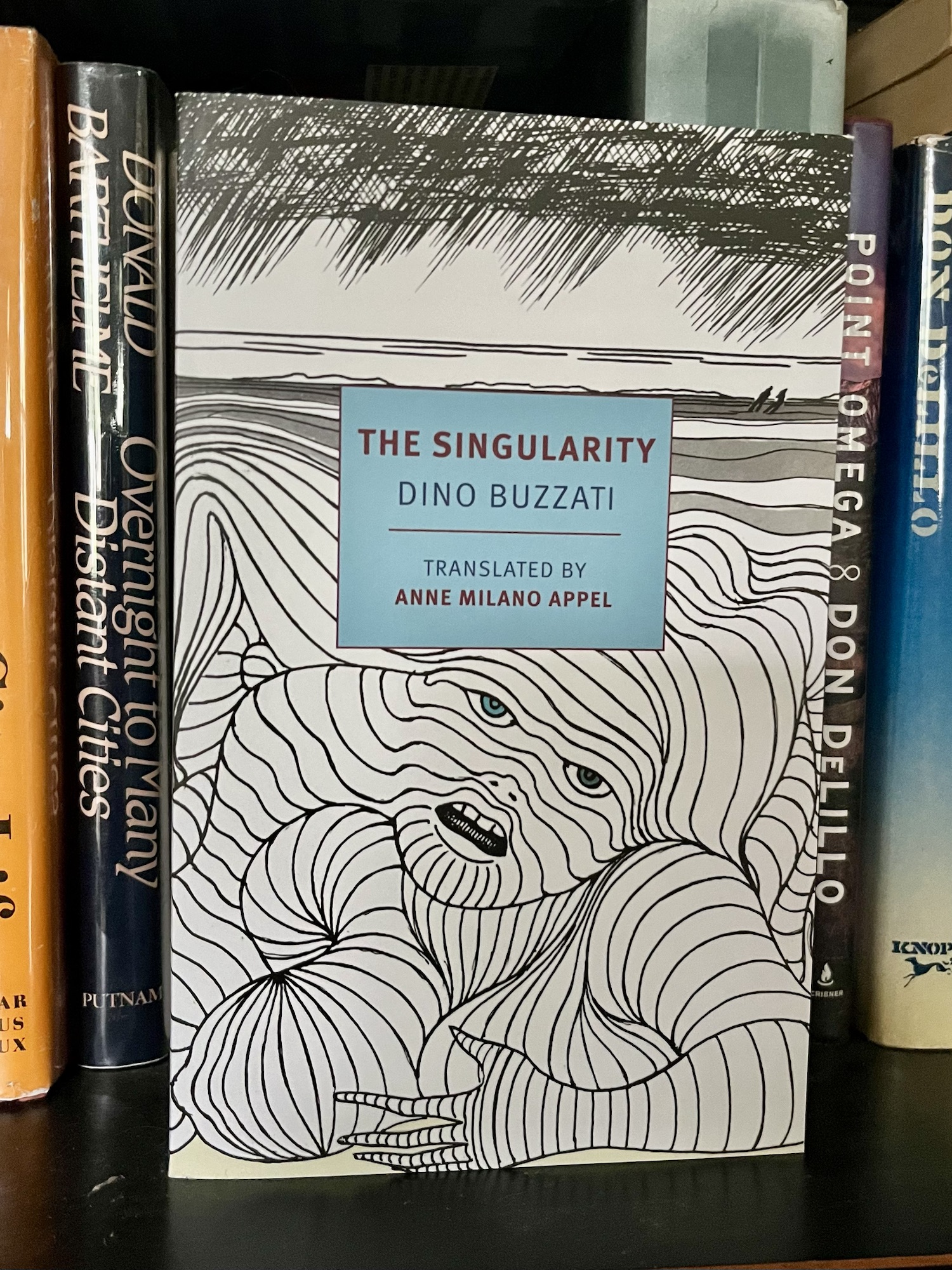
Dino Buzzati’s The Singularity (Book acquired, 23 May 2024)

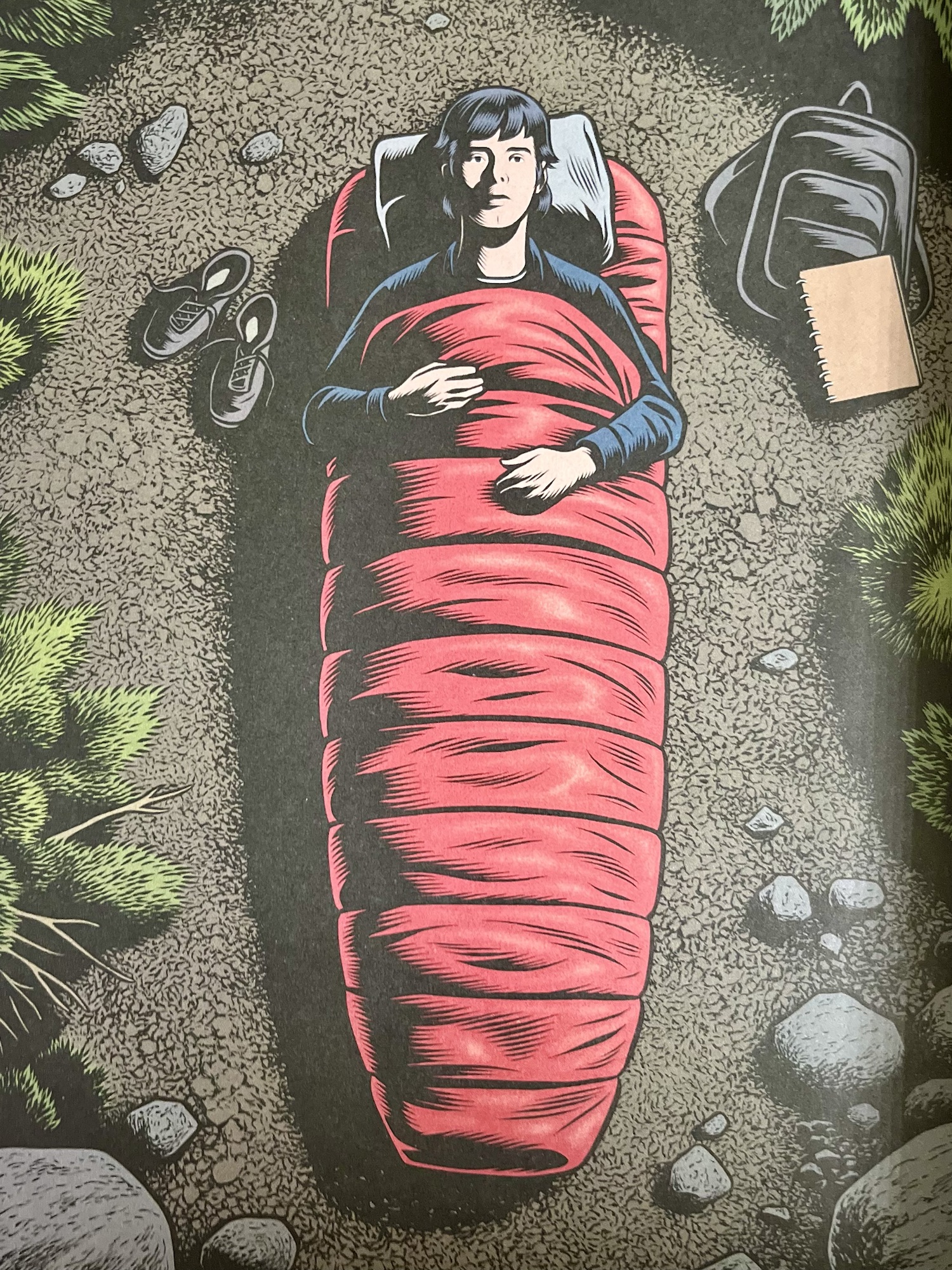
NYRB has another new translation of an old Dino Buzzati novel on deck—it’s a 1960 sci-fi called The Singularity in translation by Anne Milano Appel. NYRB’s blurb:

At the beginning of Dino Buzzati’s The Singularity, Ermanno Ismani, an unassuming university professor, is summoned by the minister of defense to accept a two-year, top-secret mission at a mysterious research center, isolated from the world among forests, plunging cliffs, and high mountains. What’s he supposed to do there? Not clear. How long will he be there? No saying.

Still, Ismani takes the mystifying job and, accompanied by his no-nonsense wife, Elisa, heads to the so-called Experimental Camp of Military Zone 36, wondering whether, in the midst of the Cold War, it’s some sort of nuclear project he’s been assigned to. But no, the colleagues the couple meets on arrival assure them, it’s nothing like that. It’s much, much more powerful.

At the center of the research complex is strange, shining, at times murmurous, white wall. Behind it, a deep gorge drops away, full of wires and radio towers and mobile sensors and a host of eccentric structures. A question begins to dawn: Could this be the shape of consciousness itself? And if so, whose?

Buzzati’s novella of 1960, a pioneering work of Italian science fiction, is published here in a brisk new translation by Anne Milano Appel. In it, Buzzati explores his favorite themes of love and longing while offering a startlingly prescient parable of artificial intelligence.

Oğuz Atay’s Waiting for the Fear (Book acquired, 7 May 2024)

A new translation of Oğuz Atay’s story collection Waiting for the Fear by Ralph Hubbell is forthcoming later this year from NYRB. Their blurb:

Adored in Turkey for his post-modern fiction and regarded internationally as one of Turkey’s greatest writers, Oğuz Atay remains largely untranslated into English. First published in 1975, Waiting for the Fear is Atay’s only collection of short stories, a book that is routinely praised in Turkey, by, among others, the Nobel Prize winner Orhan Pamuk, for having transformed the art of short fiction.

The eight stories that the book contains, all of them focused on characters living on the margins of society, are dramatic and even tragic, while also being shot through with irony and a humor. In the title story, a nameless young man, of a thoughtful and misanthropic turn of mind, returns to his home on the outskirts of an enormous nameless city to find waiting for him a letter in a foreign language of which he has no knowledge at all, and from this anomalous, if seemingly trivial, turn of events, one thing after another unfolds with stark inevitablity. Another story nods to Gogol’s “The Overcoat”: its hero is a speechless beggar wandering around the back streets of Istanbul dressed in a woman’s fur coat who will end up stuck in a shop window like a manikin. Elsewhere, a professional story peddler lives in a hut beside a train station in a country that is at war—unless it isn’t. He can’t remember. What do such life and death realities matter, however, so long as there are stories to tell? Atay’s stories are full of a vivid sense of life’s absurdities while also being psychologically true to life; his characters, oddballs and losers all, are also utterly individual with distinctive voices of their own, now plainspoken, wistful, womanly, now sophisticated and acerbic, with a dangerous swagger. And if Atay is a brilliant examiner of the inner life, he is no less aware of the flawed social world in which his people struggle to make their way.

Waiting for the Fear is a book that, page by beguiling page, holds the reader’s attention from beginning to end, the rare collection of short stories that not only reflects a unique authorial vision but reads like a page-turner. Ralph Hubbell’s new translation will introduce readers of English to a still insufficiently known giant of modern Turkish and world literature.

More Remedios Varo in English translation via Margaret Carson (Book acquired, 7 May 2024)

I’m very happy to have a copy of On Homo rodans and Other Writings, a collection of Remedios Varo’s writings translated and edited by Margaret Carson. This collection expands on the 2018 compendium Letters, Dreams and Other Writings.

Margaret told me via email that On Homo rodans and Other Writings “includes a few new stories and other interesting things that [she] found in the archive in Mexico City in 2022, and also has a rearranged presentation of everything (as requested by the estate).” I hope to have a second interview with Margaret on this new collection soon; in the meantime, check out our conversation from 2019.

Blog about some books acquired, other stuff

My family and I took our Florida asses to the West Coast for a wonderful week earlier this month. We flew into LA, stayed in Santa Monica for a few days and nights, riding bikes up and down the beautiful coast and visiting proximal neighborhoods. We later drove east to Joshua Tree, where we stayed in a lovely little house for a few days, visiting the National Park as well as nearby towns and sites, like Twentynine Palms, Palm Springs, and Mt. San Jacinto State Park. We saw coyotes and roadrunners and lots of little desert cottontails. Famous times.

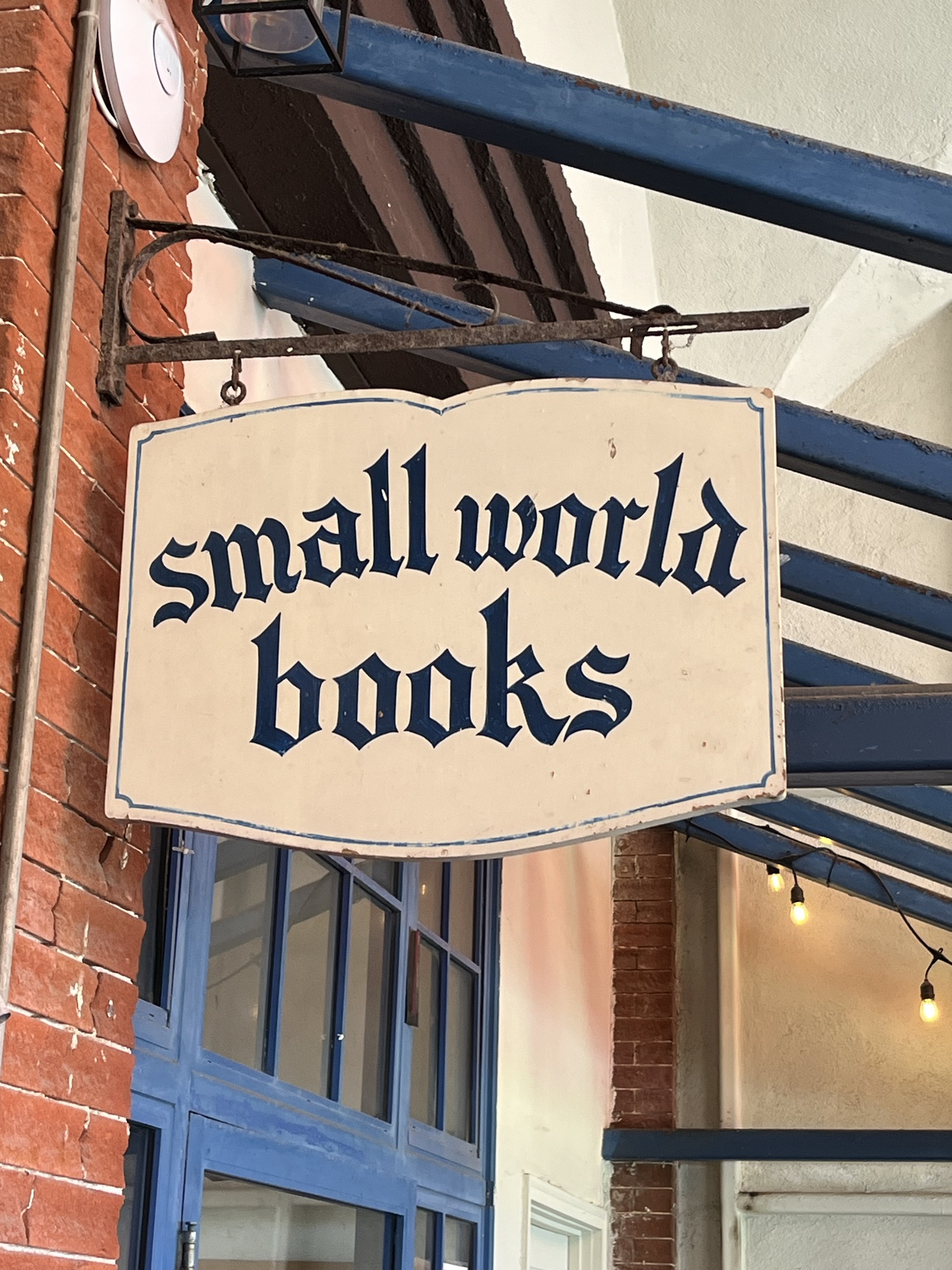
While in Santa Monica, I could not convince my family (or frankly myself) to trek the hour or so south to visit Thomas Pynchon’s old apartment in Manhattan Beach. We did, however, stop by Small World Books in Venice Beach. Small World is right across from the Venice Beach Skatepark, where we watched kids of all ages skate for almost an hour while someone blasted nineties hip-hop from a boombox (one of the nicest hours of the trip for me).

Small World is a well-stocked bookshop with an emphasis on literature and the arts; it carries plenty of indie titles and a handsome stable of standards. There was a nice cat in there too. Founded in 1969 by Mildred Gates and Mary Goodfader, Small World seems to retain some of the older vibes of Venice Beach, which is generally pretty touristy (in a fun, tacky way). It seems a bit out of place among the keychains and bad art and nasty tee shirts of Venice, what with its stock of NYRB translations, poetry zines, and novels by indie imprints like And Other Stories. But it’s clear that locals come to buy books there.

I picked up three: Lydia Davis’s Our Strangers, June-Alison Gibbons’s The Pepsi-Cola Addict, and Ann Quin’s Three. I’d been looking to buy Davis’s collection for a while now–you can buy it online, but I wanted to get it from an indie bookshop, per Davis’s intentions. Three is the only Ann Quin book I haven’t read yet; I loved her novels Berg and Passages, and I guess I wanted to leave something in the Quin take for later. The highlight purchase though for me has been Gibbons’s The Pepsi-Cola Addict, which was Small World’s featured book (I think they did a book club on it this month). I had never heard of the book or its author, but the pop art cover and goofy title caught my attention, followed by an even goofier blurb which started by describing the Pepsi-Cola Addict as the “legendary lost novel in which fourteen-year-old Preston Wildey-King must choose between his all-consuming passion for Pepsi Cola and his love for schoolmate Peggy.” The novel is not goofy though—it’s abject and odd and distressing and also very well-written, somehow naive and sophisticated, raw and refined, resoundingly truthful and plainly artificial. Here’s the full blurb:

Written by June-Alison Gibbons when she was only 16, The Pepsi Cola Addict is considered one of the great works of twentieth-century outsider literature. More than just a literary curiosity, however, this tale of a teenager whose passion for a well-known cola drink threatens to ruin his life is the uniquely vivid expression of a young woman trying to make sense of the confusing, often brutal world she in which found herself.

Published in 1982 by a vanity press who took £500 from its young author and gave her only a single book in return, it’s thought that fewer than ten original copies still exist in the world.

Shortly after its publication, June-Alison and her sister Jennifer would become infamous as “The Silent Twins” and find themselves cruelly incarcerated for over a decade in Broadmoor Hospital. This author-approved edition makes June-Alison Gibbon’s remarkable vision widely available for the first time.

I hope to have a full review to come. I read The Pepsi-Cola Addict in Joshua Tree and absolutely loved it (even though (and I guess because) it made me feel odd and ill).

Unfortunately, I didn’t make it to Angel City Books & Records in Santa Monica. I had also wanted to visit Space Cowboy Books in Joshua Tree, but didn’t realize it was closed midweek. I did drop by The Best Bookstore in Palm Springs, and was again pleasantly surprised by the rich stock of titles, which eschewed the bestseller list stuff I might have expected for a somewhat touristy area. My son conned me into buying him a Taschen volume of Michelangelo drawings and studies; he’s been copying them into his notebooks for days now.

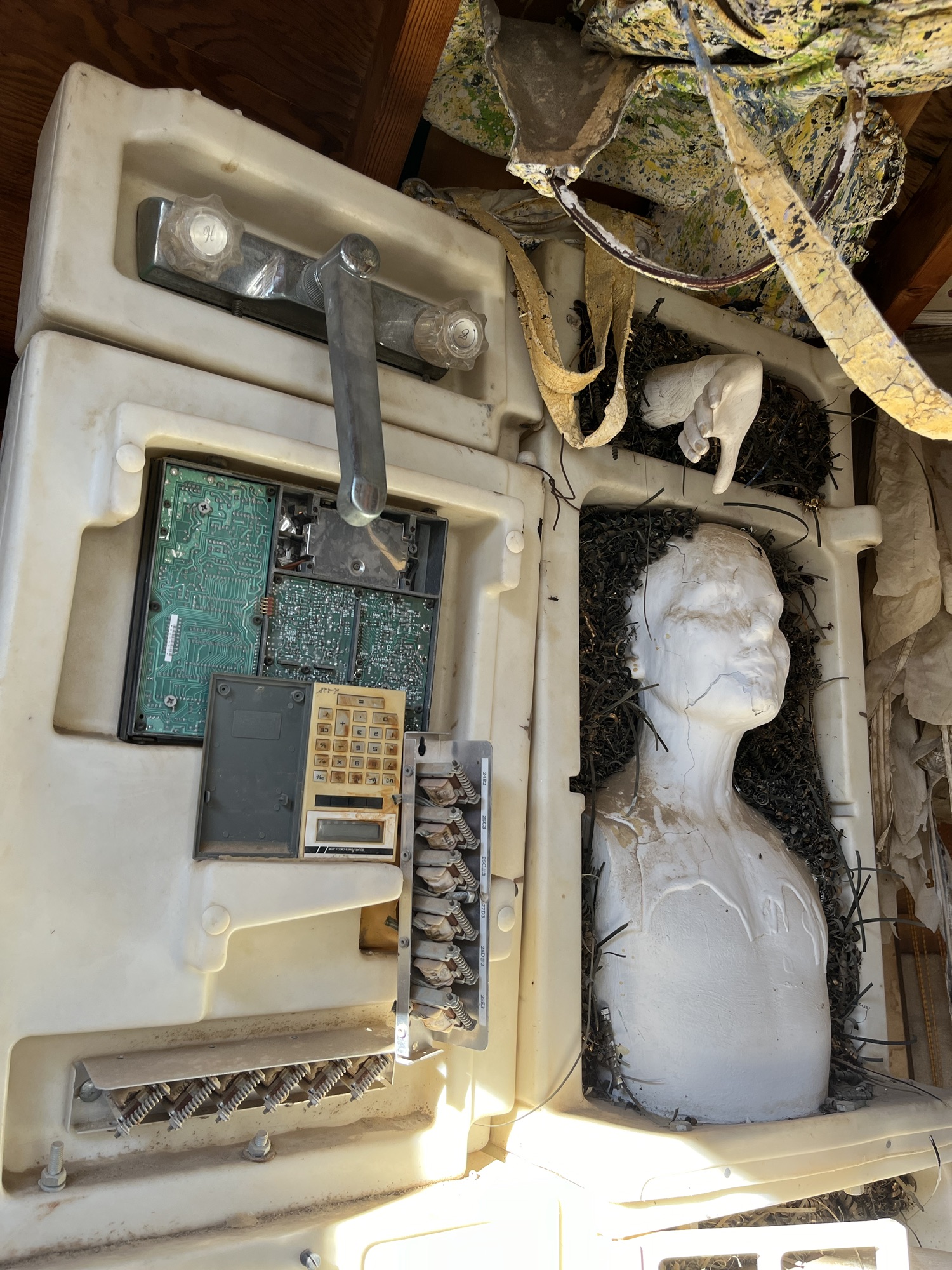
We loved Joshua Tree (park and city), and one highlight was the Noah Purifoy Outdoor Museum, a loose, sprawling collection of sculptures, installations, and buildings cobbled together out of the detritus of the twentieth century. Walking through the Museum is kind of like being on the disused set of a post-apocalyptic film, under the beautiful clear California sun filled sky. Cottontails and roadrunners hopped about as we wandered among Purifoy’s deconstructed constructions, sometimes apprehensive to enter or touch, before the sun and wind and arid sky itself reminded us that the whole tableau was naked, exposed, raw on the earth, open for contact.

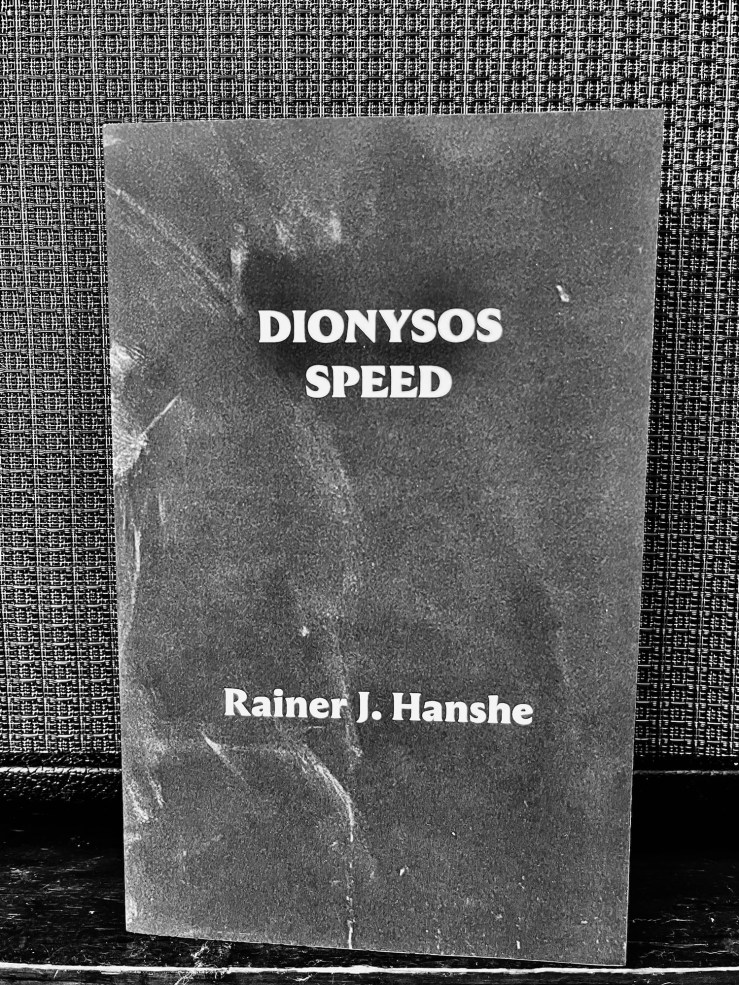
Rainer J. Hanshe’s Dionysos Speed (Book acquired, 4 March 2024)

Rainer J. Hanshe’s Dionysos Speed is out next month from Contra Mundum. Their description:

As the digitization of every aspect of existence grows more pervasive and absolute, from the monitoring of thought to the tracking even of genitals, the central nervous system of the human body has been completely rewired. In the mapping of space-time, the species has moved into a state of total possession, of the enslavement of its drives, imagination, and will. Through this virtualization of life, the society of the spectacle has reached a point of unparalleled monstrosity, with the simulacrum usurping reality itself. The species is divided between the digitalists who see the technologization of the human as its natural evolutionary development, and those who stand against them.

At this epochal crux, an enigmatic faction of anonymous figures engages in coordinated global poetic acts of destruction and creation, ludic and radical capers, dismantling machines of control and surveillance. The society of the spectacle is thereby short-circuited, scrambled, cut-up via skirmishes, détournements, and other subversive acts of havoc wreaking, interruption, and sabotage. Can these dice throws overturn all the mediums of control and enslavement? As time grows more and more constricted, the serendipities and transfigurations of human life suffer swift evisceration. In the midst of this, the anonymous clowns of revolt seek to resurrect the moments and marvels when great forces open up the boundless and the limitless, creating combustion engines of play so as to generate new hemispheres of possibility.

Written as a burst of epigrammatic sequences, like Molotov cocktails arriving from elsewhere, Dionysos Speed is a series of erupting geysers, comets flashing thru space and dispersing new forces. Akin to a Heraclitean fire machine, this book is an act meant to give birth once again to dissonant desire through the powers of the dice throw, a machine forged to release by way of its ludic freedom the vital forces of the cosmos.

Tomoé Hill’s Songs for Olympia (Book acquired, 16 Feb. 2024)

So I started in on Tomoé Hill’s Songs for Olympia last night—poetic, critical, personal, strange in the right ways. Here’s publisher Sagging Meniscus’ blurb:

In the twilight of life, a black ribbon emerges from a frame and coils itself inside the mind of one of the great French chroniclers of the internal. Across the world, a young girl stares at an image in a book: a woman, naked but for slippers, jewels, and the same ribbon which so captivates the writer. At opposite poles of experience, one follows the ribbon as it winds its way round longings, regrets, and contemplations; the other, at the beginning of development and yet to discover the world, traces the ribbon with a finger, not realising how it will imprint itself upon her.

Years later, the girl—now woman—encounters the ribbon face to face and on the page. Manet’s Olympia and the words of Michel Leiris come together, and an imaginary conversation ensues. It will be a collision and collaboration of sensorial memories and observations on everything from desire and illness to writing and grief. These frames are used to examine both interlocutors; simultaneously, a frame of another sort is removed from Olympia and her artistic kin. Everything from her flowers, Louise Bourgeois’s Sainte Sébastienne, and Francis Bacon’s Henrietta Moraes are reimagined and given new regard.

Songs for Olympia, written in the form of a response to Michel Leiris’s The Ribbon at Olympia’s Throat, itself a highly personal response to Manet’s painting, is an ode to the both the ribbon and the memory: what leads us to constantly rediscover ourselves and a world so easily assumed as viewed through a single frame.

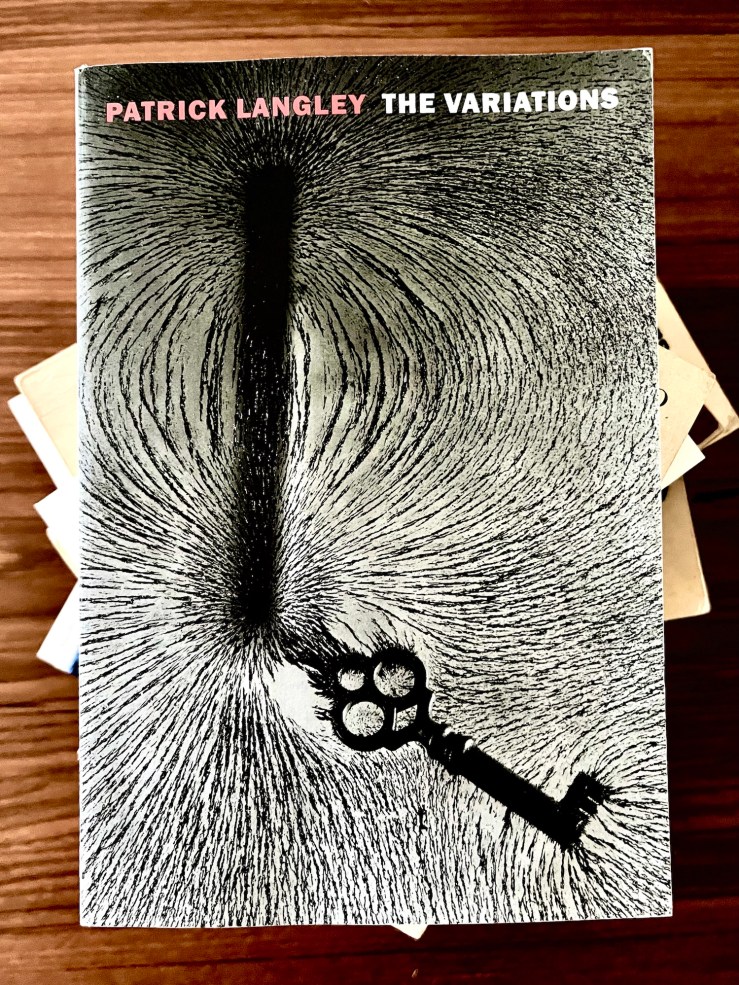
Patrick Langley’s The Variations (Book acquired, early Feb. 2024)

Patrick Langley’s novel The Variations is new from NYRB. Their blurb:

Selda Heddle, a famously reclusive composer, is found dead in a snowy field near her Cornish home. She was educated at Agnes’s Hospice for Acoustically Gifted Children, which for centuries has offered its young wards a grounding in the gift—an inherited ability to tune into the voices and sounds of the past.

When she dies, Selda’s gift passes down to her grandson Wolf, who must make sense of her legacy, and learn to live with the newly unleashed voices in his head. Ambitious and exhilarating, The Variations is a novel of startling originality about music and the difficulty—or impossibility—of living with the past.

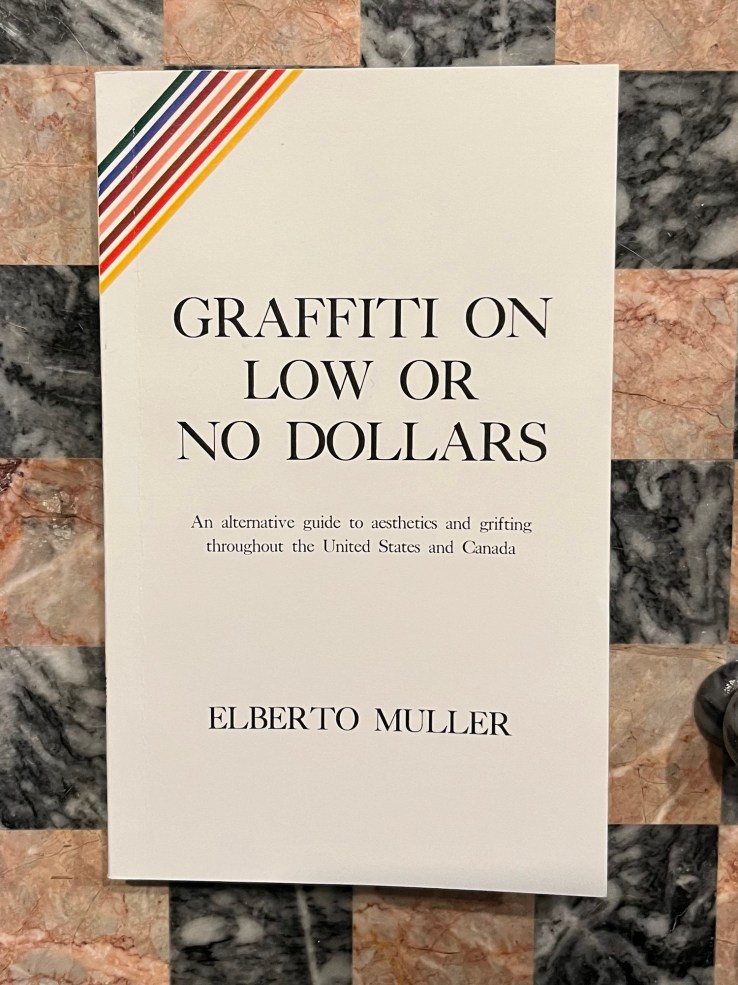
Elberto Muller’s Graffiti on Low or No Dollars (Book subtitled “An alternative guide to aesthetics and grifting throughout the United States and Canada,” Feb. 2024)

Digging Elberto Muller’s Graffiti on Low or No Dollars. Mast Books’ blurb

Muller cut his teeth riding freights across America, doing graffiti, creating zines, molding three-dimensional graffiti mosaics and has recently finished his novel: Graffiti on Low or No Dollars. His Huck Finn approach and penchant for freedom from an ordinary life is translated through his art. The work is incredibly honest and reminiscent of Daniel Johnston at times with some of the subjects being tackled a painful reflection of our society today. In the same breath his art can make you smile with all of its crassness and glory.

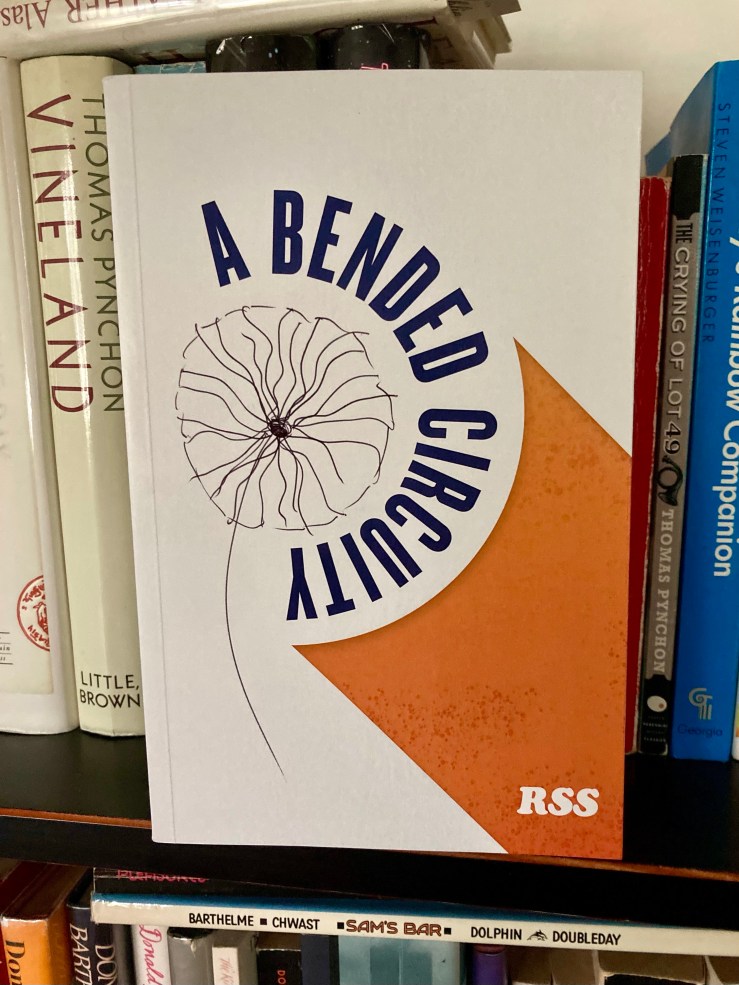
Robert S. Stickley’s A Bended Circuity (Book acquired, 27 Nov. 2023)


After hearing some positive murmurs praising its erudite maximalism and general zaniness, I caved and bought a copy of Robert S. Stickley’s 2020 novel A Bended Circuity. My copy arrived with a ballpoint flower and the front page signed with a scrawled “R S S.” I can’t really find anything about Big Box Publishing, the purported publisher of this edition, but I do know that the copies of the European reprint at Corona Samizdat sold out pretty quickly. (They have a second printing under way).

Here is the copy from the back of my edition:

There are screams in the night. Interlopers are afoot, have taken hold. Wildfires are burning the countryside and the gentry are running for cover. Fortunes are at stake. The South will not sleep.

A Bended Circuity opens on a midsummer’s afternoon with preparations being made for a soirée at the glamorous Hobcaw Barony. But not all goes according to plan. We soon find Charleston abruptly aroused from her slumber by the playful first smites of an unknown enemy waging a heinous prank war.

Calling his confederates to arms, one Bradley Pinçnit — heir to Marigold Manor and writer for revived southern mouthpiece, The Mercury — afternoon with preparations being made for a soirée at the glamorous Hobcaw Barony. But not all goes according to plan. We soon find Charleston abruptly aroused from her slumber by the playful first smites of an unknown enemy waging a heinous prank war.

Calling his confederates to arms, one Bradley Pinçnit — heir to Marigold Manor and writer for revived southern mouthpiece, The Mercury – organizes and helms a “Junto of Condign Men” then drives them to action. Offsetting her husband’s violent movement is Gabuirdine Lee, a housewife struggling to find her voice as the din of war encompasses her.

Ciphered into everything — the new roadways, the scars of the people, the tracts torn through ravaged plantations — there emerges one clear symbol: The Red Radical. Following the hints offered up by this cryptic motif, an army is mustered and pointed toward north so as to seek justice for the pernicious acts being committed upon an old way of life. But the army will first have to get out of its own way if it is to stand a chance of making it out of the South.

Read the W.A.S.T.E. Mailing List review of A Bended Circuity if you like.


Blog about some books acquired, mid-November 2023

Top to bottom:

I am a huge fan of Atticus Lish’s 2014 novel Preparation for the Next Life, and I’m a fan of indie Tyrant Books, but I’d never heard of his 2011 collection of doodles, Life Is With People. The book wasn’t even shelved properly yet, and I was initially attracted to its strange pink and black cover. It turned out the bookseller who checked out my purchases that day (the Lish and some books for my son) had brought the Lish in; his interest in it was in Lish-as-son-of-Lish. We chatted about Barry Hannah a bit and I recommended he read Hob Broun, which I recommend to anyone who expresses admiration for Hannah or Father Lish.

Here is one of the cartoons from Lish’s collection:

This particular cartoon is probably my favorite in the collection, as I find it the most relatable.

In a lovely bit of serendipity, I happened upon a first edition hardback copy of Alasdair Gray’s 1992 novel Poor Things. The previous day, I had pulled out my paperback copy to reread it in anticipation of Yorgos Lanthimos film adaptation. I ended up reading the old paperback copy, already somewhat battered, highlighted (not mine!) and dogeared (mine…), and had initially planned to trade it in toward future hardback editions of books I already own, which seems like my mission these days, but my son expressed his desire to read the novel, so it’s his I guess.

The book sans jacket is gorgeous too:

I finished Poor Things before Thanksgiving, and should have Something on it on this blog in the next week or so.

I’ve brought my son up a few times in my riff—most of these November bookstore trips were in his company; twice because he showed his art at one of the bookstore’s location, and once (the most recent, the Gray acquisition) because he’s reading like a maniac. I’m frankly jealous of how he’s reading right now—fast, somewhat indiscriminately, but with designs on reading what he calls “You know, the classics.” Initially he was reading old mass market paperbacks of mine — Kurt Vonnegut, Albert Camus, John Gardner — but he wanted his own copies (“I need to start my own little library, right?”).

I couldn’t pass up the first editions of Gass’s Middle C or Powers’ The Gold Bug Variations. I knew that I no longer had a paperback copy of The Gold Bug Variations, having loaned it to a colleague years ago who moved to Norway in the middle of a semester, leaving her history department scrambling to cover classes. Maybe it’s in Norway. I did think I had a copy of Gass’s Middle C, but I must’ve checked it out from the library or lost it, or maybe it’s shelved behind other books. I’ll shelve it by The Tunnel, a reminder that I need to take one more shot at that beast. And if that one shot is not sufficient, another shot I will take…

Thurston Moore’s memoir Sonic Life (Book acquired, 27 Oct. 2023)

I picked up Thurston Moore’s mammoth memoir Sonic Life yesterday afternoon, started reading it, and kept reading it. I was a huge Sonic Youth fan in my youth, introduced to the band in 1991 via a decent soundtrack to a mediocre film called Pump Up the Volume. Throughout the nineties and early 2000s, I bought all the Sonic Youth records I could get my hands on, and repeatedly watched their 1991 tour diary film The Year Punk Broke more times than I could count. Thurston Moore was a goofy avant hipster, ebullient, verbose, annoying, and endearing, the nexus of a band that were themselves a nexus of nascent bands and artists. (In his chapter on Sonic Youth in his 2001 history Our Band Could Be Your Life, Michael Azerrad repeatedly argues that DGC Records signed the band so that they would reel in the indie groups that majors wanted so badly after Nirvana et al. exploded.) When Thurston Moore and his wife and bandmate Kim Gordon separated in 2011, essentially ending Sonic Youth, I recall being strangely emotionally impacted, like my punk god parents were getting divorced. While I didn’t expect or want dishy answers from Gordon’s 2015 memoir Girl in a Band, I was still disappointed in the book, finding it cold and ultimately dull. So far, Moore’s memoir is richer, denser, sprawls more. It’s written in an electric rapid fire style loaded with phrasing that wouldn’t be out of place in the lyrics of an old SY track. I ended up reading the first 150 or so of the pages last night and this morning, soaking up Moore’s detailed account of the end of the New York punk rock scene and the subsequent birth of  No Wave. Moore’s intense love of music is what comes through most strongly. Chapter titles take their names from song titles or song lyrics, and I’ve started to put together a playlist, which I’ll add to as I read:


Gerald Murnane’s Inland (Beautiful book acquired some time last week, like maybe 11 Oct. 2023)

I love the new And Other Stories covers that just start, and I’m psyched on their edition of Gerald Murnane’s 1988 novel Inland. Their blurb:

Inland is a work which gathers in emotional power as it moves across the grasslands of its narrator’s imagination – from Szolnok County on the great plains of Hungary where a man writes in the library of his manor house, to the Institute of Prairie Studies in Tripp County, South Dakota, where the editor of the journal Hinterland receives his writing, to the narrator’s own native district in Melbourne County, between Moonee Ponds and the Merri, where he recalls the constant displacements of his childhood. ‘No thing in the world is one thing,’ he declares; ‘some places are many more than one place.’ These overlapping worlds are bound by recurring motifs – fish pond, fig-tree, child-woman, the colours white, red and green – and by deep feelings of intimacy and betrayal, which are brought to full expression as the book moves to its close.

My review closer to publication; in the meantime, read an excerpt.

Read one-time Biblioklept contributor Ryan Chang on Inland back in 2013.

Books acquired, 13 Oct. 2023

I couldn’t pass on a used copy of the second edition of Steven Weisenburger’s A Gravity’s Rainbow Companion even though it ate up most of my trade credit. I used the first edition of the Companion when I reread Gravity’s Rainbow about eight years ago and then gave it to a friend I had been encouraging to read GR. He still hasn’t read it.

I also picked up a hardcover first edition of Cormac McCarthy’s The Road and a pristine 1946 hardback edition of Joyce’s Ulysses. I’ll probably trade in the Gabler edition of Ulysses I have, but I think I’m too sentimental to let go of the copy of The Road I read in the hospital over a few days when my daughter was born.

I’m a big fan of Vintage Contemporaries, but I’d never seen Terry McDonell’s California Bloodstock. I pulled it out because of its spine, and found the cover intriguing–it reminded me of these weird paintings that hang in a decrepit hotel in St. Augustine Beach that we stay at for a few nights every year. The blurb from H.S. Thompson didn’t hurt either.


I opened it to find that the novel is inscribed:

Anyone know Lou Schultz? Or what SMART might be?

Walter Kempowski’s An Ordinary Youth (Book acquired, 2 Oct. 2023)

Walter Kempowski’s An Ordinary Youth gets its first published English translation thanks to Michael Lipkin. The book is new in print from NYRB. Their blurb—

An Ordinary Youth is a novel drawn directly from the author’s boyhood in Nazi Germany. Nine-year-old Walter’s family is moving house when the novel opens, but Walter’s main concerns are his tin soldiers and his older brother’s jazz records, his father’s fluctuating moods, and his mother’s ministrations and anxieties. While Walter is absorbed by his private life, the extraordinary accumulation of contemporary idioms that accompany his point of view—dialogue, song, literary quotations, commercials, and political slogans—tell a different story.  Through this echo chamber of voices, Kempowski shows a hugely turbulent and murderously intolerant nation racing toward disaster. An immediate bestseller when it was first published in Germany in 1971 (as Tadellöser & Wolff) and the best known of Kempowski’s novels in Germany, An Ordinary Youth is now available in English for the first time.

Gert Hofmann’s Our Philosopher (Book acquired, 13 Sept. 2023)

Gert Hofmann’s 1986 novel Veilchenfeld is forthcoming in the U.S. in an English translation by Eric Mace-Tessler, The new edition is from NYRB. Their back cover copy:

The time is the 1930s. Our philosopher is Herr Veilchenfeld, a renowned thinker and distinguished professor, who, after his sudden dismissal from the university, has retired to live quietly in a country town in the east of Germany. Our narrator is Hans, a clever and inquisitive boy. He relates a mix of things he witnesses himself and things he hears about from his father, the town doctor, who sees all sorts of people as he makes his rounds, even Veilchenfeld, with his troubled heart. Veilchenfeld is in decline, it’s true—he keeps ever more to himself—but the town is in ever better shape. After the defeat of the Great War and the subsequent years of poverty, things are looking up. The old, worn people are heartened to see it. The young are exhilarated. It is up to them to promote and patrol this new uplifting reality—to make it safe from the likes of Veilchenfeld, whose very existence is an affront to it. And so the doctor listens, and young Hans looks on.

And novelist Ian McEwan’s blurb:

The best novel I’ve read that describes events through the eyes of a child is little known and a minor masterpiece….Hans, the son of a small-town doctor, watches as the life of his fascinating neighbor, Professor Veilchenfeld, unravels and is then destroyed…In this learned old man, Hofmann condenses the industrialized extermination of millions…To recount it through the limited and fragmented understanding of an innocent child was an inspired authorial choice.

Elsa Morante’s Lies and Sorcery (Book acquired, 31 Aug. 2023)


NYRB is publishing a new translation of Elsa Morante’s Lies and Sorcery by Jenny McPhee.

The Letters of Gustave Flaubert (Book acquired, 26 Aug. 2023)

NYRB has a new one-volume edition of Francis Steegmuller’s translation of Flaubert’s letters. Their blurb:

Here we have Flaubert’s youthful, sensual outpourings to his mistress, the poet Louise Colet, and, as he advances, still unknown, into his thirties, the wrestle to write Madame Bovary. We hear, too, of his life-changing trip to Egypt, as described to family and friends, and then there are lively exchanges with Baudelaire, with the influential critic Sainte-Beuve, and with Guy de Maupassant, his young protégé. Flaubert’s letters to George Sand reveal her as the great confidante of his later years.

Steegmuller’s book, a classic in its own right, is both a splendid life of Flaubert in his own words and the ars poetica of the master who laid the foundations for modern writers from James Joyce to Lydia Davis. Originally issued in two volumes, the book appears here for the first time under a single cover.