Elizabeth Sewell’s The Orphic Voice (Book acquired, 12 April 2022)

Elizabeth Sewell’s 1960 work The Orphic Voice is getting a new edition this summer from NYRB. Their blurb:

Taking its bearings from the Greek myth of Orpheus, whose singing had the power to move the rocks and trees and to quiet the animals, Elizabeth Sewell’s The Orphic Voice transforms our understanding of the relationship between mind and nature. Myth, Sewell argues, is not mere fable but an ancient and vital form of reflection that unites poetry, philosophy, and natural science: Shakespeare with Francis Bacon and Giambattista Vico; Wordsworth and Rilke with Michael Polanyi. All these members of the Orphic company share a common perception that “discovery, in science and poetry, is a mythological situation in which the mind unites with a figure of its own devising as a means toward understanding the world.” Sewell’s visionary book, first published in 1960, presents brilliantly illuminating readings of A Midsummer Night’s Dream and Rilke’s Sonnets to Orpheus, among other masterpieces, while deepening our understanding not only of poetry and the history of ideas but of the biological reach of the mind.

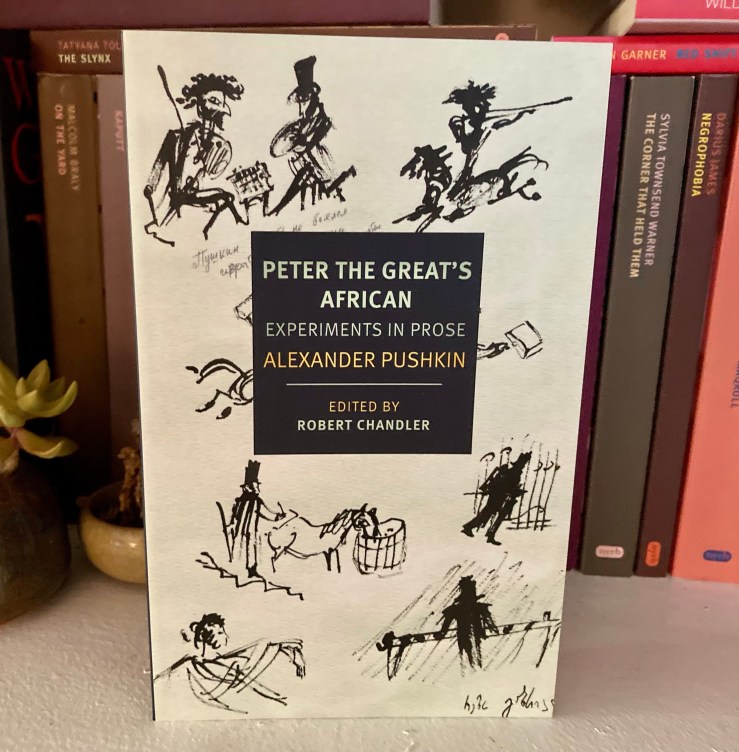
Pushkin’s Peter the Great’s African (Book acquired, sometime in the last week of March 2022)

NYRB has a new collection of Alexander Pushkin stories called Peter the Great’s African out later this month. The long short stories are translated by by Robert Chandler (who also provides the afterword), Elizabeth Chandler, and Boris Dralyuk. NYRB’s blurb:

Alexander Pushkin, Russia’s foundational writer, was constantly experimenting with new genres, and this fresh selection ushers readers into his creative laboratory. Politics and history weighed heavily on Pushkin’s imagination, and in “Peter the Great’s African” he depicts the Tsar through the eyes of one of his closest confidantes, Ibrahim, a former slave, modeled on Pushkin’s maternal great-grandfather. At once outsider and insider, Ibrahim offers a sympathetic yet questioning view of Peter’s attempt to integrate his vast, archaic empire into Europe. In the witty “History of the Village of Goriukhino” Pushkin employs parody and self-parody to explore problems of writing history, while “Dubrovsky” is both a gripping adventure story and a vivid picture of provincial Russia in the late eighteenth century, with its class conflicts ready to boil over in violence. “The Egyptian Nights,” an effervescent mixture of prose and poetry, reflects on the nature of artistic inspiration and the problem of the poet’s place in a rapidly changing and ever more commercialized society.


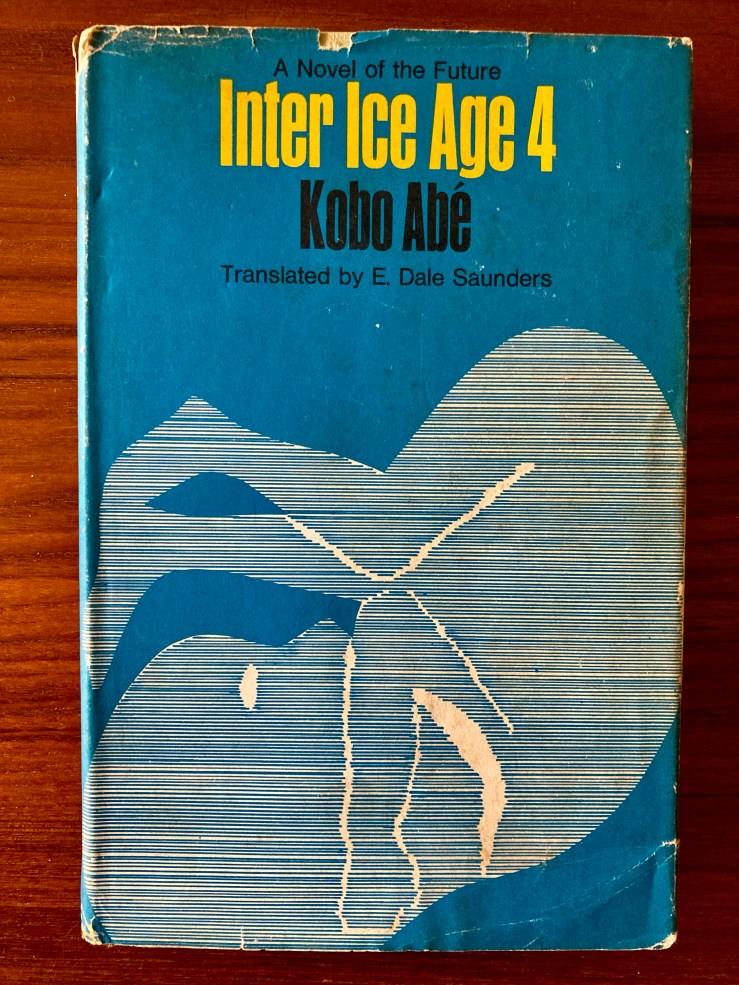
Kobo Abe’s Inter Ice Age 4 (Book acquired, 1 April 2022)

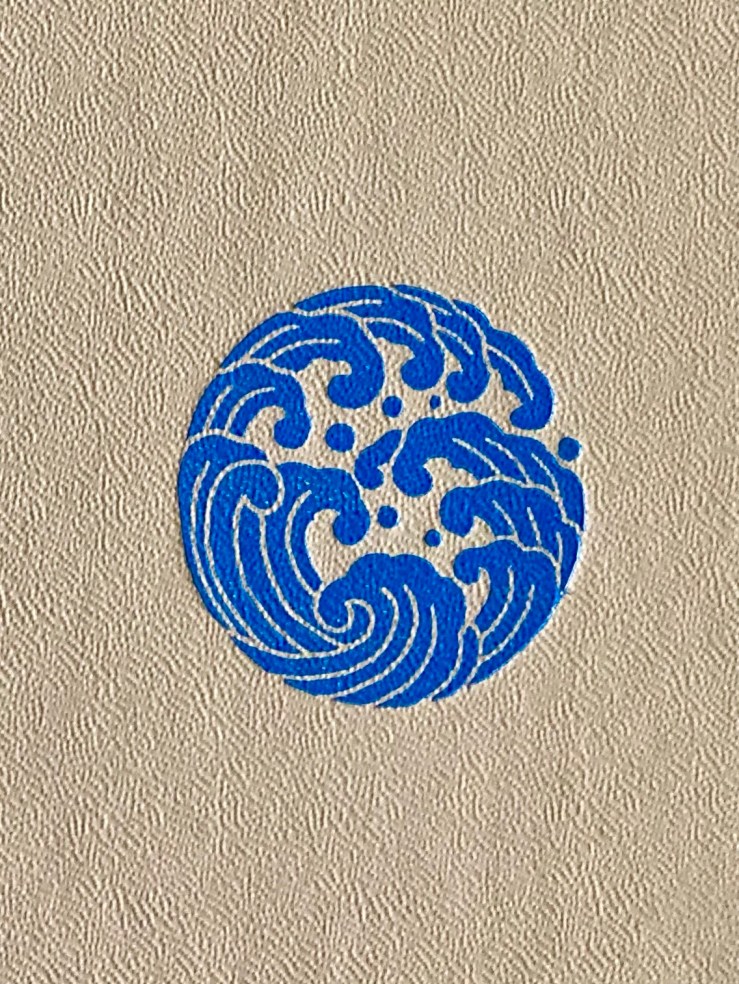
I was thrilled to find a first-edition U.S. hardback (Knopf, 1970, Book Club Edition) of Kobo Abe’s novel Inter Ice Age 4. The translation is by E. Dale Saunders, and is the only English translation of the novel that I am aware of. The jacket design is by Joseph del Gaudio; I’m not sure if he is responsible for this lovely little embossed image that takes up the bottom-right corner of the cover:

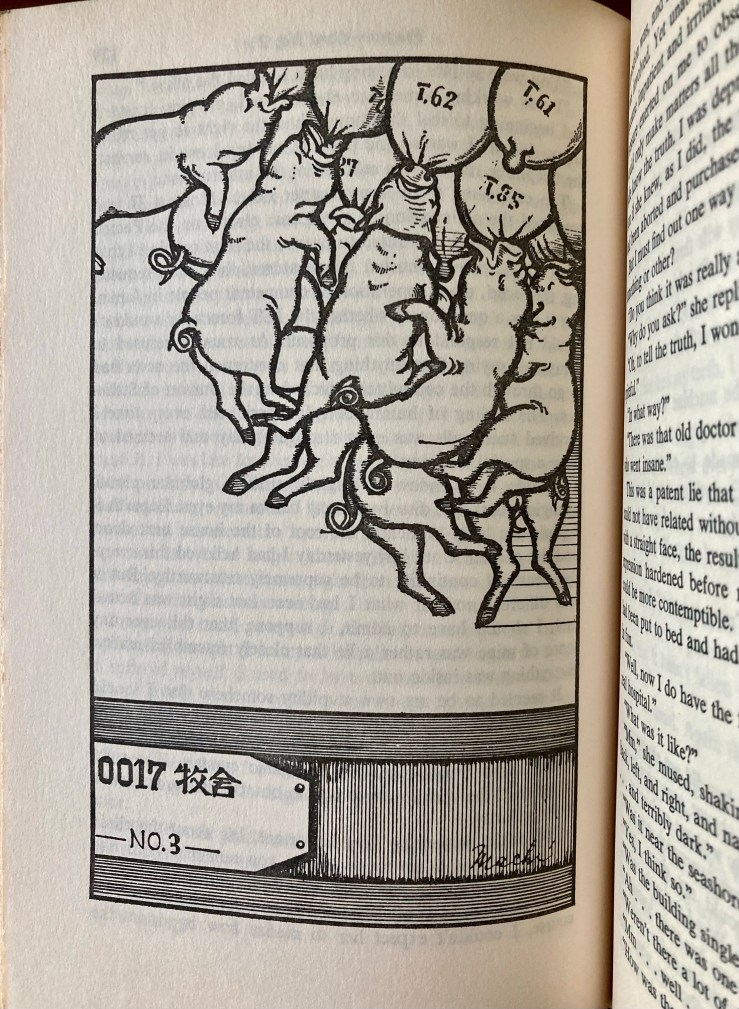
This edition includes five line drawings by Abe’s wife, the artist Machi Abe. Here is one of those drawings:

I’ve had a samizdat e-copy of Inter Ice Age 4 for ages now, but haven’t made it past the first 20 or so pages, but the intriguing, prescient plot has always intrigued me. First composed and published in serialization at the end of the 1950s, Inter Ice Age 4 is set in a world where the polar ice caps are rapidly melting. Scientists genetically modify gilled children to survive this new reality. A proto-AI, a computer that can tell the future is the novel’s central antagonist. Thank god nothing like that’s shaking down these days!

John Elizabeth Stintzi’s novel My Volcano (Book acquired, 20 Feb. 2022)

I finally had a spare half hour to dip into John Elizabeth Stintzi’s novel My Volcano this afternoon. After hearing about the novel from the good folks at weirdo indie stalwart Two Dollar Radio, I thought—well, look, here’s the publisher’s blurb:

My Volcano is a kaleidoscopic portrait of a menagerie of characters, as they each undergo personal eruptions, while the Earth itself is constantly shifting. It takes place during the turbulent summer of 2016, which saw the Pulse nightclub shooting in Orlando, and a spate of horrific hate-crimes across the country. This grounding in reality, contrasted with the sensational action that occurs in the narrative, floats the idea — which appears as the epigraph to the book, and also as a line within — that “reality is nothing but the opinion of power.” Parable, myth, science-fiction, eco-horror, My Volcano is a radical work of literary art, emerging as a subversive, intoxicating artistic statement.

–and the blurb at the TDR website is more detailed—

On June 2, 2016, a protrusion of rock growing from the Central Park Reservoir is spotted by a jogger. Three weeks later, when it finally stops growing, it’s nearly two-and-a-half miles tall, and has been determined to be an active volcano.

As the volcano grows and then looms over New York, an eight-year-old boy in Mexico City finds himself transported 500 years into the past, where he witnesses the fall of the Aztec Empire; a Nigerian scholar in Tokyo studies a folktale about a woman of fire who descends a mountain and destroys an entire village; a white trans writer in Jersey City struggles to write a sci-fi novel about a thriving civilization on an impossible planet; a nurse tends to Syrian refugees in Greece while grappling with the trauma of living through the bombing of a hospital in Kunduz, Afghanistan; a nomadic farmer in Mongolia is stung by a bee, magically transforming him into a green, thorned, flowering creature that aspires to connect every living thing into its consciousness.

With its riveting and audacious vision, My Volcano is a tapestry on fire, a distorted and cinematic new work from the fiercely talented John Elizabeth Stintzi.

—anyway, I expected a kind of weirdness of prose, something “experimental” — but Stintzi’s prose is tight, lucid, and crisp. They employ filmic techniques, including interstitial chapters announcing the myriad horrific deaths recorded in 2016, including Philando Castile, Alton Sterling, and the victims of the Pulse nightclub massacre. Flicking through the novel to graze these placards reminded me of the cruelty of the 2016, but also underlined that that cruelty was not especially special, besides, maybe, the fact that more folk could not deny systematic institutional violence in the grand ole USA. (Accept that they did. A lot of folk signed up for denying that shit.)

—well anyway, the intriguing thing, so far, is Stintzi’s spare evocations of extraordinary moments. There’s something both banal and beautiful in a sentence like, “The bumblebee in central Mongolia was eaten by a whitethroated needletail on JUNE 5.” Or hardly banal, but still frank and clear: “It didn’t take more than seeing strangely dressed Angel ingest a cloud for the Mexica people of Tenochtitlan to believe that he was holy.”

There’s also a heavy sadness under what I read, although maybe I brought that myself.
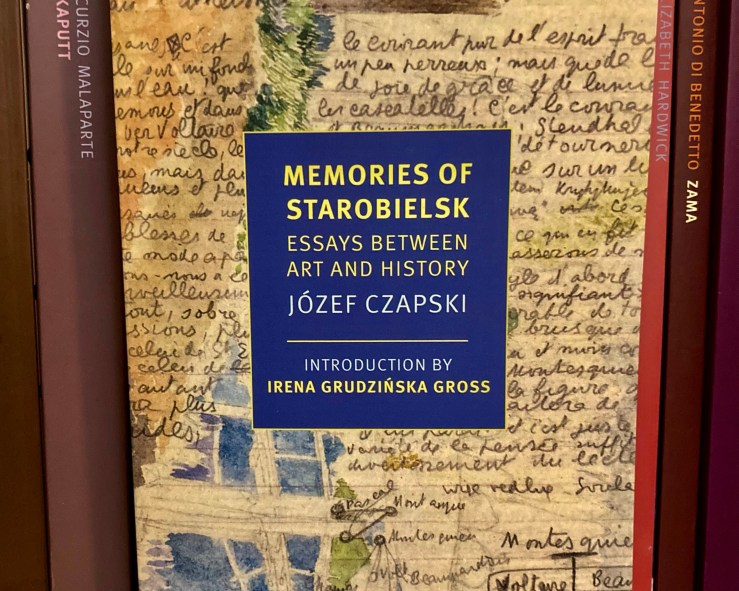
Józef Czapski’s Memories of Starobielsk (Book acquired, 7 Feb. 2022)

Józef Czapski’s Memories of Starobielsk: Essays between Art and History is forthcoming from NYRB in Alissa Valles’s translation. Their blurb:

Interned with thousands of Polish officers in the Soviet prisoner-of-war camp at Starobielsk in September 1939, Józef Czapski was one of a very small number to survive the massacre in the forest of Katyń in April 1940. Memories of Starobielsk portrays these doomed men, some with the detail of a finished portrait, others in vivid sketches that mingle intimacy with respect, as Czapski describes their struggle to remain human under hopeless circumstances. Essays on art, history, and literature complement the memoir, showing Czapski’s lifelong engagement with Russian culture. The short pieces on painting that he wrote while on a train traveling from Moscow to the Second Polish Army’s strategic base in Central Asia stand among his most lyrical and insightful reflections on art.

Rahel Varnhagen: The Life of a Jewish Woman by Hannah Arendt (Book acquired, mid-January 2022)

Hannah Arendt’s Rahel Varnhagen: The Life of a Jewish Woman is forthcoming from NYRB (in translation by Clara Winston and Richard Winston, and with an introduction by Barbara Hahn). NYRB’s blurb:

Rahel Varnhagen: The Life of a Jewish Woman was Hannah Arendt’s first book, largely completed when she went into exile from Germany in 1933, though not published until the 1950s. It is the biography of a remarkable, complicated, passionate woman, and an important figure in German romanticism. Rahel Varnhagen also bore the burdens of being an unusual woman in a man’s world and an assimilated Jew in Germany.

She was, Arendt writes, “neither beautiful nor attractive . . . and possessed no talents with which to employ her extraordinary intelligence and passionate originality.” Arendt sets out to tell the story of Rahel’s life as Rahel might have told it and, in doing so, to reveal the way in which assimilation defined one person’s destiny. On her deathbed Rahel is reported to have said, “The thing which all my life seemed to me the greatest shame, which was the misery and misfortune of my life—having been born a Jewess—this I should on no account now wish to have missed.” Only because she had remained both a Jew and a pariah, Arendt observes, “did she find a place in the history of European humanity.”

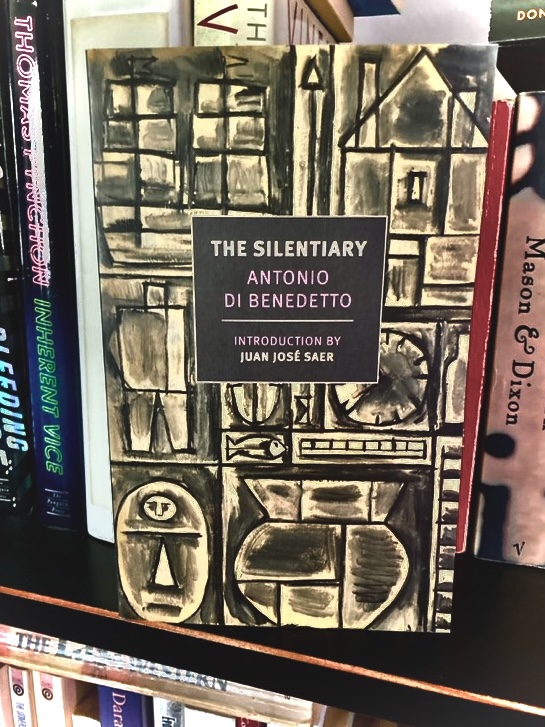
Antonio di Benedetto’s The Silentiary (Book acquired, 6 Jan. 2022)

This afternoon I finally jumped in to Esther Allen’s new translation of Antonio di Benedetto’s novel The Silentiary (the original title, El silenciero means something like “the silencer,” I think). We have an unnamed narrator living in an unnamed Latin America in a not-entirely unspecified time (“as of the late postwar era”). Our narrator is an office worker who lives with his mother. He dreams of being a writer and is in love with a neighbor. He despises noise, which is too bad because an autoshop has just opened up right next to his bedroom wall.

There’s a Kafkaesque vibe to The Silentiary—everything’s a bit uncanny, a wavelength off. The narrator is a wavelength off, I suppose. The prose is sometimes crisp and economic, and then zips out into wonderfully estranging images, like this odd sentence just a few pages in:

At dawn, the daylight a glaze of watery milk on the widowpanes, as my mind, jerked into a state of alertness, discerns a noise attached to the rear wall of my room, something like my heart grows agitated within me.

Or this little moment, longer than a haiku but still in the same spirit:

Last night the big gray cat of my childhood came to me.

I told him that noise stalks and harries me.

Slowly, intensely, he cast his animal, companionable gaze upon me.

It took me a few dozen pages to attune to the humor of The Silentiary. It’s just as odd and dry as the dark humor in Di Benedetto’s 1965 novel Zama,  but again, a wavelength off, a different flavor from the same palate. An episode of drinking that ends with our narrator carried home by his fellows is particularly entertaining. When I type out the description the bit seems hardly subtle. But it is.

More thoughts to come, but for now here’s NYRB’s blurb:

The Silentiary takes place in a nameless Latin American city during the early 1950s. A young man employed in middle management entertains an ambition to write a book of some sort. But first he must establish the necessary precondition, which the crowded and noisily industrialized city always denies him, however often he and his mother and wife move in search of it. He thinks of embarking on his writing career with something simple, a detective novel, and ponders the possibility of choosing a victim among the people he knows and planning a crime as if he himself were the killer. That way, he hopes, his book might finally begin to take shape.

The Silentiary, along with Zama and The Suicides, is one of the three thematically linked novels by Di Benedetto that have come to be known as the Trilogy of Expectation, after the dedication “To the victims of expectation” in Zama. Together they constitute, in Juan José Saer’s words, “one of the culminating moments of twentieth-century narrative fiction in Spanish.”

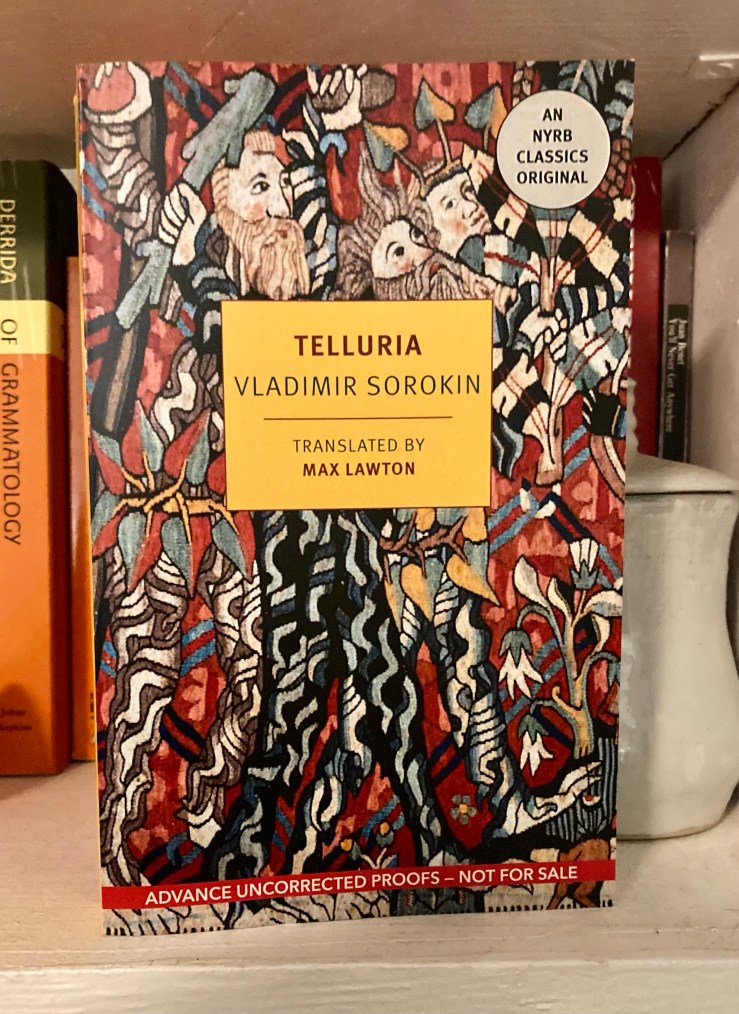
Vladimir Sorokin’s Telluria (Book acquired, 13 Jan. 2022)

I read the first few bits of Vladmir Sorokin’s postapocalyptic novel Telluria today. The book is forthcoming from NYRB in translation by Max Lawton. The fantastic blurb captured my interest right away:

Telluria is set in the future, when a devastating holy war between Europe and Islam has succeeded in returning the world to the torpor and disorganization of the Middle Ages. Europe, China, and Russia have all broken up. The people of the world now live in an array of little nations that are like puzzle pieces, each cultivating its own ideology or identity, a neo-feudal world of fads and feuds, in which no one power dominates. What does, however, travel everywhere is the appetite for the special substance tellurium. A spike of tellurium, driven into the brain by an expert hand, offers a transforming experience of bliss; incorrectly administered, it means death.

The fifty chapters of Telluria map out this brave new world from fifty different angles, as Vladimir Sorokin, always a virtuoso of the word, introduces us to, among many other figures, partisans and princes, peasants and party leaders, a new Knights Templar, a harem of phalluses, and a dog-headed poet and philosopher who feasts on carrion from the battlefield. The book is an immense and sumptuous tapestry of the word, carnivalesque and cruel, and Max Lawton, Sorokin’s gifted translator, has captured it in an English that carries the charge of Cormac McCarthy and William Gibson.

Telluria is forthcoming this summer; NYRB plans to publish three more by Sorokin, including Blue Lard, “which included a sex scene between clones of Stalin and Khrushchev [and] led to public demonstrations against the book and to demands that Sorokin be prosecuted as a pornographer.”

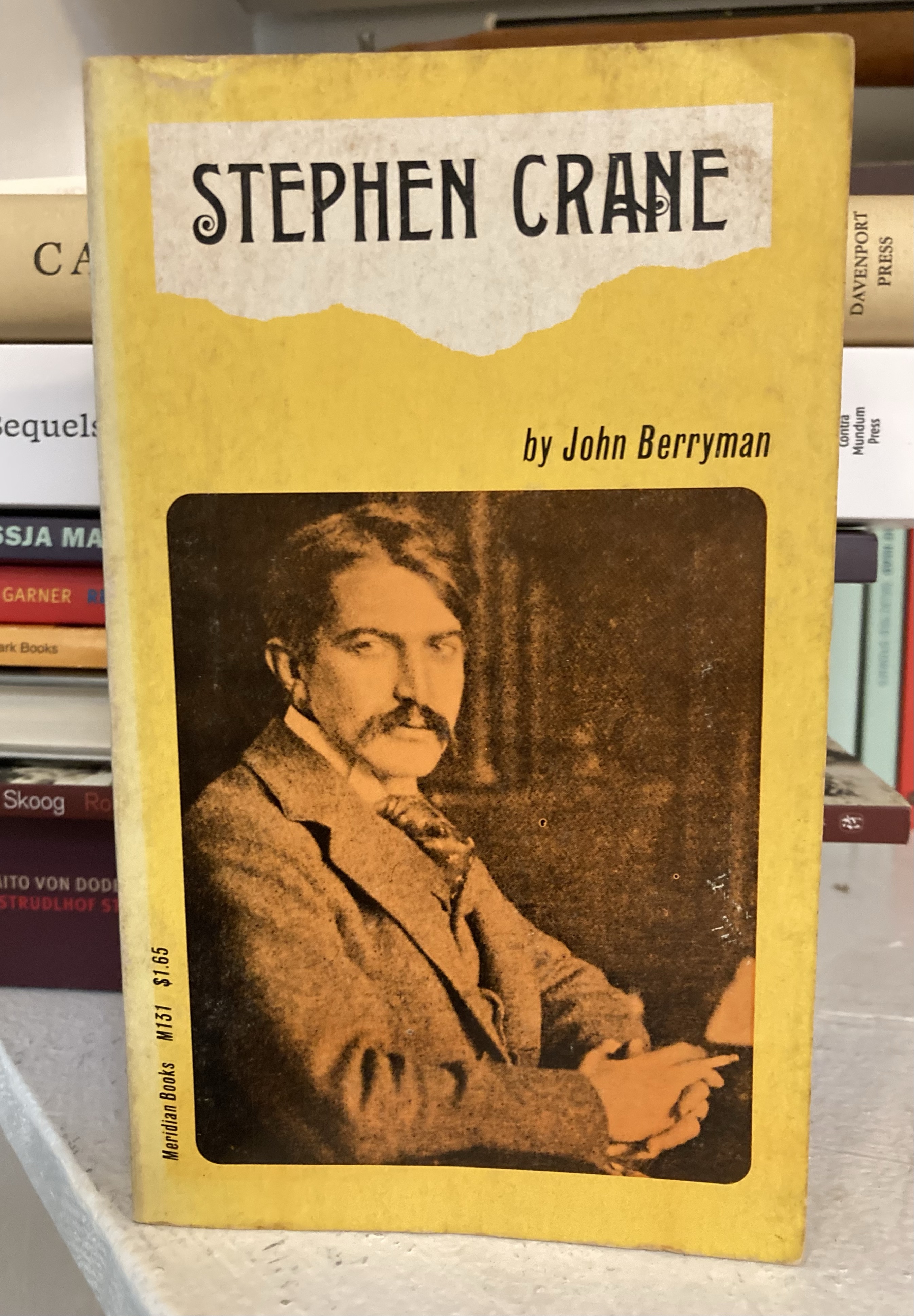
John Berryman’s Stephen Crane biography (Book acquired, 9 Dec. 2021)

I’ve been casually looking for a copy of John Berryman’s 1950 biography of Stephen Crane for a few years now. Berryman is one of my favorite poets and Crane is one of my favorite short story writers. A write up of Paul Auster’s new Crane bio led me to reread some Crane favorites over the past few weeks, which in turn made me look a bit harder for Berryman’s Stephen Crane. The used bookstore I frequent has something like two and a half million books; I had been looking for the Crane bio in three sections: with Crane’s fiction, in biographies, and in literary criticism. This week I grabbed a stool and searched through the overstock above the Crane section and found what I’d been looking for.

As he points out in his preface, Berryman’s approach is a mix of biography and critical appraisal. Berryman claims that very little was written about Crane’s fiction (apart from The Red Badge of Courage) after his death, and that his (Crane’s) reputation was essentially invisible apart from “the war book” until later modernists took to championing him (much like earlier modernists recovered Herman Melville).

After the preface, I couldn’t help but read some of the section on composing “The Open Boat”; it’s a favorite of mine, I live in Jacksonville, where the story originates, and I use it in the classroom every semester. I also dipped into the penultimate chapter, “Crane’s Art,” which includes this nugget:

…Crane has been dead half a century, academic interest has avoided him as both peculiar and undocumented, and some of his work is still decidedly alive. This is long enough.

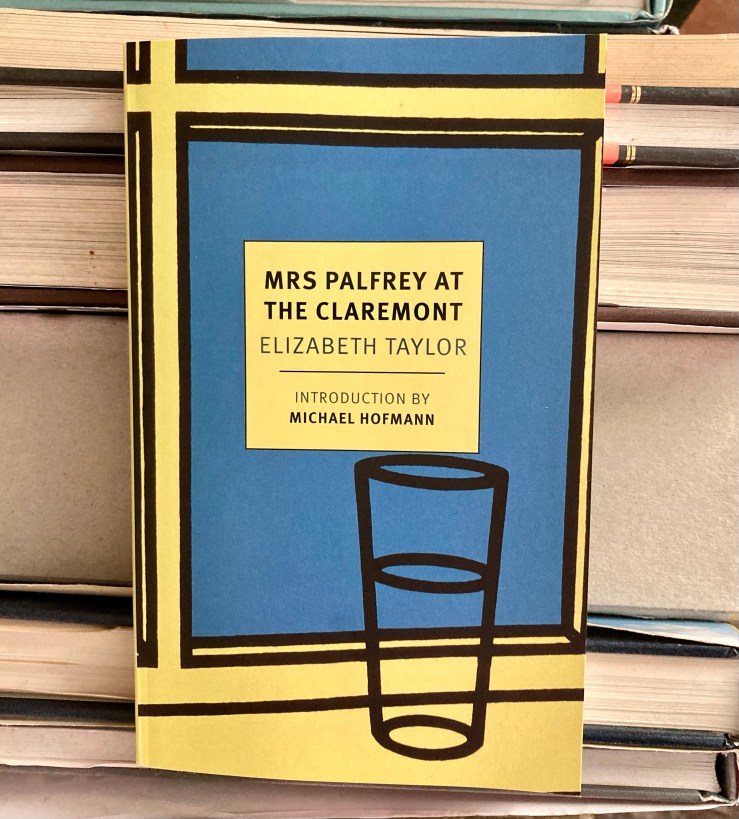
Elizabeth Taylor’s Mrs Palfrey at the Claremont (Book acquired, late Nov. 2021)

NYRB is reprinting the last novel of Elizabeth Taylor (not that one, the other one), Mrs Palfrey at the Claremont. NYRB’s blurb:

On a rainy Sunday afternoon in January, the recently widowed Mrs. Palfrey moves to the Claremont Hotel in South Kensington. “If it’s not nice, I needn’t stay,” she promises herself, as she settles into this haven for the genteel and the decayed. “Three elderly widows and one old man . . . who seemed to dislike female company and seldom got any other kind” serve for her fellow residents, and there is the staff, too, and they are one and all lonely. What is Mrs. Palfrey to do with herself now that she has all the time in the world? Go for a walk. Go to a museum. Go to the end of the block. Well, she does have her grandson who works at the British Museum, and he is sure to visit any day.

Mrs. Palfrey prides herself on having always known “the right thing to do,” but in this new situation she discovers that resource is much reduced. Before she knows it, in fact, she tries something else.

Elizabeth Taylor’s final and most popular novel is as unsparing as it is, ultimately, heartbreaking.

Heimito von Doderer’s The Strudlhof Steps (Book acquired, 15 Nov. 2021)

Heimito von Doderer’s The Strudlhof Steps is forthcoming in translation by Vincent Kling from NYRB. Their blurb:

The Strudlhof Steps is an unsurpassed portrait of Vienna in the early twentieth century, a vast novel crowded with characters ranging from an elegant, alcoholic Prussian aristocrat to an innocent ingenue to “respectable” shopkeepers and tireless sexual adventurers, bohemians, grifters, and honest working-class folk. The greatest character in the book, however, is Vienna, which Heimito von Doderer renders as distinctly as James Joyce does Dublin or Alfred Döblin does Berlin. Interweaving two time periods, 1908 to 1911 and 1923 to 1925, the novel takes the monumental eponymous outdoor double staircase as a governing metaphor for its characters’ intersecting and diverging fates. The Strudlhof Steps is an experimental tour de force with the suspense and surprise of a soap opera. Here Doderer illuminates the darkness of passing years with the dazzling extravagance that is uniquely his.

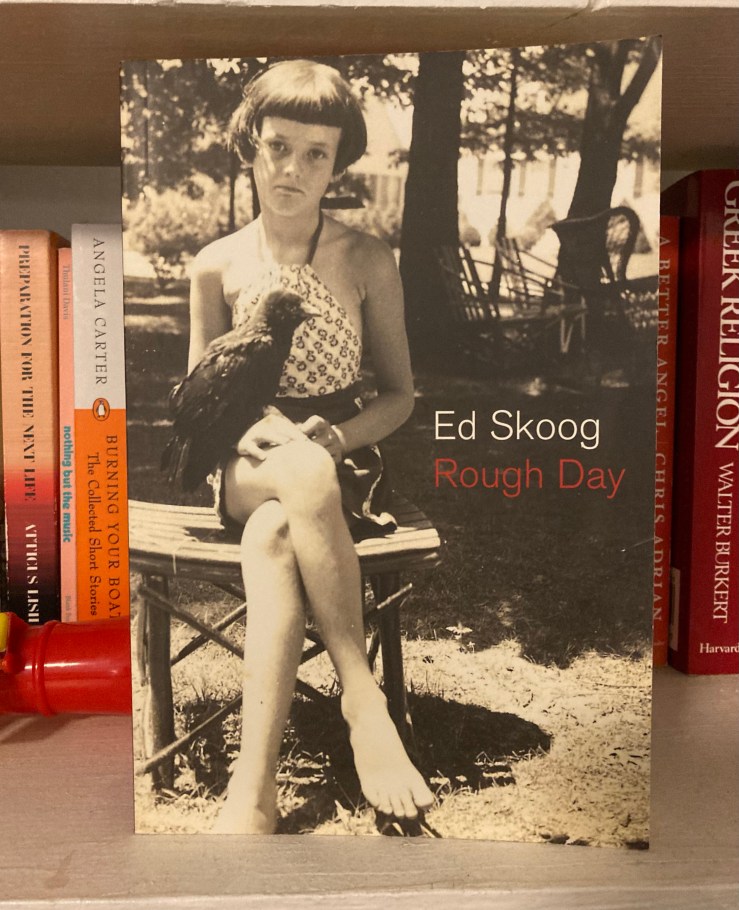
Ed Skoog’s Rough Day (Book acquired, 13 Nov. 2021)

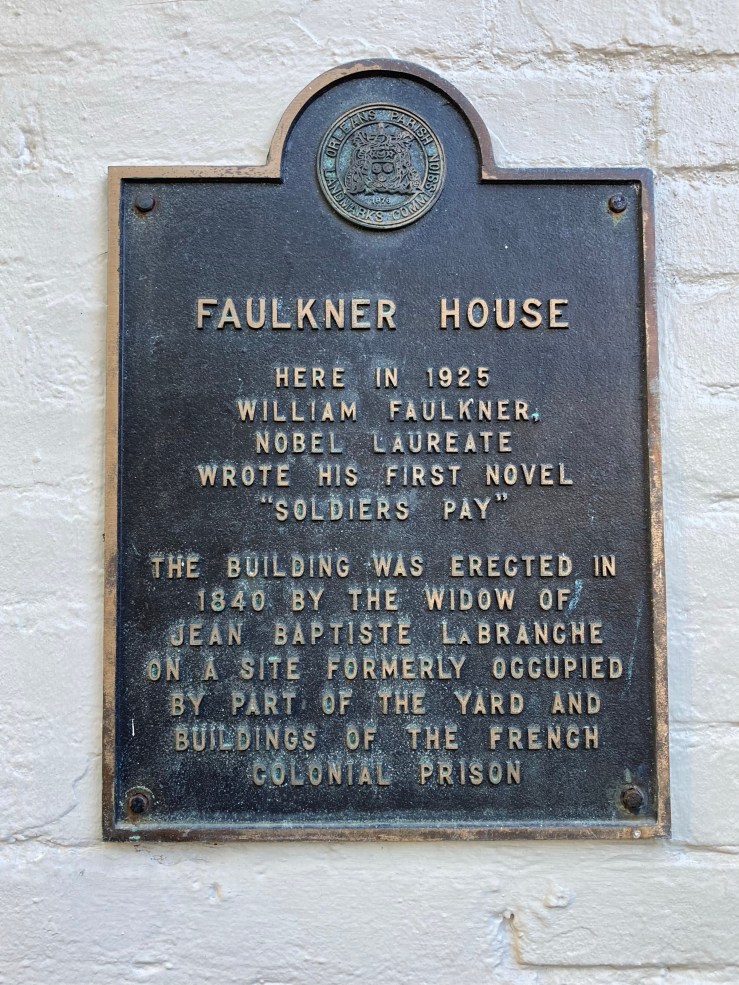
So we had a great long weekend with some friends in New Orleans. We stayed in Marigny—great food, great music, maybe too many drinks—but made it into the quarter for a few hours midday Saturday. I led our little group to Jackson Square where we respectfully finished our Bloody Marys before entering St. Louis Cathedral. My real aim though was Faulkner House Books on Pirate Alley right by the cathedral. Faulkner House imposed a strict four-guests-at-a-time policy, so my friends found a bar while I browsed. The stock in the small store is impeccable. Plenty of NYRB titles, a cadre of hardback Bolaños (including almost all of the poetry available in English), more Anne Carson than I’ve ever seen in a store. (I didn’t make it to Faulkner House when I visited NOLA in late 2016, but in 2012 I got some good stuff.) This time, I picked up a signed copy of Ed Skoog’s Rough Day, which seemed fitting—I’d scheduled a post that day of his poem “Run the Red Lights.”

After I finished up I headed to a bar on the outskirts of the Quarter to meet my friends, but first popped in to Arcadian Books & Prints on Orleans St.—perhaps the most chaotic bookstore I’ve ever been to. 

As always, I loved NOLA and look forward to returning sooner rather than later.

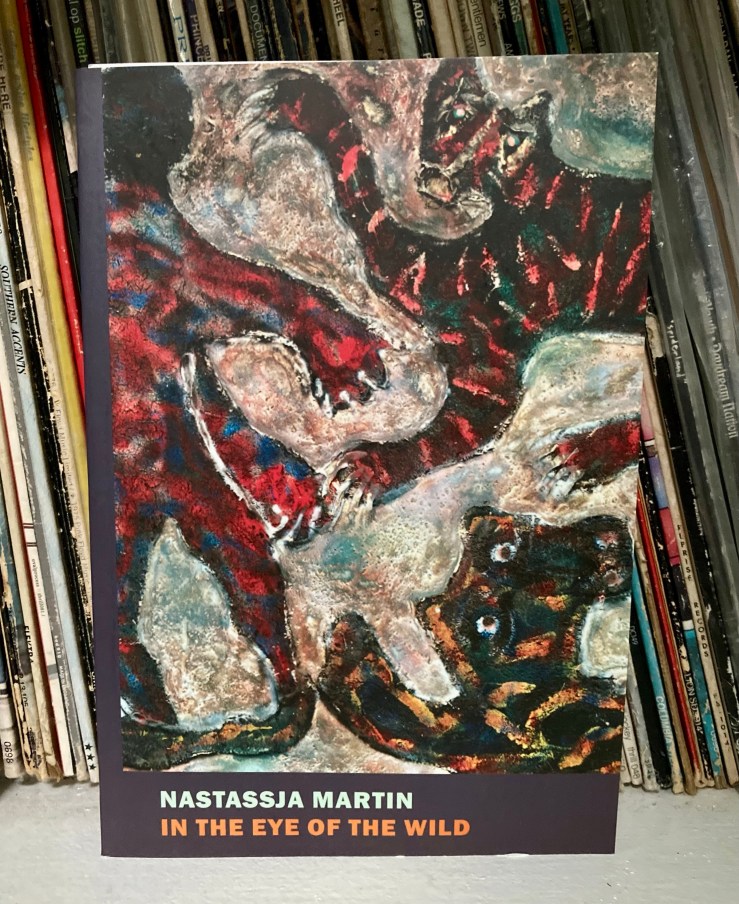
Nastassja Martin’s In the Eye of the Wild (Book acquired, late Oct. 2021)

Nastassja Martin’s In the Eye of the Wild is out in a few weeks from NYRB in a translation by Sophie R. Lewis. I dove in this morning and it’s engrossing stuff. Any book that begins with a bear mauling the author is off to a weird start. Here’s NYRB’s blurb:

In the Eye of the Wild begins with an account of the French anthropologist Nastassja Martin’s near fatal run-in with a Kamchatka bear in the mountains of Siberia. Martin’s professional interest is animism; she addresses philosophical questions about the relation of humankind to nature, and in her work she seeks to partake as fully as she can in the lives of the indigenous peoples she studies. Her violent encounter with the bear, however, brings her face-to-face with something entirely beyond her ken—the untamed, the nonhuman, the animal, the wild. In the course of that encounter something in the balance of her world shifts. A change takes place that she must somehow reckon with.

Left severely mutilated, dazed with pain, Martin undergoes multiple operations in a provincial Russian hospital, while also being grilled by the secret police. Back in France, she finds herself back on the operating table, a source of new trauma. She realizes that the only thing for her to do is to return to Kamchatka. She must discover what it means to have become, as the Even people call it, medka, a person who is half human, half bear.

In the Eye of the Wild is a fascinating, mind-altering book about terror, pain, endurance, and self-transformation, comparable in its intensity of perception and originality of style to J. A. Baker’s classic The Peregrine. Here Nastassja Martin takes us to the farthest limits of human being.

Paul Griffiths’ Mr. Beethoven (Book acquired, October 2021)

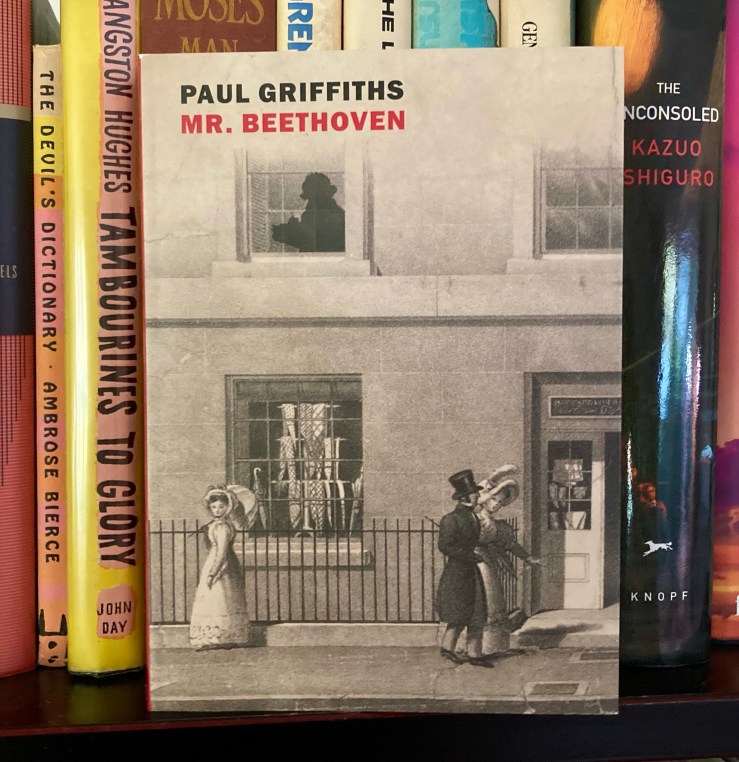
Paul Griffiths’ novel Mr. Beethoven is new this week from NYRB. Their blurb—

It is a matter of historical record that in 1823 the Handel and Haydn Society of Boston (active to this day) sought to commission Beethoven to write an oratorio. The premise of Paul Griffiths’s ingenious novel is that Beethoven accepted the commission and traveled to the United States to oversee its first performance. Griffiths grants the composer a few extra years of life and, starting with his voyage across the Atlantic and entry into Boston Harbor, chronicles his adventures and misadventures in a new world in which, great man though he is, he finds himself a new man. Relying entirely on historically attested possibilities to develop the plot, Griffiths shows Beethoven learning a form of sign language, struggling to rein in the uncertain inspiration of Reverend Ballou (his designated librettist), and finding a kindred spirit in the widowed Mrs. Hill, all the while keeping his hosts guessing as to whether he will come through with his promised composition. (And just what, the reader also wonders, will this new piece by Beethoven turn out to be?) The book that emerges is an improvisation, as virtuosic as it is delicate, on a historical theme.


The Old People (Book acquired, Sept. 2021)

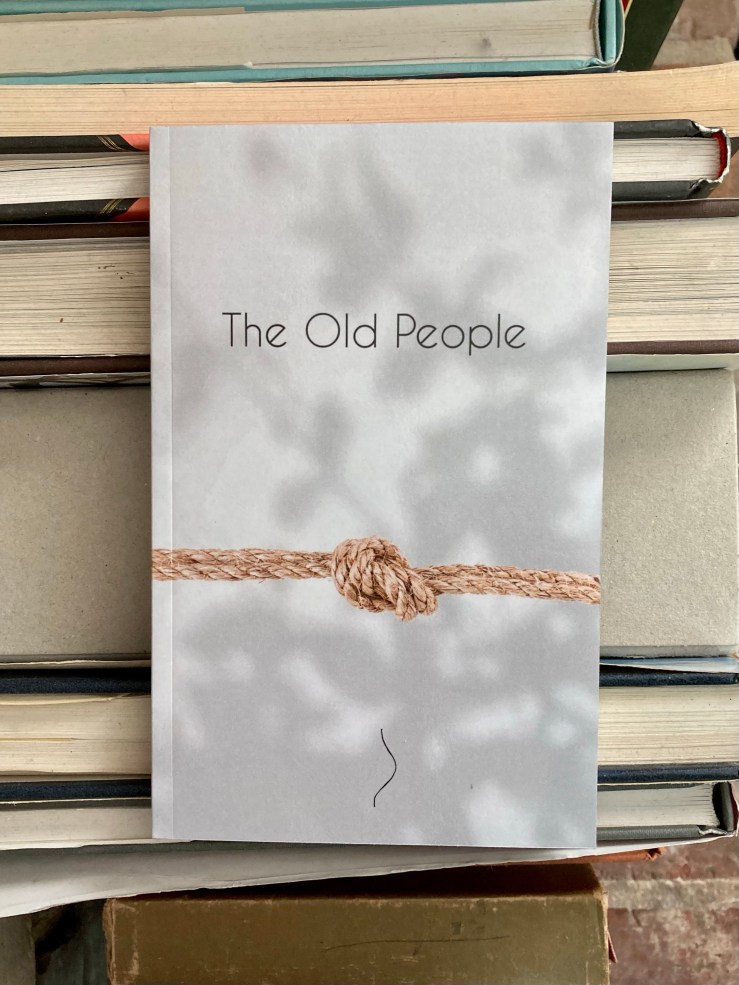
The Old People is a 2014 novel by A.J. Perry. The Old People gets a new life thanks to Carrying Woman Originals, an imprint of Cow Eye Press, which also published Perry’s novel Cow Country a few years ago.  As you can see in the photo above, Perry’s name is not on the cover. There’s no blurb on the back. Perry’s name shows up on the editions page and then on a second title page that faces the edition page (but not on the first title page).

I was under metaphorical water in September when The Old People arrived, having decided to recommit to doing a good job at my job, by which I mean trying to provide much more feedback and coaching and general mental attendance to my students than I think I was giving in the last (covid-drenched) semesters, all the while worrying about the utter idiocy of Florida Fall 2021’s Death Campaign. Anyway, I stacked it in a growing stack of other TBR copies and retreated into Barthelme’s stories I’d already read a few times when I made the time to read for pleasure.

I moved the stack around today, dropping The Old People to the floor. I picked it up, decided to read the opening pages, and then kept reading. It’s really good! I mean, it’s a really strange thing. It’s a book about tying a knot, which I guess is a metaphor, but it’s really focused on that metaphor’s concrete component. Pages and pages of digging holes and tying knots. I’m not sure exactly what The Old People reminds me of, but it taps into the intersection of myth and anthropology, all without being precious or pretentious (so far, anyway). I hunted down a blurb on Cow Eye’s site:

Since the beginnings of darkest silence the people of a mythical island have spent their days tying the ancient knot that binds them to their past. To tie this knot they must dig a hole; to dig a hole they first must have fire; and to make a fire that is hot enough for hole digging, the knot that they have been tying must finally be tied. From silence to mud to rope to knot to wood to words to fire, the Old People will work to tie their knot under the cool shade of the island’s original knotmaking.


Jean Giono’s The Open Road (Book acquired like last week or maybe the end of the week before; I can’t remember, September’s been rough)

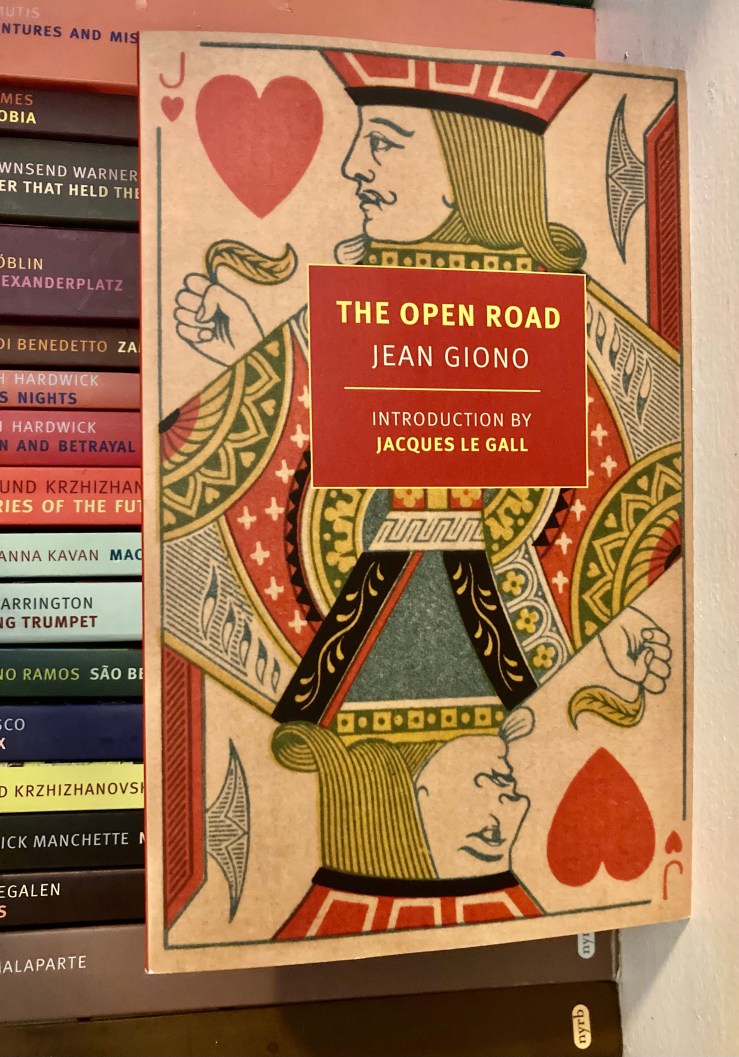
I’m a big fan of picaresque novels about con artists. Jean Giono’s The Open Road is forthcoming in translation by Paul Eprile from NYRB. Their blurb:

The south of France, 1950: A solitary vagabond walks through the villages, towns, valleys, and foothills of the region between northern Provence and the Alps. He picks up work along the way and spends the winter as the custodian of a walnut-oil mill. He also picks up a problematic companion: a cardsharp and con man, whom he calls “the Artist.” The action moves from place to place, and episode to episode, in truly picaresque fashion. Everything is told in the first person, present tense, by the vagabond narrator, who goes unnamed. He himself is a curious combination of qualities—poetic, resentful, cynical, compassionate, flirtatious, and self-absorbed.

While The Open Road can be read as loosely strung entertainment, interspersed with caustic reflections, it can also be interpreted as a projection of the relationship of author, art, and audience. But it is ultimately an exploration of the tensions and boundaries between affection and commitment, and of the competing needs for solitude, independence, and human bonds. As always in Jean Giono, the language is rich in natural imagery and as ruggedly idiomatic as it is lyrical.

Papa Hamlet (Book acquired, 20 Aug. 2021)

Papa Hamlet is kind of a weird one. This is the first time Arno Holz and Johannes Schlaf’s collaborative 1889 German novel has appeared in English, thanks to translator James J. Conway and publisher Rixdorf Editions. Here’s their blurb:

Adultery, vulgarity, disordered lives on the brink of collapse: the feverish existence of failed actor Niels Thienwiebel shocked German readers when Papa Hamlet was first published in 1889. In declaiming the soliloquies of his most famous role, ‘the great Thienwiebel’ finds delusional refuge from the squalid room he shares with despondent wife Amalie and infant son Fortinbras. But it was the radical style as much as the moral outrage of this novella that so confounded contemporaries. Reflecting their own bohemian Berlin milieu, Arno Holz and Johannes Schlaf showed the dream of the self-authored life turning to nightmare through apathy and self-absorption. Originally credited to a fabricated Norwegian writer, Papa Hamlet signalled the explosive arrival of Naturalism while also pointing ahead to Modernism; its appropriations, irony and play of identity even foretold Postmodernism. Appearing for the first time in English, it is teamed here with an early incarnation of the same narrative by Schlaf alongside further collaborations with Holz. Together their fearless candour and anarchic ingenuity reveal another side to German Naturalism that is well overdue for rediscovery.

Just four years in duration, the collaboration between Arno Holz (1863-1929) and Johannes Schlaf (1862-1941) created a revolution in form and content which exerted a huge influence on German literature. As well as Papa Hamlet their partnership produced the play The Selicke Family, a number of shorter prose works and an autobiographical comic. After living and working in bohemian isolation just outside Berlin, the pair split acrimoniously in 1892 and continued sniping at each other for decades as they moved on from their Naturalist origins. Arno Holz was something of a tragic figure, consumed with bitterness; works like his verse collection Phantasus were years head of their time yet security eluded him. The more amenable Johannes Schlaf enjoyed greater success but his posthumous reputation suffers from his later embrace of the Nazis. Neither writer has previously appeared in English.

Read an excerpt here.