
Home Land — Sam Lipsyte

[Editorial note: Biblioklept ran a version of this review last year; we run it again in the spirit of Sam Lipsyte Week].

In Sam Lipsyte’s 2004 novel Home Land, minor loser Lewis Miner sends missives to his high school alumni newsletter, Catamount Notes, about his awful, sad misadventures in small-time drug use, petty copy-writing, itinerant busboyism, and chronic masturbation (he has a strong erotic disposition toward leg warmer porn. If this idea repels you (with no reciprocal attraction) this book is not for you). Miner wants to be sweet but he can be mean. He’s obsessed with the past–and who can blame him? His nickname in high school was Teabag, an appellation literally thrust upon him by the dumbest of jock-bullies. He carries this kernel of spite for years like a pebble in the sock, one that rubs up a giant blister–Miner is all blister. Writing ostensibly to his former classmates, but really just for himself, another form of masturbation:

It’s always been this way, as many of you might recall. Somebody chucks a snowball, I’m scouring the school yard for rocks. The bully just wants to shove sadness around, shake me down for spare change, I’m looking to scrape out his eye. I lack a sense of proportion. I have no sensitivity to sport. I’m the aggrieved rider on the grievous plain. I’m still pissed about the parade.

For all his anger though, Miner is an engaging, preternaturally sensitive voice. Along with his best friend/foil Gary, he muddles through a wretched life, finding solace (and an outlet for an outsized comic voice) in his letters to Catamount Notes–even if disgraced Principal Fontana won’t publish them. Despite his censorious discretion, Fontana reignites a downright silly mentorship with Miner. Fontana, a man after Holden Caulfield’s heart who calls everyone a “phony,” plays a weird father-figure to our favorite loser (even though Lewis’s own “Daddy Miner” is an ever-present terror in this tragicomedy).

Fontana, Daddy Miner, and the other characters in Home Land often feel like props rather than fully-drawn beings. Take the aforementioned Gary, for example, flush with cash after suing the hypnotherapist who convinced him that his parents sexually abused him repeatedly as part of elaborate Satanic rituals. His ridiculous past is par for course in the book. Such characters are the stock-in-trade of Home Land; they are, paradoxically, both its strength and weakness, beings who seem to speak entirely in misplaced metaphors and fucked-up aphorisms. There are too many of them for the book’s 200 pages. The fast writing never sags under the huge cast, but, nonetheless, its spine, its plot, its quick rhythm can’t bear their weight. There’s a much bigger novel here, but I don’t think I’d want to read it. Even Lipsyte’s normals are grotesques–or maybe it’s just Miner’s bilious perspective. In any case, sympathy is in short supply in Catamount country.

None of this is meant to disparage the reading experience of Home Land, which is marvelous, quick, funny, and a little bit gross (in a good way). Lipsyte crafts his sentences with a concrete, witty excellence that is near unrivaled in contemporary lit. It’s true that he sacrifices the depth of his characters here from time to time, and then includes passages that add nothing to the plot as a whole, like this one:

An older shapely woman swerved past on rollerblades. Bronzed, undulant in black Lycra, she clutched a pack of menthol cigarettes, danced on her wheels to something pumped through headphones. It was an admirable kind of ecstasy, hard-won. I wanted her for a lewd aunt.

That last line, of course, tells us so much about Lewis Miner and is also indicative of his overall method of storytelling. Not that he sees his letters to his alumni newsletter as part of a larger narrative–indeed, he’s to be forgiven all his esoterica, his mean, incisive commentary on contemporary life that doesn’t add up. Halfway through the book he tells us:

It occurs to me, Catamounts, sitting here composing this latest update, that someday, if and when the collected works of Lewis Miner ever see the light of day, some futuristic editor-type might attempt to assemble these dispatches in a certain manner, to, for example, tell a story, or else effect some kind of thematic arrangement of interwoven leitmotifs: Work, Love, Masturbation, Gary.

This would be a mistake. There are no leitmotifs. There is no story.

Miner then goes on to makes a pretty convincing case against stories (or at least against narrative arcs) and, tellingly, Home Land is better as a series of ugly, gross, hilarious anecdotes than it is as a novel with a traditional character arc. Which it is–a novel with a traditional character arc, climax, all that good stuff. Strangely, this is the book’s biggest failure. But that failure doesn’t get in the way of what is a pretty great and often very funny reading experience. Miner’s voice is a pleasure to inhabit for a while, a postmodern Falstaff heavy on the self-loathing. Home Land is a quick, easy read, a novel destined for cult-status, and Lewis Miner’s pathetic ironic braggadocio will hit home for many folks. Recommended.

Home Land is available in trade paperback from Picador.
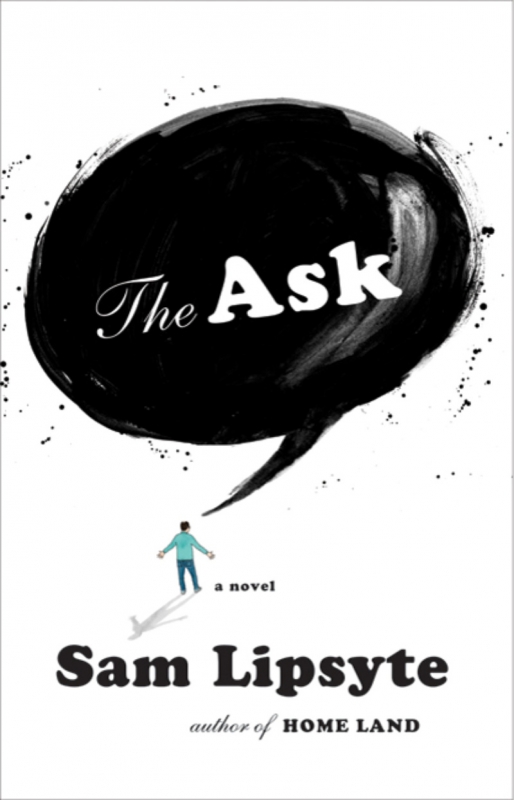
 

The Ask — Sam Lipsyte

I listened to the audiobook version of Sam Lipsyte’s hilarious, wistful, mean, and devastating novel The Ask last week. I invented chores and took any scenic route available when driving to get more of the book faster, frequently laughing out loud, or grimacing, or even feeling weird and shameful pangs of remorseful identification with the book’s protagonist and narrator, Milo Burke. I’m going to do my best to unpack the book’s themes–particularly the way it simultaneously eulogizes, valorizes, and mocks the American Dream–but first I need to get something out-of-the-way, a mea culpa of sorts.

As I mentioned, I listened to the book, but I don’t have a copy, so, shamefully, I can’t really quote any of Lipyste’s marvelous sentences. He is a master stylist, capable of zapping our dead modern idioms with the kind of alarming twists that highlight just how vacant language has become. Lipsyte also has a gift for rhythm, tone, and cadence, and he’s a master of the deadpan punchline. While the sentences in his last novel Home Land sometimes felt overly fussed over, straining under their own polish, The Ask showcases an effortless style that both seduces and repels. Lipsyte reads The Ask audiobook himself, yet lets the tone and cadence of his words dictate the tone and timbre of his voice. It’s all very good. And you’ll have to just take my word for all that as I have nothing to quote now (I’m sure I’ll re-review the book when I pick it up in paperback, though).

The plot is rather thin: Milo Burke, who once aspired to being a celebrated painter, now works for the grants department of a mediocre liberal arts college. His job, essentially, is to beg wealthy parents and alumni to donate massive gifts of cash to the school — this is “the ask.” Or rather, that was his job before he got fired for losing his cool with the spoiled brat daughter of a major patron. This leaves Milo moping around Queens, drinking too much, and pissing off the wife he is slowly becoming estranged from. Which is a shame, because he’s trying to be a good husband and father to his young son; despite his own shitty childhood–boozing, philandering father, emotionally absent mother–Milo is doing his best to give his family the American Dream. He’s more or less abandoned his own dreams of being a painter, and along with it, the weird faith he located in the various theorists–Marxists, feminists, deconstructionists, etc.–who informed his art school years. Much of the novel finds Milo pondering not just on the value (or lack thereof) in his liberal arts education, but also on the friends and anti-friends who he slummed with in those days. Just as the narrator of Home Land dwells on his high school days, Milo Burke can’t quit thinking about his college years in The Ask.

That past returns in the form of Purdy, a rich kid who slummed with Milo and his druggy art kid friends back in their college days. Purdy is incredibly wealthy even after the stock market crashes of the late 2000s, and has Milo specifically reinstated by the university to officiate an intended “give” (the answer to “the ask”). Purdy’s real intention though is to turn Milo into a kind of bag man, a go-between to deliver large sums of cash to Purdy’s caustically embittered illegitimate son Don, an Iraq War vet who’s lost both his legs to an IED. This arrangement thrusts Milo into Purdy’s surreal world of privilege and power, but also puts him into contact with a deranged, maimed, and deeply, deeply hurt young man who will, essentially, change the way that he examines the world and his role in it.

I’m now going to gloss over much of the book: there are many, many very funny situations, strange characters, and wonderful little insights. And now that theme I mentioned: the death of the American Dream.

Late in the novel, Milo calls America “Dead America.” Earlier in the novel, he complains that America never got to be Rome; that America is a dying, crumbling empire that never even got to revel in its hedonist excesses. Milo is keenly aware that his own white, white-collar, privileged, urban existence as a liberal-arts-educated American puts him in a position of greater material comfort than 99.9% of the rest of the people in the world, yet this fact does nothing to assuage his despair–in fact, it exacerbates it. Milo is ashamed of his despair, too-cognizant of its implications. His shame becomes a meta-, self-referential shame, and it leads to Milo essentially surrendering any power or agency he might have claimed in the universe. His liberal arts education and his own sensitivities render him feckless and bitter, always grumbling over the cosmic injustice of modern, Dead America. He is a walking, rambling critique of power, yet–as his wife likes to point out–he never does anything about the injustice he perceives. It’s only after interacting with Don that Milo begins to see an inroad to agency.

Don is, it must be said, a miserable, caustic human being, a racist blackmailer, and perennially cruel to anyone who extends a hand. He’s also performed the most real “give” in the novel–he’s lost his legs for Dead America, sacrificing his own mobility and freedom (those constituents of the dream) for the freedom of others, or at least for the illusion of other people’s freedom. Don’s toxic behavior makes him utterly repellent and thoroughly anti-heroic, but in Milo’s identification with the young man–and in Milo’s willingness to lose financial security and familial stability by essential siding with Don over Purdy– there is a glimmer (just a glimmer) of redemption and agency for Milo. Don embodies everything about America that Milo (and presumably Lipsyte) hates, yet he has also answered “the ask,” both literally and symbolically. The novel invokes then not just scathing ironic attack on the American Dream, but also a pity that reveals an intrinsic (and perhaps childish) wish to believe, a wish to make Dead America live again. The novel ends with Milo reclaiming (or maybe just claiming) some degree of agency, beginning with getting back an old war knife his father had given him, a clear symbol of paternal, phallic power (the kind that his liberal arts education told him was bad, bad, bad). And yet there’s no resolution, no pat answers–how could there be? Instead, the novel ends in another crisis–not Milo’s this time, but Don’s. But I won’t spoil that, because, hey, you’re going to read this now, aren’t you? Very highly recommended.