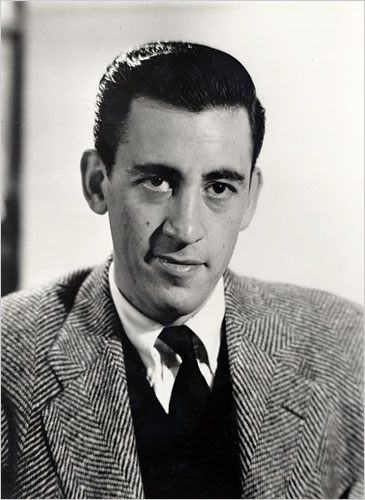
Here’s a recently unearthed photo of the famously reclusive author J.D. Salinger putting on his socks. Earth shattering! Now if we could only geta peek of Thomas Pynchon adjusting his bolo . . . (More info here).
Started a new audiobook: Hilary Mantel’s Wolf Hall, read competently by Simon Slater. Wolf Hall tells the familiar story of Henry VIII, only Mantel focuses (at least so far) mostly on Thomas Crownwell and Cardinal Wolsey. Most of the men in the story have the first name “Thomas.” I’m not particularly interested in the Tudor saga but I’m enjoying Mantel’s novel so far–its clean, precise style, its pacing, and, particularly Mantel’s sparing use of details. Historical novels sometimes succumb to the weight of the author’s passion with her subject. Thankfully, Mantel does not overload her prose with superfluity; instead she appoints detail in her narrative with care and precision, giving character and plot room to grow. Good dialogue too. More later.
I got a review copy of Adam Schwartzmann’s début novel Eddie Signwriter last week and haven’t had a good chance to read any of it until today. The novel tells the story of Kwasi Edward Michael Dankwa aka Eddie Signwriter, who journeys from his native Ghana to Senegal, and then to France, where he takes up a new life as an illegal immigrant in Paris. The story opens in a burst of action. Nana Oforwiwaa, a village elder has died and authorities are blaming Kwasi. So far, I find Schwarzmann’s prose a bit heavy. Sentences need pruning–too many redundant verbs and clauses in his sentences for my taste. Eddie Signwriter is better when Schwartzmann moves the narrative of young Kwasi along in shorter, declarative sentences. Eddie Signwriter is available now from Pantheon.
Great article in New York magazine by Roger Lathbury. “Betraying Salinger” details Lathbury’s attempt to publish J.D. Salinger’s last story, Hapsworth 16, 1924. Sad and strange. Here’s the first paragraph:
The first letter I got from J.D. Salinger was very short. It was 1988, and I had written to him with a proposal: I wanted my tiny publishing house, Orchises Press, to publish his novella Hapworth 16, 1924. And Salinger himself had improbably replied, saying that he would consider it.
If you haven’t heard any of Wizard People, Dear Reader, Brad Neely’s reimagining of Harry Potter and the Sorcerer’s Stone you should do so now. Download Neely’s audiobook (to be played concurrently with a version of the (muted) film) from Illegal Art. Neely’s revision of the first HP volume taps into the story’s primal, dark mythos; it’s hilarious. Neely’s writhing delivery sounds like a dead-on impression of Brad Dourif (particularly like Dourif’s Deadwood character, Doc Cochran). If you don’t want a full screening, YouTube is full of short, sweet solutions, like this one — “The Cribbage Match” —
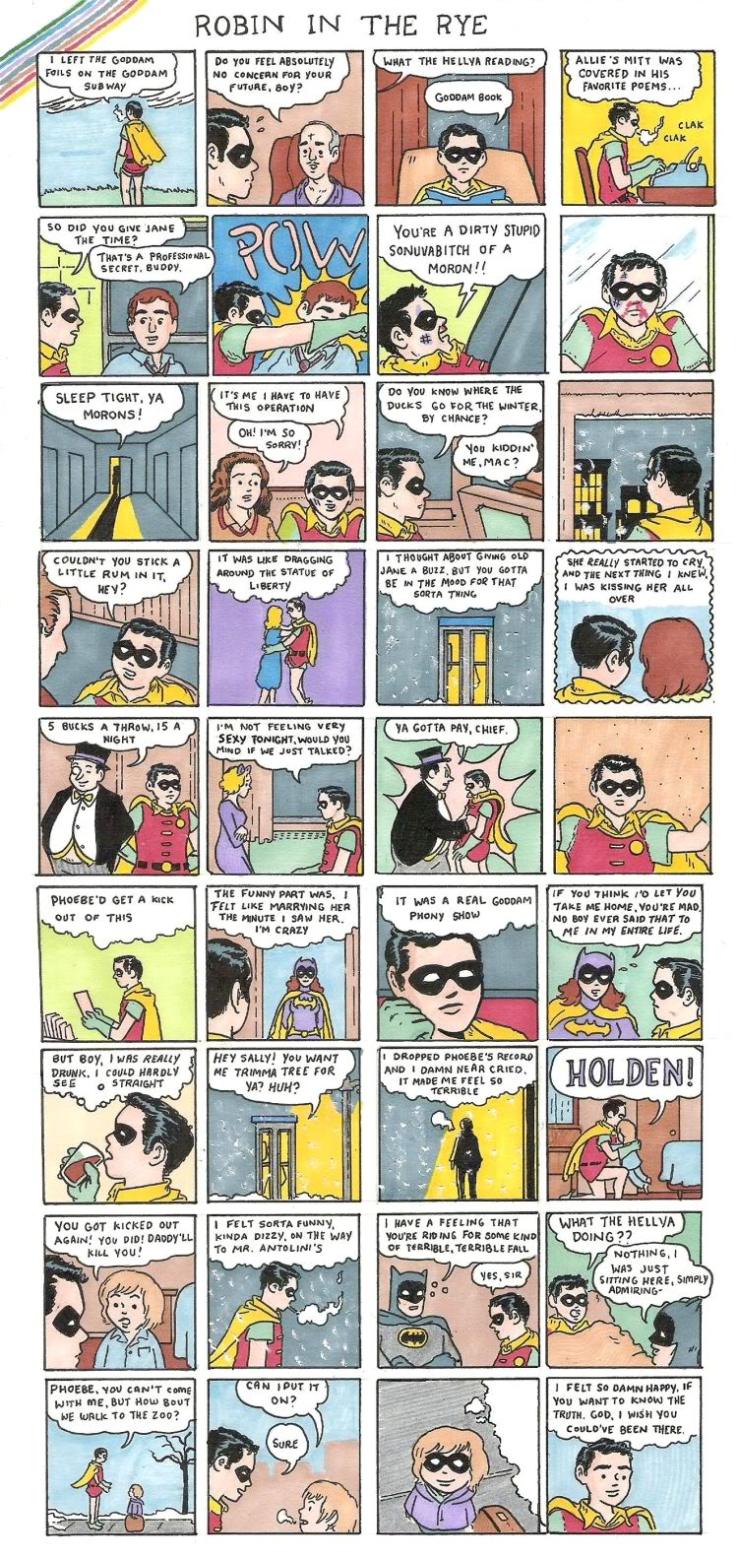
J.D. Salinger’s The Catcher in the Rye is a great read. It’s also a great way for a reader to measure how he or she has changed over the years. Like many (very, very many) readers, I cut my literary teeth onThe Catcher in the Rye. I was probably 15 when I first read the book and I sympathized wholly with Holden Caulfield. Like most teens, I was selfish and insular and thought that I was special and unique in my alienation. I was also pretty sure the world was filled with phonies and fakes, and I was determined not to become one of them when I grew up. I must’ve read it three or four times in high school, maybe more.
I was in college, maybe 19 or 20 when I read the book again. Oddly, or perhaps not oddly, I had converted (or masked) my cynicism–always an unearned pose of world-weariness for a teen–into a resolute idealism (the earnestness of which was always undercut by a generational infection of irony, of course). I could now peer into Catcher‘s great irony; I could see that Holden was a big phony too, maybe the biggest in the novel, that he was as cruel as anyone else in the book, and that his obsession with the innocence of youth was not a virtue but a sort of blindness, an ideological defense mechanism rooted in adolescent wish fulfillment. In fact, as an undergrad I begin to see the underlying themes of pedophilia that permeated Salinger’s work. They were minor and covert, to be sure, but also a bit unsettling. I’m sure I read at least twice in college, once for an English class and once on my own. I might’ve read it more than twice.
I read the book again in my mid-twenties, inspired perhaps by Will Smith’s monologue in the film adaptation of John Guare’s play Six Degrees of Separation. Here’s the monologue, where Smith’s character (who, spoiler, turns out to be a big phony) tries to explain why so many psychos and killers find justification for their mad agendas in Catcher:
At this point, I was detached enough from my own teen years to be somewhat disturbed by Holden’s behavior. I found him arrogant and clueless and largely unsympathetic. It was the end of the novel in particular that pointed toward psychopathic tendencies: Holden’s wish to “catch” all the kids who will “fall” from innocence, purity, spontaneity, whatever–this looked more to me now like a symptom of narcissistic personality disorder than the mark of tragic hero. I haven’t read the book since then.
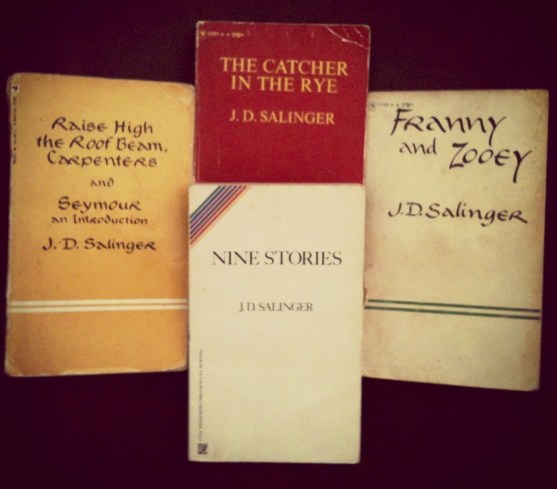
Now that Salinger’s dead, like many fans, I’m excited. I’m excited to see what’s been stacking up in Salinger’s retreat in Cornish all these years. Given the inscrutability of later work like Seymour: An Introduction and the fact that Salinger wrote solely for his own pleasure in later years, it’s difficult to even imagine what the unpublished work will look like–if we even get to see it. In any case, it seems unlikely that any posthumous work of Salinger’s will ever penetrate the national literary consciousness (and conscience) the way Catcher has. I have a stack of galleys by my bed that measures close to four feet, but I think I’m going to put aside some time to see how Catcher measures up after all these years–or, rather, how I measure up to it.




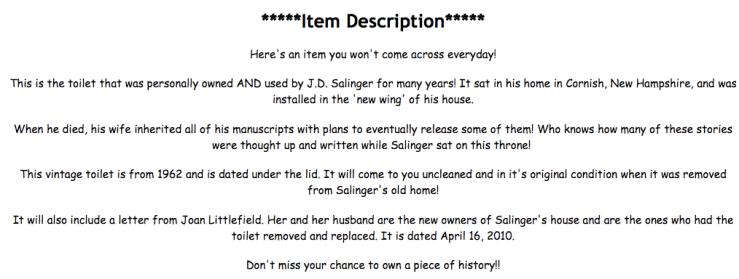 “It will come to you uncleaned”? Wow.
 Started a new audiobook: Hilary Mantel’s Wolf Hall, read competently by Simon Slater. Wolf Hall tells the familiar story of Henry VIII, only Mantel focuses (at least so far) mostly on Thomas Crownwell and Cardinal Wolsey. Most of the men in the story have the first name “Thomas.” I’m not particularly interested in the Tudor saga but I’m enjoying Mantel’s novel so far–its clean, precise style, its pacing, and, particularly Mantel’s sparing use of details. Historical novels sometimes succumb to the weight of the author’s passion with her subject. Thankfully, Mantel does not overload her prose with superfluity; instead she appoints detail in her narrative with care and precision, giving character and plot room to grow. Good dialogue too. More later.
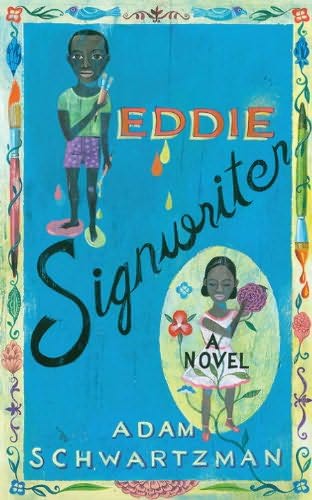 I got a review copy of Adam Schwartzmann’s début novel Eddie Signwriter last week and haven’t had a good chance to read any of it until today. The novel tells the story of Kwasi Edward Michael Dankwa aka Eddie Signwriter, who journeys from his native Ghana to Senegal, and then to France, where he takes up a new life as an illegal immigrant in Paris. The story opens in a burst of action. Nana Oforwiwaa, a village elder has died and authorities are blaming Kwasi. So far, I find Schwarzmann’s prose a bit heavy. Sentences need pruning–too many redundant verbs and clauses in his sentences for my taste. Eddie Signwriter is better when Schwartzmann moves the narrative of young Kwasi along in shorter, declarative sentences. Eddie Signwriter is available now from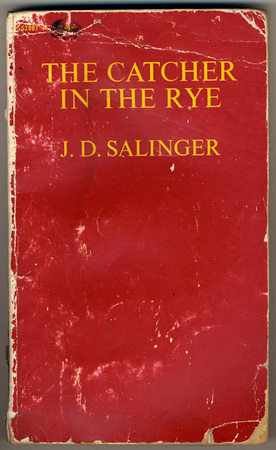
 Biblioklept