
J.T. LeRoy, James Frey, Herman Rosenblat, Margaret Seltzer . . . recent years have seen an explosion of memoirists lying, faking, or otherwise hoaxing the public—but this is hardly anything new. In honor of April Fool’s Day we present seven April Fools.
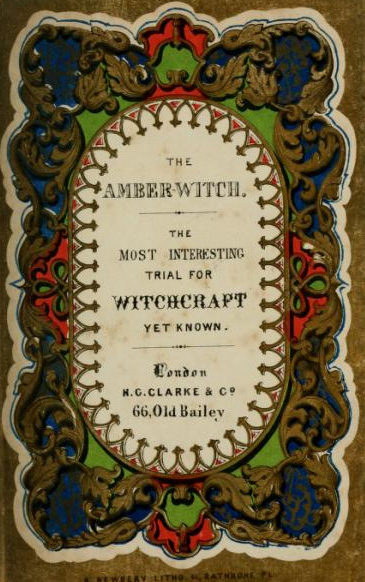
The Amber Witch — Johannes Wilhelm Meinhold (1844)
Meinhold pretended that The Amber Witch was the true story of a seventeenth-century minister’s daughter falsely accused of witchcraft. Meinhold claimed he found the minister’s manuscript in the refuse of an old church. When the book received critical attention, Meinhold admitted to the hoax, but audiences didn’t believe him at first.

“Geraint the Blue Bard” aka Iolo Morganwg aka Edward Williams (1747-1826)
Welshman Edward Williams was widely considered a leading antiquarian and expert on the antiquities of the British Isles. After his death, however, many of his manuscripts were revealed to have been forgeries, including those produced by “Geraint the Blue Bard,” supposedly a ninth-century composer. Oh well.
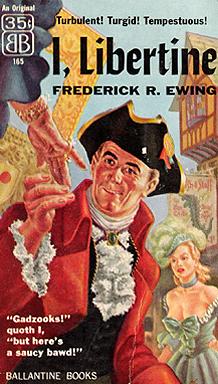
I, Libertine — Frederick R. Ewing (1956)
Proto-shock jock Jean “Shep” Shepherd perpetrated I, Libertine as a purposeful hoax. He told his radio audience to demand the (non-existent) book by the (non-existent) author “Frederick R. Ewing” from their local booksellers, and even fabricated a basic plot for listeners to in turn relate (he even included the salacious detail that the book had been banned in Boston). Publisher Ballantine hired sci-fi scribe Theodore Sturgeon to write the book from Shepherd’s outline, and the book was published very soon after. All proceeds went to charity.

Naked Came the Stranger — Penelope Ashe (1969)
To prove that American culture was smutty and degraded, Newsday columnist Mike McGrady enlisted 24 of his fellow writers to write a smutty and degraded novel that they believed would top the bestseller list in spite of its lack of literary value. By the time “Penelope Ashe” had put out Naked Came the Stranger, the hoax had leaked, and it was unclear if this is what led to the book actually topping the New York Times bestseller list (for one slim week). The book later became the basis of a porno film.
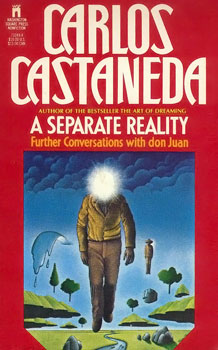
A Separate Reality — Carlos Castaneda (1971)
The debate around Castaneda’s series of “memoirs” in some ways gets to the heart of the problems of truth and invention, facts and authenticity, experience and memory. Castaneda claimed that he trained under Don Juan Matus, a Yaqui Indian sorcerer. Part of that training included taking massive amounts of psychotropic drugs like peyote as a means to “see” the energy of the universe. Don Juan Matus’s actual existence is questionable at best, but hey, when you’re doing large quantities of peyote, who knows what, like, truth is, man.
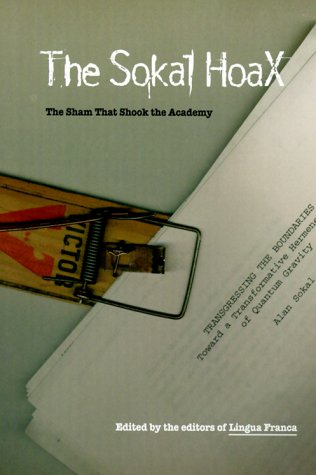
“Transgressing the Boundaries: Towards a Transformative Hermeneutics of Quantum Gravity”– Alan Sokal (1996)
Disgusted with a perceived slackness and ineptitude in modern academia, Dr. Alan Sokal published a paper full of nonsensical gibberish in Duke University’s cultural studies journal Social Text. The same day the essay was published, he announced the hoax in the journal Lingua Franca. Ouch. Biblioklept wrote a post about the incident a few years ago, if you’re interested.

The Songs of Bilitis — Pierre Louÿs (1894)
Louÿs claimed that the erotic poems he fabricated were the work of “Bilitis,” one of Sappho’s lovers; he even invented a biography of the woman, citing a fictional archaeologist named Herr G. Heim with discovering her tomb. (“Herr G. Heim” translates roughly to “Lord S. Ecret”). Despite the hoax, many critics consider it a work of literary merit, and it’s become something of a cult book among queer theory enthusiasts.
[Biblioklept originally published this post in 2010].
 It’s sort of like those kids who had pet monkeys when you were in elementary school, always someone’s cousin, or their neighbor’s friend from another school; sometimes the story was accompanied by a thumbprint-smudged Polaroid of the creature, clutching lovingly to some human torso. But did you ever actually see it? No never. Not once. And anyone who says they did is part of the conspiracy. Sure, maybe somewhere in Mexico someone has a monkey for a pet, but not here, no way, and certainly not your cousin. And look, I agree that it’s a weird thing to lie about, but that’s part of what makes good liars good, it’s some sort of weird emotional long-con that you are complicit in by listening to them.
 So, I’m thinking this thing goes deep, deeper than any of us ever imagined. Obviously Dave Eggers is involved somehow, either as the mastermind behind the whole thing, or just another pawn like the rest of us. I emailed Mr. Heartbreaking Jerk himself, asking if even he of all people can claim to have actually read all of Rising Up and Rising Down, and in return I received an auto-reply, something about the volume of emails he receives blah blah blah—the point is I think I scared him, and now I know I’m on the right trail . . .
 Biblioklept