Read “The Candy Country,” a strange tale by Louisa May Alcott

“The Candy Country”

by

Louisa May Alcott


“I shall take mamma’s red sun umbrella, it is so warm, and none of the children at school will have one like it,” said Lily, one day, as she went through the hall.

“The wind is very high; I’m afraid you’ll be blown away if you carry that big thing,” called Nurse from the window, as the red umbrella went bobbing down the garden walk with a small girl under it.

“I wish it would; I always wanted to go up in a balloon,” answered Lily, as she struggled out of the gate.

She got on very well till she came to the bridge and stopped to look over the railing at the water running by so fast, and the turtles sunning themselves on the rocks. Lily was fond of throwing stones at them; it was so funny to watch them tumble, heels over head, splash into the water. Now, when she saw three big fellows close by, she stooped for a stone, and just at that minute a gale of wind nearly took the umbrella out of her hand. She clutched it fast; and away she went like a thistle-down, right up in the air, over river and hill, houses and trees, faster and faster, till her head spun round, her breath was all gone, and she had to let go. The dear red umbrella flew away like a leaf; and Lily fell down, down, till she went crash into a tree which grew in such a curious place that she forgot her fright as she sat looking about her, wondering what part of the world it could be.

The tree looked as if made of glass or colored sugar; for she could see through the red cherries, the green leaves, and the brown branches. An agreeable smell met her nose; and she said at once, as any child would, “I smell candy!” She picked a cherry and ate it. Oh, how good it was!—all sugar and no stone. The next discovery was such a delightful one that she nearly fell off her perch; for by touching her tongue here and there, she found that the whole tree was made of candy. Think what fun to sit and break off twigs of barley sugar, candied cherries, and leaves that tasted like peppermint and sassafras!

Lily rocked and ate till she finished the top of the little tree; then she climbed down and strolled along, making more surprising and agreeable discoveries as she went.

What looked like snow under her feet was white sugar; the rocks were lumps of chocolate, the flowers of all colors and tastes; and every sort of fruit grew on these delightful trees. Little white houses soon appeared; and here lived the dainty candy-people, all made of the best sugar, and painted to look like real people. Dear little men and women, looking as if they had stepped off of wedding cakes and bonbons, went about in their gay sugar clothes, laughing and talking in the sweetest voices. Bits of babies rocked in open-work cradles, and sugar boys and girls played with sugar toys in the most natural way. Carriages rolled along the jujube streets, drawn by the red and yellow barley horses we all love so well; cows fed in the green fields, and sugar birds sang in the trees.

Lily listened, and in a moment she understood what the song said,—

“Sweet! Sweet!
Come, come and eat,
Dear little girls
With yellow curls;
For here you’ll find
Sweets to your mind.
On every tree
Sugar-plums you’ll see;
In every dell
Grows the caramel.
Over every wall
Gum-drops fall;
Molasses flows
Where our river goes.
Under your feet
Lies sugar sweet;
Over your head
Grow almonds red.
Our lily and rose
Are not for the nose;
Our flowers we pluck
To eat or suck.
And, oh! what bliss
When two friends kiss,
For they honey sip
From lip to lip!
And all you meet,
In house or street,
At work or play,
Sweethearts are they.
So, little dear,
Pray feel no fear;
Go where you will;
Eat, eat your fill.
Here is a feast
From west to east;
And you can say,
Ere you go away,
‘At last I stand
In dear Candy-land,
And no more can stuff;
For once I’ve enough.’
Sweet! Sweet!
Tweet! Tweet!
Tweedle-dee!
Tweedle-dee!”

“That is the most interesting song I ever heard,” said Lily, clapping her sticky hands and dancing along toward a fine palace of white cream candy, with pillars of striped peppermint stick, and a roof of frosting that made it look like the Milan Cathedral.

“I’ll live here, and eat candy all day long, with no tiresome school or patchwork to spoil my fun,” said Lily.

Continue reading “Read “The Candy Country,” a strange tale by Louisa May Alcott”

Little Women (The Far Side)

lw

Some content on this page was disabled on June 29, 2021 as a result of a DMCA takedown notice from Andrews McMeel Universal. You can learn more about the DMCA here:

https://wordpress.com/support/copyright-and-the-dmca/

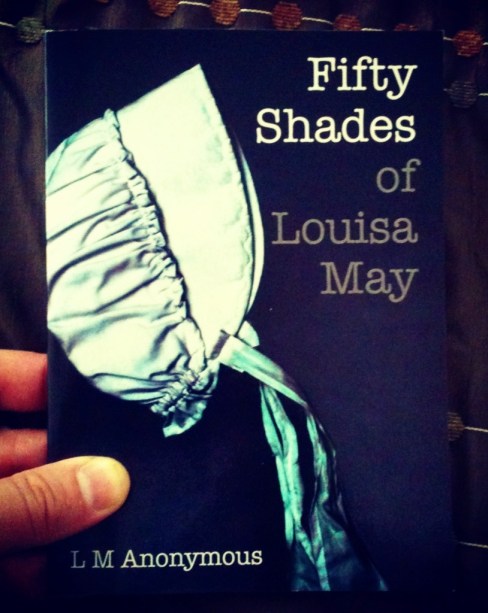
Fifty Shades of Louisa May: A Loving Biography Masquerading as a Smutty Novelty Book

20120818-173921.jpg

Fifty Shades of Louisa May by L.M. Anonymous, is , to all appearances, the kind of cheeky send-up that E.L James’s Fifty Shades of Grey hardly deserves. Satire has the strange, paradoxical power to somehow dignify its target after all, or at least point out how the thing being satirized is, you know, worth actually talking about. However, Louisa May has no proximity to Fifty Shades of Grey, other than the window dressing of its cover and its title, both of which exist somewhere on the thin line between clever and crass. Sure, Louisa May has its share of sex scenes (most are more ridiculous than erotic), but this slim little book is, at its core, really a loving biography of novelist Louisa May Alcott.

The conceit is that Alcott, dipping into her secret vice of a midnight bottle of Madeira, decides to a pen a memoir (that she intends to burn) of her “carnal episodes, some amusing, others touching, but all rife with the sighs and heavings of Love’s labours.” (How the “X-rated woodcuts” that accompany each chapter made their way into the book remains unclear; I suspect that they follow the tradition established in the mashup Pride and Prejudice and Zombies). Organized roughly around Alcott’s difficult life with her transcendentalist parents and their transcendentalist friends, each chapter of Louisa May culminates in an erotic episode, albeit one that our heroine usually witnesses as voyeur and not participant. These episodes tend to involve other transcendentalist figures. In one inspired vignette, Louisa May sneaks out of her house to follow Herman Melville to the Old Manse, where she watches him watch Sophia and Nathaniel Hawthorne get it on:

I heard a small groan from Mr. Melville’s beech tree and saw that his own garments now circled his ankles and he was busily engaged in the art of Onan, his slitted eyes on his mentor, beard shivering with concentration. I looked away quickly—even in my youth I knew that such solitary activity must remain unwitnessed.

The Hawthornes let out a quivering scream, Nathaniel’s voice as high pitched as his wife’s as he rose from his chair to finish the work that his wife had begun. Thus spent, Sophia lay back in his arms. The ever-fastidious Mr. Hawthorne reached out with one hand to set to reordering his manuscript pages.

Mr. Melville let out a low hoot and sent a frothy fusillade across the yard to strike the windowglass with a furious splash.

“Look, my Dove, it appears to be raining,” Sophia said.

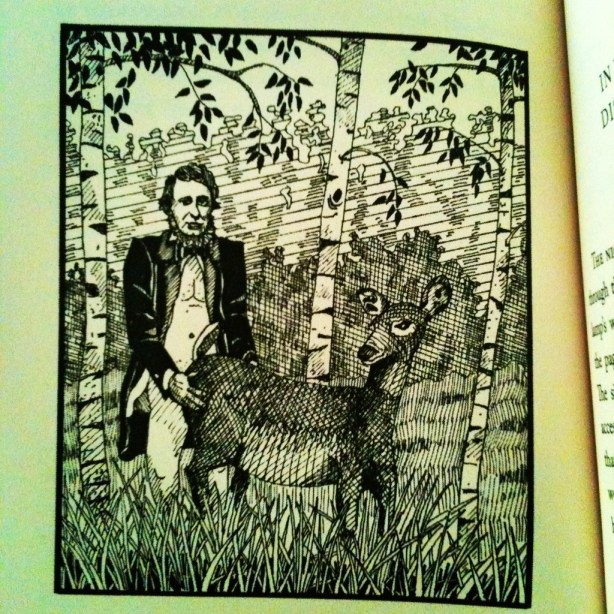
The episode is obviously more comical than erotic, its style—indeed the style of the entire book—a strange mashup of Alcott’s own rhythms and the diction of Victorian smut. There’s something joyously silly in the way L.M. Anonymous throws together various transcendentalists into would-be erotic interludes; when our heroine describes Fruitlands founder Charles Lane jacking off by moonlight, the whole thing feels like a big dirty in-joke for those of us who love this period of American history and literature. And sure, the jokes can be very crude—here’s Henry David Thoreau, nature lover:

20120818-173927.jpg

L.M. Anonymous (“a well-known writer who prefers the cloak of anonymity to the vulgar embrace of rude fame,” according to the back of the book) seems to know his/her history (and attending rhetorical styles) fairly well. I’d have to guess that the author is, if not an Alcott scholar, then at least a passionate enthusiast—because what stands out most about Fifty Shades of Louisa May isn’t the smut but the internal conflicts of our narrator Louisa May.

In Anonymous’s imagination, Alcott is an embittered soul who has never forgiven her father for his foolishness, nor gotten over the fact that she’s the sole source of income for the Alcotts. She badmouths her books as unserious trash, bemoaning that she could do more:

Too often I have found myself diminished by the company of Famous Men to praise them. Had I been but relieved of the burden of supporting the entire legions of Alcotts with my earnings, I could have written novels and poems to equal their best—of that I am most confident. Instead of greatness, I lingered at the Trough of Rubbish too long, achieving only a shining of tin, not the glimmering of gold. But it is too late for me to be concerned with such matters. Time sorts out all writers, revealing each for what they truly were. I only hope that I shall be remembered as much for what I did not achieve as for what I did.

There’s so much tenderness here: Anonymous’s love and respect for his/her subject is plain. The author also seems to write through the book, through the narrator in this passage, as if acknowledging, in some metatextual move, the book’s own novelty status, pointing out that the book, a shaky Grey cash-in, is in some way a part of the Trough of Rubbish, but also that there’s more here too.

I read Fifty Shades of Louisa May in one short sitting, and found it at times amusing, if not especially erotic. I was prepared to to write it off as a silly novelty book—which perhaps it is—but there’s also a real love—and understanding—for Louisa May Alcott that comes through here. Who is it for? I’m not really sure. I’m going to guess that Fifty Shades of Grey fans will be disappointed, and fans of Little Women and its sequels will find their beloved tome trashed by Alcott herself (or at least her character). The book might work best as a primer to the American Renaissance, although I’m not sure which professor would be brash enough to stick this on her syllabus. My hope would be that Grey fans might find in Louisa May an inroad into better writers; at minimum though, they’ll at least be exposed to prose far superior to E.L. James’s trough of rubbish.

Fifty Shades of Louisa May is new in trade paperback from OR Books.