
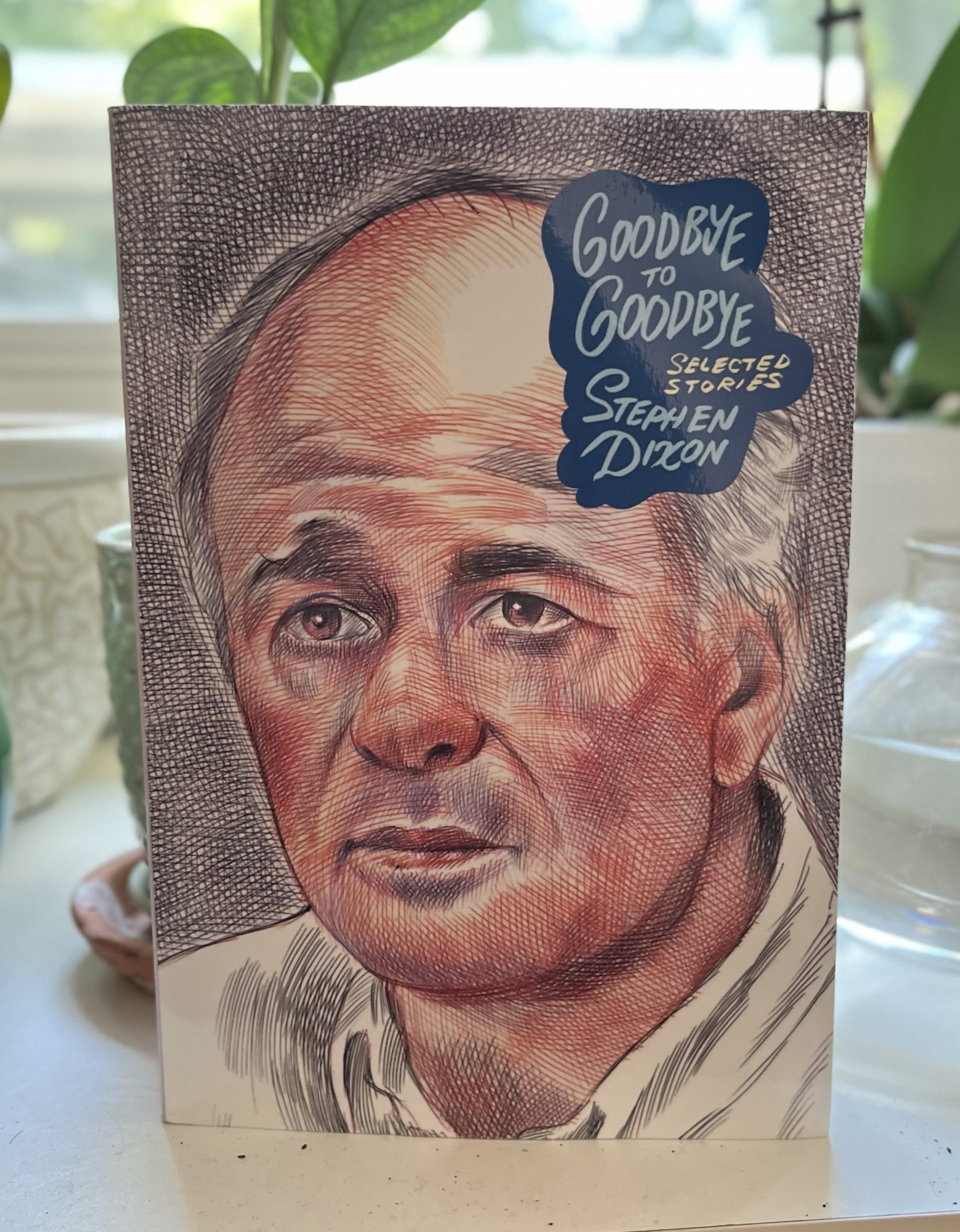
A beleaguered author attempts to reconstruct his stolen story. A father leaps from an airplane after his falling daughter. A son steals a book of Emily Dickinson’s poems on the way to his mother’s burial. These are some of the things that happen (or fail to happen) in Goodbye to Goodbye, a new compilation of Stephen Dixon’s greatest (non)hits. Dixon’s stories begin, double back, correct themselves, discard their endings, and sometimes deny that the events they have just narrated occurred at all.
There are writers’ writers, and then there is Stephen Dixon, a writer’s writer’s writer: an author other authors discover, puzzle over, envy, and use to enlarge their sense of what fiction can do. In his introduction to the volume, novelist J. Robert Lennon recalls that The Stories of Stephen Dixon renewed his “flagging faith in the short story form” and began his “lifelong love affair” with Dixon’s work. “Brashly innovative, bracingly frank, deliriously comic,” the stories changed Lennon’s idea of what a short story could be.
Yet “writer’s writer” can misleadingly suggest work that is difficult, obscure, even academic. No! Dixon’s experiments grow from familiar experiences: falling in love, losing one’s temper, caring for a sick spouse, worrying about a child, enduring humiliation, remembering the dead, or struggling to finish a story. His fiction offers what Dixon’s biographer Matthew Petti aptly declares in his foreword a “unique brand of no-relief relief.” Dixon identified “failure and loss” as his two great themes because “Everybody fails and everybody loses. And when you recognize that, you have a little more compassion for everybody else.” The relief comes from recognizing failure and loss as common experiences and from the compassion that that recognition makes possible.
Goodbye to Goodbye is a rich introduction to Dixon’s fiction. Its stories span Dixon’s six-decade career, beginning with his first published story, “The Chess House,” and extending through late works in which grief, memory, domestic routine, and writing become nearly indistinguishable. The collection shows Dixon’s methods evolving even while his obsessions persist. From the incompatible chessboards of “The Chess House” to the revised bereavements of the final stories, his characters try to make language embrace a slippery reality that will not remain still.
Dixon’s fiction is hard to categorize, and when folks try to do so they’ll likely file him under “E” for Experimental or “P” for Postmodern. But his work tends to operate on a smaller, more intimate scale than the encyclopedic, often labyrinthine fiction associated with fellow late-twentieth century modernists like John Barth, Thomas Pynchon, or Don DeLillo. Rather than building elaborate systems that (attempt to) absorb history, science, technology, etc., Dixon concentrates on the unstable distance between thought and speech, memory and revision, love and irritation.
A more useful writerly comparison may be the cranky Austrian sentence-slinger Thomas Bernhard. In both writers, repetition creates momentum rather than stasis. A statement prompts a qualification; the qualification produces an objection; the objection demands a correction; the correction returns the speaker to an altered form of the original statement. Bernhard’s repetitions often build monumental denunciations. Dixon’s expose vulnerability, tenderness, embarrassment, grief, desire, and self-deception. His characters circle an experience because they cannot leave it alone and because each circuit reveals something the previous one concealed.
Consider: “I’ve written about this before. But maybe I missed something,” the narrator announces at the beginning of “Intermezzo.” He recalls arriving at his future wife’s apartment and hearing her play a Brahms intermezzo from the hallway. Almost nothing happens: he listens, rings the bell, receives a smile, a hug, and a kiss, and goes inside for tea and cookies. But remembrance is not retrieval:
I didn’t use the door key to get into her apartment. I’d put the key ring back in my pants pocket while I was listening to her play. Then she opened the door for me. Big smile happy to see me, and we kissed and hugged before we closed the door. I asked and she told me what she’d been playing—“I’ve just begun to learn it, so I’m not very good at it yet and probably never will be”—and what key and opus it was. She opened the door for me because I rang the bell. I rang it after she stopped playing—maybe a minute after, because I thought if she was going to play more of that piece, if there was more to it, or something else, then I wanted to hear it for a while outside her door.
Our narrator’s hesitation at the threshold comes with more qualifications. He thinks he waited “maybe a minute”; he repeats the possibility that there was more of the piece, “or something else.” The memory breaks into questions about the elevator, the doorman, and the music itself. Details seem to promise a firmer accounting of the moment, but none can pin it down. Memory may preserve the details of a meaningful experience, but the act of recalling it brings the past into contact with the present mind. Dixon brings the experience alive for his readers by showing the mind revising it. But it’s all a slippery business.
This slippery, recursive logic makes Dixon’s prose addictive to a certain stripe of reader (me). Sentences tangle out, promising to settle a matter, a moment, a memory, but instead twist open into new corridors. Dixon’s narrators assert, qualify, imagine objections, answer them, and reconsider whether the original assertion was even accurate in the first (second third fourth) place. His spare but precise vocabulary belies his complex syntax. Sentences wriggle into rills of suspense: what will the mind say next to evade, clarify, contradict, or deepen what it has just said? In “Photos,” a widower tells himself, “I have to put a stop to this. This has to stop,” while preparing to throw away photographs of his dead wife, an action he knows he may can will might could reverse (p. 339). His repetition expresses resolve but proves that resolve inadequate.
Dixon’s stories often seem not to exist before their telling. “I’ve never tried this before and it won’t be easy,” begins “The Lost Story,” in which a writer’s only copy of a completed manuscript has been stolen from his car. He tries to reconstruct it, but his recollections become entangled with a dream, his wife’s illness, and his attempts to produce a replacement.
“The Lost Story” is not the recovered manuscript; rather, it records that manuscript’s failure to return. The narrator recalls fragments, rejects his reconstructions, invents new openings, and then abandons them. The lost story generates the surviving one. He’s gotta slam out a draft as though he does not know what will happen next, he explains, until “the story, in a single sitting, comes to a quick natural stop.” He immediately qualifies the explanation: “Something like that. I’m not good about explaining these things, knowing why I do them and how it all works.” All he knows is that “it all has to come out in a rush.” All the herky-jerky hesitations, corrections, and false starts end up being the story of the lost story. The debris is the artifact. Near the story’s end, another possible beginning occurs to the narrator and he writes it on a piece of paper: “He should stop writing about his wife.”
“Said,” by contrast, conducts its experiment through subtraction. Dixon depicts a violent domestic incident and its aftermath while removing the characters’ spoken words, retaining only dialogue tags and actions:
He said, she said.
She left the room, he followed her.
He said, she said.
She locked herself in the bathroom, he slammed the door with his fists.
He said.
She said nothing.
He said.
He slammed the door with his fists, kicked the door bottom.
She said, he said, she said.
He batted the door with his shoulder, went into the kitchen, got a screwdriver, returned and started unscrewing the bathroom doorknob.
She said.
Dixon’s deleting dialogue denies readers the furniture we might easily rest on in a more conventional story — accusations and defenses, explanations and apologies. Speech is active, but its content has vanished. Our plain ol’ vanilla verb said rings ominously, a blunt beat carrying the exchange toward the threat of violence. The omissions also expose how little dialogue might actually explain. We know that the characters argue, that their exchange escalates, yet no imagined dialogue could fully explain the violence that follows. At the same time, the absent words force the reader to actively construct the scene. We reach for a phrase that might fit like a puzzle piece, clumsily thumb it forward, replace it, and then recognize that no linguistic placeholder can stabilize emotional reality. Much of Dixon’s fiction accumulates language until consciousness becomes almost unbearably present. “Said” reaches a similar intensity by taking language away.
Other stories expose their construction through different means. “Detours” moves among first, third, and second person as its narrator writes about an angry outburst directed at his family. Point of view becomes a shifting moral distance from the self. “In This One” tries to exclude Dixon’s recurrent materials: no dying wife, no illness, no familiar domestic grief, no repetition. Each prohibition simply reintroduces what it would seek to forbid. “Finding an Ending” cannot finish one story, recalls another unfinished story, and converts the inability to conclude into another beginning. These stories seem to create themselves on the page because Dixon makes composition part of their form. A narrator begins, revises, rejects a version, and tries again; each failure supplies material for the next attempt. The finished story retains this process instead of concealing it, allowing readers to watch a mind make and remake its account as it slips along. The narrators’ revisions also allow readers to imagine versions of themselves capable of surviving what happened, what might have happened, or what they fear will happen.
The same impulse to revise the past sends Dixon’s characters into imagined futures — usually doomed, or at least quite negative. His characters manufacture accidents, deaths, abandonments, betrayals, and occasionally damned heroism. Consider “Flying,” which transmutes fatherly anxiety into a borderline magical realist episode. Here, parental love becomes the compulsion to follow the child into catastrophe. I’d jump out of a plane for you, my dear!
And there’s “Sleep,” where a widower remembers that one of his first thoughts upon realizing his wife was dead was, “Now I can sleep better.” Or perhaps it was “Now I can get some sleep.” Jesus Christ, what a line! And the story rewrites that line, that thought, searching for how its wording might match a greater moral significance. Exhaustion, devotion, guilt, grief and relief wrap into a strange gum of emotion. “The Note” converts a related fantasy into potential fiction when a widower discovers a message apparently written by his dead wife in his own handwriting. “What They’ll Find” imagines the narrator’s death through the household inventory his daughters will confront. Dixon’s negative imagination evinces chronic pessimism but also ecstatic love rehearsing infinite bereavement.
The same intensity that produces tenderness might produce anger. In “The Apology,” the father-narrator (so so many father-narrators in Dixon!) repeats: “I’m sorry for the way I acted before” again and again. The phrase mutates from apology to accusation to family joke to written reminder to inherited language before eventually precipitating a dispute over whether the father’s outbursts occurred as often as his daughter remembers. “I’m sorry for the way I acted before” changes with each repetition, but its recurrence proves that apology has done little to stop the behavior requiring it. “I’m sorry” isn’t a magic spell, a performative utterance. There are no magic words, only endless corrections.
Goodbye to Goodbye’s title track connects anger to fantasy and revision. A man repeatedly revises the story of his wife’s departure, inventing versions in which he recasts his aggression as proof of love and imagines winning her back. Each draft gets withdrawn: “That’s not the way it happened, of course”; “That’s not the way it happened either”; “That’s ridiculous also and never happened.” Our narrator’s authority skews closer to wish fulfillment and confession than mimetic representation. Each version of departure exposes the fiction of the previous version while moving closer to what the narrator cannot bear to say. Finally, his wife asks him to close the door so they will not have to say goodbye again. “I shut the door,” the story ends.
Goodbye to Goodbye begins with “The Chess House,” published in the Winter/Spring 1963 issue of The Paris Review, and samples each of Dixon’s six publishing decades, with particular attention to work published after 1994’s The Stories of Stephen Dixon. Early stories such as “Mac in Love” and “Love Has Its Own Action” turn romantic obsession into comic verbal escalation. A beautiful highlight, “Frog Dances,” follows a man’s longing for fatherhood through failed relationships until — well, look, I won’t spoil it. It’s a lovely story, true, earnest, heartfelt, wildly real even through its clear artifice of language. (Dixon’s postmodernism is wonderfully unfussy.) Dixon’s later stories return to familiar motifs: dead wife, grown children, aging writer, a page in the typewriter. Over the decades, a central method inheres: Dixon’s narrators (and characters) revise reality as they speak.
For readers who hear “writer’s writer” and assume difficulty, Goodbye to Goodbye offers a correction. Dixon is difficult only in the sense that life is difficult. I mean really fucking difficult, more difficult than words can pin down — living with others, controlling anger, raising children, caring for the ill, remembering the dead. Communication. But the reading itself is alarmingly easy to continue. Start here, but do not expect relief. Expect Dixon’s stranger pleasure: the feeling that a story is making itself on the page, one correction at a time. Highly recommended.

