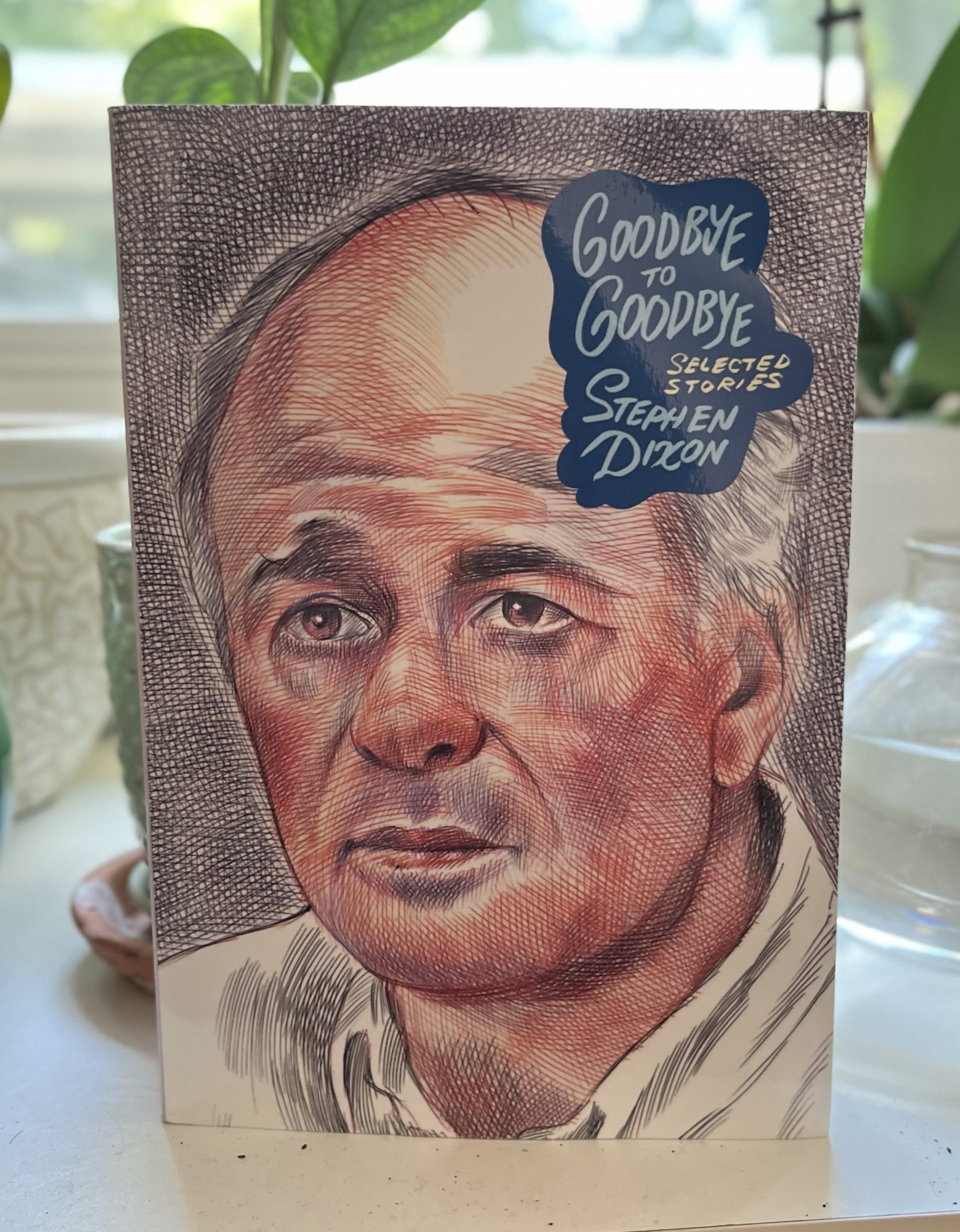
Goodbye to Goodbye makes a strong case for Stephen Dixon’s strange and humane art of storytelling

A beleaguered author attempts to reconstruct his stolen story. A father leaps from an airplane after his falling daughter. A son steals a book of Emily Dickinson’s poems on the way to his mother’s burial. These are some of the things that happen (or fail to happen) in Goodbye to Goodbye, a new compilation of Stephen Dixon’s greatest (non)hits. Dixon’s stories begin, double back, correct themselves, discard their endings, and sometimes deny that the events they have just narrated occurred at all.

There are writers’ writers, and then there is Stephen Dixon, a writer’s writer’s writer: an author other authors discover, puzzle over, envy, and use to enlarge their sense of what fiction can do. In his introduction to the volume, novelist J. Robert Lennon recalls that The Stories of Stephen Dixon renewed his “flagging faith in the short story form” and began his “lifelong love affair” with Dixon’s work. “Brashly innovative, bracingly frank, deliriously comic,” the stories changed Lennon’s idea of what a short story could be.

Yet “writer’s writer” can misleadingly suggest work that is difficult, obscure, even academic. No! Dixon’s experiments grow from familiar experiences: falling in love, losing one’s temper, caring for a sick spouse, worrying about a child, enduring humiliation, remembering the dead, or struggling to finish a story. His fiction offers what Dixon’s biographer Matthew Petti aptly declares in his foreword a “unique brand of no-relief relief.” Dixon identified “failure and loss” as his two great themes because “Everybody fails and everybody loses. And when you recognize that, you have a little more compassion for everybody else.” The relief comes from recognizing failure and loss as common experiences and from the compassion that that recognition makes possible.

Goodbye to Goodbye is a rich introduction to Dixon’s fiction. Its stories span Dixon’s six-decade career, beginning with his first published story, “The Chess House,” and extending through late works in which grief, memory, domestic routine, and writing become nearly indistinguishable. The collection shows Dixon’s methods evolving even while his obsessions persist. From the incompatible chessboards of “The Chess House” to the revised bereavements of the final stories, his characters try to make language embrace a slippery reality that will not remain still.

Dixon’s fiction is hard to categorize, and when folks try to do so they’ll likely file him under “E” for Experimental or “P” for Postmodern. But his work tends to operate on a smaller, more intimate scale than the encyclopedic, often labyrinthine fiction associated with fellow late-twentieth century modernists like John Barth, Thomas Pynchon, or Don DeLillo. Rather than building elaborate systems that (attempt to) absorb history, science, technology, etc., Dixon concentrates on the unstable distance between thought and speech, memory and revision, love and irritation.

A more useful writerly comparison may be the cranky Austrian sentence-slinger Thomas Bernhard. In both writers, repetition creates momentum rather than stasis. A statement prompts a qualification; the qualification produces an objection; the objection demands a correction; the correction returns the speaker to an altered form of the original statement. Bernhard’s repetitions often build monumental denunciations. Dixon’s expose vulnerability, tenderness, embarrassment, grief, desire, and self-deception. His characters circle an experience because they cannot leave it alone and because each circuit reveals something the previous one concealed.

Consider: “I’ve written about this before. But maybe I missed something,” the narrator announces at the beginning of “Intermezzo.” He recalls arriving at his future wife’s apartment and hearing her play a Brahms intermezzo from the hallway. Almost nothing happens: he listens, rings the bell, receives a smile, a hug, and a kiss, and goes inside for tea and cookies. But remembrance is not retrieval:

I didn’t use the door key to get into her apartment. I’d put the key ring back in my pants pocket while I was listening to her play. Then she opened the door for me. Big smile happy to see me, and we kissed and hugged before we closed the door. I asked and she told me what she’d been playing—“I’ve just begun to learn it, so I’m not very good at it yet and probably never will be”—and what key and opus it was. She opened the door for me because I rang the bell. I rang it after she stopped playing—maybe a minute after, because I thought if she was going to play more of that piece, if there was more to it, or something else, then I wanted to hear it for a while outside her door.

Our narrator’s hesitation at the threshold comes with more qualifications. He thinks he waited “maybe a minute”; he repeats the possibility that there was more of the piece, “or something else.” The memory breaks into questions about the elevator, the doorman, and the music itself. Details seem to promise a firmer accounting of the moment, but none can pin it down. Memory may preserve the details of a meaningful experience, but the act of recalling it brings the past into contact with the present mind. Dixon brings the experience alive for his readers by showing the mind revising it. But it’s all a slippery business.

This slippery, recursive logic makes Dixon’s prose addictive to a certain stripe of reader (me). Sentences tangle out, promising to settle a matter, a moment, a memory, but instead twist open into new corridors. Dixon’s narrators assert, qualify, imagine objections, answer them, and reconsider whether the original assertion was even accurate in the first (second third fourth) place. His spare but precise vocabulary belies his complex syntax. Sentences wriggle into rills of suspense: what will the mind say next to evade, clarify, contradict, or deepen what it has just said? In “Photos,” a widower tells himself, “I have to put a stop to this. This has to stop,” while preparing to throw away photographs of his dead wife, an action he knows he may can will might could reverse (p. 339). His repetition expresses resolve but proves that resolve inadequate.

Dixon’s stories often seem not to exist before their telling. “I’ve never tried this before and it won’t be easy,” begins “The Lost Story,” in which a writer’s only copy of a completed manuscript has been stolen from his car. He tries to reconstruct it, but his recollections become entangled with a dream, his wife’s illness, and his attempts to produce a replacement.

“The Lost Story” is not the recovered manuscript; rather, it records that manuscript’s failure to return. The narrator recalls fragments, rejects his reconstructions, invents new openings, and then abandons them. The lost story generates the surviving one. He’s gotta slam out a draft as though he does not know what will happen next, he explains, until “the story, in a single sitting, comes to a quick natural stop.” He immediately qualifies the explanation: “Something like that. I’m not good about explaining these things, knowing why I do them and how it all works.” All he knows is that “it all has to come out in a rush.” All the herky-jerky hesitations, corrections, and false starts end up being the story of the lost story. The debris is the artifact. Near the story’s end, another possible beginning occurs to the narrator and he writes it on a piece of paper: “He should stop writing about his wife.”

“Said,” by contrast, conducts its experiment through subtraction. Dixon depicts a violent domestic incident and its aftermath while removing the characters’ spoken words, retaining only dialogue tags and actions:

He said, she said.
She left the room, he followed her.
He said, she said.
She locked herself in the bathroom, he slammed the door with his fists.
He said.
She said nothing.
He said.
He slammed the door with his fists, kicked the door bottom.
She said, he said, she said.
He batted the door with his shoulder, went into the kitchen, got a screwdriver, returned and started unscrewing the bathroom doorknob.
She said.

Dixon’s deleting dialogue denies readers the furniture we might easily rest on in a more conventional story — accusations and defenses, explanations and apologies. Speech is active, but its content has vanished. Our plain ol’ vanilla verb said rings ominously, a blunt beat carrying the exchange toward the threat of violence. The omissions also expose how little dialogue might actually explain. We know that the characters argue, that their exchange escalates, yet no imagined dialogue could fully explain the violence that follows. At the same time, the absent words force the reader to actively construct the scene. We reach for a phrase that might fit like a puzzle piece, clumsily thumb it forward, replace it, and then recognize that no linguistic placeholder can stabilize emotional reality. Much of Dixon’s fiction accumulates language until consciousness becomes almost unbearably present. “Said” reaches a similar intensity by taking language away.

Other stories expose their construction through different means. “Detours” moves among first, third, and second person as its narrator writes about an angry outburst directed at his family. Point of view becomes a shifting moral distance from the self. “In This One” tries to exclude Dixon’s recurrent materials: no dying wife, no illness, no familiar domestic grief, no repetition. Each prohibition simply reintroduces what it would seek to forbid. “Finding an Ending” cannot finish one story, recalls another unfinished story, and converts the inability to conclude into another beginning. These stories seem to create themselves on the page because Dixon makes composition part of their form. A narrator begins, revises, rejects a version, and tries again; each failure supplies material for the next attempt. The finished story retains this process instead of concealing it, allowing readers to watch a mind make and remake its account as it slips along. The narrators’ revisions also allow readers to imagine versions of themselves capable of surviving what happened, what might have happened, or what they fear will happen.

The same impulse to revise the past sends Dixon’s characters into imagined futures — usually doomed, or at least quite negative. His characters manufacture accidents, deaths, abandonments, betrayals, and occasionally damned heroism. Consider “Flying,” which transmutes fatherly anxiety into a borderline magical realist episode. Here, parental love becomes the compulsion to follow the child into catastrophe. I’d jump out of a plane for you, my dear!

And there’s “Sleep,” where a widower remembers that one of his first thoughts upon realizing his wife was dead was, “Now I can sleep better.” Or perhaps it was “Now I can get some sleep.” Jesus Christ, what a line! And the story rewrites that line, that thought, searching for how its wording might match a greater moral significance. Exhaustion, devotion, guilt, grief and relief wrap into a strange gum of emotion. “The Note” converts a related fantasy into potential fiction when a widower discovers a message apparently written by his dead wife in his own handwriting. “What They’ll Find” imagines the narrator’s death through the household inventory his daughters will confront. Dixon’s negative imagination evinces chronic pessimism but also ecstatic love rehearsing infinite bereavement.

The same intensity that produces tenderness might produce anger. In “The Apology,” the father-narrator (so so many father-narrators in Dixon!) repeats: “I’m sorry for the way I acted before” again and again. The phrase mutates from apology to accusation to family joke to written reminder to inherited language before eventually precipitating a dispute over whether the father’s outbursts occurred as often as his daughter remembers. “I’m sorry for the way I acted before” changes with each repetition, but its recurrence proves that apology has done little to stop the behavior requiring it. “I’m sorry” isn’t a magic spell, a performative utterance. There are no magic words, only endless corrections.

Goodbye to Goodbye’s title track connects anger to fantasy and revision. A man repeatedly revises the story of his wife’s departure, inventing versions in which he recasts his aggression as proof of love and imagines winning her back. Each draft gets withdrawn: “That’s not the way it happened, of course”; “That’s not the way it happened either”; “That’s ridiculous also and never happened.” Our narrator’s authority skews closer to wish fulfillment and confession than mimetic representation. Each version of departure exposes the fiction of the previous version while moving closer to what the narrator cannot bear to say. Finally, his wife asks him to close the door so they will not have to say goodbye again. “I shut the door,” the story ends.

Goodbye to Goodbye begins with “The Chess House,” published in the Winter/Spring 1963 issue of The Paris Review, and samples each of Dixon’s six publishing decades, with particular attention to work published after 1994’s The Stories of Stephen Dixon. Early stories such as “Mac in Love” and “Love Has Its Own Action” turn romantic obsession into comic verbal escalation. A beautiful highlight, “Frog Dances,” follows a man’s longing for fatherhood through failed relationships until — well, look, I won’t spoil it. It’s a lovely story, true, earnest, heartfelt, wildly real even through its clear artifice of language. (Dixon’s postmodernism is wonderfully unfussy.) Dixon’s later stories return to familiar motifs: dead wife, grown children, aging writer, a page in the typewriter. Over the decades, a central method inheres: Dixon’s narrators (and characters) revise reality as they speak.

For readers who hear “writer’s writer” and assume difficulty, Goodbye to Goodbye offers a correction. Dixon is difficult only in the sense that life is difficult. I mean really fucking difficult, more difficult than words can pin down — living with others, controlling anger, raising children, caring for the ill, remembering the dead. Communication. But the reading itself is alarmingly easy to continue. Start here, but do not expect relief. Expect Dixon’s stranger pleasure: the feeling that a story is making itself on the page, one correction at a time. Highly recommended.
Goodbye to Goodbye is new from McSweeney’s.

Book Shelves #38, 9.16.2012

20120916-133140.jpg

Book shelves series #38, thirty-eighth Sunday of 2012

The final entry on this corner piece.

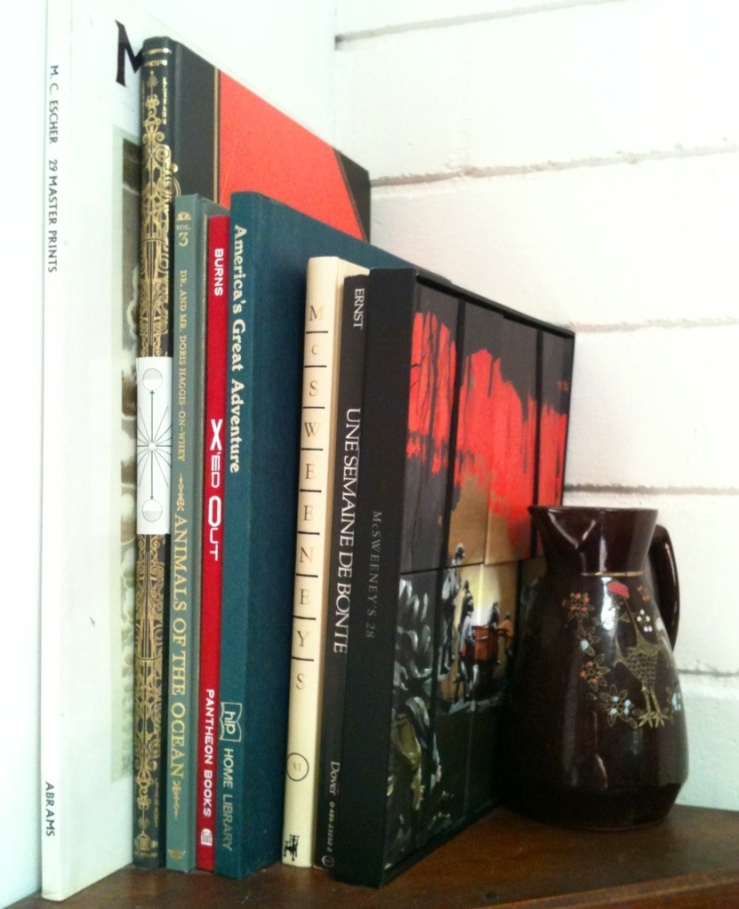
What have these volumes in common? They are all aesthetically pleasing.

They are all too tall to fit elsewhere comfortably.

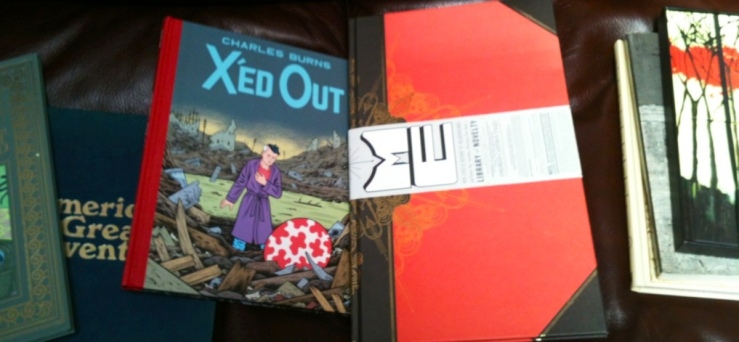
Several issues of McSweeney’s, some art books, and some graphic novels:

20120916-133146.jpg

I’ve already expressed my strong enthusiasm for Charles Burns’s X’ed Out. The Acme Library pictured is part of Chris Ware’s series, and is beautiful and claustrophobic.

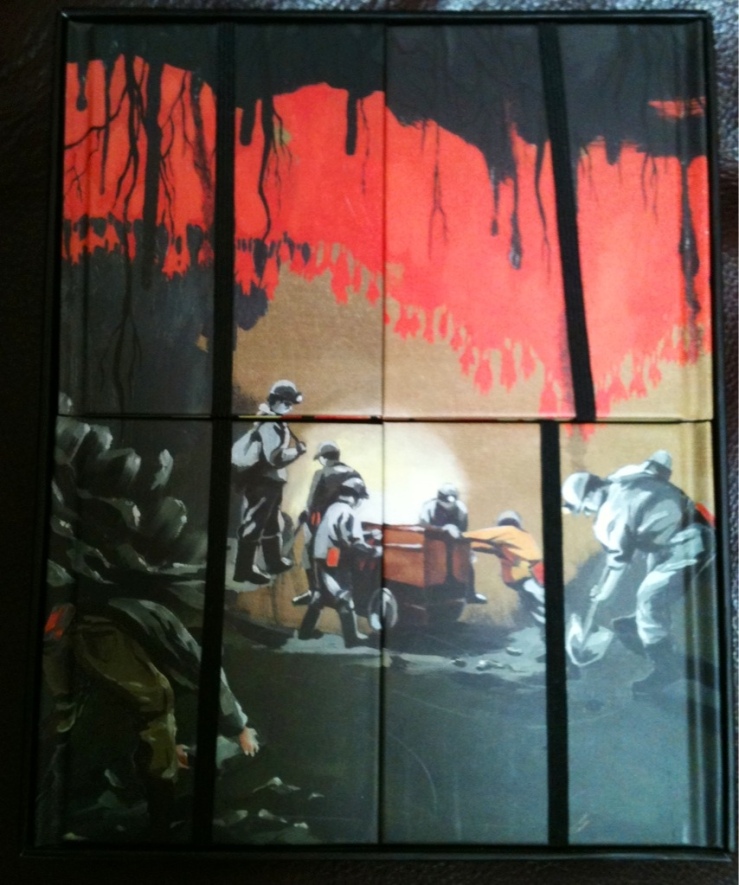
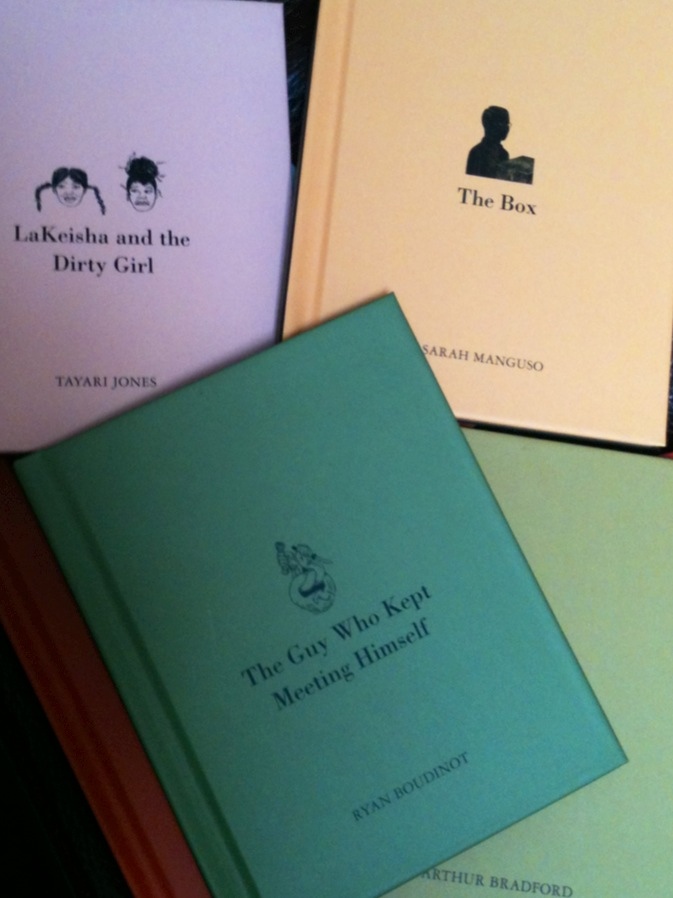
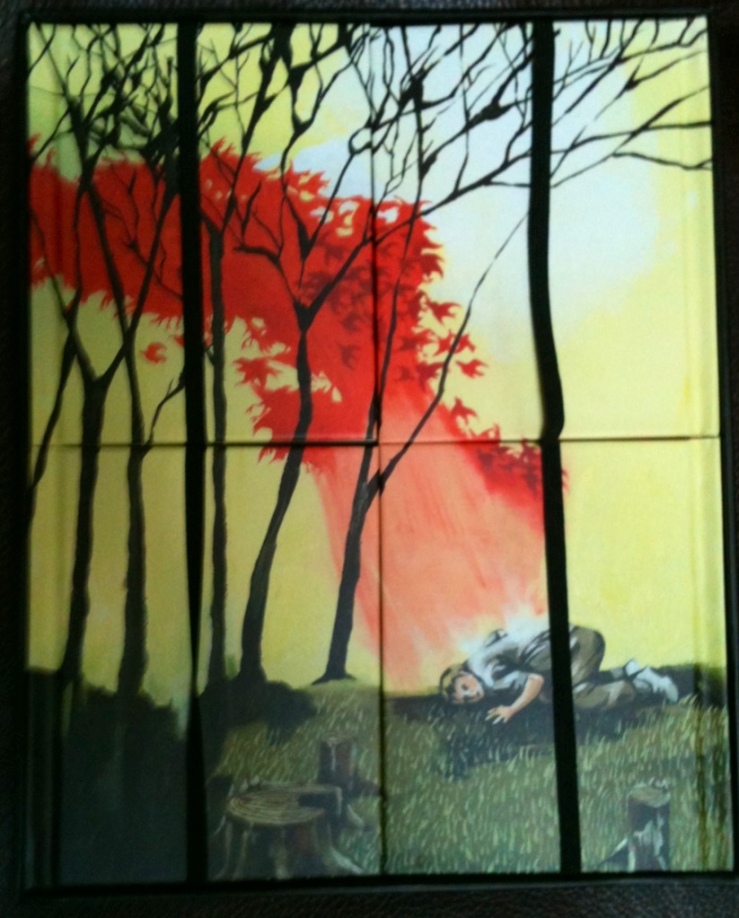
McSweeney’s #28 comprises eight little hardbacked fables that arrange into two “puzzle” covers:

20120916-133153.jpg

20120916-133200.jpg

20120916-133207.jpg

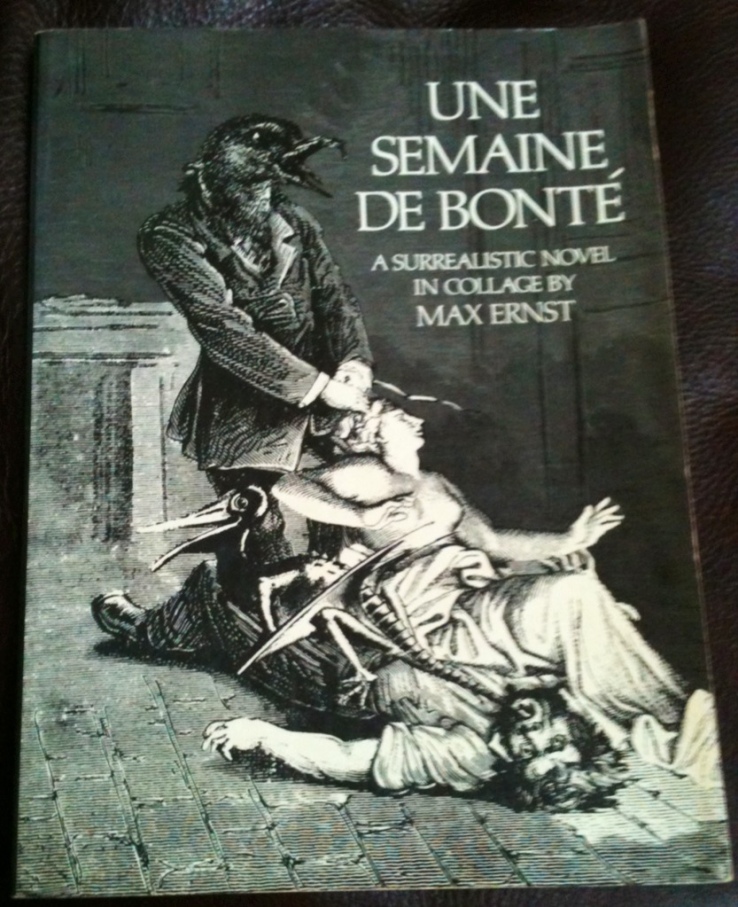
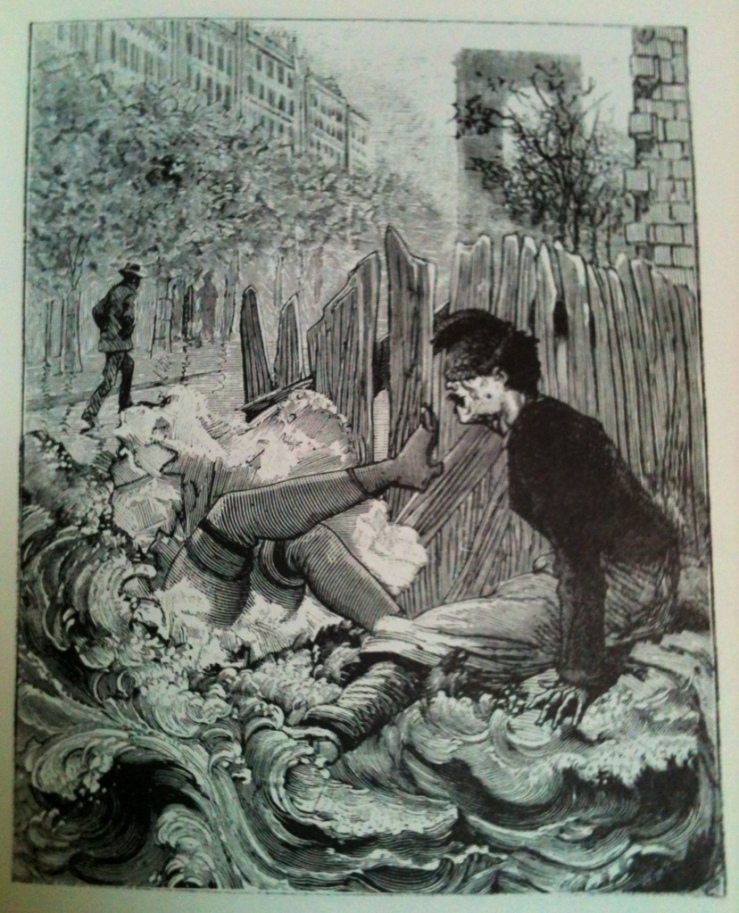
I’ve also written enthusiastically about Max Ernst’s surreal graphic novel, Une Semaine de Bonte:

20120916-133214.jpg

20120916-133221.jpg

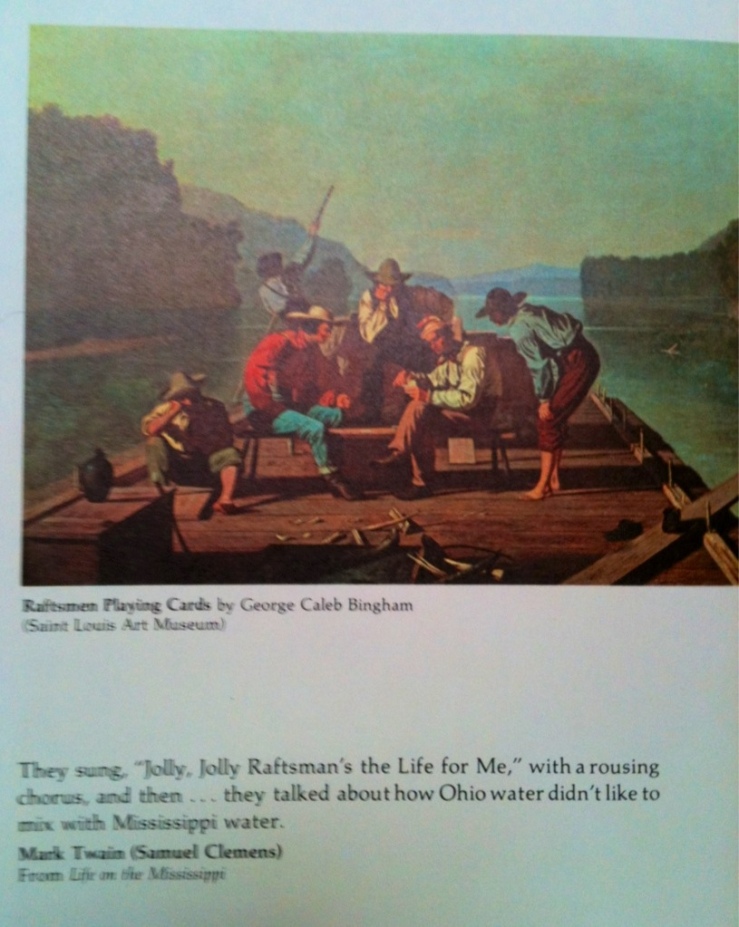
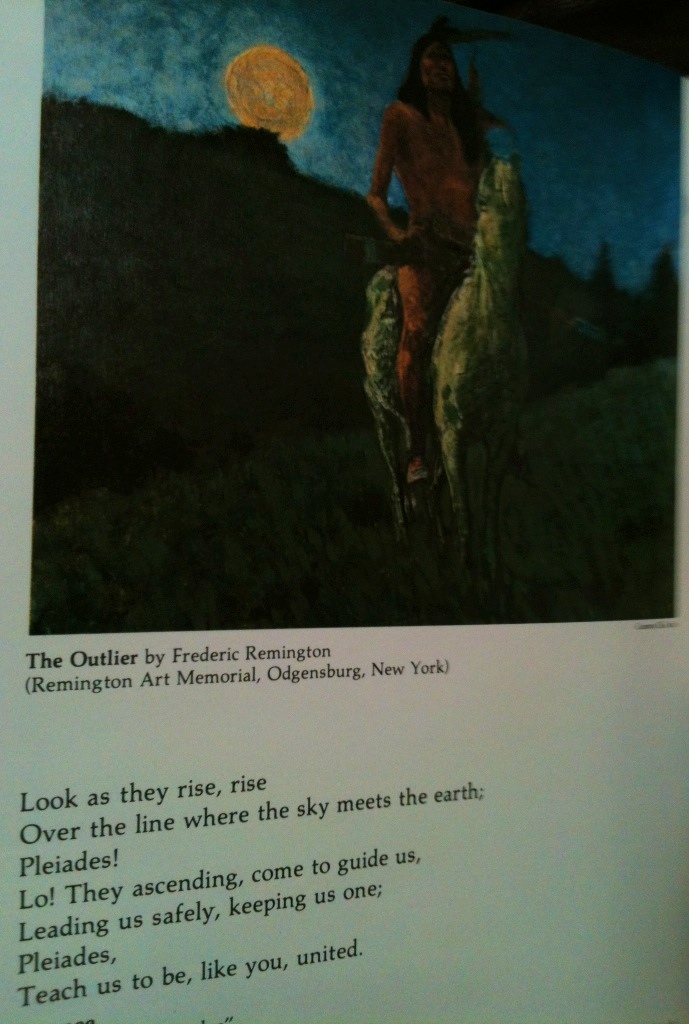
America’s Great Adventure is this wonderful book that pairs American writing (poems, songs, excerpts from novels and journals) with American paintings to tell a version of American history:

20120916-133230.jpg

20120916-133238.jpg

20120916-133244.jpg

It probably deserves its own review. Short review: It’s a wonderful book if you can find it.

Book Shelves #37, 9.09.2012

20120909-105221.jpg

Book shelves series #37, thirty-seventh Sunday of 2012

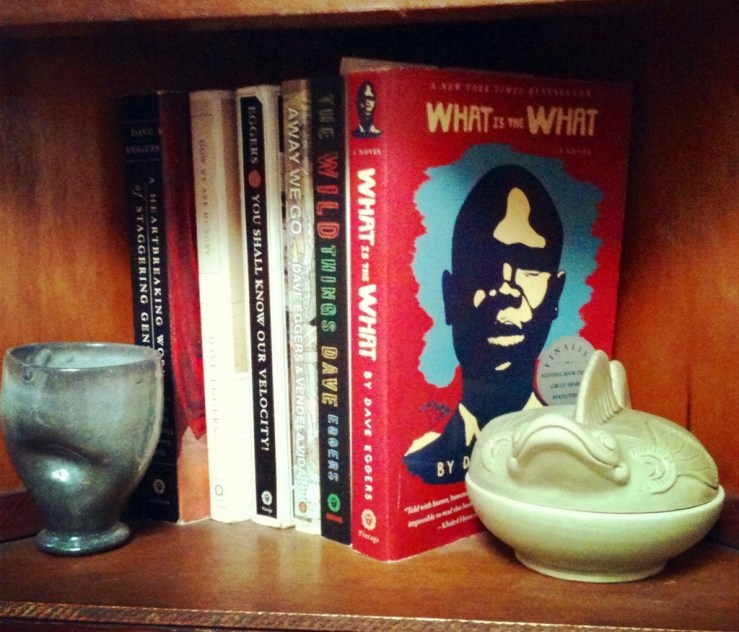
Eggers, Dave. Beloved, reviled, sainted, hated.
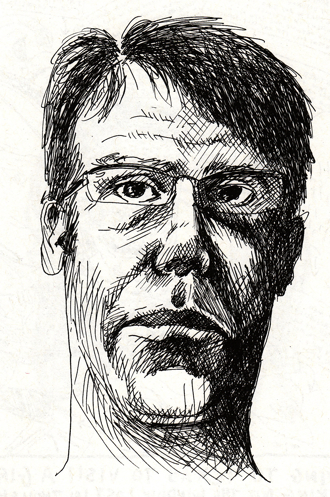
I wrote about Eggers at some length here already, so I won’t repeat myself.

Book Shelves #34, 8.19.2012


20120819-113046.jpg

Book shelves series #34, thirty-fourth Sunday of 2012

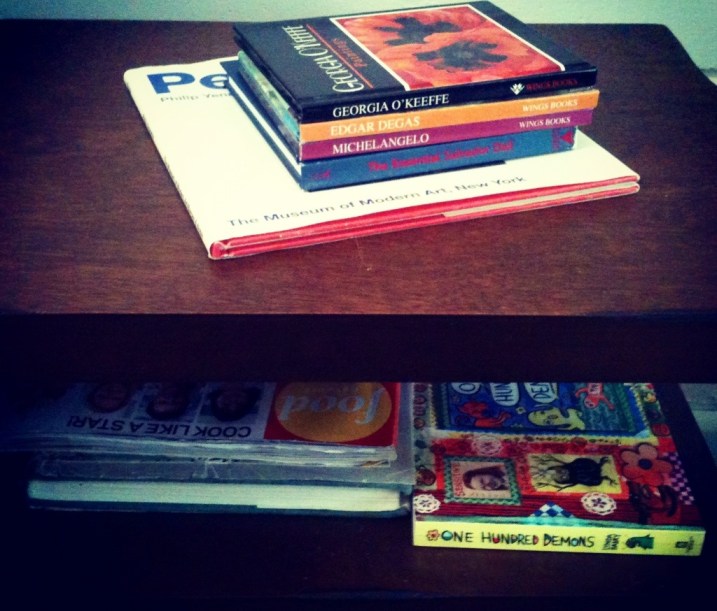
A little end table next to the couch in our family room.

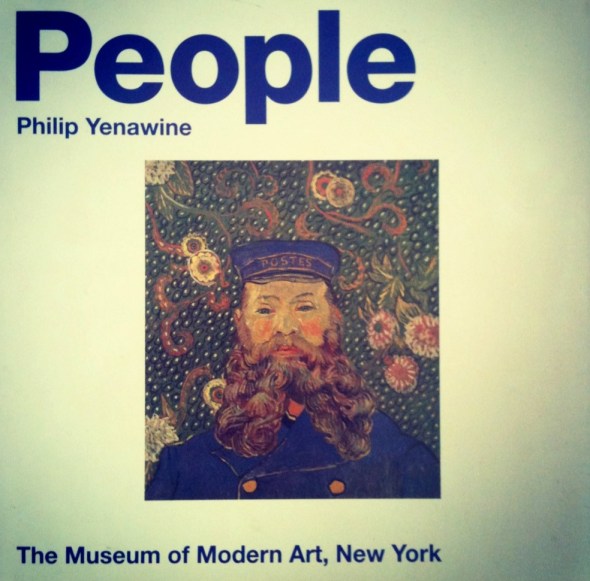
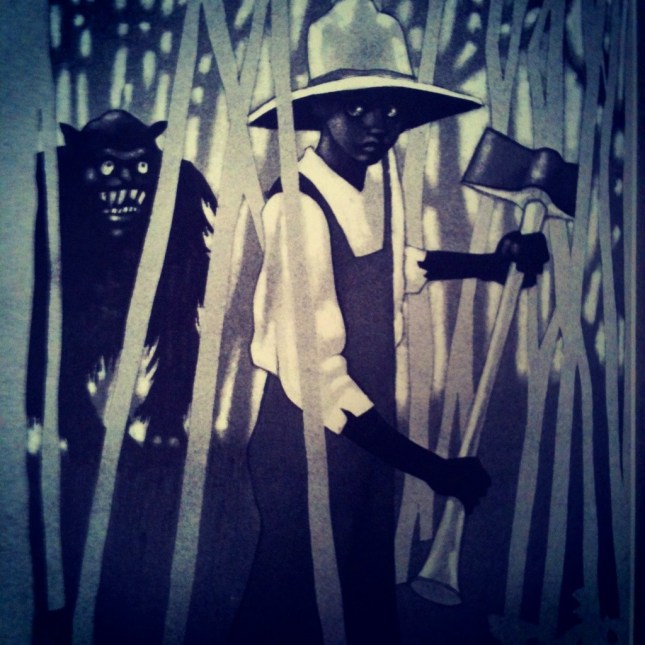
The books on top are little art books we keep out for the kids to look at, including People—

20120819-113052.jpg

20120819-113058.jpg

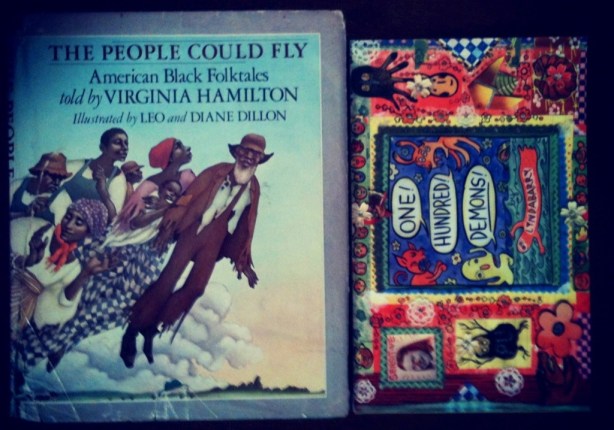
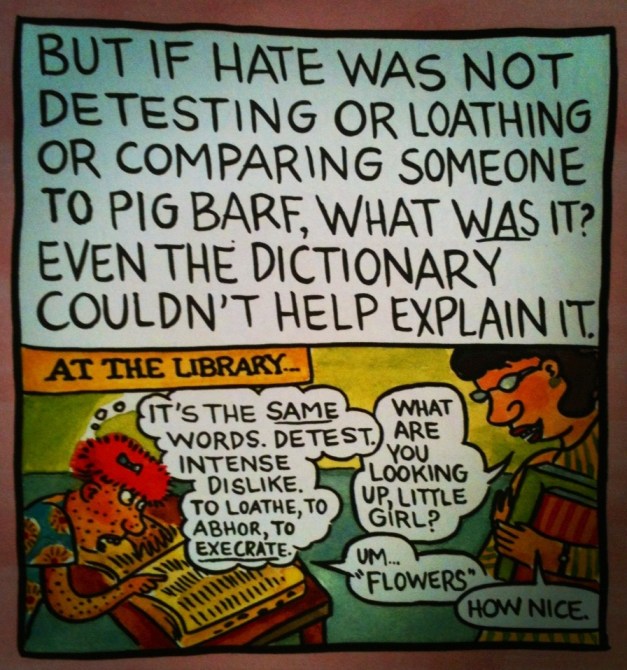
On the second shelf, along with a cooking magazine: The People Could Fly and Lynda Barry’s One Hundred Demons:

20120819-113104.jpg

20120819-113112.jpg

20120819-113121.jpg

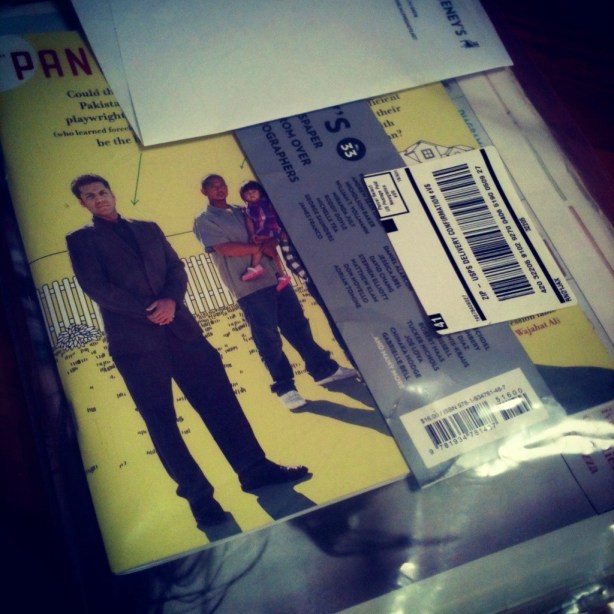
There are two drawers; one holds electronic manuals. The second holds McSweeney’s #33, the newspaper issue, which was pretty damn unwieldy:

20120819-113127.jpg

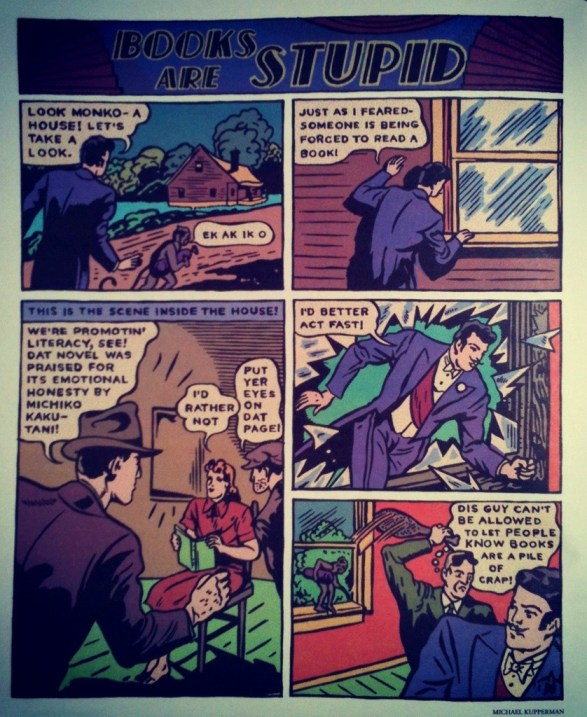
A comic from the McSweeney’s by Michael Kupperman:

20120819-113136.jpg

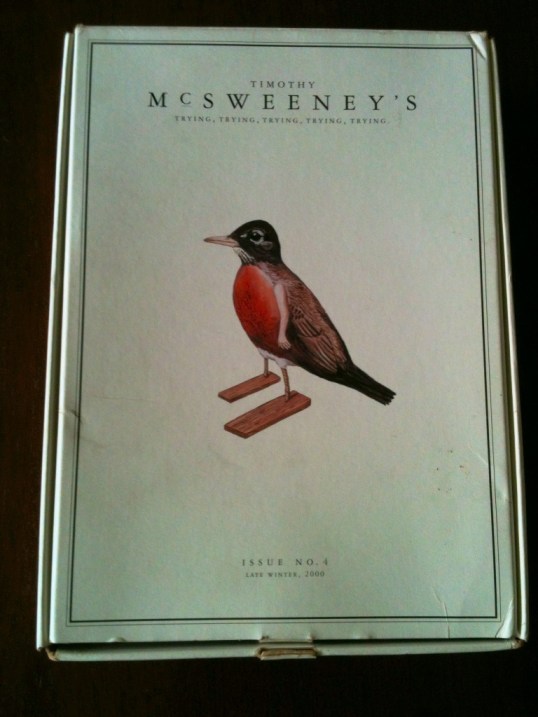
McSweeney’s #4 (Box of Books Acquired 6.14.2012)

20120626-095248.jpg

The novelist John Warner (The Funny Man), in an act of incredible kindness, sent me a copy of McSweeney’s #4, which he helped to put out years ago. In one of our emails, John offers the following:

It could be the best issue ever, a kind of platonic ideal of the McSweeney’s aesthetic before people started saying that things had a McSweeney’s aesthetic, a more innocent time if you will. My memory is that we were selling them at a live event at the Ethiopian Diamond restaurant in Chicago that we set up to help promote Neal Pollack’s book, and somehow the leftovers wound up in my trunk and I’ve been hauling them place to place ever since. . .

It’s a sort of fun artifact of the early/carefree days of McSweeney’s before Dave was DAVE, and the whole thing was still very haphazard.

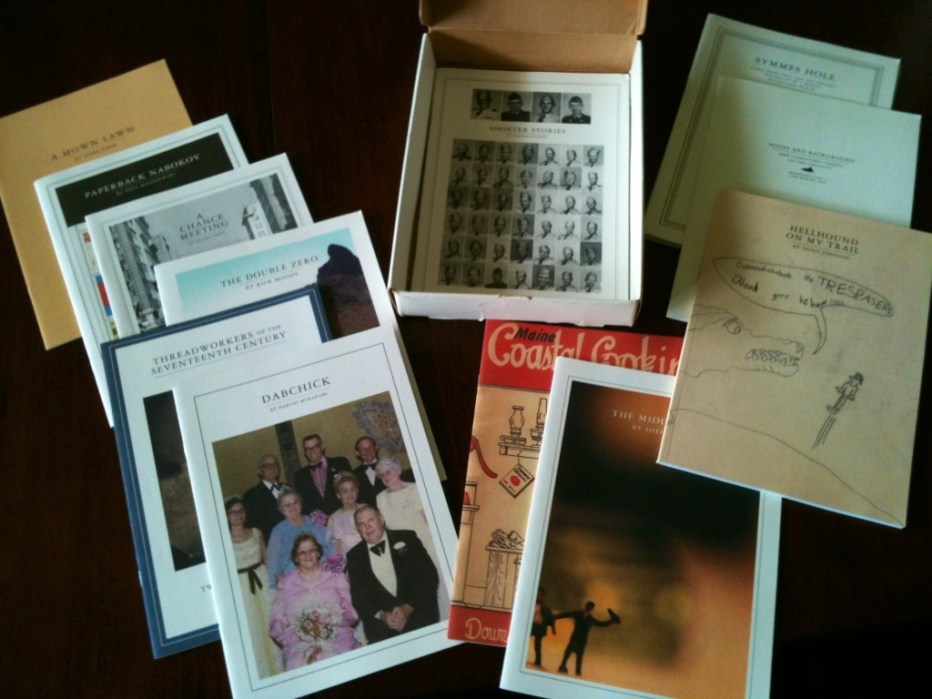
It’s difficult to overstate the range of writers here: Lydia Davis, Jonathan Lethem, George Saunders, Rick Moody, Haruki Murakami, a three-act play by Denis Johnson, and much, much more:

20120626-100530.jpg

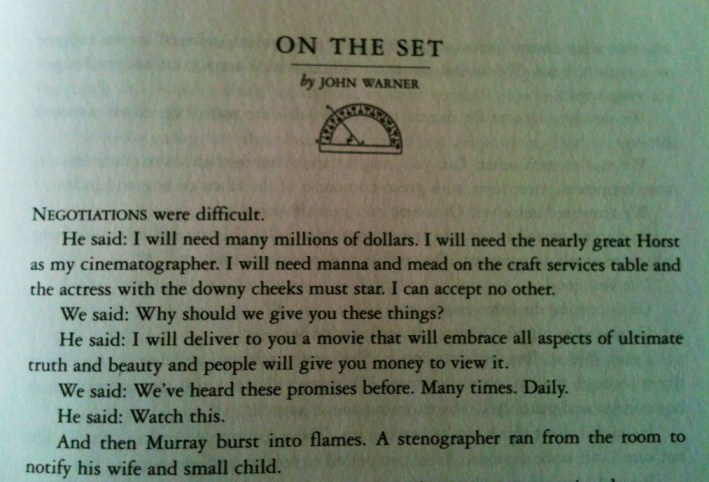
 There are also many short stories, including “On the Set” by John Warner, his second published story:

20120626-100545.jpg

It’s wonderfully absurd.
To read something hilarious and absurd and ultimately kind of touching, read John’s interview with critic Kevin Morris, who hated The Funny Man.

Book Shelves #18, 4.29.2012

20120429-131113.jpg

Book shelves series #18, eighteenth Sunday of 2012.

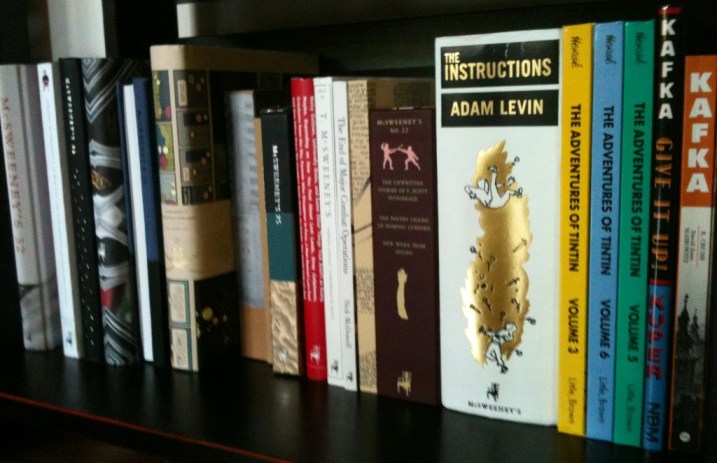
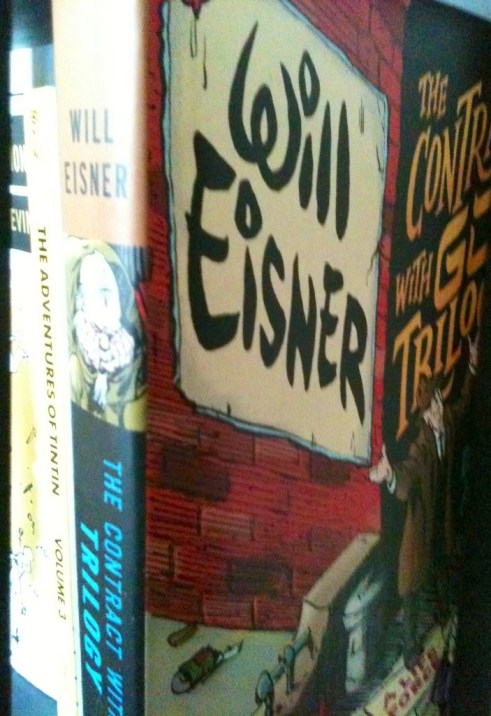
Lots of issues of McSweeney’s on this shelf. I abandoned The Instructions. Some Tintin omnibuses. Crumb-illustrated Kafka bio. Bookended by Will Eisner’s masterwork A Contract with God:

20120429-131124.jpg

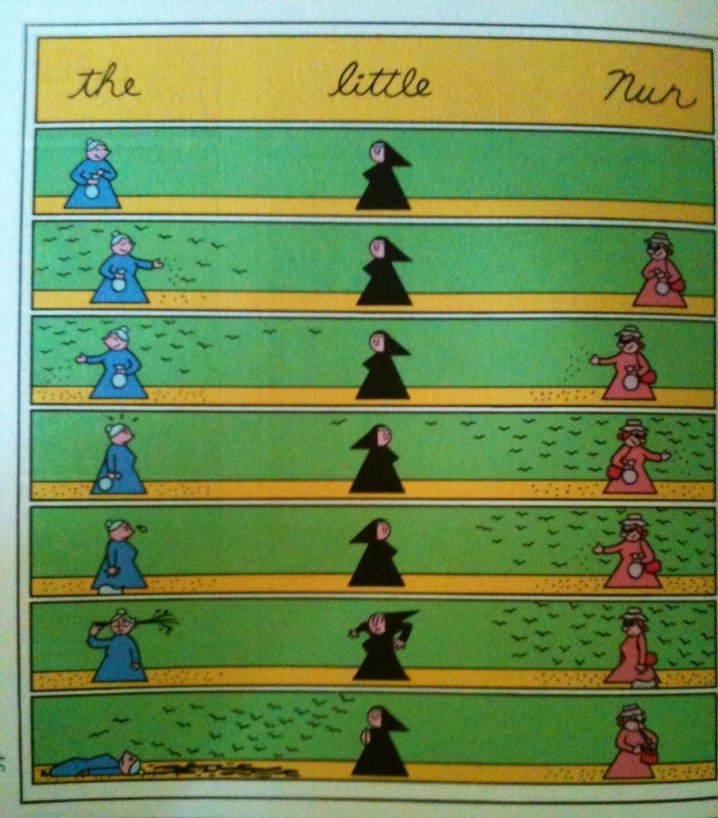
A Chris Ware comic from McSweeney’s #13:

20120429-131132.jpg

The Best Book Cover of 2011 (So Far)

Our Favorite Book Covers of 2010

We know you’re not supposed to judge a book by its cover and blah blah blah, but really, c’mon, aesthetic sensibilities go a long way. Here are a some of our favorite covers for books published in 2010.

Has Melville House made a book that’s not really really good looking? This NY indie not only put out some of our favorite reading of 2010, they also put out some of the best designed books of the year. Books like Jean-Christophe Valtat’s Aurorarama and Mahendra Singh and Lewis Carroll’s The Hunting Carroll evince a diverse aesthetic range unified by simple and attractive designs. We absolutely love the cover for Tao Lin’s Richard Yates; the visual non sequitur dovetails nicely with the book’s arbitrary name.

In fact, it’s a trio of forthcoming books from Melville House that prompted this post. In January, they’ll release the first in a series of books by Nobel winning German author Heinrich Böll. The first three books, which arrived at Biblioklept World Headquarters yesterday, are beautiful, simple, and elegant.

We’ve started The Clown; a review of the book’s guts forthcoming. Another book with a cool cover that we haven’t read yet is Adam Ross’s Mr. Peanut. We know someone on Twitter pointed out that skulls are the smiley faces of this decade but we can’t remember who gets credit, so let’s just pretend you heard that witticism here first.


We haven’t read Adam Levin’s mammoth début The Instructions yet, but a copy arrived today, and man is it beautiful. McSweeney’s knows how to do a hardback right–why encumber a book with a dusty dust jacket that’s going to get in the reader’s way when some gold embossing will do much nicer? Our copy is white but we couldn’t find an image of a white one on the internet, so here’s a blue one because Jesus Christ we’re not about to start photographing books now, are we?

We like both covers for Tom McCarthy’s C, but maybe we’re biased here because we loved the book so much.

We also love the cover of Charles Burns’s X’ed Out.

Picador’s British edition of Roberto Bolaño’s Nazi Literature in the Americas is somehow playful and deadly serious at the same time (just like the book).

Another one on the posthumous tip: We’re not big into tattoos but we can’t help digging this cover for David Foster Wallace’s The Broom of the System.

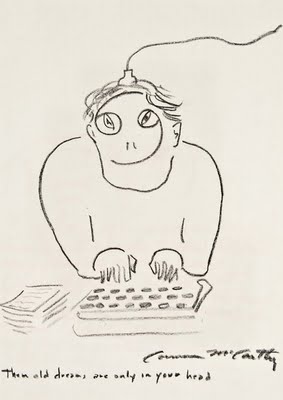
Cormac McCarthy’s Self-portrait

From Burt Britton’s collection of self-portraits, um, Self-portrait. McSweeney’s 34 has taken the work as inspiration. See a full gallery here, including portraits from Jorge Luis Borges, Maurice Sendak, and Margaret Atwood, among others. This goofy Cormac McCarthy self-portrait is priceless, especially from a guy famous for images of trees hanging with dead babies.

Jonathan Lethem’s Self-portrait

From McSweeney’s 34, out now.

Poster Making

If you had a million years to do it in, you couldn’t rub out even half the ‘Fuck you’ signs in the world. It’s impossible. –Holden Caulfield in The Catcher in the Rye

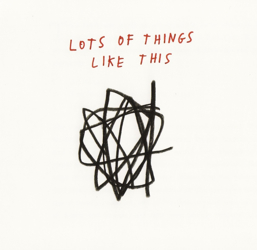
Royal Art Lodge piece from Lots of Things Like This, a slim volume of pictures with words (or words with pictures?) included with McSweeney’s #27 (two other books comprise the issue: a volume of short stories including pieces by Jim Shepard and Stephen King, and a really cool notebook of weird doodles and crazy thoughts by Art Spiegelman). Other artists represented in Lots of Things Like This include Magritte, Goya, Warhol, Raymond Pettibon, Jeffrey Brown, Leonard Cohen, David Mamet, David Berman, Basquiat, and more.

Summer Reading List: Anthologies to Know and Love

No summer reading is complete without imbibing the variegated prose of an anthology. The following are the literary equivalents of skillfully-detailed mixtapes, made by a friend who wishes to communicate only that he or she has your best interest at heart.

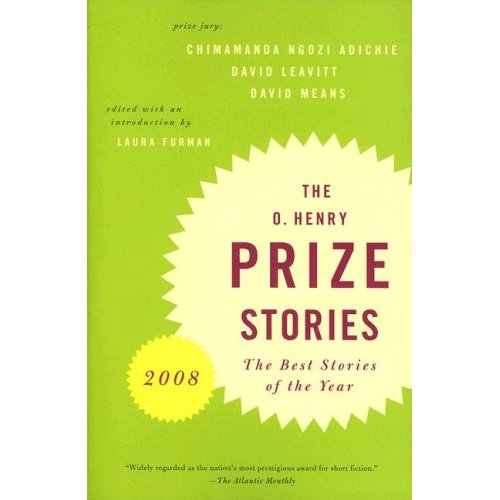
The 2008 O. Henry Prize Stories anthology is a great way to play catch up on all of the reading you missed last year. Culled from publications like Zoetrope, Harper’s, Granta, and Tin House, this anthology features established masters like William Gass and Alice Munro along with newer voices. There are plenty of highlights and no duds. Sharon Cain’s “The Necessities of Certain Behaviors” explores an amorphous world of gender-bending, while Stephen Millhauser’s “A Change in Fashion” imagines a new mode where women cover every inch of their flesh from the gaze of men. Lore Segal’s “Other People’s Deaths” perfectly captures the painful awkwardness and shame we experience when encountering, um, other people’s deaths. Similarly, the title of Tony Tulathimutte’s “Scenes from the Life of the Only Girl in Water Shield, Alaska” is spot-on, and Gass’s contribution, “A Little History of Modern Music,” is the funniest monologue we’ve read all year. But our favorite in the collection has to be Edward P. Jones’s “Bad Neighbors,” which examines the changing fortunes of an African-American neighborhood in Washington, D.C. A great collection, and if a story disappoints you, there’ll be three to make up for it.

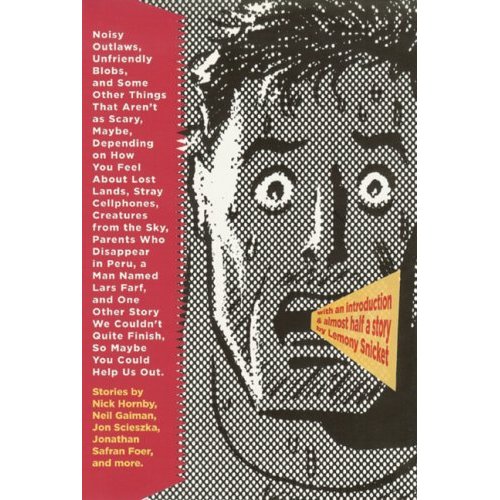
In the ultimate in lazy reviewing, we will let the title of McSweeney’s kids anthology Noisy Outlaws, Unfriendly Blobs, and Some Other Things That Aren’t as Scary, Maybe, Depending on How You Feel About Lost Lands, Stray Cellphones, Creatures from the Sky, Parents Who Disappear in Peru, a Man Named Lars Farf, and One Other Story We Couldn’t Quite Finish, So Maybe You Could Help Us Out stand as its own summary. However, this is a beautiful book with lots of lovely pictures, and the collection is worth it for Nick Hornby’s story alone. Good stuff.

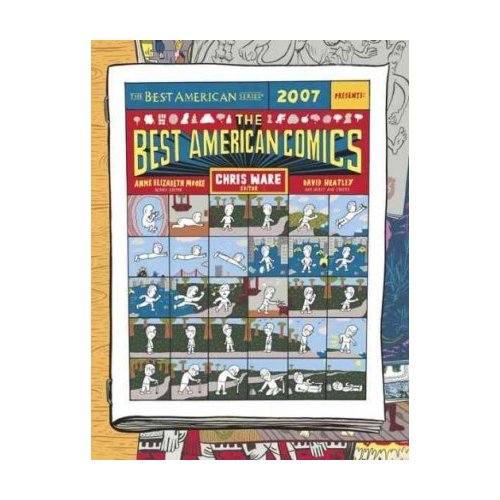
Edited by superstar Chris Ware, The Best American Comics 2007 serves as a delicious tasting menu of some of the best comix published in the past few years. Although hardcore comix fans will no doubt have already read the selections from Charles Burns’s Black Hole and Adrian Tomine’s Optic Nerve, there’s plenty here for aficionados and newbies alike.

Chances are you’ve read a number of the canonical texts in 50 Great Short Stories, but it’s also likely you haven’t read them in years. We’ve had this book for years, and have revisited often to indulge in old favorites for new inspiration. Classics like Shirley Jackson’s “The Lottery” and Hemingway’s “The Three-Day Blow” nestle up against lesser-reads like Edmund Wilson’s “The Man Who Shot Snapping Turtles” and Francis Steegmuller’s “The Foreigner.” And have you read Flannery O’Connor’s “A Good Man is Hard to Find” since high school? No? Shame on you! What about Carson McCuller’s “The Jockey”? Dorothy Parker? Kipling? Consider it a light crash course in great literature.

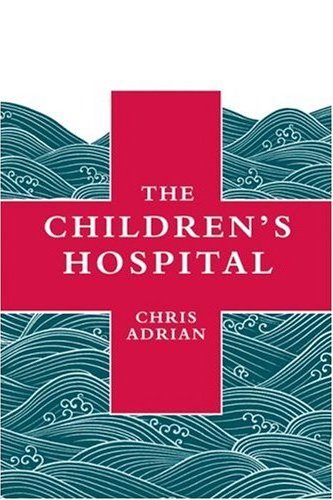
The Children’s Hospital — Chris Adrian

childrenshospital.jpg

“The book started out a lot more like a big happy Love Boat episode, then 9/11 (and all that followed) happened and blew it in a new direction.”–Chris Adrian (McSweeney’s interview)

Chris Adrian’s 2006 novel The Children’s Hospital begins with the end of the world. A flood of (excuse me) biblical proportions drowns every living thing on earth with the exception of a children’s hospital which has been specially engineered with the aid of an angel to withstand both the flood as well as life at sea. The residents of the newly nautical hospital–doctors, med students, specialists, nurses, some 699 sick children, portions of their families and sundry others–must navigate an uncertain future drenched in despair and loss. Their mission of helping the ill is the only thing that sustains them–initially.

Central to the story is Jemma Claflin, a mediocre third-year med student with a haunted past. Years before the deluge, each member of her family and her long-term boyfriend died in a horrific way, leaving Jemma unable to love, let alone believe in a positive future. However, as the book progresses, it becomes apparent that Jemma will have to best her fear and become the hero of this epic novel.

I really, really enjoyed The Children’s Hospital. Adrian’s writing communicates a stirring mix of immediacy and pathos, tempered in a cynical humor that sharply bites at any hint of sentimentality. Despite its 615 pages, epic scale, and use of multiple narrative viewpoints, The Children’s Hospital never sprawls into logorrhea–Adrian holds the plot reins tightly at all times, sparingly measuring details which accrue neatly to an affecting payoff. The middle 200 page section of this book is easily the best thing I’ve read in the past few years. I actually had to stand up to read it–the highest Biblioklept endorsement there is. Yes folks–if you have to stand up to read it, it’s truly excellent stuff.

You can read the entirety of Chris Adrian’s short story “A Better Angel” here.

Support Indie Publishers

It’s no secret that we love McSweeney’s here at the Biblioklept–sure, some of the writing can be smartassed and some people might find their publishing concepts gimmicky at times (not me!)–but Dave Eggers’s collective puts out some of the best stuff around these days, and in some of the freshest packaging. Unfortunately, McSweeney’s distributor went bankrupt, leaving them in dire economic straits. The silver lining here (if you can call it that) is that they’re having a big sale, including half off on old stuff, and 30% off on new stuff. They’re also auctioning off a ton of original art. If you’re interested, check out the email below–

As you may know, it’s been tough going for many independent publishers, McSweeney’s included, since our distributor filed for bankruptcy last December 29. We lost about $130,000 — actual earnings that were simply erased. Due to the intricacies of the settlement, the real hurt didn’t hit right away, but it’s hitting now. Like most small publishers, our business is basically a break-even proposition in the best of times, so there’s really no way to absorb a loss that big.

We are committed to getting through and past this difficult time, and we’re hoping you, the readers who have from the start made McSweeney’s possible, will help us.

Over the next week or so, we’ll be holding an inventory sell-off and rare-item auction, which we hope will make a dent in the losses we sustained. A few years ago, the indispensible comics publisher Fantagraphics, in similarly dire straits, held a similar sale, and it helped them greatly. We’re hoping to do the same.

So if you’ve had your eye on anything we’ve produced, now would be a great time to take the plunge. For the next week or so, subscriptions are $5 off, new books are 30 percent off, and all backlist is 50 percent off. Please check out the store and enjoy the astounding savings, while knowing every purchase will help dig us out of a big hole.

Many of our contributors have stepped up and given us original artwork and limited editions to auction off. We’ve got original artwork from Chris Ware, Marcel Dzama, David Byrne, and Tony Millionaire; a limited-edition music mix from Nick Hornby; rare early issues of the quarterly, direct from Sean Wilsey’s closet; and more. We’re even auctioning off Dave Eggers’s painting of George Bush as a double-amputee, from the cover of Issue 14.

This is the bulk of our groundbreaking business-saving plan: to continue to sell the things we’ve made, albeit at a greatly accelerated pace for a brief period of time. We are not business masterminds, but we are optimistic that this will work. If you’ve liked what we’ve done up to now, this is the time to ensure we’ll be able to keep on doing more.

Plenty of excellent presses are in similar straits these days; two top-notch peers of ours, Soft Skull and Counterpoint, were just acquired by Winton, Shoemaker & Co. in the last few weeks. It’s an unsteady time for everybody, and we know we don’t have any special claim to your book-buying budget. We owe all of you a lot for everything you’ve allowed us to do over the last nine years, for all the time and freedom we’ve been given.

Once this calamity is averted, we’ll get back to our bread and butter — the now-legendary Believer music issue is already creeping into mailboxes everywhere; Issue 24 of our quarterly is in the midst of a really pretty silkscreening process; and in July the fourth issue of Wholphin, our DVD magazine, will slip over the border from Canada, bringing with it some very good footage of Maggie Gyllenhaal and a Moroccan drummer who messes up a wedding in an entertaining way. And then a couple of months after that, we’ll publish a debut novel from a writer named Millard Kaufman. This book is exactly the kind of thing McSweeney’s was created to do: The novel came through the mail, without an agent’s imprimatur, and it was written by a first-time novelist. This first-time novelist is ninety years old. It was pulled from the submissions pile and it knocked the socks off of everyone who read it. Millard may well be the best extant epic-comedic writer of his generation, and he stands at equal height with the best of several generations since.

Whatever you can do to help in the coming days, we thank you a thousand times. We’ll keep updating everybody on how this is going over the next few weeks; for now, pick up a few things for yourself, your friends, for Barack Obama. More news soon — thanks for reading.

Yours warmly,
The folks at McSweeney’s

———–

This email was sent by: McSweeney’s
826 Valencia Street San Francisco, CA, 94110, USA

McSweeney’s Issue 13 (Chris Ware)

McSweeney’s Issue 13

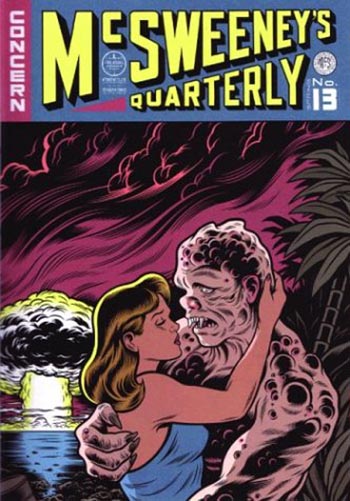
Charles Burns’s gorgeous title page for McSweeney’s Issue 13 captures the bizarre mix of romance, abject horror, and mutually assured destruction present in the horror comics of the 1950’s.

I love all things McSweeney’s–Dave Eggers, The Believer, etc–but Issue 13 of McSweeney’s Quarterly Concern is particularly excellent, and is easily the most beautiful, most aesthetically pleasing book I own. Designer and editor Chris Ware (author of the sad and dense graphic novel Jimmy Corrigan, Smartest Kid on Earth) offers a concise but thorough history of cartooning. Ware places Robert Crumb, the Hernandez brothers, Art Spiegelman, Daniel Clowes, and other great artists into a tradition initiated by Rodolphe Töpffer and Krazy Kat, and perfected by Charles Schulz. This richly-colored book comes wrapped in an old fashioned broadsheet comics page, and includes work from some of the best artists and cartoonists from the past 100 years. Despite the wide range of cartoonists represented, Ware unifies the issue in a theme of despair and depression. Imagine this famous moment in cartooning–Lucy pulls the football away from Charlie Brown’s wishful kick at the last minute, tripping him and humiliating him and betraying him: that pretty much somes up Ware’s theme. But even though it’s sad, it’s funny and somehow beautiful–and real.

If you are a bibliophile, you must buy this book. You won’t be disappointed.