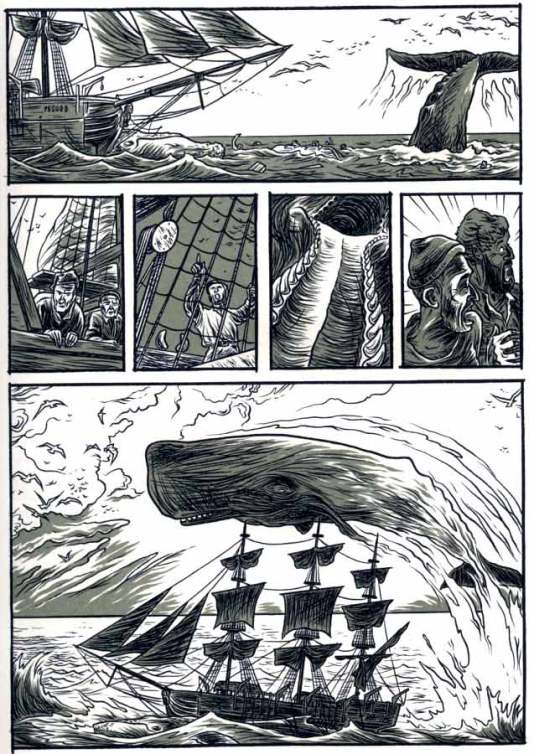
Will Eisner’s Adaptation of Herman Melville’s Moby-Dick

moby_dick_cv_300

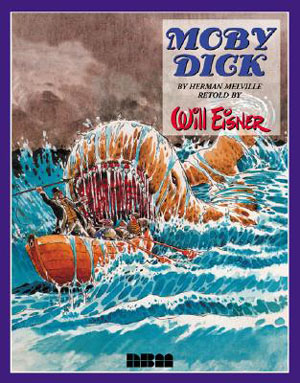
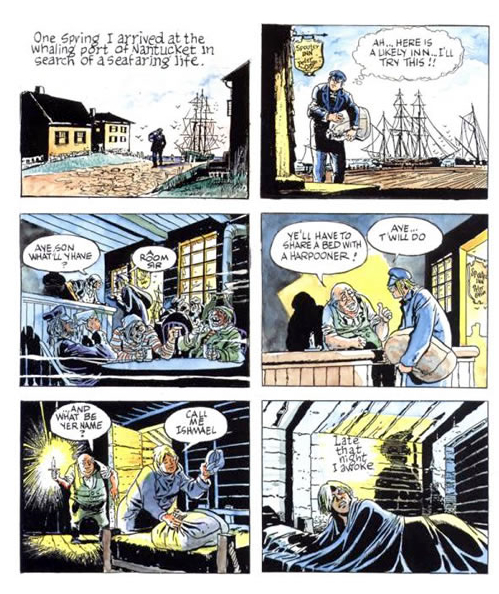
Will Eisner’s adaptation of Herman Melville’s Moby-Dick was one of his last works, completed in 2001 just four years before his death. While no comic book adaptation can match Ishmael’s expansive voice, Eisner’s work here does capture the spirit of adventure and the wish for communion that underpins Melville’s tome. We think it would make a great introduction for younger readers to Melville’s massive book, and will surely interest older readers apprehensive of Moby-Dick. Great stuff.

Eisner Moby-DickMore here.

Summer Reading List: Tales of Adventure

Indulge yourself this summer by taking a fantastic voyage–literary or literally. To help you get started, check out the following tales of adventure.

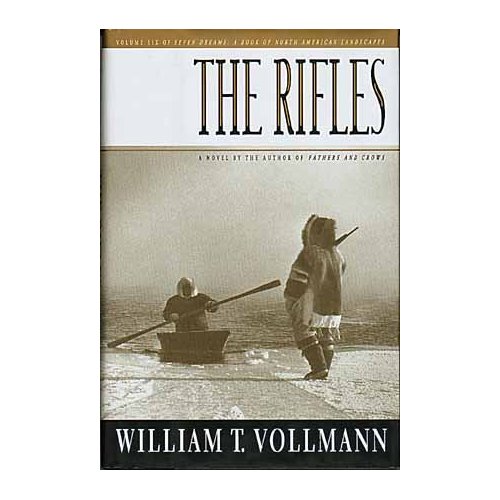
William Vollman’s The Rifles, part of his as-yet-unfinished Seven Dreams series is a brilliant engagement of history, colonialism, identity, and all of those Big Profound Issues that we so adore in our modern literature. It’s also a really cool adventure story, the tale of John Franklin’s nineteenth-century exploration of Inuit territory. Sad, beautiful, breathtaking.

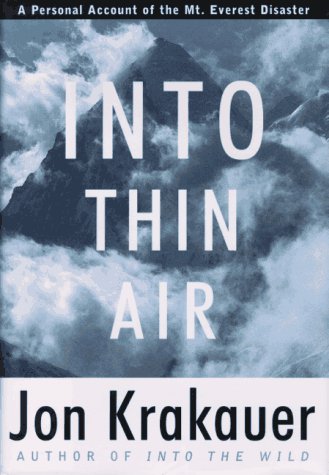
If you prefer your adventure tales uncomplicated by postmodern gambits, check out John Krakauer’s Into Thin Air, a journalistic account of the writer’s 1996 ascent of Mt. Everest, and the disasters that befell his expedition. The word “harrowing” fits well, gentle readers.

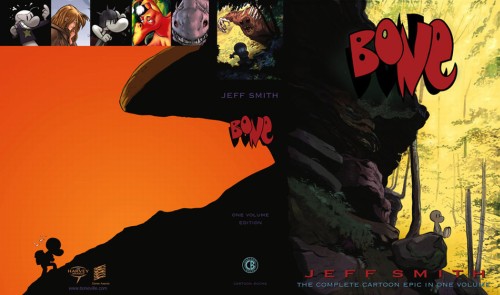
On the lighter-but-not-too-much-lighter side, Jeff Smith’s self-published comic Bone is fantastic; even better, you can get the entire 1300 page run of the whole series in Bone: One Volume Edition. We use the word “delightful” here in an absolutely unpejorative sense, friends: the adventures of Fone Bone, his cousins Phoney Bone and Smiley Bone, and Thorn, Granma Rose, and the Red Dragon are epic in scope yet retain an honest humor that will keep in the most cynical folks laughing. A major literary accomplishment that has been unjustly overlooked.

Also somewhat overlooked is Herman Melville’s Benito Cereno. In Bone, protagonist Fone Bone lugs around a massive copy of Melville’s masterpiece Moby-Dick everywhere he goes–and while that book is undoubtedly a desert island classic, Benito Cereno is an underappreciated gem of a tale. Revealing the strange secret at the heart of this book would spoil it, so suffice to say that the short novel enigmatically investigates slavery and colonialism in ways that beg for closer analysis. Good stuff.

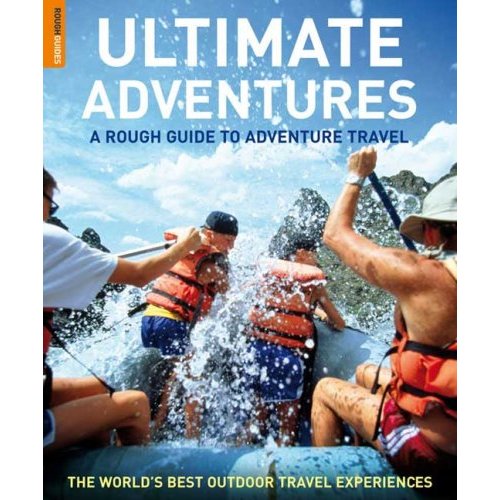
Perhaps, though, you beg for the real thing. In that case, we recommend Ultimate Adventures (from Rough Guides) for all your camel-trekking-in-the-Sahara, rock-climbing-at-Joshua-tree, Pacuare-River-rafting needs. Beautiful photography and tantalizing descriptions are coupled with informative “Need to Know” sections that spell out the who-what-when-where-and-how that will help you get your adventure under way.

Also in the exploratory vein, Where to Go When: The Americas, from DK’s Eyewitness Travel, serves as a kind of travel almanac–the kind that makes you wish you were very, very rich with an excess of free time. If that were the case, you’d be spending nine days in May on the Amazon River, spotting pink river dolphins, gorgeous macaws, and darling squirrel monkeys instead of reading this blog right now. Even if you’re not excessively rich with nothing more pressing to do other than trek the Alaskan fjords, The Americas is fun daydreaming material–perhaps the realist response to Vollman’s Seven Dreams. In any case, Ultimate Adventures and The Americas both come out at the end of this summer, giving you plenty of time to plan that awesome adventure getaway for next year.

Shilling for DFW, Special Babies, Ursula K. LeGuin, Sunshine, and (Moby)Dick Jokes

This month’s issue of Harper’s has some great stuff, including a selection called “The Compliance Branch” from David Foster Wallace’s current work in progress. In the short piece, an unidentified narrator is overcome by a “fierce” infant:

The infant’s face, as I experienced it, was mostly eyes and lower lip, its nose a mere pinch, its forehead milky and domed, its pale red hair wispy, no eyebrows or lashes or even eyelids I could see. I never saw it blink. Its features seemed suggestions only. It had roughly as much face as a whale does. I did not like it at all.

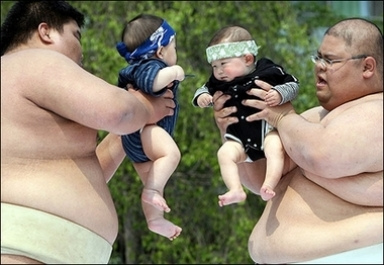
Doesn’t this guy know that all babies are special? Evidence of special babies:

baby-sumo.jpg

You can read DFW’s last piece for Harper’s, “Tense Present,” an essay about grammar and usage and democracy, here. Or, alternately, you could treat yourself to the entirety of Consider the Lobster, where said essay is collected. Or, if you’re spectacularly lazy, hear DFW read unpublished work here and here.

Harper’s also has a great essay by ‘klept fave Ursula K. LeGuin. In “Staying Awake,” LeGuin takes on the relationship between reading, capitalism, literature in art. Good stuff. Bibliophile’s will appreciate LeGuin on the physiognomy of books:

The book itself is a curious artifact, not showy in its technology but complex and extremely efficient: a really neat little device, compact, often very pleasant to look at and handle, that can last decades, even centuries. It doesn’t have to be plugged in, activated, or performed by a machine; all it needs is light, a human eye, and a human mind. It is not one of a kind, and it is not ephemeral. It lasts. It is reliable. If a book told you something when you were fifteen, it will tell it to you again when you are fifty, though you may understand it so differently that it seems you’re reading a whole new book.

If you haven’t read LeGuin, I highly recommend The Left Hand of Darkness, a book that scrutinizes gender roles with more interesting results than, say, Eugenides’s Middlesex or Woolf’s Orlando.

Abrupt transition: Sunshine, the latest movie from director Danny Boyle, the mastermind behind Trainspotting, Millions, and 28 Days Later, is out on DVD. Sunshine, scripted by long-time Boyle collaborator Alex Garland (The Beach, 28 Days Later, 28 Weeks Later), was eaten alive last summer by a host of tertiary blockbuster sequels. I liked Sunshine; in addition to being a shiny, beautiful movie, it also raised some interesting questions about the cost of existence, individual worth, and the merits of self-sacrifice. Although the end unravels a bit, the movie is well worth seeing. Recommended.

Finally, lit nerds and Melville fans such as myself might have a laugh at Teddy Wayne’s take on Ishmael as comedian. Sample joke:

What’s the deal with the biscuits? Do they really expect this to suffice for a six months’ imperialistic voyage for exotic spices? And the servings they give you—is this for, like, a baby sailor? Did I accidentally request the infant meal?

Ishmael’s a hack–get it? Is there anything funnier than whaling humor?

whale.jpg

Alphabet Soup: I

1831s.jpg

I is for Ishmael, narrator of Herman Melville’s Moby-Dick, a story about whaling/wailing. Ishmael’s narrative is an attempt to transform his pain and loss into some kind of meaningful human connection–to try to measure the incomprehensible and to put the ineffable into words. He’s a lovable guy, something of an eccentric in his time, who makes good friends with his strange bedfellow Queequeg. Of course, the whole thing ends in disaster, a disaster that Ishmael alone bears witness to, like one of Job’s servants returning to the master.

Also, I think that the great white whale, Moby Dick, is like a symbol or something.

infinitejest.jpg

I is also for Incandenza, Hal, the would-be tennis prodigy, secret stoner, and eidetically gifted prescriptive grammarian who is–along with Don Gately (somehow unjustly skipped over in installments D and G)–the protagonist of David Foster Wallace’s mammoth novel Infinite Jest. Hal is a sensitive kid, the son of a mad scientist filmmaker/tennis academy founder, who kinda sorta haunts both the novel as well as the Enfield Tennis Academy. Writing this makes me wish for a free month (i.e. no grad school) to re-read IJ, just so that I could take another crack at why Hal comes down with the howling fantods. Plenty of theories here.

Leviathan–Jens Harder

Jens Harder’s Leviathan is a graphic novel in the truest sense. Harder uses scratchy but fluid images to tell the story of a mystical whale who battles a giant squid, saves Noah’s ark, attacks the Pequod, wreaks havoc on a cruise ship, and eventually battles an armada of anachronisms. The only text Harder employs in Leviathan are excerpts and quotes from a variety of sources including the Bible and a host of philosophers; the bulk of quotes come from Melville’s Moby-Dick. Just as that novel begins with an “Etymology” followed by a section called “Extracts,” Harder begins with a section called “Leviathanology,” a collection of quotes about leviathans from the likes of Hobbes, Milton, and the book of Job. These quotes inform the story of Leviathan, connecting the whale to a sublime and unknowable mystery that Harder will explore. Harder’s surreal images often invert notions of “proper” space and time, giving the whale an awesome significance, but also positing the beast as something that denies signification. By eschewing the traditional forms of graphic storytelling, which rely on speech bubbles and clear-cut panel transitions, Harder is able to capture something that is essentially too large to capture. This book works. Highly recommended.

leviathan.jpg

2006 Superlatives

 Best Book I Read in 2006:

Moby-Dick by Herman Melville.

Best Book Published in 2006 that I Read in 2006:

I read plenty of fantastic books this year, but I don’t think any of them were published this year (although I’m sure that plenty of great books came out this year. I’m always playing catch-up). The closest I think I can come is a paperback of Dave Egger’s collection of short fiction, How We Are Hungry, which came out in October of 2005, actually (to plenty of mixed reviews–but I liked it a lot!). I will also read Egger’s What Is the What as soon as possible. Maybe this Christmas break (feel free to send me a copy). Here’s The New York Times Book Review Top 10 of 2006, and courtesy of the American Library Association, the TTT (the Teen’s Top Ten, popularly known as “the titties”).

Least Enjoyable Book I Read in 2006:

God, Dr. Buzzard, and the Bolito Man: A Saltwater Geechee Talks About Life on Sapelo Island, Georgia by Cornelia Walker Bailey (with Christena Bledsoe). I’m sure lots of people would really enjoy this book, in fact, I recommended it to a few of my students. Not for me though.

Most Likely to Succeed:

Ricotta Park will storm the nation (if Nicky Longlunch ever decides to start posting again). 

Most Likely to be President:

Barack Obama?

Best Dressed:

Saddam Hussein always was a sharp dresser–

Saddam Hussein

–but after some {ahem} troubles–

saddam-capture-unofficial4.jpg

–he had a fabulous makeover! Saddam looking dapper and energetic, yet casual and academic (oh, and seriously pissed)–

_41064274_051128_hussein203i.jpg

Best Movie I Saw in the Movie Theater in 2006:

I’m pretty sure it was Litle Miss Sunshine, although I also enjoyed the movie where Will Ferrell was a race car driver.

Best Movie I Saw in 2006:

The New World (dir. Terrence Malick). This film is beautiful. You must watch it (twice).

Best Album of 2006:

Lots of contenders–M. Ward’s Post-War, Joanna Newsom’s Ys,  Destroyer’s Rubies, OOIOO’s Taiga, Girl Talk’s Night Ripper –all were great (and I know that I’m forgetting dozens)–but The Fiery Furnaces’ Bitter Tea didn’t leave my CD player for months…in fact I’m sure it’s still in there.

bitter_tea_dig-fiery_furnaces_480.gif

Best Song of 2006:

“Star Witness” by Neko Case. Crafted from images that at first seem vague, “Star Witness” relates the haunting tale of a tragic accident. And the worst part of the accident is how mundane the whole scene is to everyone besides the speaker: “This is nothing new/No television crew/They don’t even put on the siren.”

Most Overrated Album of 2006:

The Crane Wife by The Decemberists. The Decemberists are so boring.

Best Live Performance of a Musical Group:

The Fiery Furnaces at Common Grounds (Gainesville, FL). One of the best concerts I have ever attended. The kids danced as The Fiery Furnaces deconstructed their songs, rearranging them into new suites, punching in and out of different albums. The true rocknroll.

Most Disappointing Live Performance of a Musical Group:

Wilco at The Florida Theater (Jacksonville, FL). Wilco didn’t seem to know that they were playing in a theater. Jeff Tweedy seemed completely annoyed at the crowd for not boogeying to the jams. Wilco’s performance came off like a simulation of a band that was really “into” the vibe–like they had watched films of themselves to improve, like a football team or something.

Best New Product:

Okay, boxed wine is nothing new, but in 2006 I started gleaming the cube. Boxed wines stay fresher longer than wine from a bottle, and are generally much less expensive. This summer I found my habit–which a prejudiced few might think declasse–validated by the cultural elite. I attended a pre-wedding party in a cave in the south of France this summer; Damien, the winemaker (it was his cave) served us box after box of delicious wine, trumpeting the superiority of the box as a vessel. So see.

Worst People of 2006:

Check out my previous post for some superlative hatin’. 

Man of the Year:

I wasn’t on the committee this year. I understand that they might have met in Orlando this year. This guy John Griffis heads the whole thing up. I’m sure he has a MySpace account. I really don’t know who won. I think this guy Andy won.

Woman of the Year:

The woman of the year is my darling wife Christy, of course.