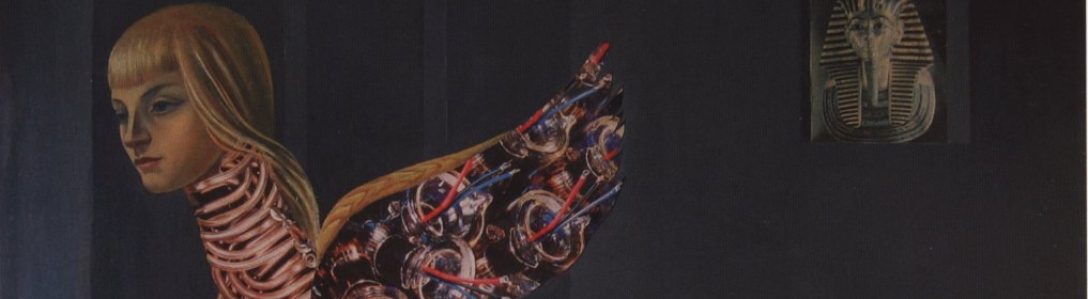
“Doña Faustina”
by
Paul Bowles
NO ONE COULD UNDERSTAND why Doña Faustina had bought the inn. It stood on one of the hairpin curves in the old highway leading up from the river valley to the
town, but the route had been made useless by the building of the new paved road. Now it was impossible to reach the inn except by climbing up a stony path over the embankment and walking several hundred feet down the old road which, no longer kept in repair, already was being washed away by the rains and strangled by the shiny vegetation of that lowland region.
On Sundays the people used to walk out from the town, the women carrying parasols and the men guitars (for this was before the days of the radio, when almost everyone knew how to make a little music); they would get as far as the great breadfruit tree and look up the road at the faded façade of the building, more than half hidden by young bamboo and banana plants, stare a few seconds, and turn around to go back. “Why does she leave the sign up?” they would say. “Does she think anyone would ever spend the night there now?” And they were quite right: no one went near the inn anymore. Only the people of the town knew that it existed, and they had no need of it.
There remained the mystery of why she had bought it. As usual when there is something townspeople cannot understand, they invented a whole series of unpleasant explanations for Doña Faustina’s behavior. The earliest and most common one, which was that she had decided to transform the place into a house of ill-repute, soon fell to pieces, for there was absolutely nothing to substantiate such a theory. No one had been seen to go near the inn for weeks, except Doña Faustina’s younger sister Carlota who arrived from Jalapa, and the old servants José and Elena, who went to market each morning and minded their business strictly enough to satisfy even the most vicious gossips. As for Carlota, she appeared occasionally at Mass, dressed in black. It was said that she had taken their father’s death very much to heart, and would probably not remove the mourning, ever.
The other suppositions evolved by the people of the town in their effort to bring light to the mystery proved as unlikely as the first. It was rumored that Doña Faustina was giving asylum to Chato Morales, a bandit whom the police of the region had been trying for months to capture, but he was caught soon afterward in a distant part of the province. Then it was said that the inn was a depository for a drug ring; this also proved to be false. The leaders of the ring, having been arrested, divulged their secrets, and the cache proved to be in a room above the Farmácia Ideal. There were darker hints to the effect that Carlota might be luring lone voyagers to the inn, where they met the fate that traditionally befalls such solitary visitors to lonely inns. But people did not take such suggestions seriously. The opinion grew that Doña Faustina had merely gone a little mad, and that her madness, having taken an antisocial turn, had induced her to retire to the outskirts of town where she could live without ever seeing anyone. To be sure, this theory was contested by certain younger members of the community who claimed that she was no more crazy than they, that on the contrary she was extremely crafty. They said that having a great deal of money she had bought the inn because of the ample lands which surrounded it, and that there in the privacy of the plant-smothered gardens and orchards she had devised all kinds of clever ways of hiding her riches. The older citizens of the town took no stock in this, however, since they clearly remembered both her husband and her father, neither of whom had evinced any unusual prowess in collecting money. And she had bought the inn for practically nothing. “Where would she have got the pesos?” they said sceptically. “Out of the trees, perhaps?” Continue reading ““Doña Faustina” — Paul Bowles”
 Biblioklept