“Herman Melville” — Conrad Aiken

“Herman Melville” by Conrad Aiken:

‘My towers at last!’—
What meant the word
from what acknowledged circuit sprung
and in the heart and on the tongue
at sight of few familiar birds
when seaward his last sail unfurled
to leeward from the wheel once more
bloomed the pale crags of haunted shore
that once-more-visited notch of world:
and straight he knew as known before
the Logos in Leviathan’s roar
he deepest sounding with his lead
who all had fathomed all had said.

Much-loving hero—towers indeed
were those that overhung your log
with entries of typhoon and fog
and thunderstone for Adam’s breed:
man’s warm Sargasso Sea of faith
dislimned in light by luck or fate
you for mankind set sail by hate
and weathered it, and with it death.
And now at world’s end coasting late
in dolphined calms beyond the gate
which Hercules flung down, you come
to the grim rocks that nod you home.
Depth below depth this love of man:
among unnumbered and unknown
to mark and make his cryptic own
one landfall of all time began:
of all life’s hurts to treasure one
and hug it to the wounded breast,
in this to dedicate the rest,
all injuries received or done.
Your towers again but towers now blest
your haven in a shoreless west
o mariner of the human soul
who in the landmark notched the Pole
and in the Item loved the Whole.


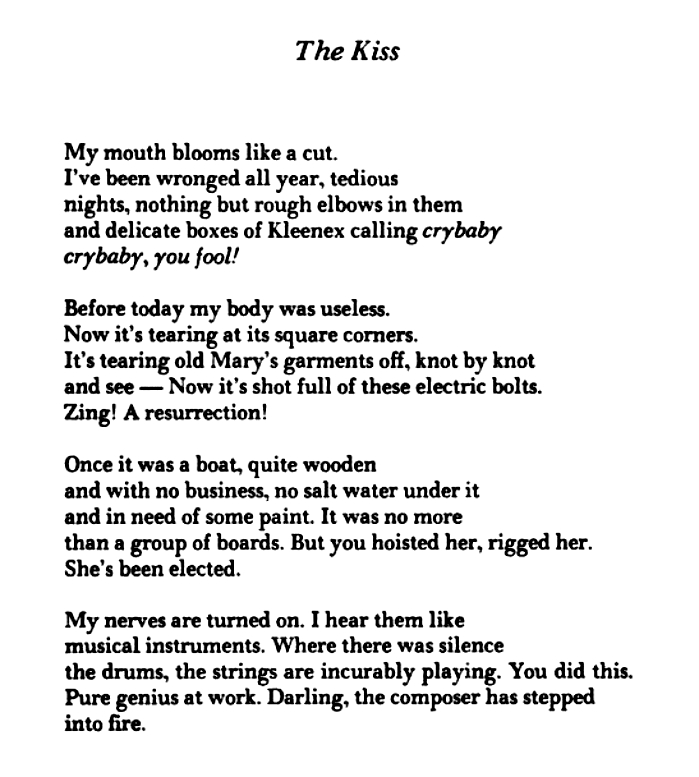
“The Kiss” — Anne Sexton

kiss

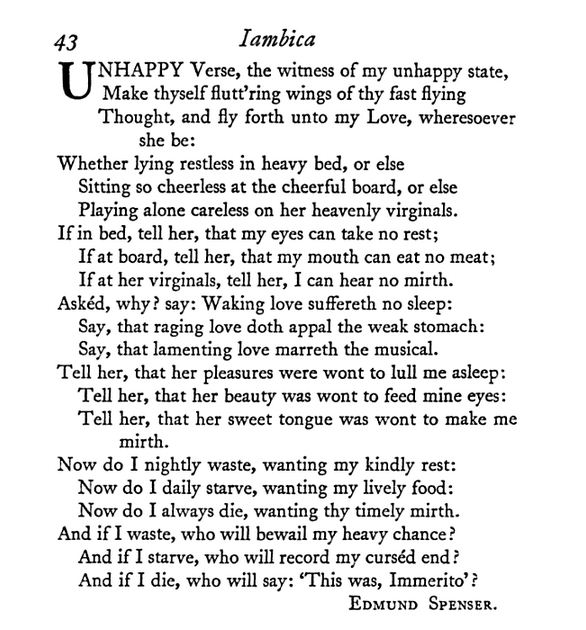
“Iambica” — Edmund Spenser

imabica

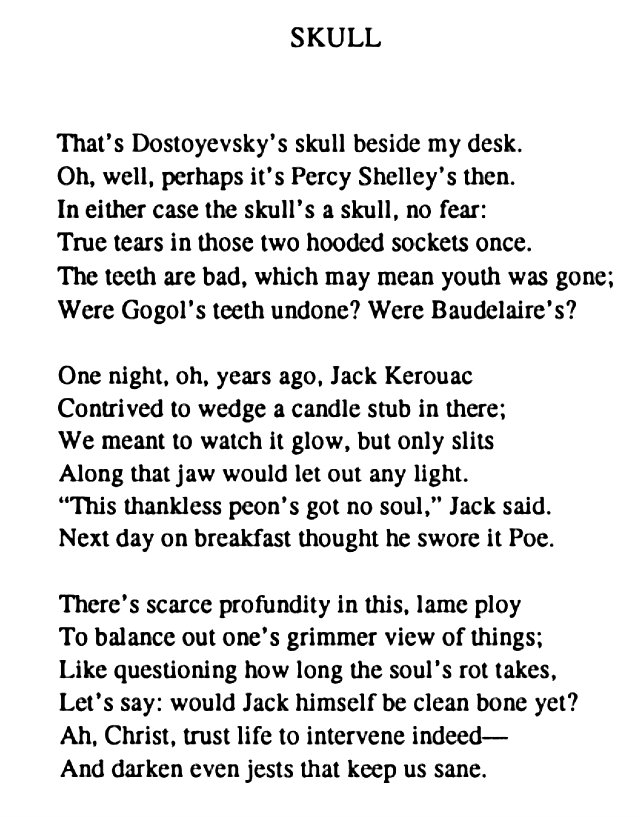
“Skull” — David Markson

skull

(Via).

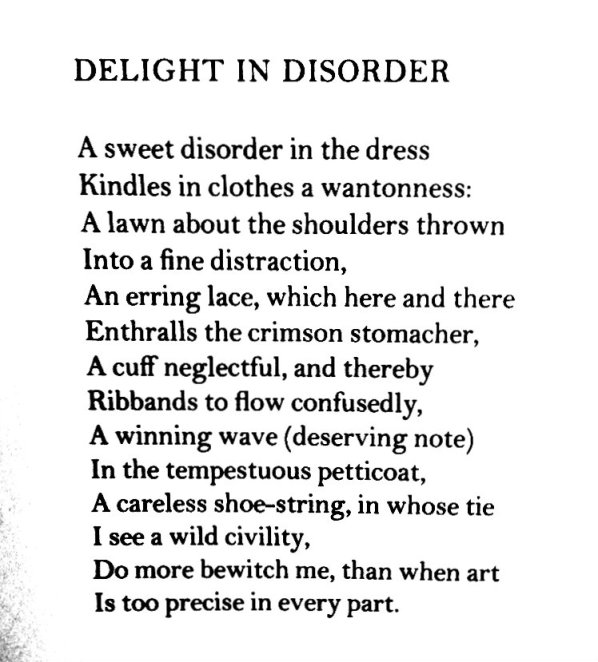
“Delight in Disorder” — Robert Herrick

herrick

“Openin’ Night” — Shel Silverstein

“Openin’ Night” by Shel Silverstein—

She had the jitters
She had the flu
She showed up late
She missed her cue
She kicked the director
She screamed at the crew
And tripped on a prop
And fell in some goo
And ripped her costume
A place or two
Then she forgot
A line she knew
And went “Meow”
Instead of “Moo”
She heard ‘em giggle
She heard ‘em boo
The programs sailed
The popcorn flew
As she stomped offstage
With a boo-hoo-hoo
The fringe of the curtain
Got caught in her shoe
The set crashed down
The lights did too
Maybe that’s why she didn’t want to do
An interview.

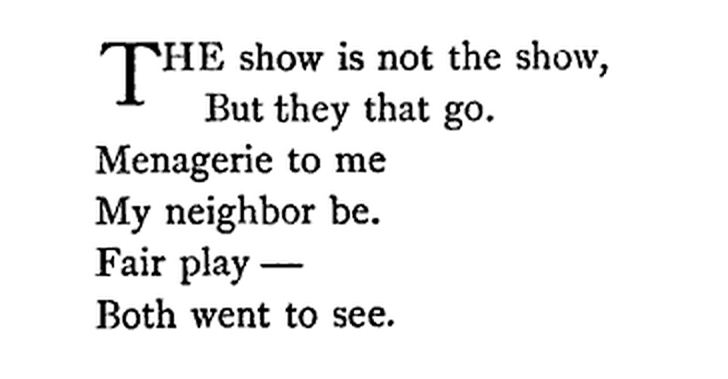
“The show is not the show” — Emily Dickinson

ed

“Giant Snail” — Elizabeth Bishop

“Giant Snail” by Elizabeth Bishop

The rain has stopped. The waterfall will roar like that all
night. I have come out to take a walk and feed. My body–foot,
that is–is wet and cold and covered with sharp gravel. It is
white, the size of a dinner plate. I have set myself a goal, a
certain rock, but it may well be dawn before I get there.
Although I move ghostlike and my floating edges barely graze
the ground, I am heavy, heavy, heavy. My white muscles are
already tired. I give the impression of mysterious ease, but it is
only with the greatest effort of my will that I can rise above the
smallest stones and sticks. And I must not let myself be dis-
tracted by those rough spears of grass. Don’t touch them. Draw
back. Withdrawal is always best.
The rain has stopped. The waterfall makes such a noise! (And
what if I fall over it?) The mountains of black rock give off such
clouds of steam! Shiny streamers are hanging down their sides.
When this occurs, we have a saying that the Snail Gods have
come down in haste. I could never descend such steep escarp-
ments, much less dream of climbing them.
That toad was too big, too, like me. His eyes beseeched my
love. Our proportions horrify our neighbors.
Rest a minute; relax. Flattened to the ground, my body is like
a pallid, decomposing leaf. What’s that tapping on my shell?
Nothing. Let’s go on.
My sides move in rhythmic waves, just off the ground, from
front to back, the wake of a ship, wax-white water, or a slowly
melting floe. I am cold, cold, cold as ice. My blind, white bull’s
head was a Cretan scare-head; degenerate, my four horns that
can’t attack. The sides of my mouth are now my hands. They
press the earth and suck it hard. Ah, but I know my shell is
beautiful, and high, and glazed, and shining. I know it well,
although I have not seen it. Its curled white lip is of the finest
enamel. Inside, it is as smooth as silk, and I, I fill it to perfection.
My wide wake shines, now it is growing dark. I leave a lovely
opalescent ribbon: I know this.
But O! I am too big. I feel it. Pity me.
If and when I reach the rock, I shall go into a certain crack
there for the night. The waterfall below will vibrate through
my shell and body all night long. In that steady pulsing I can
rest. All night I shall be like a sleeping ear.

“What lips my lips have kissed, and where, and why” — Edna St. Vincent Millay

esvm

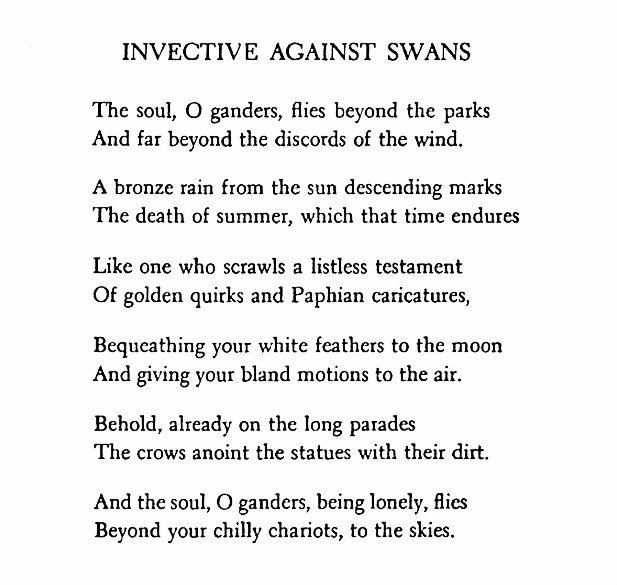
“Invective Against Swans” — Wallace Stevens

Capture

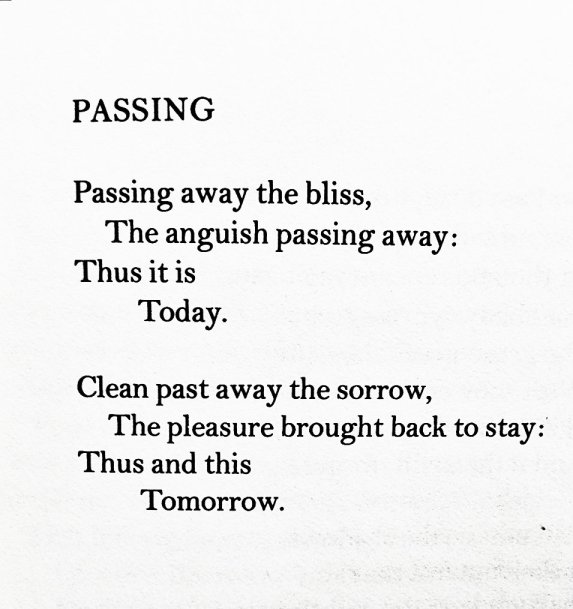
“Passing” — Christina Rossetti

passing

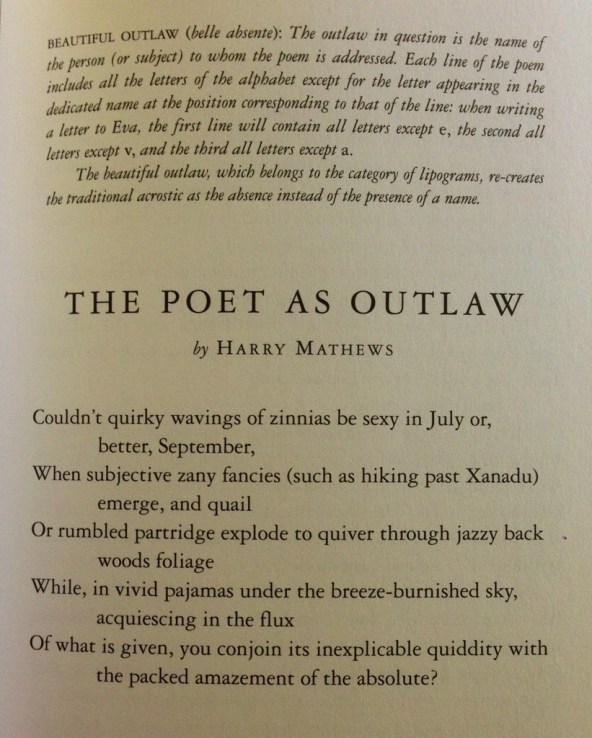
“The Poet as Outlaw” — Harry Mathews

20130527-113327.jpg

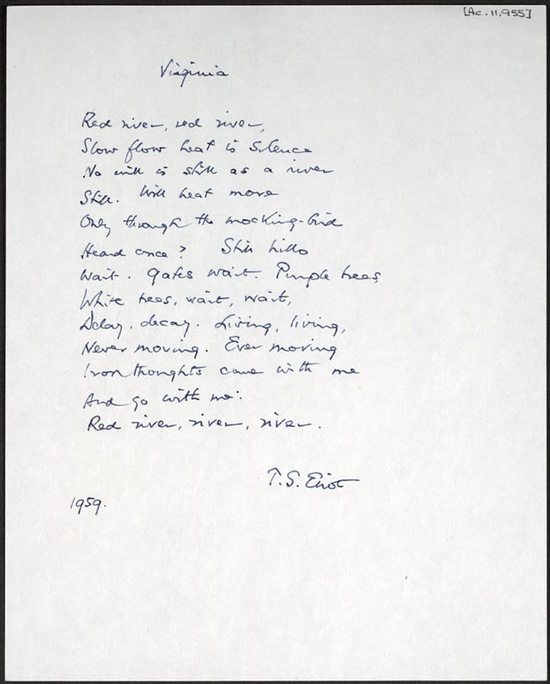
T.S. Eliot’s Handwritten Manuscript for “Virginia”

virginia_eliot

Red river, red river,
Slow flow heat is silence
No will is still as a river
Still. Will heat move
Only through the mocking-bird
Heard once? Still hills
Wait. Gates wait. Purple trees,
White trees, wait, wait,
Delay, decay. Living, living,
Never moving. Ever moving
Iron thoughts came with me
And go with me:
Red river, river, river.


(Via).

“To Some Ladies” — John Keats

keats

“After Death” — Christina Rossetti

IMG_5619

“Out, Out—” — Robert Frost

“Out, Out—” by Robert Frost

The buzz-saw snarled and rattled in the yard
And made dust and dropped stove-length sticks of wood,
Sweet-scented stuff when the breeze drew across it.
And from there those that lifted eyes could count
Five mountain ranges one behind the other
Under the sunset far into Vermont.
And the saw snarled and rattled, snarled and rattled,
As it ran light, or had to bear a load.
And nothing happened: day was all but done.
Call it a day, I wish they might have said
To please the boy by giving him the half hour
That a boy counts so much when saved from work.
His sister stood beside them in her apron
To tell them “Supper.” At the word, the saw,
As if to prove saws knew what supper meant,
Leaped out at the boy’s hand, or seemed to leap—
He must have given the hand. However it was,
Neither refused the meeting. But the hand!
The boy’s first outcry was a rueful laugh,
As he swung toward them holding up the hand
Half in appeal, but half as if to keep
The life from spilling. Then the boy saw all—
Since he was old enough to know, big boy
Doing a man’s work, though a child at heart—
He saw all spoiled. “Don’t let him cut my hand off—
The doctor, when he comes. Don’t let him, sister!”
So. But the hand was gone already.
The doctor put him in the dark of ether.
He lay and puffed his lips out with his breath.
And then—the watcher at his pulse took fright.
No one believed. They listened at his heart.
Little—less—nothing!—and that ended it.
No more to build on there. And they, since they
Were not the one dead, turned to their affairs

“Meiosis” — W.H. Auden

meiosis