

Tag: Poetry
“Leda” — Robert Graves
“On the Back of a Photograph” — János Pilinszky
“Alone” — Edgar Allan Poe

“Doing, a filthy pleasure is, and short” — Petronius
“The Discharged Soldier” — William Wordsworth
“The Discharged Soldier” by William Wordsworth:
No living thing appeared in earth or air,
And, save the flowing water’s peaceful voice,
Sound there was none–but, lo! an uncouth shape,
Shown by a sudden turning of the road,
So near that, slipping back into the shade
Of a thick hawthorn, I could mark him well,
Myself unseen. He was of stature tall,
A span above man’s common measure, tall,
Stiff, lank, and upright; a more meagre man
Was never seen before by night or day.
Long were his arms, pallid his hands; his mouth
Looked ghastly in the moonlight: from behind,
A mile-stone propped him; I could also ken
That he was clothed in military garb,
Though faded, yet entire. Companionless,
No dog attending, by no staff sustained,
He stood, and in his very dress appeared
A desolation, a simplicity,
To which the trappings of a gaudy world
Make a strange back-ground. From his lips, ere long,
Issued low muttered sounds, as if of pain
Or some uneasy thought; yet still his form
Kept the same awful steadiness–at his feet
His shadow lay, and moved not. From self-blame
Not wholly free, I watched him thus; at length
Subduing my heart’s specious cowardice,
I left the shady nook where I had stood
And hailed him. Slowly from his resting-place
He rose, and with a lean and wasted arm
In measured gesture lifted to his head
Returned my salutation; then resumed
His station as before; and when I asked
His history, the veteran, in reply,
Was neither slow nor eager; but, unmoved,
And with a quiet uncomplaining voice,
A stately air of mild indifference,
He told in few plain words a soldier’s tale–
That in the Tropic Islands he had served,
Whence he had landed scarcely three weeks past;
That on his landing he had been dismissed,
And now was travelling towards his native home.
This heard, I said, in pity, “Come with me.”
He stooped, and straightway from the ground took up
An oaken staff by me yet unobserved–
A staff which must have dropped from his slack hand
And lay till now neglected in the grass.
Though weak his step and cautious, he appeared
To travel without pain, and I beheld,
With an astonishment but ill suppressed,
His ghostly figure moving at my side;
Nor could I, while we journeyed thus, forbear
To turn from present hardships to the past,
And speak of war, battle, and pestilence,
Sprinkling this talk with questions, better spared,
On what he might himself have seen or felt.
He all the while was in demeanour calm,
Concise in answer; solemn and sublime
He might have seemed, but that in all he said
There was a strange half-absence, as of one
Knowing too well the importance of his theme,
But feeling it no longer. Our discourse
Soon ended, and together on we passed
In silence through a wood gloomy and still.
Up-turning, then, along an open field,
We reached a cottage. At the door I knocked,
And earnestly to charitable care
Commended him as a poor friendless man,
Belated and by sickness overcome.
Assured that now the traveller would repose
In comfort, I entreated that henceforth
He would not linger in the public ways,
But ask for timely furtherance and help
Such as his state required. At this reproof,
With the same ghastly mildness in his look,
He said, “My trust is in the God of Heaven,
And in the eye of him who passes me!”The cottage door was speedily unbarred,
And now the soldier touched his hat once more
With his lean hand, and in a faltering voice,
Whose tone bespake reviving interests
Till then unfelt, he thanked me; I returned
The farewell blessing of the patient man,
And so we parted. Back I cast a look,
And lingered near the door a little space,
Then sought with quiet heart my distant home.
“Lay of Ill Luck” — W.G. Sebald

“To a Friend Whose Work Has Come to Triumph” — Anne Sexton
“The Non-Entity” — William Carlos Williams

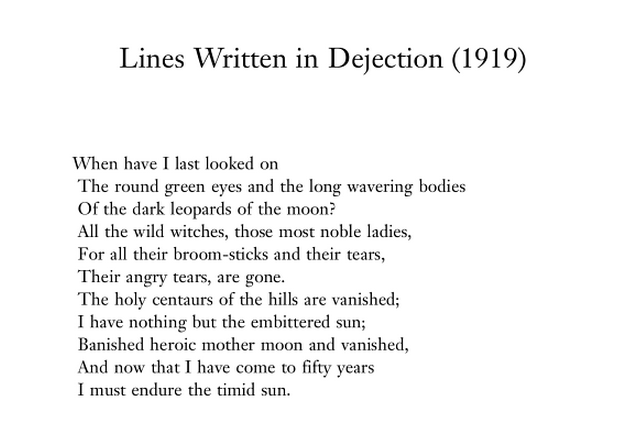
“All the wild witches” (Yeats)
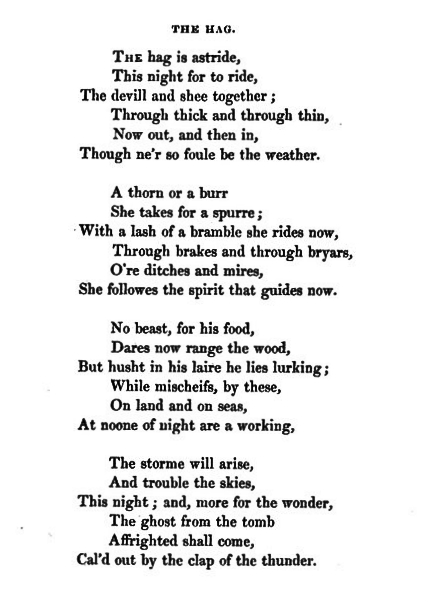
“The Hag” — Robert Herrick
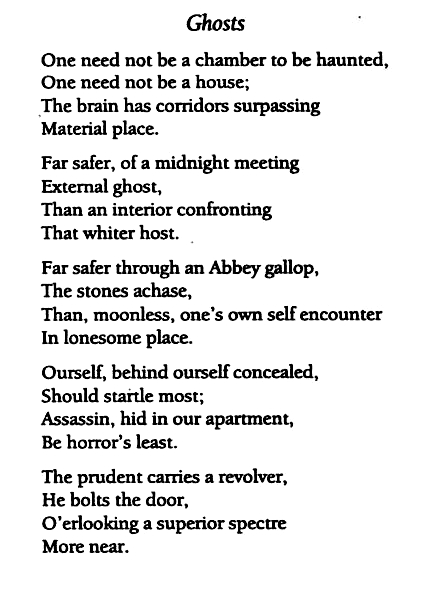
“One need not be a chamber to be haunted” — Emily Dickinson
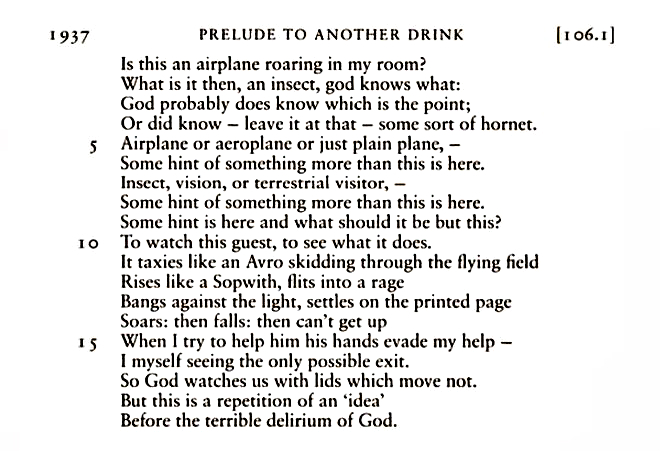
“Prelude to Another Drink” — Malcolm Lowry
“The air is the only true conscience, do you understand me?” (Thomas Bernhard)
We came out of the larch wood, making for the village and beyond into the deep forest. I was leading the way. The painter followed me, all the time I had the sense he’s about to lay into me, he’ll attack me from behind. I don’t know what prompted me to think that way, but I was unable to lose the fear that was oozing out of me. From time to time I picked up a word he was saying, it was completely incomprehensible to me, I couldn’t answer him when he asked me something, because really he was only asking himself. He growled at me: “Kindly stop when I ask you a question!” I stopped. “Come here!” he commanded. Suddenly I realized (it was in his tone, and I felt only I was in a position to realize this) the resemblance to his brother, the assistant. He said: “The air is the only true conscience, do you understand me?” I replied: “I don’t understand you.”—“The air, I say, is the only true science!” he repeated. I still didn’t understand, but nodded anyway. He said: “The gesture of the air, the great aerial gesture, you understand. The nightmarish sweat of fear, that’s the air.” I told him that was a great thought. In my opinion it was even poetry, to me what he had just said was the distillation of all memory, of all possibility. “Poetry is nothing!” he said. “Poetry as you understand it is nothing. Poetry as the world understands it, as the poetry hound understands it, is nothing. No, this poetry is nothing! The poetry that I have in mind is something else. If you meant that poetry, then you’d be right. Then I’d have to embrace you!” I said: “What is your poetry?”—“My poetry isn’t my poetry. But if you mean my poetry, then I’ll have to admit I’m unable to offer you a description of it. You see, my poetry, which is the only poetry, and therefore also the only truth, just as much as the only truth that I find in the air, which I feel in the air, which is the air, this poetry of mine is always generated at the center of its own thought, which is all its own. This poetry is momentary, is instantaneous. And therefore it isn’t. It is my poetry.”—“Yes,” I said, “it is your poetry.” I had understood nothing of what he had said. “Let’s go on,” he said, “it’s cold. The cold is eating into the center of my brain. If only you knew how far the cold had already advanced into my brain. The insatiable cold, the cold that insists on its bloody nourishment of cells, that insists on my brain, on everything that could make anything, could become anything. You see,” he said, “the brain, the skull and the brain within it, are an incredible irresponsibility, a dilettantism, a lethal dilettantism, that’s what I want to say. One’s forces are attacked, the cold bites into my forces, into my human forces, into the lofty muscle power of reason. It’s this ancient tourism of cold, billions of years old, this exploitative and pernicious tourism, that penetrates my brain, the entry of frost … There is,” he said, “no longer the category of ‘secret,’ it doesn’t exist, everything is just frigor mortis. I see the cold, I can write it down, I can dictate it, it’s killing me …” In the village, he popped into the abattoir. He said: “Cold is one of the great A-truths, the greatest of all the A-truths, and therefore it is all truths rolled into one. Truth is always a process of extermination, you must understand. Truth leads downhill, points downhill, truth is always an abyss. Untruth is a climbing, an up, untruth is no death, as truth is death, untruth is no abyss, but untruth is not A-truth, you understand: the great infirmities do not approach us from outside, the great infirmities have been within us, surprisingly, for millions of years …” He says, staring through the open abattoir doors: “There it is clearly in front of you, broken open, sliced apart. And there’s the scream as well, of course! If you listen, you’ll catch the scream as well. You will still hear the scream, even though the facility for the production of the scream is dead, is severed, chopped up, ripped open. The vocal cords have been rendered, but the scream is still there! It’s a grotesque realization that the vocal cords have been smashed, chopped up, sliced apart, and the scream is still there. That the scream is always there. Even if all the vocal cords have been chopped up and sliced apart, are dead, all the vocal cords in the world, all the vocal cords of all the worlds, all the imaginations, all the vocal cords of every creature, the scream is always there, is always still there, the scream cannot be chopped up, cannot be cut through, the scream is the only eternal thing, the only infinite thing, the only ineradicable thing, the only constant thing … The lesson of humanity and inhumanity and human opinions, and of the great human silence, the lesson of the great memory protocol of the great being, should all be tackled through the abattoir! Schoolchildren should not be brought to heated classrooms, they should be made to attend abattoirs; it is only from abattoirs that I expect understanding of the world and of the world’s bloody life. Our teachers should do their work in abattoirs. Not read from books, but swing hammers, wield saws, and apply knives … Reading should be taught from the coiled intestines, and not from useless lines in books … The word ‘nectar’ should be traded in forthwith for the word ‘blood’ … You see,” said the painter, “the abattoir is the only essentially philosophical venue. The abattoir is the classroom and the lecture hall. The only wisdom is abattoir wisdom! A-truth, truth, untruth, all added up come to the vast abattoir immatriculation, which I would like to make compulsory for humans, for new humans, and those tempted to become humans. Knowledge in the world is not abattoir knowledge, and it lacks thoroughness. The abattoir makes possible a radical philosophy of thoroughness.” We had gone into the slaughterhouse. “Let’s go,” said the painter, “in me the smell of blood turns into the extraordinary, the smell of blood is the only parity. Let’s go, otherwise I should have to uproot the possibility of new intellectual disciplines from my own thinking materiality, and I don’t have the strength for that.” He took large steps, and said: “The beast bleeds for the human, and knows it. Meanwhile the human doesn’t bleed for the beast, and doesn’t know it. The human is the incomplete beast, the beast could be fully human. Do you understand what I mean: the one is disproportionate to the other, the one is massively dark to the other. Neither is for the other. Neither excludes the other.”
From Thomas Bernhard’s novel Frost.
“The Tea Shop” — Ezra Pound

“Leda and the Swan” — W.B. Yeats

“She” — Tom Clark

 Biblioklept