Gravity’s Rainbow — annotations and illustrations for pages 627-28 | Our optimum time is 8 May

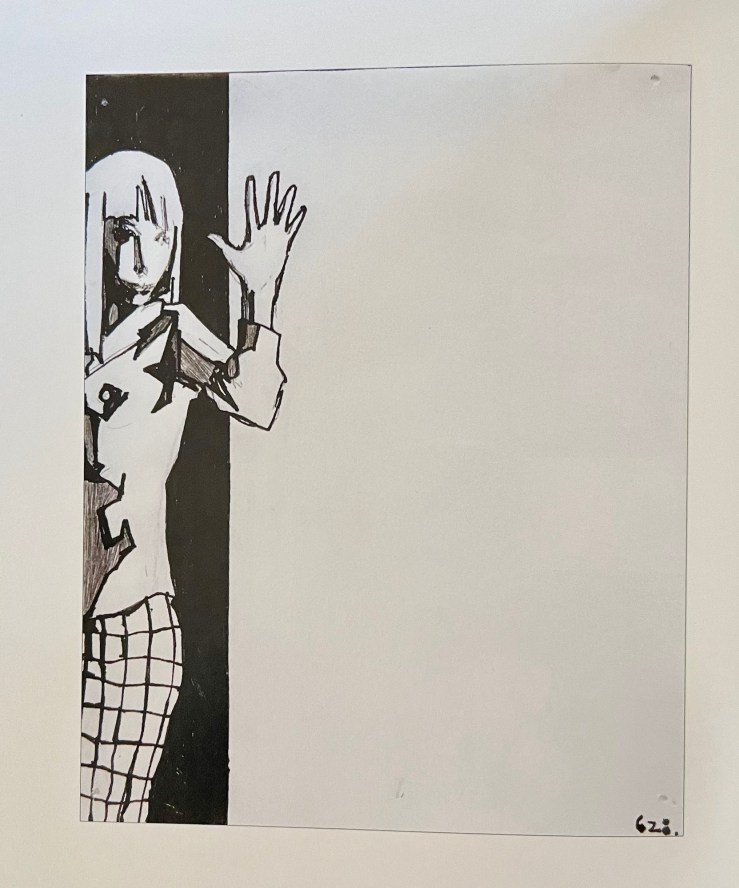
Page 628 from Zak Smith’s Pictures Showing What Happens on Each Page of Thomas Pynchon’s Novel Gravity’s Rainbow (2006)

A week before she1 left, she came out to “The White Visitation”2 for the last time. Except for the negligible rump of PISCES, the place was a loony bin again. The barrage-balloon cables3 lay rusting across the sodden meadows, going to flakes, to ions and earth4—tendons that sang in the violent nights, among the sirens wailing in thirds smooth as distant wind, among the drumbeats of bombs, now lying slack, old, in hard twists of metal ash. Forget-me-nots boil everywhere underfoot, and ants crowd, bustling with a sense of kingdom. Commas, brimstones, painted ladies coast on the thermoclines along the cliffs.5 Jessica has cut fringes since Roger saw her last, and is going through the usual anxiety—“It looks utterly horrible, you don’t have to say it. . . .”

“It’s utterly swoony,” sez Roger, “I love it.”

“You’re making fun.”

“Jess, why are we talking about haircuts for God’s sake?”6

While somewhere, out beyond the Channel, a barrier difficult as the wall of Death7 to a novice medium, Leftenant Slothrop, corrupted, given up on, creeps over the face of the Zone. Roger doesn’t want to give him up: Roger wants to do what’s right. “I just can’t leave the poor twit out there, can I? They’re trying to destroy him—”8

But, “Roger,” she’d smile, “it’s spring. We’re at peace.”9

No, we’re not. It’s another bit of propaganda. Something the P.W.E. planted10. Now gentlemen as you’ve seen from the studies our optimum time is 8 May11, just before the traditional Whitsun exodus, schools letting out, weather projections for an excellent growing season, coal requirements beginning their seasonal decline, giving us a few months’ grace to get our Ruhr interests back on their feet—no, he sees only the same flows of power, the same impoverishments he’s been thrashing around in since ’3912. His girl is about to be taken away to Germany, when she ought to be demobbed like everyone else. No channel upward that will show either of them any hope of escape13. There’s something still on, don’t call it a “war” if it makes you nervous, maybe the death rate’s gone down a point or two, beer in cans is back at last and there were a lot of people in Trafalgar Square one night not so long ago . . . but Their enterprise goes on.

The sad fact, lacerating his heart, laying open his emptiness, is that Jessica believes Them14. “The War” was the condition she needed for being with Roger. “Peace” allows her to leave him. His resources, next to Theirs, are too meager.

1 The she here, for those wishing to tune in, is Jessica Swanlake, who has decided post-War to return to her normie roots: she will choose a petite bourgeoisie life with Beaver/Jeremy, and reject Roger Mexico (and, implicitly, refuse the Counterforce and the mission to save Tyrone Slothrop).

2 Normally wouldn’t give a gloss for this, as its so late in the novel, but it’s been like eight years since I’ve done one of these, so: Pynchon Wiki gives the following description for the White Visitation:

former mental hospital located in the fictional town of Ick Regis on the coast of southern England; now part of SOE [Special Operations Executive; aka the “Firm”]; location of PISCES; D-Wing still has “loonies”; “devoted to psychological warfare”

I like to imagine The White Visitation as a kind X-Men scenario–or, more geekily, an X-Force scenario–a group of the freaky preterite using their weird powers for Maybe Good. But at this point, post eurowar, it’s all over, a “negligible rump” to be absorbed into post-war administrative Control.

3 I’ve read Gravity’s Rainbow like half a dozen times and rusting barrage-balloon cables is the kind of image I just keep going past, just kinda sorta like, letting my imagination fill in the details. But doing these posts makes me stop and look around a bit. A description from Keith Thomson’s website:

Barrage balloons are large balloons tethered to the ground or the deck of a ship with metal cables. They are deployed as a defense against low-level air attack, damaging aircraft on collision with the cables or, at the least, making flying in the vicinity treacherous.

1940s Barrage Balloon At The Kew Bridge Steam Museum, London. Jim Linwood.

4 Everything in the Zone is disintegrating–including Our Hero Tyrone Slothrop.

5 “Commas, brimstones, painted ladies coast on the thermoclines along the cliffs” — an absolutely gorgeous sentence, and also one we might pass over at this fragmented, surreal section of the novel as a bit of surrealist poetry.

But it’s not—these are butterflies. From Pynchon Wiki:

627.28-29 Commas, brimstones, painted ladies
Three taxa of butterflies. The Comma (Polygonia c-album) is one of the anglewings; sulfur-yellow brimstones are in the genus Gonepteryx in the family Pieridae; painted ladies are in the genus Vanessa. The Comma is named for a so-shaped white mark on the underside of its hindwing; a similarly-marked North American congener is called the Question Mark (P. interrogationis).
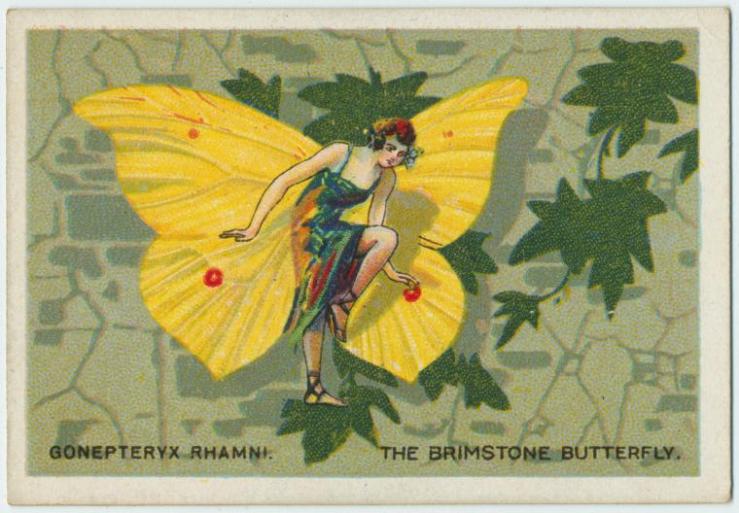
Cigarette card depicting a fanciful “brimstone butterfly”

6 “Can’t say it often enough–change your hair, change your life,” Inherent Vice.

7 “Wall of Death,” Richard and Linda Thompson, 1982:

Let me ride on the Wall of Death one more time / You can waste your time on the other rides / This is the nearest to being alive / Oh let me take my chances on the Wall of Death / You can go with the crazy people in the Crooked House / You can fly away on the Rocket or spin in the Mouse / The Tunnel of Love might amuse you / Noah’s Ark might confuse you / But let me take my chances on the Wall of Death

8 Every time I go through Gravity’s Rainbow, I find Slothrop’s fate more distressing and dispiriting—but also more inspiring. I think what’s important to remember here is that Roger Mexico is a numbers guy, a statistics guy—in 2024 terms, he might be a spreadsheet guy, a potential money guy. But he finds himself dedicated to Something Bigger Even If It Destroys Him, which means dedicating hope to the ever-fragmenting figure of Tyrone Slothrop, who, through his dispersal, might sow new seeds.

9 A devastating reversal of “They are in love. Fuck the war,” the lines we get from our first meeting of the failed lovers.

10 Political Warfare Executive (an iteration of Them). From Pynchon Wiki:

In 1940, MIR and Section D were combined with the War Office to form the Special Operations Executive (SOE). A “black” (sub rosa) propaganda section of SOE, created by the Foreign Office and named “Electra House,” was attached to the SOE in 1940 to become the Political Warfare Executive (PWE), charged with political and psychological warfare.

11 Thomas Ruggles Pynchon was born on 8 May 1937. Today is his 87th birthday.

If you’re the kinda weirdo who likes to celebrate Pynchon’s work and legacy, indulge in Pynchon in Public Day.

Steven Weisenburger’s 2nd’ edition of the Companion gives the following gloss on the date:

8 May, just before the traditional Whitsun exodus. Recall that part 2 ends with Pointsman and crew spending “Whitsun by the sea” (V269.26n). This traditional British holiday weekend fell on May 20 in 1945.

12 Roger Mexico “sees only the same flows of power, the same impoverishments” that he’s seen throughout the war. Unlike Jessica, he’s hep now to the knowledge that “the real business of the War is buying and selling.”

13 Pynchon here reiterates one of GR’s central themes, of the preterite vs the elect, of a “channel upward” or crashing down. The theme permeates the book, right from its opening lines. Consider the novel’s fourth sentence “The Evacuation still proceeds, but it’s all theatre.” The opening “evacuation” scene is surreal and apocalyptic, with each potential evacuee hearing an inner voice that cruelly coos, “You didn’t really believe you’d be saved. Come, we all know who we are by now. No one was ever going to take the trouble to save you, old fellow. . . .” The narrator’s very early note that “it’s all theatre” is one of Pynchon’s central diagnoses of power in GR, and one that not every character comes to fully understand. As if to underline that it’s all kayfabe, Pynchon ends GR by introducing a new character, Richard M. Zhlubb, a parody of Nixon. Zhlubb is the night manager of the Orpheus Theatre.

14 I think what finally most breaks Roger’s heart isn’t the loss of Jessica, but that “Jessica believes Them.” She’s subscribed to the theater of “war” and “peace,” an illusion that can no longer comfort Roger.
A few sentences on every Thomas Pynchon novel to date

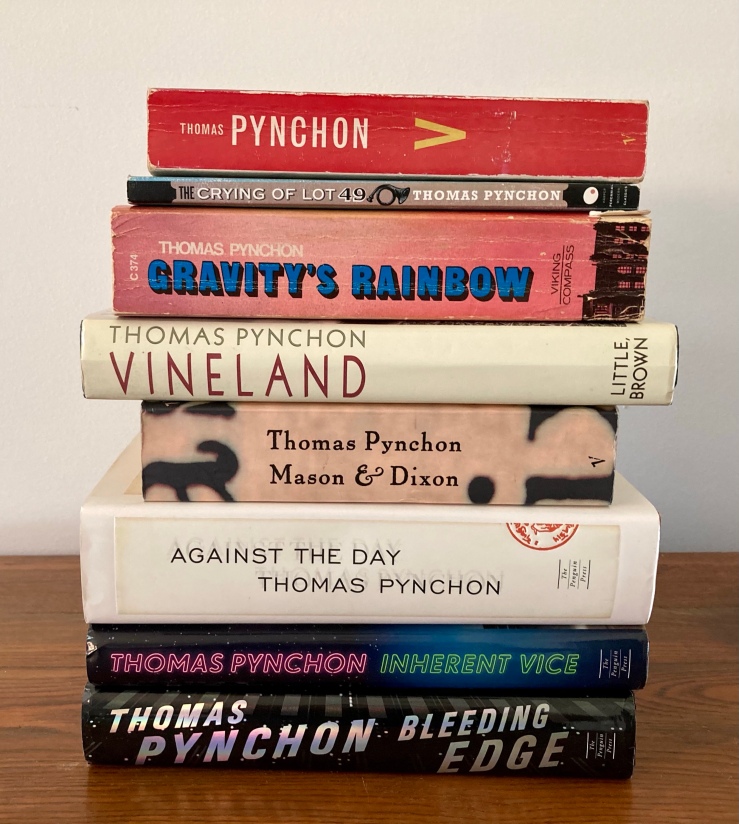
Today, 8 May 2022, is Thomas Ruggles Pynchon’s 85th birthday. Some of us nerds celebrate the work of one of the world’s greatest living authors with something called Pynchon in Public Day. In the past I’ve rounded up links to Pynchon stuff on Biblioklept and elsewhere. To celebrate, here are short riffs on Pynchon’s eight novels:

V. (1963)

I reread Pynchon’s first novel for the first time last year and found it far more achieved than I had remembered. For years I’ve always recalled it as a dress rehearsal for the superior and more complex Gravity’s Rainbow. And while V. certainly points in GR’s direction, even sharing some characters, it’s nevertheless its own entity. I first read V. as a very young man, and as I recall, thought it scattershot, zany, often very funny, but also an assemblage of set pieces that fail to cohere. Rereading it two decades later I can see that there’s far more architecture to its plot, a twinned, yoyoing plot diagrammed in the novel’s title. The twin strands allow Pynchon to critique modernism on two fronts, split by the world wars that mark the first half of the twentieth century. It’s a perfect starting point for anyone new to Pynchon, and its midpoint chapter, “Mondaugen’s Story,” is as good as anything else he’s written.

The Crying of Lot 49 (1966)

Pynchon’s shortest novel is not necessarily his most accessible: Crying is a dense labyrinth to get lost in. At times Pynchon’s second novel feels like a parody of L.A. detective noir (a well he’d return to in Inherent Vice), but there’s plenty of pastiche going on here as well. For example, at one point we are treated to a Jacobean revenge play, The Courier’s Tragedy, which serves as a kind of metatextual comment on the novel’s plot about a secret war between secret armies of…letter carriers. The whole mailman thing might seem ridiculous, but Pynchon’s zaniness is always doubled in sinister paranoia: The Crying of Lot 49 is a story about how information is disseminated, controlled, and manipulated. Its end might frustrate many readers. We never get to hear the actual crying of lot 49 (just as we never discover the “true” identity of V in V.): fixing a stable, centered truth is an impossibility in the Pynchonverse.

Gravity’s Rainbow (1973)

Unbelievably rich, light, dark, cruel, loving, exasperating, challenging, and rewarding, Pynchon’s third novel is one of a handful of books that end up on “difficult novel” lists that is actually difficult. The difficulty though has everything to do with how we expect a novel to “happen” as we read—Gravity’s Rainbow is an entirely new thing, a literature that responds to the rise of mass media as modernist painters had to respond to the advent of photography and moving pictures. The key to appreciating and enjoying Gravity’s Rainbow, in my estimation, is to concede to the language, to the plasticity of it all, with an agreement with yourself to immediately reread it all.

Vineland (1990)

It took Pynchon a decade and a half to follow up Gravity’s Rainbow. I was a boy when Vineland came out—it was obviously nowhere on my radar (I think my favorite books around this time would probably have been The Once and Future King, The Lord of the Rings trilogy, and likely a ton of Dragonlance novels). I do know that Vineland was a disappointment to many fans and critics, and I can see why. At the time, novelist David Foster Wallace neatly summed it up in a letter to novelist Jonathan Franzen: “I get the strong sense he’s spent 20 years smoking pot and watching TV.” Vineland is angry about the Reagan years, but somehow not angry enough. The novel’s villain Brock Vond seems to prefigure the authoritarian police detective Bigfoot Bjornsen of Inherent Vice, but Pynchon’s condemnation of Vond never quite reconciles with his condemnation of the political failures of the 1960s.  Vineland is ultimately depressing and easily my least-favorite Pynchon novel, but it does have some exquisite prose moments.

Mason & Dixon (1997)

If Mason & Dixon isn’t Pynchon’s best book, it has to be 1A to Gravity’s Rainbow’s 1. The novel is another sprawling epic, a loose, baggy adventure story chronicling Charles Mason and Jeremiah Dixon’s Enlightenment effort to survey their bit of the Western World. Mason & Dixon presents an initial formal challenge to its reader: the story is told in a kind of (faux) 18th-century vernacular. Diction, syntax, and even punctuation jostle the contemporary ear. However, once you tune your ear to the (perhaps-not-quite-so-trustworthy) tone of Rev. Wicks Cherrycoke (who tells this tall tall tale), Mason & Dixon somehow becomes breezy, jaunty, even picaresque. It’s jammed with all sorts of adventures: the talking Learned English Dog, smoking weed with George Washington, Gnostic revelations, Asiatic Pygmies who colonize the missing eleven days lost when the British moved from the Julian to the Gregorian calendar…Wonderful stuff. But it’s really the evocation of a strange, hedged, incomplete but loving friendship that comes through in Mason & Dixon.

Against the Day (2006)

Oof. She’s a big boy. At over a thousand pages, Against the Day is Pynchon’s longest novel. Despite its size, I think Against the Day is the best starting point for Pynchon. It offers a surprisingly succinct and clear summation of his major themes, which might be condensed to something like: resist the military-industrial-entertainment-complex, while also showing off his rhetorical power. It’s late period Pynchon, but the prose is some of his strongest stuff. The songs are tight, the pastiche is tighter, and the novel’s epic sweep comes together in the end, resolving its parodic ironies with an earnest love that I believe is the core of Pynchon’s worldview. I forgot to say what it’s about: It’s about the end of the nineteenth century, or, more accurately, the beginning of the twentieth century.

Inherent Vice (2009)

Inherent Vice is a leaner work than its two predecessors, but could stand to be leaner still. The book pushes towards 400 pages but would probably be stronger at 200—or 800. I don’t know. In any case, Inherent Vice is a goofy but sinister stoner detective jaunt that frags out as much as its protagonist, PI Doc Sportello. Paul Thomas Anderson’s film adaptation finds its way through those fragments to an end a bit different from Pynchon’s original (which is closer to an echo of the end of The Crying of Lot 49)—PTA’s film finds its emotional resolution in the restoration of couple—not the main couple, but adjacent characters—an ending that Pynchon pulled in his first novel V.

Bleeding Edge (2013)

While Bleeding Edge was generally well received by critics, it’s not as esteemed as his major works. I think that the novel is much, much better than its reputation though (even its reputation among Pynchon fans). Pynchon retreads some familiar plot territory—this is another detective novel, like Crying and Inherent Vice—but in many ways he’s doing something wholly new here: Bleeding Edge is his Dot Com Novel, his 9/11 Novel, and his New York Novel. It’s also probably his domestic novel, and possibly (dare I?) his most autobiographical, or at least autobiographical in the sense of evoking life with teenagers in New York City, perhaps drawing on material from his own life with wife and son in the city. It’s good stuff, but I really hope we get one more.

[Ed. note–Biblioklept ran a version of this post on 8 May 2021.]

A few sentences on every Thomas Pynchon novel to date

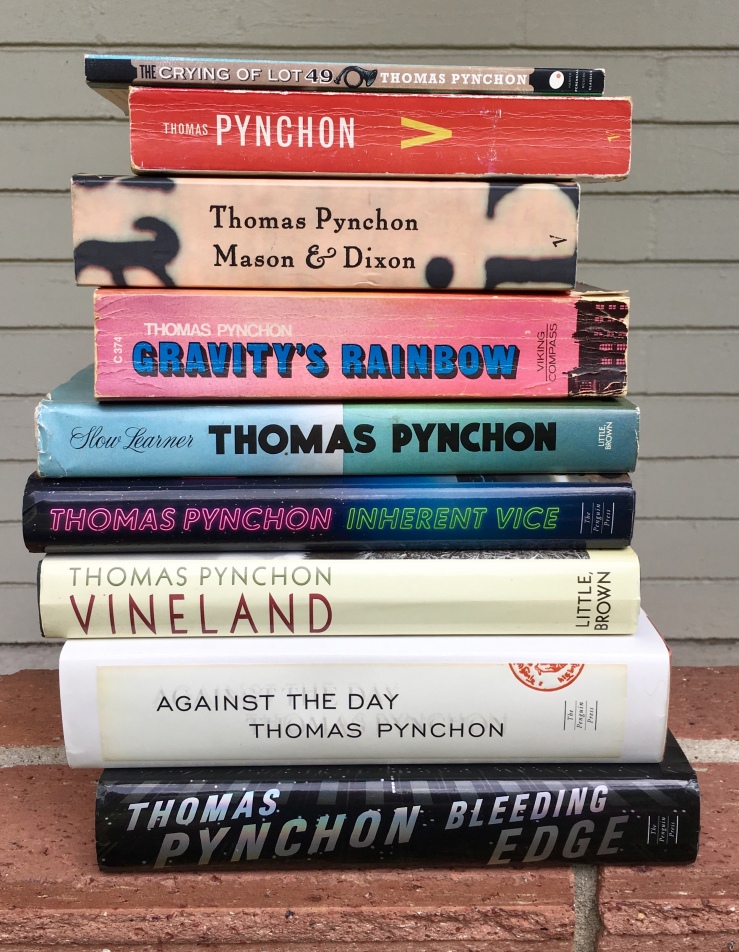
Today, 8 May 2021, is Thomas Ruggles Pynchon’s 84th birthday. Some of us nerds celebrate the work of one of the world’s greatest living authors with something called Pynchon in Public Day. In the past I’ve rounded up links to Pynchon stuff on Biblioklept and elsewhere. Last year, that weird pandemic year, I finally finished all of Pynchon’s novels. I’d been “saving” Bleeding Edge for a while, but broke down and read it that spring. Having read all eight Pynchon novels (a few more than once), I’ll offer some quick scattershot thoughts.

V. (1963)

I reread Pynchon’s first novel for the first time last month and found it far more achieved than I had remembered. For years I’ve always recalled it as a dress rehearsal for the superior and more complex Gravity’s Rainbow. And while V. certainly points in GR’s direction, even sharing some characters, it’s nevertheless its own entity. I first read V. as a very young man, and as I recall, thought it scattershot, zany, often very funny, but also an assemblage of set pieces that fail to cohere. Rereading it two decades later I can see that there’s far more architecture to its plot, a twinned, yoyoing plot diagrammed in the novel’s title. The twin strands allow Pynchon to critique modernism on two fronts, split by the world wars mark the first half of the twentieth century. It’s a perfect starting point for anyone new to Pynchon, and its midpoint chapter, “Mondaugen’s Story,” is as good as anything else he’s written.

The Crying of Lot 49 (1966)

Pynchon’s shortest novel is not necessarily his most accessible: Crying is a dense labyrinth to get lost in. At times Pynchon’s second novel feels like a parody of L.A. detective noir (a well he’d return to in Inherent Vice), but there’s plenty of pastiche going on here as well. For example, at one point we are treated to a Jacobean revenge play, The Courier’s Tragedy, which serves as a kind of metatextual comment on the novel’s plot about a secret war between secret armies of…letter carriers. The whole mailman thing might seem ridiculous, but Pynchon’s zaniness is always doubled in sinister paranoia: The Crying of Lot 49 is a story about how information is disseminated, controlled, and manipulated. Its end might frustrate many readers. We never get to hear the actual crying of lot 49 (just as we never discover the “true” identity of V in V.): fixing a stable, centered truth is an impossibility in the Pynchonverse.

Gravity’s Rainbow (1973)

Unbelievably rich, light, dark, cruel, loving, exasperating, challenging, and rewarding, Pynchon’s third novel is one of a handful of books that end up on “difficult novel” lists that is actually difficult. The difficulty though has everything to do with how we expect a novel to “happen” as we read—Gravity’s Rainbow is an entirely new thing, a literature that responds to the rise of mass media as modernist painters had to respond to the advent of photography and moving pictures. The key to appreciating and enjoying Gravity’s Rainbow, in my estimation, is to concede to the language, to the plasticity of it all, with an agreement with yourself to immediately reread it all.

Vineland (1990)

It took Pynchon a decade and a half to follow up Gravity’s Rainbow. I was a boy when Vineland came out—it was obviously nowhere on my radar (I think my favorite books around this time would probably have been The Once and Future King, The Lord of the Rings trilogy, and likely a ton of Dragonlance novels). I do know that Vineland was a disappointment to many fans and critics, and I can see why. At the time, novelist David Foster Wallace neatly summed it up in a letter to novelist Jonathan Franzen: “I get the strong sense he’s spent 20 years smoking pot and watching TV.” Vineland is angry about the Reagan years, but somehow not angry enough. The novel’s villain Brock Vond seems to prefigure the authoritarian police detective Bigfoot Bjornsen of Inherent Vice, but Pynchon’s condemnation of Vond never quite reconciles with his condemnation of the political failures of the 1960s.  Vineland is ultimately depressing and easily my least-favorite Pynchon novel, but it does have some exquisite prose moments.

Mason & Dixon (1997)

If Mason & Dixon isn’t Pynchon’s best book, it has to be 1A to Gravity’s Rainbow’s 1. The novel is another sprawling epic, a loose, baggy adventure story chronicling Charles Mason and Jeremiah Dixon’s Enlightenment effort to survey their bit of the Western World. Mason & Dixon presents an initial formal challenge to its reader: the story is told in a kind of (faux) 18th-century vernacular. Diction, syntax, and even punctuation jostle the contemporary ear. However, once you tune your ear to the (perhaps-not-quite-so-trustworthy) tone of Rev. Wicks Cherrycoke (who tells this tall tall tale), Mason & Dixon somehow becomes breezy, jaunty, even picaresque. It’s jammed with all sorts of adventures: the talking Learned English Dog, smoking weed with George Washington, Gnostic revelations, Asiatic Pygmies who colonize the missing eleven days lost when the British moved from the Julian to the Gregorian calendar…Wonderful stuff. But it’s really the evocation of a strange, hedged, incomplete but loving friendship that comes through in Mason & Dixon.

Against the Day (2006)

Oof. She’s a big boy. At over a thousand pages, Against the Day is Pynchon’s longest novel. Despite its size, I think Against the Day is the best starting point for Pynchon. It offers a surprisingly succinct and clear summation of his major themes, which might be condensed to something like: resist the military-industrial-entertainment-complex, while also showing off his rhetorical power. It’s late period Pynchon, but the prose is some of his strongest stuff. The songs are tight, the pastiche is tighter, and the novel’s epic sweep comes together in the end, resolving its parodic ironies with an earnest love that I believe is the core of Pynchon’s worldview. I forgot to say what it’s about: It’s about the end of the nineteenth century, or, more accurately, the beginning of the twentieth century.

Inherent Vice (2009)

Inherent Vice is a leaner work than its two predecessors, but could stand to be leaner still. The book pushes towards 400 pages but would probably be stronger at 200—or 800. I don’t know. In any case, Inherent Vice is a goofy but sinister stoner detective jaunt that frags out as much as its protagonist, PI Doc Sportello. Paul Thomas Anderson’s film adaptation finds its way through those fragments to an end a bit different from Pynchon’s original (which is closer to an echo of the end of The Crying of Lot 49)—PTA’s film finds its emotional resolution in the restoration of couple—not the main couple, but adjacent characters—an ending that Pynchon pulled in his first novel V.

Bleeding Edge (2013)

While Bleeding Edge was generally well received by critics, it’s not as esteemed as his major works. I think that the novel is much, much better than its reputation though (even its reputation among Pynchon fans. Pynchon retreads some familiar plot territory—this is another detective novel, like Crying and Inherent Vice—but in many ways he’s doing something wholly new here: Bleeding Edge is his Dot Com Novel, his 9/11 Novel, and his New York Novel. It’s also probably his domestic novel, and possibly (dare I?) his most autobiographical, or at least autobiographical in the sense of evoking life with teenagers in New York City, perhaps drawing on material from his own life with wife and son in the city. It’s good stuff, but I really hope we get one more.


Pynchon in Public Post, 2019

img_2774

Today is the 82nd birthday of the American author Thomas Ruggles Pynchon, which a lot of jokers on the internet have turned into Pynchon in Public Day.

The spirit of Pynchon in Public Day is zany fun, and mostly centers around reading Pynchon’s works in public and spreading the muted post horn symbol from The Crying of Lot 49 around as much as possible. I am the last person in the world who will read a book in a coffee shop, but I did don my second 49 shirt today—-

66581c11-b06d-4dfe-89e3-0bc25fa0c64c

—and head to the bookstore to pick up the only Pynchon novel I don’t own, Bleeding Edge. More on that in second, but—no real recognition on the shirt today, although I’ve gotten some reactions to the other muted post horn shirt I own over the years, mostly from booksellers (not that interesting I know).

A few years ago though, wandering around downtown Los Angeles (wearing a muted post horn shirt), a stranger passing opposite me on the sidewalk hailed me with this question: “Are you the Trystero, guy?” At least that’s what I thought I said. I looked confused, asked, “What?” and he repeated — “Are you the Trystero guy?”

This particular moment struck me with a neat silly wave of minor paranoia, a Pynchonian moment, maybe—was this some kind of call sign for me to repeat, a password in a game of good fun? So I did the only thing that seemed sensible and replied, “Yes, I am the Trystero.”

The guy then proceeded to tell me that he loved my coffee. This confused me, so I told him that loved his coffee. Then he looked confused. After a few minutes on the hot July L.A. sidewalk we finally figured out a few things: He was referring to Trystero Coffee, which he showed me all about on his iPhone, and I was referring to The Crying of Lot 49, which he promised to read at the end of our exchange.

So anyway I went to the bookstore and picked up Bleeding Edge (and a few other books too, I admit). Along with Vineland, it’s the only Pynchon novel I haven’t read (despite two attempts on each). I’ll read Bleeding Edge before May 8th, 2020 though.

I started a retry of Vineland though. I had hoped to get past the farthest I remember going in—like the first 90 pages—before this post—-but I only made it through the first five chapters these past two days (through page 67). Still, I’d forgotten all about Ch. 5, the “Kahuna Airlines” chapter, which steers the book into new territory, and even though it still hasn’t hooked me yet (unlike the other Pynchons at this point), I’m starting to appreciate it for what I guess it is: Pynchon’s analysis of the eighties, of the absorption of the counterculture into culture, of nostalgia. The jokes are often hilarious and terrible, sometimes simultaneously. Pynchon sets up a Loony Tunes diner bit to deliver the execrable punchline, “Check’s in the mayo” for example. Pynchon names a lawn care company “The Marquis de Sod.” There’s a moment where protagonist Zoyd Wheeler pays for a ludicrous psychedelic party dress with “a check both he and the saleslady shared a premonition would end up taped to this very cash register after failing to clear,” a wonderful little throwaway line that shows Zoyd’s brokeassedness and empathy (and also highlights the Lebowski-Pynchon overlap, if you like). The line that’s cracked me up each time I’ve read it though is Zoyd’s daughter Prairie’s punker boyfriend being described as “the NBA-sized violence enthusiast who might or might not be fucking his daughter.” It’s just so dumb and poetic. I had also missed a few things — the night manager of Bodhi Dharma Pizza is named “Baba Havabananda,” a reference I’m thinking to Gravity’s Rainbow (“Have a banana”). There’s also a reference to the Vulcan hand salute, which shows up improbably in Pynchon’s next novel, Mason & Dixon (more on that here). And there’s the whole Bigfoot motif too, which Pynchon would echo in Inherent Vice, with Zoyd and Zuniga prefigurations of Doc Sportello and Bigfoot Bjornsen. And like every Pynchon novel, I’m sure I’ve already missed a ton of stuff.

Anyway, more on Vineland to come. In the meantime, if you haven’t read Pynchon–why not check him out?