I’ve concluded that whiteness is an American invention | Ishmael Reed

I’ve concluded that whiteness is an American invention. In Europe people have their cathedrals, ancient towns and cities, paintings, opera houses, that have been there for centuries. They have their roots. They’re secure. In the United States we have people who call themselves ‘white.’ They don’t say they’re Irish, or French, or German, or Swedish . . . just white.

The white middle class, however, is in more trouble now than the blacks were thirty years ago. With all the big migrations, this country is not going to be all-white, all English-speaking, in a few years. Of course these migrations, changes, are enriching their culture. But they don’t see it that way. The white middle class has a settler mentality: very paranoid, insecure, embattled. They become more and more isolated. What this class forms at this point in time is a group of people who call themselves white and who feel that their experience is the only permanent, historically viable experience, that everyone else’s—Afro-American, Latin, whatever—is just a short term fad. This point of view affects American education, politics, culture, the psyche.

The white settler culture can’t relate to other cultures. There’s more resistance to cultural change in the United States than in almost any country. But just as there’s transformation, now, from the old technology to a high technology, there’s a transition going on from a settler to an international culture, and this only increases the white settler’s sense of being embattled, and increases anxiety and paranoia.

From persons who are spokespersons for this settler culture, you aren’t going to get an accurate reading of reality. It’s too paranoid. It’s appropriate they have a white settler cowboy for a leader. But I feel sorry for Reagan. I think what’s happened to him is probably the worst tragedy since what happened to the salesman in Arthur Miller’s play. It’s pathetic that he’s been used as he has. He’s just another expendable front man.

The white male can’t rule the roost anymore. He’s in a terrible position. The kind of power he had is disappearing, and looked at over the longer historical view, he didn’t even have power that long. It’s become difficult to be a white man. I didn’t think I’d ever hear myself say that…

A white man…is some kind of homogenized, standardized profile that occurred in the United States. It began in a Yankee puritanical ideal that these old patriarchs, codgers, elders, who formed our leadership class, men like the Mathers and Jonathan Edwards who built the Ivy League schools our  leaders—like George Bush, for instance—went to, a man who’s just ignorant, who talks about voodoo economics. Being a white man is an ideal that comes out of that matrix. I guess you would call it ‘patrix.’ All white men—and white women—are supposed to mold themselves in that ideal. They’re supposed to give up their ethnic roots—Polish, Irish, French—and become some kind of bland homogenized… supermen. Some kind of Rocky, the white male wish fulfillment. There’s a lot of narcissism, too, in the white man’s ideal. But this white macho swaggering stuff, the Yankee ideal and old Puritan myth of self help, discipline, self-sufficiency—all that transcendental moralizing you get with Emerson—it doesn’t work in this world. It worked at a time when a man could go out and hunt and fish and raise cattle. But now, more and more white males can’t make it, can’t do it, can’t be successful at it. And then they start striking out.

From “A Conversation with Ishmael Reed” with Judith Moore. First published in Express: The East Bay’s Free Weekly, 18 Feb. 1983; reprinted in Conversations with Ishmael Reed, 1995, UP Mississippi.

Ishmael Reed on John A. Williams’ !Click Song

The following essay is from Rediscoveries II, a 1988 “gathering of essays by novelists…asked to rediscover their favorite neglected work of fiction.” Ishmael Reed’s overview of John Williams’ 1982 novel !Click Song motivated me to track down a copy of the book. And while elements of Reed’s typically prickly essay are dated in their contemporaneous references, the essay’s thrust — that the Invisible Empire persists — is as timely as ever. Read more on Rediscoveries II at Neglected Books.


Ishmael Reed

on

John A. Williams’ !Click Song


The Ku Klux Klan may appear to be clownish, and inept to some, but they have one thing right. They do represent an “Invisible Empire,” of which, the kind of monkeyshines that go on in places like Forsyth County belong to those of a small ignorant outpost. On the day that some joker held a sign warning of welfare disaster if blacks moved into the county, a New York Times columnist and a book reviewer spread the same lie about welfare being an exclusively black problem, yet, I doubt whether demonstrators will march on the editorial offices of the Times.

Klan thinking goes on in the editorial rooms of our major newspapers, in the film, and television studios; and in the public schools, and universities whose white male supremacist curricula are driving Hispanic, and black children out of education. One hears Ku Kluxer remarks in places that present themselves as the carriers of “Western civilization” like National Public Radio where,recently, a man congratulated a musician for using the saxophone as a “serious” symphonic instrument. “Up to now,” he said,
“the saxophone has merely been used to make ‘jazzy howls.’ ” In “the Invisible Empire,” George Shearing will always receive more recognition than Bud Powell, Paul Cummings more recognition than Cato Douglass, and racist mediocrities will always get more publicity and praise than John A. Williams. Continue reading “Ishmael Reed on John A. Williams’ !Click Song”

Imperial Vollmann, Populist Beach Reading, and Henry Louis Gates, Jr.

A few odds and ends (and perhaps a bit of ranting):

vollmann_imperial_cover1

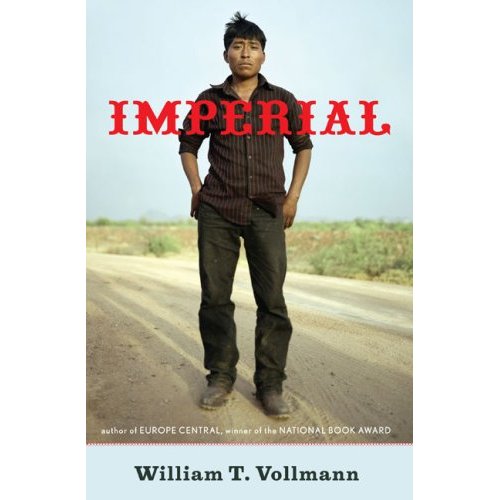
Read this fascinating profile of William Vollmann from this week’s New York Times. It makes me wish I had nothing to do but read everything this maniac writes. Vollmann’s new book Imperial comes out today from Viking. You can read an excerpt here.

Not really surprisingly, Vollmann did not make NPR‘s reader poll for the 100 Best Beach Books Ever. J.K. Rowling’s Harry Potter series topped a list that pretty much consists of a bunch of drivel (Twilight, Divine Secrets of the Ya-Ya Sisterhood), drivel posing as non-drivel (The Kite Runner, The Time Traveler’s Wife), overrated “classics,” (To Kill A Mockingbird), and a few surprises (Cormac McCarthy’s The Road is a fantastic book, but is it really best enjoyed on a sunny beach?)

TheClassicSlaveNarratives7517_f

This one didn’t make the beach reading list either. For a few years now, selections from The Classic Slave Narratives have been required reading in my high school classroom. I usually emphasize sections from Olaudah Equiano and Frederick Douglass, two masterful writers whose complex syntax and diction can be stunning, if not overwhelming, to the average AP student. I think that these narratives speak to why writing matters, and, importantly in today’s idiocracy, why reading matters as well. These first-person accounts of the horrors of slavery need to be read, and editor Henry Louis Gates, Jr. does a great job of setting the stage in his remarkable introduction to the collection. It’s sad, intellectually tragic, really, that Gates’s recent arrest should be given so much credit for sparking a “debate” or “teachable moment” about race, when Gates’s own scholarship makes the rootedness of racial tension in this country so plain. When a demagogue like Glenn Beck calls President Obama a “racist,” or a big fat idiot like Rush Limbaugh suggests that Obama simply has a “chip on his shoulder” because he’s black, we can see precisely why the first-person narratives of Equiano, Douglass, Mary Prince, and Harriet Jacobs are so important. These dangerous lunatics repeatedly suggest on their shows that America needs to keep its “traditions,” that our “history” is a strength, and that somehow the past was a place of better values. Perhaps if they read something outside of the dominant narrative they’d understand why someone might want to reappraise historically traditional values (and also, why someone might have a chip on his shoulder). But I’ve digressed from my main point: The Classic Slave Narratives is a valuable and important collection, and the stories collected here are a real entry point for any genuine discussion on race.