
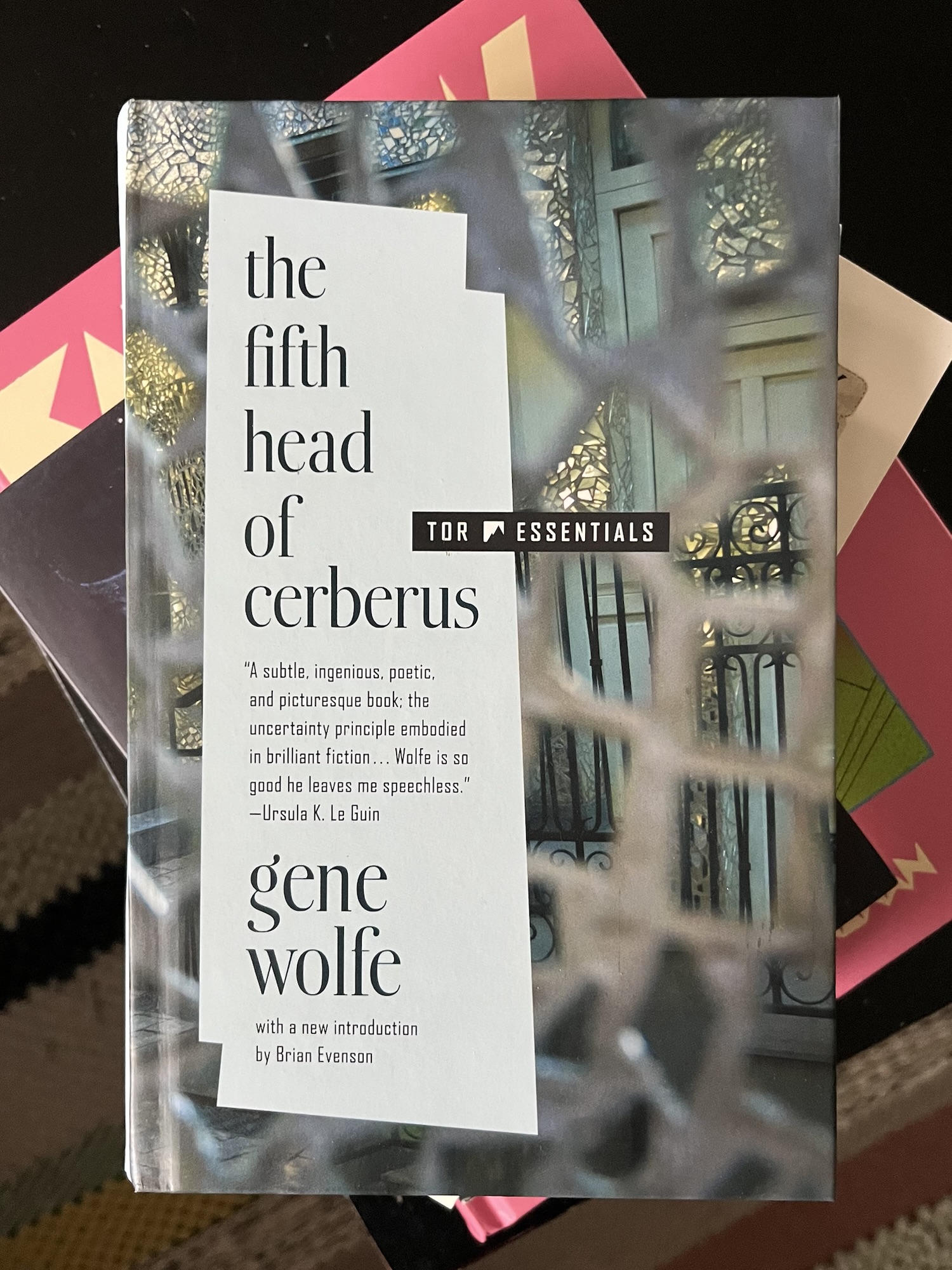
I picked up a copy of Gene Wolfe’s 1972 novel The Fifth Head of Cerberus on Friday afternoon. I’d been hoping to find a more interesting-looking edition, but the Tor Essentials hardback with an introduction by Brian Evenson fit handsomely and handily in my hands, and I haven’t had any luck hunting old Wolfes lately. After reading and then rereading his wonderful 1975 novel Peace a week or so ago, I found myself wanting more of that weird flavor. And while Cerberus isn’t as masterful or achieved as Peace, it is similarly confounding, a puzzle that baits its reader via any number of rhetorical feints, traps, false doors.
I used the term novel above to describe The Fifth Head of Cerberus. I think that is the appropriate term, although cursory research will show you that the book comprises three novellas. I had known or understood this going into reading Cerberus, but somewhere I had read that the novellas worked together (intertextually? metatextually?) to cohere into a novelly-novel. I dutifully skipped Brian Evenson’s introduction — which I promise I will read when I begin re-reading Cerberus later tonight — and dug into the title tale on Friday night.
Like Peace, I think Cerberus is best experienced as raw as possible. The great pleasure of reading Wolfe is the disorientation; his narrators will deliver stacks of details at any time that may or may not be of the profoundest importance to the “truth” or “reality” of the narrative; meanwhile, the reader is trying to adjust to the strange (but not-that-strange) world Wolfe is conjuring in his prose. Is this here and now? The past or the future? Are we in alien lanes or human spaces? I think neatly summarizing the work denies a potential reader the pleasure (and challenge) of engaging with the work. To be clear, these novels (Peace and Cerberus) do not rely on gimmicky “spoilers” for their power, but rather work as strange metadetective narratives, where the reader plays the role of investigator.
But a reader will want something more concrete, eh, a little something beyond vague gesturing. Here are some elements that The Fifth Head of Cerberus engages with all three of its pieces: colonialism, cloning, slavery, patricide, twinning, mimesis, adaptation, immortality, vision questing, dream worlds, anthropology, espionage, crime, punishment. And precursor/postcursor texts: Crime and Punishment, Flannery O’Connor, Faulkner (especially As I Lay Dying and The Sound and the Fury), Le Guin’s Hainish novels, the Vietnam War, Jules Verne, Edgar Allan Poe, J.G. Ballard, The Vorrh, À la recherche du temps perdu, Nathaniel Hawthorne’s fables, Melville’s Benito Cereno (or Pierre or The Confidence Man), Conrad, Pale Fire, Borges (really any Borges, but like especially “Pierre Menard”), any number of “the accounts of the pith helmet and puttee expeditions of the Victorians” (as one of the narrators of the third piece of Cerberus, the key text V.R.T. puts it), Kavan’s Ice, Kafka of course, mythology (all), etc., etc., etc.
But perhaps just a few broad strokes to draw a potential reader in. The first and eponymous piece, The Fifth Head of Cerberus, offers what seems to be a boyhood memoir shaped by a sinister father and a colonial world. The second piece, “A Story,” by John V. Marsch, recasts (and simultaneously complicates and simplifies) that world in a primeval dreamworld vision quest. The novel coheres (this is not the correct verb) through its final, discursive, intertextual section, V.R.T., which both reveals and confounds the previous narratives. V.R.T. offers fragments — reports, lists, transcripts, notebooks, testimony — that reverberate and loop and replay the motifs and mysteries of the previous sections. The reader’s basic questions — who is this person? — is this a person? — collapse into a more unsettling one: who gets to authorize who someone is? Thus identity is never stable, but a production, narrated, copied, inherited, imposed, revised, never quite secured. More thoughts after a second visit.

