
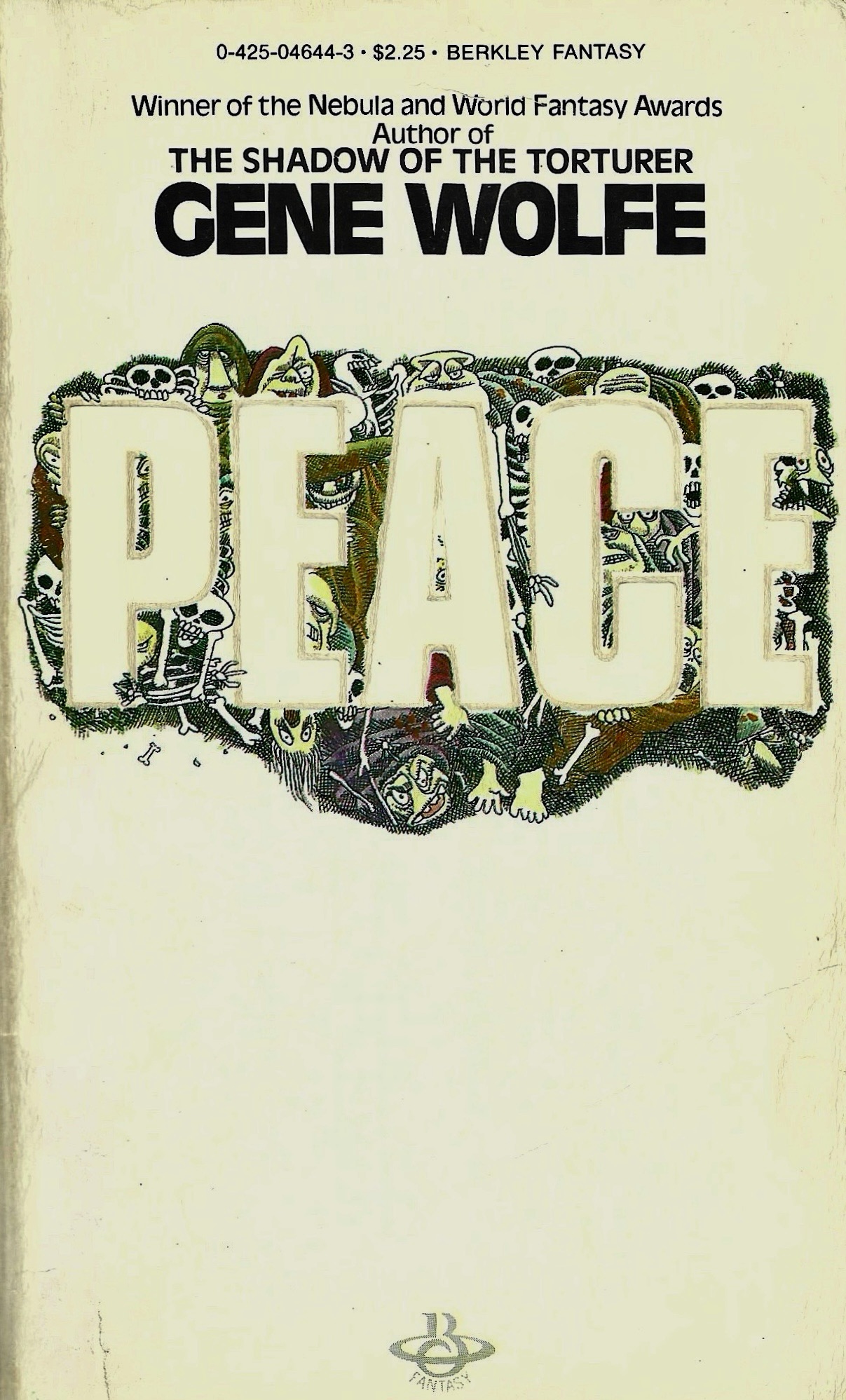
I read Gene Wolfe’s 1975 novel Peace a few weeks ago and then obsessively reread it. The adverb obsessively in the previous clause refers to a rereading that engendered more rereading, taking more notes, going on extratextual jaunts. In my brief write-up of the novel a few weeks ago, I suggested that Peace is
an American post-modernist classic that we would now talk about alongside novels of writers like Pynchon, Barth, Reed, Coover, Barthelme, etc., if the Publishing Industry and Academia didn’t have hangups about sci-fi and fantasy. And the novel is only sci-fi or fantasy in the sense that, like, Gravity’s Rainbow is sci-fi fantasy or Pricksongs & Descants is sci-fi fantasy or Chimera is sci-fi fantasy.
A rereading confirms this belief. (Another way to put it might be, and I’m not a fan of the phrase, is that Peace is what Tom LeClair (using DeLillo as an example) called a “systems novel.”)
But what is it about?
(This What is it about? is entirely the wrong question, but–)
Peace is a postmodern American Gothic ghost novel about houses, games, trees, extinction, alchemy, caves, mythology, aunts, suitors, simulation, bones, forgery, foreclosure, freaks, farming, modernity, murder, hell, eggs, apples, oranges, art, artifice, color, stags, birds, capitalism, rooms, storytelling…
Okay but like, what happens in Peace?
It is the story of Alden Dennis Weer, a boy-man-oldman-etc. unstuck in time and his relation to his family and community. There is a life|death story here, but its telling is really what matters — Peace is crammed with interpolated stories, tales without terminus. There are banshees and princesses and saints and rats and djinn and time travelers and men who are slowly turning into stone. And more more more. Peace is incredibly, powerfully rich, and its profusion of storytelling coheres into a maddening puzzle for the careful reader to tease out.
A proper summary of the novel Peace, of the life(death) of Alden Dennis Weer would require spoilers; I do not think great literature (or Great Literature if you like) can be spoiled, but I do think that part of the charm (and we can use that term charm in its occult sense here) of Wolfe’s novel is that the narrative consistently obscures/hides/buries significant plot elements while at the same time highlighting its thematic emblems in dazzling, baroque passages.
By way of a favorable comparison let me grab William Faulkner’s classic short story “A Rose for Emily.” Both Peace and “Rose” are thematically Gothic, but they are also formally Gothic, concealing mysteries through rhetorical techniques that do not present as obvious techniques. If we were to parse out and then jot down the timeline of “A Rose for Emily,” we might give such notes to a reader who has never read the tale; that virgin reader might then intuit the story’s central horror (and macabre joke) without the heady veil of confusion that usually attends a first reading — and then the story would simply be a freak in a show, labeled neatly, compartmentalized, subsumed into a more general order that paradoxically reinforces the normality of polite human relations, no alarms and no surprises. But that’s not how “A Rose for Emily” works and that’s not how Peace works. The Peace plot, conveyed through the shifty first-personeering of reliably unreliable Den, dares its reader to attend closely to quick flashes and flares that might otherwise be obscured in the dazzle of rampant storytelling. Our Peace is a murders (plural-ess) mystery; keep looking for clues in the coldest cases.
The prose is not cold. Wolfe’s sentences make a body tingle. Here (a version of) Den, Alden Dennis Weer, our narrator, describes his boyhood pocketknife before spiraling into a vision of creation restrained into simulacrum; the scene terminates in plastic, modern, postmodern infertility:
It was large, and stamped with the words “Boy Scout.” The scales were of simulated black staghorn, bringing to mind (at least to mine) the image of a simulated stag, his horns held proudly as those of any elm-deer, ranging the forest among the now-waking trees, trees whose leaves are dying with the summer in every color, like bruises, but bruises beautiful as the skins of races unborn, withheld from us because God, or destiny, or the bland chance of the scientists (whose blind, piping ape-god, idiot-god, we have met before; we know you, troubler of Babylon) has denied us the sight of all these scarlet and yellow—truly red, orange, russet-brown—races on our sidewalks, and all the wonderful richness of stereotypes we might have entertained ourselves with if only they had been permitted us: the scarlet people with tight fists and loose women, gobbling dialects, a talent for paintings done with chalk upon the sides of newspaper kiosks, and high abilities in the retail merchandising of hobby supplies such as tiny-toy jet engines, and model garbage trucks whose hungry rumps, trundled about the wooden tops of retired dining-room tables in basements, will devour the dross of train-station quick-eat restaurants; the orange people with their weird religion demanding the worship of sundials (as our own seems to others that of telephone poles), so that in friendly locker-room conversations, when we have at last and at the threat of certain legal pressures admitted them to Pinelawn and are discussing the round now past, they out with strange oaths. What is a wabe?
And all of them, since all the lands of this earth are occupied, must be from strange and farther countries, from Hi Brasil and the Islands of the Sun, from the Continental Islands and the Isles of the Tethys Sea. Only the rarest, the russet browns, belong here, native to St. Brendan’s land, and they are dying; the things they are famous for are not strange oaths, or ability at any art, or cunning in a trade, but alcoholism and gonorrhea and dwindling. They make good soldiers and that is fatal, just as is the bravery of the simulated stag, which will bring him to death, answering the call of the simulated war cry to meet bullets in the dry autumn woods and fall, his lungs hemorrhaging substitute blood at the edge of the potato fields. The imitation huntsman shouts and dances for joy, and then, having learned very well to shoot, but never to butcher, and being, in his own opinion, no longer of an age to carry heavy burdens, leaves him to rot and stink, the bait of plastic flies with fishhooks in their bellies. In time his flesh, torn by such fur-like foxes as remain, and by the teeth of curs, falls away, and only his horns and his celluloid bones remain, the prey of the boys’-knife maker.
I’ve painted myself into a corner here with such a chunk of Wolfe’s prose (my paint thinned with cold grey pink wine on this hot summer night). Sci-fi and fantasy aficionados already know the power of Wolfe’s prose, and his New Sun solar cycle has impressed readers of “serious” American postmodernism, who might be willing to peek into The Shadow of the Torturer and its sequels. Those novels, narrated by eidetic-memoried exile Severian are fantastic, and are probably Wolfe’s masterwork. But Peace shows imagination within postmodern American Gothic restraints; this is a novel that shows the slow painful choking extinction of the American Dream while at the same time showing that the Dream was always just a dream, a drift into nightmare, a notion, foggy or otherwise, corrupted even in its inception, bound to play out in a decaying reverberation that evinces again as a simulation, a ghost. Seek it out.


Earlier today I ordered the book via inter-library loan based on your prior Mass-Market Monday post and my reading of The Book of the New Sun – so this just further whetted my appetite for it.
LikeLiked by 1 person
Weirdly enough, I’ve never caught on Gene Wolfe’s geniality while reading his books. Only with retrospection I’ve realized how brilliant he was. Each of the four original volumes of “The Book of the New Sun” won at least one major fantasy or science fiction award as the year’s “Best Novel”, but was never considered as a whole.
LikeLike
[…] 🛸🦄 Riff on rereading Gene Wolfe’s postmodern American Gothic ghost novel Peace – Edwin Turner “read Gene Wolfe’s 1975 novel Peace a few weeks ago and then obsessively […]
LikeLike